Showing posts with label Glamis. Show all posts

Monday, August 17, 2015

An Encounter with Poet Robert Frost

Robert Frost, circa 1910

Exactly 100 years ago, members of the Glessner family were enjoying their bucolic summer estate, The Rocks, in the White Mountains of New Hampshire.  John Glessner noted in the journal for Sunday, August 8, 1915:

“Frances, George and Alice, George Macbeth, Robert and Anne von Moschzisker at supper, Anne much pleased at having ‘discovered’ and met Robert Frost, a poet, now living on 40 acre farm near Franconia.”

(George Macbeth was Frances Glessner’s brother and lived on a nearby summer estate known as Glamis.  His daughter Anne was married to Robert von Moschzisker, a justice of the Pennsylvania Supreme Court; he served as Chief Justice from 1921 to 1930).

One can imagine Anne’s delight at “discovering” the poet Robert Frost while touring through the countryside.  Frost (1874-1963) was not yet widely known in the U.S., which may account for John Glessner referring to him as “a poet” as opposed to “the poet.”  Frost and his family had travelled to Great Britain in 1912, and his first two collections of poetry were published there.  He returned to the United States at the start of World War I in 1915 and purchased the property at Franconia, New Hampshire, which included a modest frame house built in the 1860s.  The Frost family would live in the home for five years, and would continue to spend their summers there until 1938.  It was here that Frost launched his successful career as a writer, teacher, and lecturer, eventually being awarded four Pulitzer Prizes for his poetry. 


In 1976, the town of Franconia purchased the house and nine acres of land, restoring it and giving it the name The Frost Place.  Added to the National Register of Historic Places later that year, it opened as a museum in 1977.  

2015 Conference on Poetry and Teaching

It is operated as a nonprofit educational center and hosts annual events including a Conference on Poetry, a Poetry Seminar, and a Conference on Poetry and Teaching.  Each year, Frost Place awards a resident poet award to an emerging American poet; the award includes a stipend and the opportunity to live and write in the house during July and August.
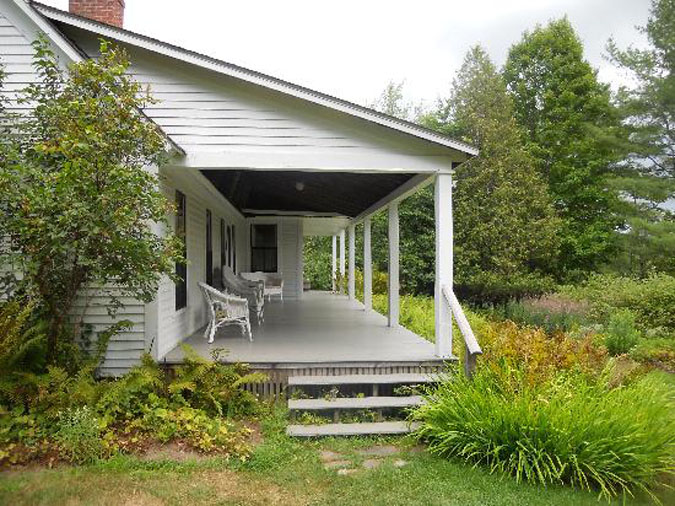

The non-profit organization that operates Frost Place has worked hard to preserve the ambiance that drew Robert Frost to this location.  Situated on a quiet north country lane with a spectacular view of the White Mountains from the front porch, visitors won’t encounter fancy multi-media displays or cafes, but rather “a sense of the kind of place where a young poet could concentrate.”  The collection includes signed first editions of Frost’s works and other memorabilia from his years in the home.  There is also a half-mile nature trail with plaques displaying poems that Frost wrote during his years in Franconia.

Frost Place is located about six miles from the Glessners’ summer estate.  As an interesting note, until earlier this year, the organization maintained their offices on the second floor of Frances Glessner Lee’s home, The Cottage, at The Rocks Estate.


Frost Place is open from Memorial Day weekend through mid-October each year.  For further information, visit www.frostplace.org.    

Monday, July 2, 2012

Hermann von Holst and the Glessners

Hermann von Holst was a prominent Chicago architect in the first decades of the 20th century.  His acceptance to take over Frank Lloyd Wright’s practice in 1909, when Wright left for Europe with Mamah Cheney, has largely overshadowed a significant and productive career.

Hermann Valentin Von Holst was born on June 17, 1874 in Freiburg, Germany.  In 1891, his family moved to Chicago when his father, Hermann Eduard von Holst accepted the position as head of the Department of History of the newly formed University of Chicago.  It was soon after that John and Frances Glessner became acquainted with the family through their intimate friendship with William Rainey Harper, president of the University.

Von Holst received his B.A. from the University of Chicago in 1893 and continued his studies at the Massachusetts Institute of Technology, where he earned a B.S. degree in Architecture in 1896.  He returned to Chicago and entered the firm of Shepley, Rutan & Coolidge (successors to H. H. Richardson) where he became head draftsman and remained until establishing his own office in the Rookery Building in 1905. 

By the time he opened his own practice, von Holst had become a close friend of the Glessners.  Although the same age as their children (he was born the same year as their son John who died as an infant), von Holst became a regular visitor to their Prairie Avenue home.  When his father retired from the University of Chicago in 1900 due to ill health and returned to Germany, it was as though the Glessners “adopted” the younger Hermann, making him part of family celebrations at Christmas and other times of the year.  They also provided him with several early commissions at their summer estate, The Rocks, in New Hampshire.   In a letter from von Holst to the Glessners dated February 24, 1905 he states, in part, “I shall always remember with great pleasure the fact, that when I opened my office the first order came from you, which I consider, in a half superstitious way, a good omen.”  Those early commissions included a large horse barn addition to the carriage house, a sawmill-pigpen, a cowbarn, additions to the cottage residence of Frances Glessner Lee, and a residence for the Glessners’ son George, known as the Ledge (shown at the top of the article).

Another significant commission for von Holst was the summer home known as Glamis, built for Frances Glessner’s brother George Macbeth of Pittsburgh (shown above).  Located adjacent to the Glessners’ summer estate in Bethlehem, New Hampshire, the sprawling residence featured eleven bedrooms and combined the shingle style of the northeast with the Prairie style of the Midwest.  Bryant Tolles, in his book Summer Cottages in the White Mountains, praises the house as “one shining example of von Holst’s abilities” and goes so far as to declare it the most significant example of summer country estate architecture in northern New Hampshire.

In 1909, von Holst moved his office to Steinway Hall, where he became part of an influential group of Prairie School architects, including Frank Lloyd Wright.  It was in that same year that Wright abruptly left for Europe with his married client Mamah Cheney.   Wright asked several architects to take over his office and open commissions, all of whom refused until von Holst accepted in conjunction with Marion Mahony Griffin (who had complete control of architectural design), her husband Walter Burley Griffin, Isabel Roberts, and John Van Bergen. 

In 1912, von Holst published Modern American Homes, which, although it only contained a few of his own designs, embodied the “back to nature” movement of the time and serves as an important record of the developments in Craftsman and Prairie style architecture.  (It has since been reprinted by Dover Publications as Country and Suburban Homes of the Prairie School Period).  In presenting a copy of the book to Frances Glessner for Christmas in 1912, von Holst inscribed the book as follows, “To Mrs. Glessner – Your ideals and ideas for the American Home have ever been an inspiration, to seek and strive for beauty along simple straightforward lines.” 

Von Holst actively taught throughout this period, serving as a professor of architectural design at the Chicago School of Architecture at the Art Institute of Chicago and in the Department of Architecture at the Armour Institute of Technology (later the Illinois Institute of Technology).  He also published other books and served in several professional organizations, including the Architectural League of America and the Chicago Architectural League. 

He continued to practice in Chicago through the 1920s, designing a number of buildings for Peoples Gas and Commonwealth Edison, including the ComEd substation which still stands at 1620 S. Prairie Avenue (detail above).  One of his larger commissions was Condell Memorial Hospital in Libertyville, dedicated in June 1928.

By the late 1920s, von Holst relocated to Boca Raton, Florida where he headed a group that completed a charming subdivision of 29 homes in the Spanish Revival style known as Floresta.   His own home in the subdivision, Lavender House, was completed about 1928.  He retired from architecture in 1932 but remained active in civic affairs in Boca Raton, serving on the City Council which granted him honorary life membership in 1953 just two years before his death.

Related Posts Plugin for WordPress, Blogger...