Showing posts with label Madeline Yale Wynne. Show all posts

Monday, February 16, 2015

Frances Glessner, crafter of jewelry

Gold and black opal necklace made by Frances Glessner
Collection of the Chicago History Museum
Photo by John A. Faier for the Driehaus Museum

On February 14, 2015, the Driehaus Museum, 40 E. Erie Street, Chicago, opened its newest exhibit entitled “Maker & Muse: Women and Early Twentieth Century Art Jewelry.”  The exhibition features more than 250 pieces of jewelry, about half from the personal collection of Richard H. Driehaus, and the remainder from museums and private collections around the country.  These artistic pieces are grouped into five categories exploring the Arts and Crafts movement in Britain, Art Nouveau in France, Jugendstil in Germany and Austria, Louis Comfort Tiffany in New York, and American Arts and Crafts in Chicago.  The exhibit will continue through January 3, 2016.  For more information, visit http://www.driehausmuseum.org/exhibitions/view/maker_muse

Gold and yellow stone necklace made by Frances Glessner
Collection of the Chicago History Museum

Of particular interest are three pieces handcrafted by Frances Glessner, who began taking lessons in metalwork in December 1904, actively continuing her hobby for at least a decade.  Glessner House Museum has three examples of her silver work on permanent display in the dining room silver closet (see blog article dated December 30, 2013), but no examples of her jewelry, so this is an rare opportunity to see these exquisitely crafted objects.  The pieces, two necklaces (shown above) and a hatpin (not shown), are from the collection of the Chicago History Museum, which received them as gifts from the Glessners’ granddaughter, Martha Lee Batchelder, in the 1970s and 1980s.

Madeline Yale Wynne

Frances Glessner honed her skills under the guidance of three talented metalworkers.  The first of these, Madeline Yale Wynne, was prominent in Chicago society and the craft community.  Just one year older than Mrs. Glessner, Wynne had arrived in Chicago in the 1880s, taking up residence with her brother on the north side “Gold Coast.”  Mrs. Glessner met with Wynne in the spring of 1904 to have set stones for her and during the next several months purchased a silver chain, a pin, and an amethyst necklace from her as gifts for various family members.  In late October 1904, Frances Glessner noted in her journal, “I went . . . to call on Mrs. Wynne to arrange to take lessons in metal work.”  She took her first lesson on December 3rd, and made an elegant salt cellar in time to present to her husband that Christmas.  (The piece is on display in the dining room.  For further information on Madeline Yale Wynne, see the blog article dated August 29, 2011).

Necklace by Annibale Fogliata for Frances Glessner
Private collection

Frances Glessner’s second teacher was Annibale Fogliata, a native of Milan, Italy, who came from London to Chicago in 1904 to teach metalworking at Hull-House.  As was the case with Wynne, Mrs. Glessner appears to have been a customer of Fogliata for some months before beginning lessons with him.  In January 1905, just a few weeks after the death of symphony conductor Theodore Thomas, Mrs. Glessner noted in her journal, “I sent Fogliata’s beautiful silver and brass picture frame to Mrs. Thomas.”  In March, she gave her daughter a gold pendant made by Fogliata as a birthday gift, and by May, he was crafting metal trays for her to present to her niece as a wedding gift.  In November, 1905, she noted that she was taking lessons with Fogliata:

“Wednesday Fogliata came back and I had my silver lesson.  He was overjoyed to get back.  We put the bands on the two gavels I have had made for the two beekeeper’s associations, from the wood from Rev. L. L. Lanstroth’s garden in Oxford, Ohio.”

Frances Glessner at her work bench in the basement
of her home at 1800 South Prairie Avenue, Chicago

Exactly how long she continued her lessons is not known, but she remained a customer of Fogliata as late as May 1907, by which time he had moved to New York.  He continued working in metal, the 1930 census listing him as an engraver in the steel industry.


Necklace of gold and amethyst made by Frances Glessner
Private collection

Frances Glessner’s third and final teacher was Fredrik W. Sandberg, who will be the subject of an article on March 2, 2015.

Monday, December 30, 2013

All that glitters IS silver

On Saturday December 14th, the museum opened the newest restored space on its public tours – the dining room silver closet.  This space, located to the left of the fireplace in the dining room, had served as a simple storage closet since the Glessners died in the 1930s and was in need of some attention.  Thanks to a generous anonymous gift to the museum’s 125th anniversary fund, the space has been restored to its original appearance, and now showcases pieces from the Glessners’ large collection of silver. 

The restoration involved the work of several talented craftsmen:
Historic paint analysis – Robert Furhoff
Oak-framed glass enclosure – Kevin Welter
Lighting consultant – Peter Hugh
Electrical – Block Electric
Wood refinishing – Lee Redmond
Painting and wall repair – Shamrock Decorating

The display in the silver closet will change from time to time, as there are many more pieces of silver in the museum collection than can be displayed at any one time.  These include pieces owned by John and Frances Glessner, items owned by their daughter Frances Glessner Lee, and a wonderful collection from the Fisk-Botsford-Harvey family that moved into their nearby home at 2100 S. Calumet Avenue in 1885.  The display will also include several silver bags from Marshall Field and other dealers from whom the Glessners purchased their pieces.  Silver items would have typically been stored in the closet in bags such as these to prevent tarnishing.

Three items that will remain on permanent display in the closet are among the most special in the entire museum collection.  These three pieces were handcrafted by Frances Glessner in her silversmithing shop located in the basement of the house, directly beneath the dining room.

We know from her journal that she began doing her silver work in late 1904.  An entry dated October 28, 1904 reads “I went to call on Mrs. Wynne to arrange to take lessons in metal work.”  Mrs. Wynne was Madeline Yale Wynne, a highly talented metal worker and a charter member of the Chicago Arts and Crafts Society, founded at Hull-House in 1897.  (For more information on her, see the blog article dated August 29, 2011).  Frances Glessner also took lessons from Annibale Fogliata, a metal smith who taught at Hull-House.

She had her first lesson from Mrs. Wynne on November 29th and soon after made the salt cellar shown above as a gift for her husband.  The inscription on the underside of the piece reads “Made by F.M.G. for J.J.G. Dec. 25th 1904.”  It is one of the three pieces now on display in the silver closet, all of which display her trademark features – simple clean lines and visible hammer marks across the surface.

The largest piece on display is a calling card tray, measuring 8-1/2 inches in length and featuring simple curved sides.  For many years, the tray sat on the drum table in the main hall, allowing lady visitors to leave their cards when paying a call. 

The third piece is a charming silver bowl with an elegant scalloped edge.  Frances Glessner made the piece for her youngest granddaughter, Martha Lee, born in November 1906.   The inscription reads “Martha Lee from FMG.”  All three pieces were donated to the museum by this granddaughter, later Martha (Lee) Batchelder.

Frances Glessner’s silver mark features her initial “G” encircling a honeybee, the symbol of another of her favorite hobbies – beekeeping.  She actively pursued her interest in metal work for about a decade – making countless pieces and expanding to make jewelry as well, usually long chains set with semi-precious stones.  Her journal is full of letters from thankful recipients, and it appears that most, if not all, of the members of her Monday Morning Reading Class were among those to receive one of these special hand-made gifts.


Today, this exhibit of her silver work is another way in which we can interpret the life of this most fascinating individual.

Monday, December 10, 2012

The Crafts of Frances Macbeth Glessner

Frances Macbeth Glessner (1848-1932) was a talented woman, proficient in a number of crafts both traditional and non-traditional for the period in which she lived.  In addition, she was an accomplished pianist. 

She produced enormous quantities of fine embroidery work, in many cases using designs specifically created for her by family friend Isaac Scott.  Several examples of her needlework are on display in the museum including table runners and bedspreads.  John Glessner said of his wife, “Indeed there was nothing she could not do with her needle.”  Frances Glessner was an excellent knitter as well, making countless sweaters, scarves and hats for the male employees at her summer estate, The Rocks, and for servicemen during World War I.

As an early and prominent member of the Society of Decorative Art, formed in Chicago in 1877, Frances Glessner conducted classes in wood carving (probably learned from Isaac Scott) and took classes in hammering brass.   (The organization was the forerunner to the present Antiquarians of the Art Institute).

In November 1904, Frances Glessner began taking lessons in metal work from Madeline Yale Wynne, a distinguished metal worker and important proponent of the Arts and Crafts movement.  (She was one of the 126 charter members of the Chicago Arts and Crafts Society when it was founded at Hull-House in 1897).  Mrs. Glessner also took lessons in metal work from A. Fogliati, an instructor of metalwork at Hull-House.

She set up a silversmithing studio in the basement of her home (see photo at the top of the article), where she fashioned silver bowls, pitchers, and saltcellars.  Many of these were given away as gifts, including the bowl and spoon pictured below, now owned by a private collector.  Her pieces featured simple lines and often visible hammer marks, making them excellent examples of Arts and Crafts metal work. 

As her silver mark she chose a honeybee (she maintained a number of beehives at her summer estate) set within the letter “G.”

In addition to silverwork, she also made numerous pieces of jewelry, typically long chains into which she would set semi-precious stones.  Her journal is full of letters from appreciative recipients, indicating that her output was significant.  The example shown below is now in the collection of the Art Institute of Chicago.

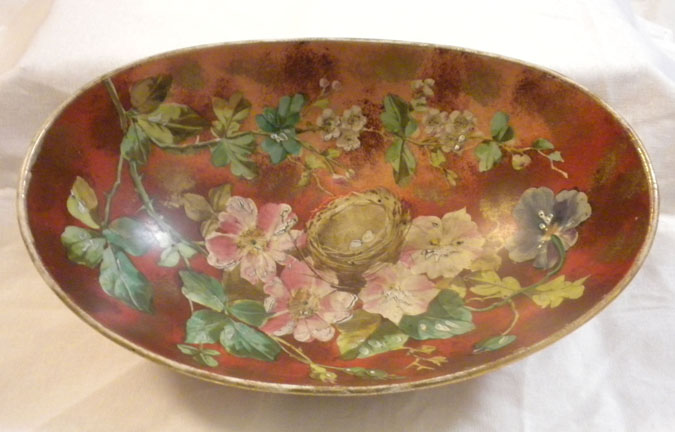
An unknown talent of Frances Glessner until recently was her ability as a china painter.  China painting was a common hobby for women of the period, and again many of the pieces would be made as gifts.  The bowl shown below, featuring a bird’s nest set amongst roses and cherry blossoms was given by Mrs. Glessner to the wife of the Glessner’s chauffeur, Swan Johnson.  It was returned to the house in 2010 through a friend of the Johnson family.

Considering the enormous quantity of items produced by Frances Glessner through the years, from embroidered textiles to hand-painted china pieces, and from silver work to jewelry, it is clear that she rarely if ever let her hands go idle.  The museum is thrilled to have this record of her works, as one more way of understanding this extraordinary individual.

Monday, August 29, 2011

Madeline Yale Wynne

On October 28, 1904, Frances Glessner recorded in her journal: “I went to call on Mrs. Wynne to arrange to take lessons in metal work.”  She had her first lesson in silver work on November 29, and soon after fashioned a salt cellar which she presented to her husband as a Christmas gift.  The salt cellar, pictured below, is engraved “Made by F.M.G. for J.J.G. Dec. 25th 1904” and is now in the collection of the museum.  Frances Glessner vigorously pursued her hobby for more than a decade, producing countless pieces of silverwork, most of which were presented as gifts to friends and family.

Frances Glessner’s teacher, Madeline Yale Wynne, was a distinguished metal worker and important proponent of the Arts and Craft movement.  She was born in Newport, New York in 1847, the daughter of the inventor of the Yale lock.  Her father possessed considerable artistic aptitude as a miniature painter, and as a child, Madeline spent countless hours in her father’s garden-studio.  She studied painting at the Museum of Fine Arts in Boston and later attended the Art Students’ League in New York, before advanced studies in Europe. 

Widowed at a young age, Wynne came to Chicago in 1893 and took up residence with her brother Julian in his home at 9 Ritchie Place (current address would be 1311 N. Ritchie Court).  The home soon became a Mecca for true lovers of art and literature, and the “imposing dowager” presided over a distinguished salon of Chicago artists and literati.  She and her brother also created a home workshop where they began producing unique and fascinating items of silver and jewelry.  Wynne’s designs, which frequently included enamels and semi-precious stones, were entirely original and usually featured obvious hammer marks (a trademark of Frances Glessner’s designs as well).  The examples below were illustrated in the June 1899 issue of House Beautiful.

Wynne was one of the 126 charter members of the Chicago Arts and Crafts Society when it was founded at Hull-House in October 1897.  Members included metalworkers, designers, potters, artists, writers, and architects, including Frank Lloyd Wright.  The Society’s constitution promised “to cultivate in its members, and through them in others, a just sense of beauty” particularly in the design and decoration of everyday articles.   Wynne was also a founder of the Deerfield Society of Arts and Crafts in Deerfield Massachusetts where she spent her summers for many years.

Wynne was a writer of some note and penned a short story called “The Little Room.”  The title was adopted by an important group of Chicago painters, sculptors, writers, and architects who formed themselves into an informal group in the 1890s which lasted well into the 20th century. 

After the death of her brother, she took a studio in the Tree Studio Building.  She died in Asheville North Carolina in January 1918 at the age of 70. 
Related Posts Plugin for WordPress, Blogger...