Showing posts with label 1836 Calumet Avenue. Show all posts

Monday, July 1, 2013

The House at 1836 Calumet Avenue, concluded

In last week’s installment, we looked at the life and career of prominent Chicago attorney Norman Williams and the home he built for his family at 1836 Calumet Avenue.  After Williams died in 1899, his widow continued to occupy the old family homestead until 1907 when she moved to Washington, D.C. and built a new home on fashionable Scott Circle.  This week we will look at the later history of the Williams’ Calumet Avenue home. 

In 1907, the house was purchased by Charles S. Holt, a Chicago attorney and long-time partner of Norman Williams.  When Williams died in 1899, Holt was quoted as saying the following about his friend in the Chicago Tribune:
“I cannot talk about him now.  We were most intimately associated for twenty-three years.  No man ever had more friends or was more loyal to them.  His whole nature was genial and sweet and he delighted in sacrificing himself for those he loved.  Above all his mental power and professional success he will live in the memory of those that knew him as a man of great and affectionate love.”

Charles S. Holt moved into the house with his wife Camilla McPherson Holt, their two daughters Isabella McPherson Holt and Marian Hubbard Holt, and their son Charles McPherson Holt.  Holt was born in Chicago in 1855 and was prominent in numerous professional and social clubs including the Union League, Chicago, University, Onwentsia, South Shore, Chicago Literary, and Chicago Law.  He was also an active member at Second Presbyterian Church and served as the president of the Presbyterian Brotherhood of America, was a director of McCormick Theological Seminary, and once served as the vice moderator of the Presbyterian General Assembly.  He was a trustee of both the Chicago Orphan Asylum and Williams College. 

Holt sold the house in 1918 and moved to 60 Cedar Street where he died on December 13, 1918 at the age of 63.  His funeral was held at Second Presbyterian Church.

By 1921, the next owner of the house had leased it to the Pestalozzi Froebel Teachers College for use as a dormitory.  A booklet about the College from the 1921-1922 school year provides interesting information about the College, founded in 1896 and incorporated in 1913 as the Pestalozzi Froebel Kindergarten Training School.  Offering a two-year course of training in three departments – Kindergarten, Primary, and Playleaders and Community Service – the school was named after two influential European educators.  Johann Heinrich Pestalozzi (1746-1827) was a Swiss educational reformer credited with eliminating illiteracy in Switzerland and whose motto was “The hands as much as the head and heart.”  His student, Friedrich Froebel (1782-1852) was a German educator who laid the foundation for modern education and created the concept of kindergarten.  His name is best remembered today for the “Froebel Gifts” he developed, including the Froebel blocks made famous through their association with Frank Lloyd Wright. 

The Pestalozzi Froebel Teachers College had its office and class rooms on the 7th floor of the Arcade Building at 618 South Michigan Avenue, designed in 1913 by architect William Carbys Zimmerman.  (Now owned by Columbia College Chicago, the building recently received a new façade which interprets the original terra cotta, removed in 1958).  The 1921-1922 booklet states the advantage of completing the Teachers’ Training Course:
“It is always a good investment for a young woman to take a teachers’ training course.  It not only secures her a desirable means of support, but it extends her general culture and rounds out her education.  This is especially true of the Kindergarten, Primary and Playground training courses.  They provide all that is required for a professional, certified teacher, and at the same time develop a young woman in the most desirable way along cultural and social lines.”
The booklet goes on to state that the Kindergarten is now part of the public school system in the majority of cities in the country and that salaried positions are available from $125 to $200 per month.

About the college dormitory, the booklet goes on to state:
“The College building and the Dormitory, which is conveniently near, both overlook Lake Michigan.  The Dormitory neighborhood is one of the most interesting and historic in Chicago.  In the same block are such well known Chicago land marks as the W. W. Kimball, Mrs. Marshall Field, and the Pullman homes.  At the corner stands the historic Fort Dearborn statue, beyond which the new Field Museum juts into the lake.  Students walk to the College on Michigan Boulevard along the lake front, or take the cars on Eighteenth Street.

“The Dormitory faces the lake, and the rooms are arranged so that most of them overlook the water.  On the second floor the larger rooms for three students open into baths with showers; also an additional alcove with stationary basin, hot and cold water.  These rooms are connected with a sun parlor and a balcony overlooking the lake.  On the third floor the larger rooms for three students open into raised alcoves overlooking the water.  They also have roomy closets.

“The building is heated by a hot water system, supplemented by hot air, and is lighted with electricity.  The dining room opens into a sun parlor that commands a wide view of the lake.  The rooms are furnished with comfortable single metal beds, mattresses, pillows, curtains, study tables, chairs, chiffoniers and dressers.”
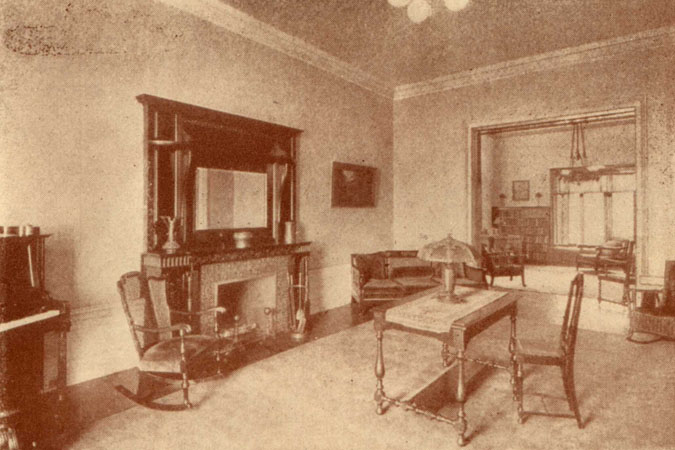
Residents were expected to provide their own bed linens and towels, as well as dresser scarves, laundry bags, a waste paper basket and a rug.  Recommended clothing included one simple evening dress, sensible skirts “that do not interfere with free movement,” a rain coat and umbrella, and sensible shoes.  “Extravagant” dress was discouraged.  Each resident was expected to assist with chores in the dormitory following the spirit that “Self activity ought always to be co-ordinated with an activity the result of which is consecrated to others.” 

Rates for board and room for the school year were $360-$400 on the third floor and $450-$500 on the second floor.  This included daily breakfast and dinner, and mid-day meals on the weekends and holidays.

It is not known exactly how long the house was used as a dormitory, but in March 1935, the building was demolished along with the three neighboring houses at 1830, 1832 and 1840 Calumet Avenue.  This was during the widespread destruction of the neighborhood in the 1930s during which time more than one-third of all the houses were razed. Today, the site of the house is occupied by a National Guard Armory which covers an entire block and extends all the way south to Cullerton Street. 

NOTE:  The Pestalozzi Froebel Teachers College survived until 1971, when its assets were purchased by the National College of Education, now known as National-Louis University.  Interestingly, that institution, founded in 1886 as the Chicago Kindergarten Training School, also has a connection to Prairie Avenue.  Its co-founder, Mrs. Rumah Arvilla Crouse, resided at 2231 Prairie Avenue from 1886 until 1914.  The other co-founder, Miss Elizabeth Harrison, also resided at that address from 1886 to 1896.  From 1913 until the mid-1920s, the school was headquartered in the former Sidney A. Kent house at 2944 S. Michigan Avenue, designed by Burnham & Root in 1883, and today, one of the last surviving mansions along that once prominent residential thoroughfare.

Monday, June 24, 2013

Norman Williams and His House at 1836 Calumet Avenue

Today, only one house survives on Calumet Avenue north of Cermak Road (formerly Twenty-second street), but in the late 19th century, this street rivaled Prairie Avenue in both its residents and residences.  In this installment, we look at the life and home of attorney Norman Williams. 

Norman Williams was born on February 1, 1835 in Woodstock, Vermont.  His great-grandfather Phineas Williams (1734-1820) commanded the first company of militia in Vermont and an ancestor on his mother’s line had served as a governor of New Hampshire.  Williams attended the University of Vermont and the Albany Law School and in October 1858 arrived in Chicago to set up his law practice.  In 1866, he established a partnership with General John L. Thompson under the firm name of Williams & Thompson.  (The firm survives today as Sidley Austin LLP and is now the sixth largest U.S.-based corporate law firm, with 1,700 lawyers and 19 offices globally).

On December 11, 1867, Norman Williams married Caroline Caton, a daughter of Judge John Dean Caton, Chief Justice of the Illinois Supreme Court.   The wedding took place in Ottawa Illinois where the Caton’s maintained their home.  In the 1870s, the Williams resided with the Catons in their home at 2 Calumet Avenue (later 1900 Calumet Avenue). 

Norman and Caroline Caton were the parents of five children:
-An infant son who died at birth in 1869
-Laura Williams, born 1871
-Norman Williams, Jr., born 1873
-Caroline Caton Williams, born 1875 (died 1876)
-Mary Wentworth Williams, born 1878

In 1879, Judge Caton gave his daughter a parcel of land north of his home on Calumet Avenue, and the Williams engaged architects Treat & Foltz to design a home for them.  The 2-1/2 story brick house in the Queen Anne style featured a broad two-story front porch that afforded beautiful views of Lake Michigan directly across the street.  The house was one of four that formed a Caton family “compound” on the street.  The Williams resided at 1836 Calumet; immediately to the south was the home of Laura (Caton) Towne at 1840 Calumet; then the home of Judge Caton at 1900 Calumet; and finally the home of Arthur Caton at 1910 Calumet. 

The Caton family gathered on the porch of the Williams house in 1885 during the celebration of the 50th wedding anniversary of Judge John Caton and his wife Laura.  Pictured left to right in the photograph above are Delia (Spencer) Caton, Caroline (Caton) Williams, Norman Williams, Judge John Caton, Arthur Caton, Laura (Sherrill) Caton, Charles Towne, and Laura (Caton) Towne.  (NOTE:  After the death of Arthur Caton, his widow Delia became the second Mrs. Marshall Field).

Caroline Williams joined Second Presbyterian Church in 1870, when the church was still located in its previous building at the northeast corner of Washington and Wabash streets.  Norman Williams joined in 1877, and the three children were baptized and confirmed in the church as well.  The Williams’ daughter Caroline died at the age of one in 1876.  In 1888, they donated a beautiful marble baptismal font in her memory.  The inscription read “In Memoriam Caroline Caton Williams 1875-1876.”  It was recarved in limestone in 1901, after the original was destroyed in the fire that devastated the sanctuary of the church.   Williams served as a Trustee of the church and oversaw the construction of the bell tower in memory of his good friend George Armour.  The Armour family placed a plaque in the north narthex vestibule of the church to acknowledge Williams’ dedicated service in the construction of the tower.   It reads:

THINE OWN FRIEND AND THY FATHER’S FRIEND FORSAKE NOT
The family of George Armour places this
Tablet here to thankfully perpetuate the untiring
attention, the painstaking care & the loving labour
which their esteemed friend Norman Williams
gave to the completion of this tower, 1884

At the time the bell tower was constructed, Williams also donated the carved stone head of Christ and had it placed over the front entrance of the church. 

In 1889, John Crerar died at the home of his good friends, Norman and Caroline Williams.  Crerar had made his fortune as a partner in the firm of Crerar, Adams & Company, the largest railroad supply concern in the Midwest.  He also helped finance and promote George Pullman’s new Palace Car Company.  Crerar was a lifelong bachelor and had no direct heirs, and made numerous generous bequests, the largest of which was set aside for the creation, construction, and maintenance of the John Crerar Library.  Norman Williams was a trustee of the Crerar estate and served as first president of the Crerar Library.  Crerar also bequeathed $50,000 to his friend Caroline Williams, and established a $60,000 trust fund for the Williams’ three children. 

Norman Williams became one of the most successful and respected attorneys in the city of Chicago.  He was one of the organizers of the Pullman Palace Car Company, was a founder of the Chicago Telephone Company, and helped to organize the Western Electric Company.  In addition, he served as special counsel to the Santa Fe Railroad and as legal advisor to the Western Union Telegraph Company.  He was one of a small group of lawyers whose influence upon the early legislatures of Illinois helped shape the commercial laws of the state.  A prominent club man as well, he served as president of the Chicago Club and was a charter member of the Calumet Club.

Williams contracted Bright’s disease in 1896, and succumbed to that illness on June 19, 1899 while at his summer home at Little Boar’s Head, Hampton Beach, New Hampshire.  The funeral was held at Woodstock Vermont, and Williams was interred in the Williams family plot at River Street Cemetery in that town.  Pall bearers included fellow lawyers and friends Robert Todd Lincoln and Edward Isham.  The evangelist Dwight L. Moody spoke at the graveside.  A memorial service was held in Chicago at Second Presbyterian Church on June 25th. 

Caroline Williams remained in the old family home on Calumet Avenue until 1907, when she sold the house and moved to Washington, D.C.  She hired architects Wyeth & Cresson to design a four-story brick dwelling the Beaux-Arts style at 1227 Sixteenth Street, N.W. just a few blocks from the White House, and became a prominent member of Washington society.  She died there on March 3, 1927, the cause of death attributed in part to the treatment she was subjected to when her home was robbed a year earlier.  At that time, the house was entered by six armed men who bound her seven maids to chairs and robbed Caroline Williams, her daughter, and a friend of valuable jewelry.  She was gagged and badly bruised, but, at age 81, was praised for her bravery for refusing to stop screaming when the robbers confronted her with guns.  (After her death, the house was sold to the Sons of the American Revolution for use as their national headquarters, and later to the National Education Association.  It was razed in 1965).

The Williams’ oldest daughter Laura married Wesley Merritt in 1898.  Merritt was a celebrated Civil War general, and following his service during the Spanish-American War, was appointed the first American Military Governor of the Philippines.  At the time of their marriage, Merritt was 62, and his bride was 27.  General Merritt died in 1910.  Laura Williams Merritt later married Wilbur E. Wilder, and she died in 1951.

The youngest daughter Mary Wentworth Williams never married and died in September 1953. 

The Williams’ son Norman Jr. was a close friend of George Glessner.  In The Story of a House, John Glessner recalls Norman while talking about the schoolroom of the house:
“The school room, approached from the front door without going through other parts of the house, was a rendezvous for George’s friends and teachers alike, for they were all comrades together.  Here they had their long, long thoughts of youth, their boyish activities, their fire brigade, their regularly organized telegraph company, presided over, as a labor of love, by Norman Williams, one of the ablest and most astute of lawyers, with wires connecting seven different residences of the members, all centering on this house.”
In 1902, Norman Jr. was married to Joan Chalmers, a granddaughter of famed detective Allan Pinkerton.  Together they had two children, Joan and Norman, Jr.  She died in 1923 and he later remarried.  He died in 1955.

In the next installment, we will explore the later history of the house, including its conversion to a college dormitory.
Related Posts Plugin for WordPress, Blogger...