Showing posts with label Marshall Field Wholesale Store. Show all posts

Tuesday, January 17, 2023

Early Modern Architecture: Chicago 1870-1910


Exhibition with photo of Glessner House at far right


On January 18, 1933 – exactly 90 years ago – the Museum of Modern Art in New York City opened its second architectural exhibition. Entitled
Early Modern Architecture: Chicago, 1870-1910, the exhibition was curated by architect Philip Johnson, who noted in the official press release that, “Chicago, and not New York, is the birthplace of the skyscraper.” Thirty-one Chicago buildings were featured, including three of H. H. Richardson’s four Chicago commissions – the Marshall Field Wholesale Store, and the Glessner and MacVeagh houses. In this article, we will explore how Johnson came to curate the exhibit, how the buildings included demonstrated the development of “modern architecture,” and how the exhibition helped to restore Richardson’s legacy.

The Museum of Modern Art and Philip Johnson

The Museum of Modern Art (MoMA) had its beginnings in 1929, when a group of seven collectors and patrons decided to challenge the conservative policies of traditional museums, and the Metropolitan Museum of Art in particular. Founding director Alfred H. Barr, Jr., had a vision that it would soon become “the greatest museum of modern art in the world.”

MoMA started out in six rooms in the Heckscher Building at Fifth Avenue and 57th Street. Within months, 1,500 people a day were visiting the galleries, so in May of 1932, the museum moved into a six-story house at 11 West 53rd Street owned by John D. Rockefeller, Jr. (his wife Abby Aldrich Rockefeller was one of MoMA’s founders). Five years later, the site was cleared for construction of the present building.


Museum of Modern Art in 1933

Architect Philip Johnson (1906-2005) attended Harvard University after which he traveled extensively in Europe, becoming exposed to the work of Le Corbusier, Walter Gropius, and Ludwig Mies van der Rohe. In 1930, utilizing a considerable fortune from his father, Johnson financed the architecture department at MoMA. Two years later, he was named curator, and soon arranged for Gropius and Le Corbusier to visit the United States. He also negotiated the first American commission for Mies van der Rohe.
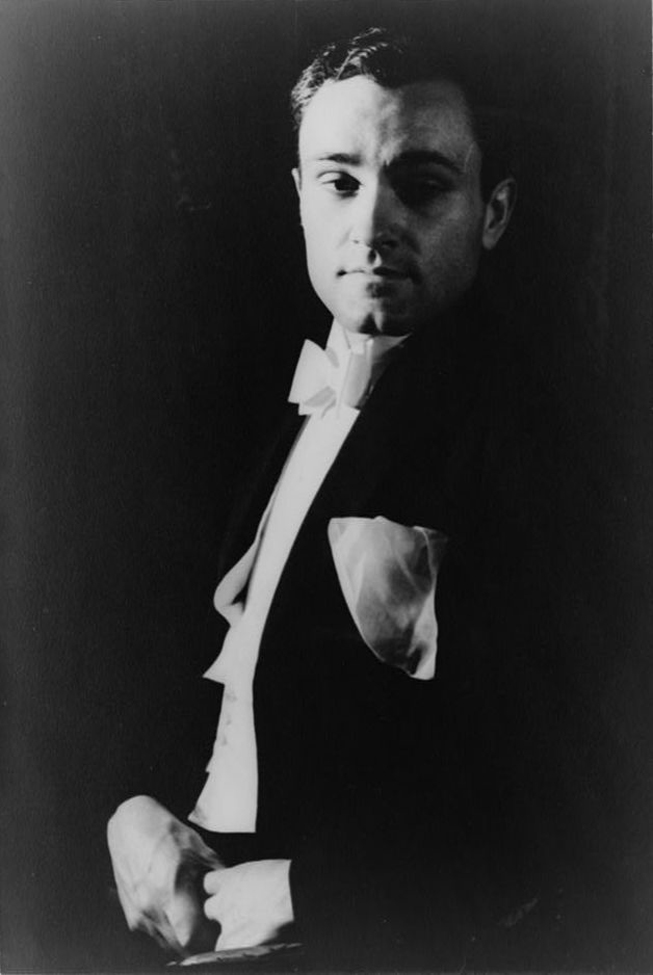

This photograph of Philip Johnson was taken on January 18, 1933, the day the exhibition opened.


In February 1932, working with architectural historian Henry-Russell Hitchcock, Jr., Johnson organized the first exhibition of modern architecture at MoMA, entitled
Modern Architecture: International Exhibition. They simultaneously published the book International Style: Modern Architecture Since 1922, which introduced modern architecture to the American public.

Early Modern Architecture: Chicago 1870-1910

Johnson’s second exhibition for MoMA was announced in early January 1933. The press release quoted Johnson:

“Chicago, and not New York, is the birthplace of the skyscraper. Few people realize that on the ashes of the Chicago fire of 1871 there was built the only architecture that can truly be called American. The great names in the building of the frontier city were three architects, H. H. Richardson, Louis Sullivan and Frank Lloyd Wright, who, with their followers, made the end of the nineteenth century the greatest epoch in the architectural development of our country. They created a native product not indebted to English or continental precedent.

“To these men goes the credit of bridging the gap between the Crystal Palace of steel and glass in London in 1851 and the skyscraper of today. They were the first to take advantage of the shift from masonry to cast iron and from cast iron to steel. This independent American architecture finally succumbed to the wave of classical revivalism which the World’s Fair first brought to Chicago in 1893.”

The press release went on to note that Johnson and Hitchcock had spent the summer of 1932 in Chicago collecting information and photographing important buildings. It also noted that the exhibition would be “the first record of a great architecture which is vanishing rapidly under the sledgehammer of the housewrecker.” This was a poignant statement given that five of the buildings included in the exhibit had already been demolished.

Johnson felt that there were two main reasons why Chicago became the center of architectural development in the late 19th century. The first was its inland location which “removed it from the influence of traditional architecture active on the Atlantic seaboard.” The second was the fire of 1871 which brought countless architects to the city to assist in the rebuilding and finding ways to construct taller structures.  

The exhibition consisted of photographs of 31 Chicago buildings, and one from New York, included to show how backward thinking the latter city was at the turn of the century. Each photograph was accompanied by an explanatory wall label prepared by Johnson and Hitchcock:

“We don’t want people merely to look at this show, we want them to study it and carry away with them a conception of what went into the making of the greatest epoch in our American architecture.”

Glessner House was the only building included for which the plan was displayed, clearly demonstrating how its innovative floor plan was central to the significance of its design. The Auditorium building was the only one for which an interior view was included, which revealed “Sullivan’s power of original design.”


Philip Johnson with the building models; Glessner House is partially visible at far left

The only three-dimensional items included in the exhibition were three models showing the progression from masonry to steel:
-The All Masonry Building
-The Masonry Building with Metal Skeleton
-The Steel Skeleton Building
The models were built by Alfred Clauss (1906-1998) a German architect who, in collaboration with his wife, architect Jane West Clauss, is credited with designing one of the earliest examples of the International Style in the United States. (The development of distinctive split-level homes was known as “Little Switzerland” and was located outside of Knoxville, Tennessee.)

The exhibition catalog included chronologies of both the technical and aesthetic development of the skyscraper, along with selected architect biographies. Johnson’s comments are brief but telling. Of William LeBaron Jenney, he credits him with the first use of steel skeleton construction, but notes he was “a technician rather than a designer.”


Henry Hobson Richardson

He praised H. H. Richardson:
“In his later work the importance of reminiscent elements of design grew less and less, but his originality as an architect was based on the integrity of his use of traditional construction rather than on technical innovations. To the new national architecture, he contributed not methods of building but a formative spirit.”

Louis Sullivan was clearly a favorite:
“Applying the basic stylistic discipline of Richardson’s Marshall Field Wholesale Store to the new skeleton construction, Sullivan first found a dignified clothing for the skyscraper. In his work of the late eighties and early nineties, his designs emphasized the vertical. Soon, however, he found a more logical expression of the underlying construction with a scheme of wide windowed horizontality. Sullivan led for two decades a considerable group of architects known as the Chicago School, but he alone made of the early skyscraper an aesthetic invention.”

Burnham & Root received mixed reviews, Root being noted as “one of the more original Chicago Richardsonians.” But after his death in 1891, “the prolific work of the firm, beginning with the general supervision of the World’s Fair, was rarely original or distinguished in design.”

Johnson made several comments in the catalog noting the negative impact the World’s Fair of 1893 had on the development of modern architecture.

Buildings included in the exhibition

The exhibition included 31 buildings in Chicago, ranging from the 1872 Field Building (architect not identified) to Carl Schurz High School, a design of Dwight Perkins completed in 1910. Most were tall buildings located in downtown, but the range included a synagogue, an armory, a park pavilion, a school, and five houses.

Louis Sullivan was represented with eight buildings, designed in partnership with Dankmar Adler, or from his independent practice. Four buildings represented the work of Burnham & Root and D. H. Burnham and Co. Richardson, Jenney, and Richard E. Schmidt each had three buildings, while Holabird & Roche had two.

A short paragraph described each building. Among the more interesting entries are the following:


Leiter Building I
William LeBaron Jenney, 1879
“An important step toward the skyscraper: the use of cast iron posts between the masonry piers introduces more light. The design is crude, but the general horizontal ordering foreshadows the more finished designs of the later steel skyscrapers.”


Home Insurance Building
William LeBaron Jenney, 1884-85 (demolished 1931)
“The crucial step in the creation of the skyscraper. The metal skeleton supports all the weight of the building except the exterior walls which are partially self supporting. . . In principle, the building has ceased to be a crustacean (chief support by masonry shell) and is already implicitly a vertebrate (chief support by skeleton). Jenney did not yet realize the revolutionary quality of the device he had employed above the second floor.” 


Marshall Field Wholesale Store
H. H. Richardson, 1885-86 (demolished 1930)
“The masterpiece of commercial architecture in masonry, and the strongest single influence on the design of Chicago commercial architecture of the next generation. Even when this influence was no longer direct, the aesthetic discipline of regular and simple design continued.”


Glessner House
H. H. Richardson, 1885-1886
“Here, as in the Marshall Field Wholesale Store, Richardson generalized and recreated the traditional elements of design which he had earlier borrowed directly from the Romanesque. The disposition of the plan with the main rooms opening toward the court rather than toward the street is unusual in America.”


MacVeagh House
H. H. Richardson, 1885 (demolished 1922)
“Less original than the Glessner House this house by Richardson is nevertheless superior to most work of the Richardsonians of the eighties.” 


First Infantry Armory
Burnham & Root, 1890
(Note: located just four blocks from Glessner House)
“The contrast of tiny windows and colossal portal, the avoidance of fussy detail, and the fortress-like scale of the whole, illustrate the possibilities of the free traditional design which existed in Chicago before the World’s Fair. The medievalism is hardly Richardsonian but rather that of the projects of the early nineteenth century in France.” 


Auditorium Building
Adler & Sullivan, 1887-89
“The treatment here of the masonry bearing walls shows strongly the direct influence of the Marshall Field Wholesale Store. The lower portions have been influenced by the Marquis de Vogüé’s publications on early Syrian architecture. Only in the tower appears the beginning of Sullivan’s more personal style.” 


Walker Warehouse
Adler & Sullivan, 1888-89
“Here the flatter surfaces and the more vertical grouping indicate the direction Sullivan’s manner was to take as it freed itself from the influence of Richardson.” 


Carl Schurz High School
Dwight H. Perkins, 1910
“This building owes little specifically to Sullivan. But it indicates the ability of the members of the Chicago School to find a new type of design for new problems. Especially in such a school is the superiority of their inventions over the archaeology of the stylistic revivalists clear.” 


Johnson included one New York building in the exhibition – George B. Post’s Pulitzer Building (also known as the World Building), completed in 1890. He was clear in his disdain for the design:
“Although at its completion the tallest building in the world (349 feet), this New York tower is progressive neither in structure nor design. It has masonry bearing walls on the exterior, 12 feet thick at the base, and only the interior is supported on wrought iron columns. Yet the Home Insurance and Tacoma Buildings had been completed several years earlier. 

“The conventional scheme of academic Renaissance design (the dome of the Invalides has been placed on top of the Louvre) is characteristic of the Eastern architecture of this period and is inappropriate and devoid of scale.”

Chicago’s awareness of the exhibition

Despite Johnson’s praise of Chicago’s architecture, it appears that the exhibition, which ran for five weeks, received little attention in Chicago. The Chicago Tribune carried a brief article entitled “Chicago Architecture in Gotham” two weeks after the exhibit opened.

However, Chicagoans were given the opportunity to see the exhibit for themselves, when it traveled to Chicago that summer. In a move that would be considered unusual today, the exhibition was installed not in a museum, but in the interior decoration galleries at Marshall Field & Co. This was a smart move, and probably resulted in many more Chicagoans being exposed to it than if it had been installed in a traditional setting. Additionally, that was the first summer of the Century of Progress World’s Fair and, for many visitors to Chicago, a trip to Marshall Field’s was an absolute must.


It was an ironic twist of fate that the exhibition ended up at Field’s. Clearly one of Johnson’s favorite Chicago buildings was the Marshall Field Wholesale Store by H. H. Richardson – a structure Field’s had razed just three years earlier.

Conclusion

The 1933 exhibition is the earliest to have brought attention to the innovative design and plan of Glessner House. Richardson had slipped into obscurity by this time, and with Prairie Avenue in significant decline, few would have an opportunity to see the house in person. If they had, they would have seen it blackened with soot and surrounded by empty lots, shuttered houses, and factories.

Three years later, Henry-Russell Hitchcock, Jr. curated The Architecture of H. H. Richardson and His Times at MoMA, to commemorate the 50th anniversary of Richardson’s death. (Johnson had abruptly resigned as curator in late 1934). The exhibition opened on January 14, 1936, just six days before John Glessner’s death at the age of 92. Hitchcock’s accompanying book was instrumental in restoring Richardson’s legacy, and even made the case that the distant roots of European Modernism were actually found in the United States.

Of the 31 Chicago buildings featured in the exhibition, five had been demolished by 1933. An additional 13 have since been razed, leaving 13 survivors (listed in chronological order):
-Glessner House
-Auditorium Building
-Leiter Building II
-Monadnock Building
-Anshe Maariv Synagogue (Pilgrim Baptist Church, some exterior walls remain)
-Charnley House
-Winslow House
-Reliance Building
-Schlesinger-Mayer Building (Carson, Pirie, Scott)
-Gage Building
-Nepeenauk Building (Chapin & Gore Building)
-Humboldt Park Pavilion
-Carl Schurz High School 


Philip Johnson at Glessner House, 1995

When Glessner House went up for sale in 1965 and was threatened with demolition, Philip Johnson became one of the most outspoken advocates for its preservation. In an interview with the
Chicago Daily News, Johnson referred to it as “the most important house in the country to me.” He stood behind his words and provided $10,000 toward the $35,000 purchase price. His appreciation for Glessner House extended back more than three decades to his 1933 exhibition, a time when he probably would have never imagined the critical role he would one day play in its preservation.

Tuesday, January 5, 2021

Chicago's Century of Architectural Progress

Exactly ninety years ago, from December 1930 through February 1931, the Chicago Tribune ran a four-part series entitled “Chicago’s Century of Architectural Progress.” The timing was appropriate, as the year of 1930 had marked the unofficial centennial of Chicago, commemorating James Thompson’s first plat map of the future town and city on August 4, 1830. (Note: The map, shown below, laid out fifty-eight blocks around the juncture of the three branches of the Chicago River in an area bounded by State, Madison, Des Plaines, and Kinzie streets.)

Each of the four installments included a full page of pictures in the Tribune’s rotogravure section. The Committee on Public Information of the Chicago Chapter, American Institute of Architects, chaired by architect and urban planner Eugene H. Klaber (1883-1971), partnered with the Tribune on the project to make the selection of buildings and provide the narrative.

The four installments and supervising architect for each were as follows:

December 7, 1930
Chicago prior to the Great Chicago Fire of 1871
Earl H. Reed, Jr. (1884-1968) 

December 14, 1930
The Fire to the World’s Columbian Exposition of 1893
Arthur Woltersdorf (1870-1948) 

January 25, 1931
The Exposition through the end of World War I in 1918
Harry Howe Bentley (1883-1968) 

February 8, 1931
Contemporary architecture
Thomas E. Tallmadge (1876-1940) 

The first installment included an article explaining the series, quoting Eugene Klaber:

“In the years since the great war, there has been a growing appreciation of architecture in Chicago. The man in the street, who previously hardly knew the names of the important buildings in the city, is today familiar with its principal architectural developments that are taking place. 

“He watches the loop as it grows; and the development of Grant park, of Wacker drive, of Michigan boulevard and the near north side engage his sympathetic attention. This change in attitude of the public toward architecture was greatly stimulated, if not actually fostered, by the competition for the Tribune tower. The worldwide response to this intriguing project, and the variety and excellence of the designs presented, caused endless comment. 

“What is less well known, is that the architecture of contemporary Chicago is but a link in a chain that stretches over more than a century. It is no sporadic manifestation. From the earliest days to the present day, it forms a continuous history. Various influences have affected the flow of architectural development from time to time, but it is nevertheless one continuous story. During that period, the architects of Chicago have manifested a constant and progressive spirit in the design of their buildings. Skeleton steel construction had its origin here, and the resultant architecture, as well as the original thinking of such men as Louis H. Sullivan and Frank Lloyd Wright, have created a wave of influence that has spread throughout the world.”

Chicago Architecture 1871-1893

This article will look at the second installment of the series which includes a total of thirteen sites constructed between 1871 and 1893. Despite the enormous building activity that took place in the years immediately following the Fire, it is interesting to note that none of the sites actually predate 1880. Sadly, only four sites survive today – the Town of Pullman, Monadnock Building, Auditorium Building, and Glessner House.

The sites in the second installment were selected by Arthur F. Woltersdorf, a life-long Chicagoan born in 1870, one year before the Fire. He attended the Massachusetts Institute of Technology and received training in the office of Burnham and Root before forming the partnership of Hill and Woltersdorf in 1894. Elected a Fellow of the American Institute of Architects, he wrote extensively on the theory and practice of architecture and served as editor of Living Architecture: A Discussion of Present Day Problems published in 1930. He died in 1948.

The sites are shown below with their original narrative; additional notes are included in parentheses following each entry: 

PULLMAN

“An industrial town planned in 1880 by S. S. Beman, architect. It was the forerunner by more than a decade of industrial town plans in America, incorporating recreational, sanitary, and aesthetic features for the life of this community. The buildings of red brick and gray stone reflected Victorian Gothic architecture of the time. (Drawing by Irving K. Pond.)”

(NOTE: Pullman was designated a National Historic Landmark in 1970, a Chicago Landmark in 1972 [expanded 1993], and a National Monument in 2015. The style of architecture is generally referred to as Queen Anne, with influences of Richardsonian Romanesque.)

THE MARSHALL FIELD WAREHOUSE

“Erected in the later 1880’s, it stood until 1930, living evidence of H. H. Richardson’s skill in handling simple masses with charm and great power. Historians of American architecture will not forget it.”

(NOTE: The building, known as the Marshall Field Wholesale Store, covered the block bounded by Wells, Quincy, Franklin, and Adams. Richardson considered it one of his most important contributions to American architecture and was saddened when he realized he would not live to see it completed. It was completed in 1887, razed in 1930 and replaced by a parking lot, when the wholesale division moved to the Merchandise Mart.) 

THE ART INSTITUTE

“The Art Institute, later the Chicago Club, by John Wellborn Root (Burnham and Root, architects), displayed Romanesque forms and proportions in a modern and masterly manner. The influence of Richardson is clearly evident. The disappearance of this structure was Chicago’s loss.” 

(NOTE: The building was completed in 1885 and was located at 404 S. Michigan Avenue [southwest corner of Van Buren]. Ownership of the building changed hands when the Art Institute moved into its present building in 1893. The interior of the building collapsed in 1928 during renovation. The old structure was razed and replaced by the current Chicago Club, with Granger & Bollenbacher serving as architects).

THE REVOLUTION OF THE SKYSCRAPER
(The next three buildings were treated together) 

MONADNOCK

“The Monadnock block, north section, dates from 1892. The power expressed in the simple soaring walls is the swan song of wall bearing floor construction for high buildings. Burnham and Root were the architects.” 

(NOTE: At sixteen stories, the north half of the Monadnock building, 53 W. Jackson, was the tallest wall-bearing building in Chicago. Holabird & Roche designed the south half in 1893, which incorporated a more traditional steel skeleton frame. The Monadnock was designated a Chicago landmark in 1973).

HOME INSURANCE BUILDING

“In the Home Insurance Building is the germ of the steel skeleton building, originating in 1884. Up to the second floor the walls are solid masonry. Above this, the floor systems are carried on cast iron columns in self-supporting masonry piers; the spandrel walls are supported by rolled iron beams, such as comprise the floor systems. The two top stories were added in 1890. W. L. B. Jenney was the architect.”

(NOTE: Located at the northeast corner of LaSalle and Adams, this was one of the most important buildings ever constructed in the United States. Although there has been considerable debate as to whether this can be considered the first true “skyscraper,” an analysis undertaken at the time of its demolition in 1931, to make way for the Field Building, confirmed that it was “the first high building to utilize as the basic principle of this design the method known as skeleton construction.”)

MASONIC TEMPLE

“In the Masonic temple, now the Capitol building, the skeleton building, with the date of 1891, appears in its full development. All walls are carried from floor to floor on the metal frame. Burnham and Root were the architects.”

(NOTE: The Masonic Temple, which stood at the northeast corner of State and Randolph, was the tallest building in the world. It remained the tallest building in Chicago until the 1920s when Chicago’s building regulations were amended to allow for taller buildings. The construction of the State Street subway resulted in its demolition 1939, as expensive alterations to the foundation would have been required. The Joffrey Tower now stands on the site).

GLESSNER HOUSE

“The J. J. Glessner house, last remaining example in Chicago of the work of Architect H. H. Richardson. Rugged exterior stone walls enclose stately rooms and a patio. It is destined to become the home of the Chicago chapter, American Institute of Architects.” 

(NOTE: The Glessners deeded the house to the Chicago Chapter (CCAIA) in December 1924, retaining a life-tenancy. After their deaths in the 1930s, the CCAIA did not feel it had the resources to renovate and maintain the building and returned it to the Glessner heirs. In the late 1970s, the CCAIA did rent the former children’s bedrooms on the second floor as its headquarters. Glessner house was designated a Chicago landmark in 1970 and a National Historic Landmark in 1976). 

BORDEN HOUSE

“Richard M. Hunt, designer of the Administration building of the 1893 World’s fair, was architect. Its design is inspired by chateaux of the Loire of the time of Francis I. Its stonework is exquisite.” 

(NOTE: The William Borden house stood at 1020 N. Lake Shore Drive [northeast corner of Bellevue Place]. Completed in 1884, it was one of the earliest houses on the Drive. After William’s death in 1906, it passed to his son John, a noted Arctic explorer, and was occupied by his wife, the former Ellen Waller, after their divorce. Their daughter, also named Ellen (and the ex-wife of Governor Adlai Stevenson II), operated the 1020 Art Center out of the house in the 1950s. It was demolished in 1962 to make way for The Carlyle apartments. Click here for images of the demolition taken by Richard Nickel).

McCLURG HOUSE

“The McClurg house is the work of Francis M. Whitehouse, architect, with Arthur Heun as the designer. Reminiscent of the Louis XII wing of Chateau Blois, its charming proportions and color still hold the passerby in Lake Shore Drive.” 

(NOTE: The house stood at 1444 N. Lake Shore Drive and was completed in 1892 for bookseller Alexander C. McClurg. [In June 1891, Frances Glessner noted in her journal, “Genl. And Mrs. McClurg called in the afternoon to see something about our house – to see if they could get any suggestions about their own building. We took them all over the house.”] It was later home to George M. Reynolds, chairman of Continental Illinois National Bank and Trust. In 1935, it was leased to the Republic of Poland as a consulate, which closed in 1941 after Poland was invaded by Germany. It was converted into apartments at that time and was razed in 1955 for construction of the current apartment building designed by Philip B. Maher known as 1440 Lake Shore Drive.)

COONLEY-WARD HOUSE

“On a visit to Chicago, President Taft pronounced this the best example of American residence architecture in the city. It is untrammeled by historic formalism, distinctively an American home. Pond and Pond, were the architects.” 

(NOTE: Built for Lydia Coonley, widow of the founder of the Chicago Malleable Iron Company, and later the wife of eminent geologist Henry Ward. The house stood at 1150 N. Lake Shore Drive [southwest corner of Division]. Pond and Pond received the commission in late 1888, and the house was completed in 1891. (Coonley’s son, Avery, later commissioned Frank Lloyd Wright to design his home in Riverside, Illinois.) She sold the house to Frank Logan in 1911. It remained in the Logan family until it was razed in 1955 for construction of the current high rise, known as 1150 N. Lake Shore Drive.

An amusing incident took place in January 1889, as recorded in Frances Glessner’s journal: “Sunday, Mrs. Coonley came over with a party of ten to ‘see the house.’ She brought her six children and four very ordinary young men – two of them architects, who said they knew the house by heart, had been all through it time without number – and were making Mrs. Coonley’s house as near like ours as they knew how. The whole call was most disagreeable.”)

BANQUET HALL OF THE AUDITORIUM HOTEL

“Adler & Sullivan were architects. This was an early Sullivan blossom in ornament and color after tryouts in loft and office buildings. The medal of the Societe central des Arts Decoratifs, awarded to Mr. Sullivan after the Columbian exposition, was the only French testimonial elicited for architecture.” 

(NOTE: The hotel’s 10th floor dining room now functions as the Murray-Green Library for Roosevelt University. The Auditorium Building, completed in 1889 and located at the northwest corner of Michigan and Ida B. Wells Drive, was designated a National Historic Landmark in 1975, and a Chicago landmark in 1976).

SCHILLER BUILDING

“A new note in street architecture, introducing the tower dominant. An early application of ‘progressive recessions from base to pinnacle.’ Adler and Sullivan were the architects.” 

(NOTE: The Schiller, later known as the Garrick Theatre, was completed in 1892 at 64 W. Randolph Street. Designated an “honorary landmark” by the City of Chicago and considered one of Sullivan’s masterpieces, the significant effort to save the building turned to a salvage operation prior to demolition in 1961. The building and its preservation battle will be the focus of an upcoming exhibition at Wrightwood 659.)

GOLDEN DOORWAY OF THE TRANSPORTATION BUILDING OF THE WORLD’S FAIR

“American’s most gorgeous flower of architectural romanticism. Aglow with color, it stood apart from the classic formalism of the Court of Honor. The term Sullivanesque, after Louis H. Sullivan, creator of this doorway, applies to the style of the Banquet Hall, Schiller building, and doorway.”

 (NOTE: Sullivan’s displeasure with the Classical architecture of the Fair, in particular the Court of Honor, is well documented, including his famous comment, “The damage wrought by the World’s Fair will last for half a century from its date, if not longer. It has penetrated deep into the constitution of the American mind.” An exhibition featuring a plaster cast of the “Golden Door” and photographs of several of Sullivan’s taller buildings toured France, Russia, and Finland after the Fair. When built, the Barack Obama Presidential Center in Jackson Park will occupy portions of the sites of various Fair buildings, including the Transportation Building).

Monday, April 13, 2015

The Marshall Field Wholesale Store


The Marshall Field Wholesale Store, although gone for 85 years now, is still considered among the most important commercial structures constructed during the last half of the nineteenth century.  Virtually every book dealing with American architecture makes reference to this Chicago edifice, both for its own design and for the impact it had on later buildings in the city and across the country.  

By the time of the Great Chicago Fire in October 1871, Marshall Field had established himself as one of the giants of commerce in the city of Chicago.  His company was known for its innovative and groundbreaking policies, and consisted of two divisions for retail and wholesale.  The building which they shared was destroyed in the fire, giving Field the opportunity to construct new buildings for each.  In 1872, he completed a five-story structure at Madison and Water (now Wacker) to house the wholesale division, but within a decade, the division was already outgrowing its space, as Field continued to add new product lines.  By May 1881 he had purchased all the lots on the block bordered by Adams, Fifth (now Wells), Quincy, and Franklin. 

In 1885, Field contacted architect Henry Hobson Richardson with the proposition of designing a new building on the site.  Richardson completed preliminary plans by summer and in October travelled to Chicago to unveil the finished plans and sign the contract.  An article in the Chicago Tribune said in part:

“Beauty will be one of the objects aimed at in the plans, but it will be the beauty of material and symmetry rather than of mere superficial ornamentation.  H. H. Richardson, the famous architect . . . has long had certain ideas which he wished to embody in such a building . . . It will be as plain as it can be made, the effects depending on the relations of the ‘voids and solids’ – that is, on the proportion of the parts . . . The structure will be a distinct advance in the architecture of buildings devoted to commercial purposes in this country.”

By December 1885, the foundation was in and the stonework was underway, but the building did not even begin to approach completion before Richardson’s untimely death in April 1886.  This saddened him greatly, as evidenced by the following account of his final days written by his first biographer, Mariana Griswold Van Rensselaer:

“The two weeks which passed before he died were weeks of infinite restlessness and pain; but he never complained and never lost his spirits, his hopefulness, or his keen interest in the work that was going on in the offices below.  The day he died he talked confidently to his doctor about his tasks and aspirations, and declared once more that what he wanted was ‘to live two years to see the Pittsburgh Court-house and the Chicago store complete.’  These, he said, were the works he wished to be judged by.”


The statistics for the building were staggering for the time.  The completed structure stood seven stories high, with full basement on spread foundations.  It fronted 325 feet on Adams and 190 feet on Franklin and Wells, and was 130 feet tall.  The plan encompassed 61,750 square feet per floor, totaling almost twelve acres of floor space, which could accommodate 1,800 employees.  The final cost of $888,807 was an enormous sum of money at the time, but just a fraction of the sales of the wholesale division for 1887, which were over $23,000,000.  Marshall Field owned the land and the building personally, and leased it back to his company.  The Wholesale Store opened on June 20, 1887, amid little fanfare in comparison to the opening of the retail store. 


The load-bearing outer walls were brick covered by rock-faced Missouri red granite up to the second-floor windowsills, and East Longmeadow red sandstone above.  The structure was impressive both for its overall size and for the size of the stones used.  Adjectives such as “enormous,” “palatial,” “Cyclopean,” “immense,” and “mammoth” were used to describe it in contemporary accounts.  These terms are not surprising, given that the stones in the granite base were larger than those utilized in any other building in the city.  The first-floor window sills alone were nearly eighteen feet long.

The second through fourth floors were tied together by the main arcade stretching thirteen bays on Adams and seven each on Franklin and Wells between broad corner piers ornamented with boltels.  The fifth and sixth floors were also joined by an arcade having two arches over every one for the floors below.  Groups of four rectangular openings marked the top floor creating a horizontal band above the vertically thrusting arches.  


Above this was the crocketted cornice in Gothic style “vigorously and crudely cut, to be in scale with the whole mass which it terminates.”  The plate glass windows, set in wood framed double-hung sash were recessed to the inner face of the walls to emphasize the thickness of the stone when viewed from the exterior.

Architectural critics and historians have noted the significance of the building from the day it was completed.  Richardson’s biographer Van Rensselaer said in part:

“No cathedral, however magnificent in scheme or perfect in detail, would be worth so much to us as the Pittsburgh Court-house or the great simple Field Building at Chicago . . . The Field Building is in one way his most remarkable. . . No building could more frankly express its purpose or be most self-denying in the use of ornament.  In short, the vast, plain building is as carefully studied as the smallest and most elaborate could be, and is a text-book of instruction in treatment no less than in composition.”

When Richardson’s work was the subject of an exhibit organized by the Department of Architecture of the Museum of Modern Art in New York in the 1930s, its catalog went so far as to say that:

“The Field Store is Richardson’s most important building . . . Richardson shows in the Field Store that commercial architecture might have its own honest distinction, independent both of the past and of other contemporary types of design.”

The Wholesale Store had a profound impact on other architects of the day.  Perhaps none of them was more affected than Louis Sullivan, who immediately incorporated ideas he gleaned from the Wholesale Store into such projects as the Standard Club, the Walker Warehouse and, especially, the Auditorium.  Carl Condit, in his book The Chicago School of Architecture, stated:

“The decisive change in the plans of the Auditorium came as the result of the influence of Richardson’s Marshall Field Store.  Both Sullivan and (Ferdinand) Peck had a profound admiration for the earlier building; in addition, the board of the Opera Association saw many possible economies in the adoption of its simplicity.  Fortunately, for architects everywhere, Sullivan abandoned his propensity for elaborate exterior ornament and concentrated on the architectonic effect of mass, texture, and the proportioning and scaling of large and simple elements . . .”


In spite of all the praise lavished on the building, it was pure economics that eventually led to its demolition.  By the early 1920s, the wholesale division was in serious trouble.  The railroad and especially the automobile made it easier for rural residents to travel into larger cities to shop; spelling disaster for the country merchants who had been wholesale’s best customers.  Additionally, many of the merchants in the small towns succumbed to manufacturer’s appeals to buy direct at lower prices, and the success of huge mail-order houses further contributed to the decline of wholesale.  In an effort to breathe new life into the wholesale division, plans were announced in 1927 for the construction of a huge new facility, covering two city blocks, and containing 4,000,000 square feet of space.  The new building, known as the Merchandise Mart, served as the death knell for Richardson’s Wholesale Store building.

The Merchandise Mart opened in 1930 and the company engaged Graham, Anderson, Probst & White to draw up specifications for the demolition of the old building.  The massive structure was reduced to rubble by mid-summer to accommodate a parking lot.  Little was salvaged other than machinery and equipment, lighting fixtures, brass rails, gates and revolving doors.  The granite and sandstone, so praised for its visual impact, was used as fill to create a level surface for the asphalt parking lot.  


Two sandstone capitals did survive and were later found supporting the “Horace Oakley Memorial Bench” at the Lake Zurich Golf Club.  They were subsequently moved and are now installed amongst other significant Chicago architectural fragments in the collections of the Art Institute of Chicago and the Graham Foundation.  A plaster casting of one of the capitals has just been installed in the visitor’s center at Glessner House Museum, adjacent to the permanent exhibit on H. H. Richardson.


Ironically, Richardson’s American Merchant’s Express Building was destroyed by fire the same year that the Wholesale Store was demolished.   The residence designed for Franklin MacVeagh had been razed in 1922, leaving only the Glessner house to serve as a legacy of Richardson’s impact on Chicago.  
Related Posts Plugin for WordPress, Blogger...