Showing posts with label Frances Glessner Lee. Show all posts

Tuesday, February 14, 2023

Frances Glessner Lee is married


This month marks the 125
th anniversary of the marriage of Frances Glessner and Blewett Lee. The ceremony took place on February 9, 1898, in the parlor of her parents’ Prairie Avenue home. It was a small affair attended by family and close friends, but a great effort went into all the preparations. In this article, we will examine the event from beginning to end.

Frances Glessner returned from her fourteen month Grand Tour of Europe in July 1897 and immediately joined her family at The Rocks, their New Hampshire summer estate. Soon, she met Blewett Lee, a friend of her brother George. The relationship developed quickly and just three months later, on October 17, Blewett asked her parents for her hand in marriage. However, Frances had not yet had her formal introduction into Chicago society, so although her parents consented to the union, the announcement was withheld until after her debut took place in late November. (Click here to read an article about the debut). The engagement was announced to the extended family over the Christmas holiday. On the last day of the year, Frances’s mother wrote in her journal that she had spent much of the day writing letters to friends announcing the engagement. The letter read as follows:

“We have a very precious bit of news which we wish to share with you and Mr. ___. Our Frances is engaged and to be married early in February to Mr. Blewett Lee. We should rather have her a little older than she will be then, but Mr. Lee is so nearly everything in the world that is good and perfect that we cannot find it in our hearts to interfere with their complete happiness. Mr. Lee is a well established practicing lawyer and is also a professor of law in the Northwestern University, is a man of very unusual parts, character and education. He comes from old and distinguished families, the Lees and Harrisons of Virginia. He and Frances are heartily in love with each other and if we must lose our only daughter, he is the one man in the world to whom we are willing to give her. So, we ask you to congratulate the young people upon their happiness and us too because our daughter loves so good a man and one whom we cordially love and approve.”

The letter noted the bride’s young age – she was just 19 at the time; her husband-to-be was 30. Chicago newspapers announced the engagement on January 2, 1898, the Chicago Tribune noting this about Blewett:

“Mr. Blewett Lee, whose residence is at the Chicago Club, was educated at the Universities of Mississippi and of Virginia, studied at Leipsic and Freiburg, graduated from Harvard, and, besides his practice here, is professor of constitutional law and equity in Northwestern University, and has recently been asked to take similar positions at prominent Eastern colleges.”


The Inter Ocean provided a few additional facts including the fact that Blewett had been in Chicago for four years, and that following his graduation from Harvard in 1889, he “began his practical legal experience” with Justice Horace Gray of the U.S. Supreme Court. None of the articles provides any information about Frances Glessner herself. In mid-January, the date of Wednesday, February 9 was announced. By coincidence, it was the same date as the wedding of Elizabeth Henderson, daughter of the Glessners’ neighbors who lived three doors to the south at 1816 S. Prairie Avenue.

Over the next month, the journal is filled with entries relating to the wedding planning, including multiple visits to Madame Weeks at 1521 S. Michigan Avenue. She was Mrs. Glessner’s preferred dressmaker and made both the wedding dress and most of the trousseau, with items such as the lingerie coming from Schlesinger & Mayer’s.


Wedding corset, embroidered cotton coutil
(Collection of the Chicago History Museum)


As presents began to arrive, a third floor room was converted into an area to display the variety of costly gifts, and Mrs. Glessner notes many occasions where she took friends up to see the gifts and the trousseau. A notebook was purchased in which to record all the presents and from whom they were received, with sections for silver, china, glassware, embroideries, bed linens, household linens, and table linens. The image below shows a portion of the silver on display in the third floor room. The chest of silver flatware, with service for 18, was made by Gorham in the Antique pattern, and was a gift from the Glessners, as was the hammered silver tea and coffee service at left. The silver platters came from Frances’s favorite uncle, George Glessner, and the silver trays from her brother George. All the pieces have been donated to Glessner House by the family.


On Saturday, February 5, the 900-pound Steinway grand piano was moved up to the second floor. The cook, Mattie Williamson, baked the cakes, and they were taken to Charles Smiley, Chicago’s premiere African American caterer, for icing. Mrs. Glessner noted that the “little brides which were on our wedding cakes” were taken in for repair, and that some of the preserved orange flowers from her bouquet were to be put in with Frances’s fresh flowers.

The day before the wedding, men came in to lay white muslin on the floors, and the florist came to decorate the rooms. White lilies adorned the music cabinet, and the parlor mantel was filled with a bank of ferns and orchids. The northeast corner of the parlor, where the ceremony was to take place, was hung with wild smilax and white orchids, tied back on either side with small wreathes of lily of the valley. The stairway was decorated with palms and azaleas, and a group of these stood in the hall in front of the door to the courtyard. An immense bunch of American beauties stood on the sideboard.

Out of town guests began to arrive, and presents were sent all day. Rev. Philip H. Mowry, who had presided over the wedding ceremony of John and Frances Glessner in 1870, traveled from Chester, Pennsylvania to perform the ceremony for their daughter. More out-of-town family arrived on Wednesday, some staying with the Glessners’ neighbors, the O. R. Keiths, at 1808 S. Prairie Avenue.


Rev. Philip H. Mowry


The ceremony was scheduled for 5:00pm. Madame Weeks and two assistants arrived at 3:00pm to dress Frances. The wedding gown was made of white satin with a deep flounce of double rose Venetian point lace which Mrs. Glessner had acquired from Rome. Frances wore a tulle veil and carried a bouquet of lily of the valley (which was preserved, see image below). She wore a handkerchief and point lace in her sleeves that her mother had worn when she was married. She borrowed a pearl headed pin from her mother and wore a diamond necklace given to her by Blewett’s mother, whose fragile health prevented her traveling from Mississippi to attend.


The bridal party:

·        Helen Macbeth, maid of honor, was the bride’s aunt. She was Frances’s traveling companion during her Grand Tour of Europe in 1896-1897. Helen had served as the maid of honor when her sister Frances married John Glessner in 1870.

·        Alice Hamlin of Springfield, Ohio. Her engagement to George Glessner was announced later that evening.

·        Frances Ream of 1901 S. Prairie Avenue, a childhood friend. She went on to marry industrialist and coal mine operator John Kemmerer.

·        Marion Ream, Frances’s oldest sister. Her first husband was Redmond Stephens and together they owned what is now the Charnley-Persky House. Her second husband, Anastase Vonsiatsky, was a founder of the White Russian Fascist movement in the United States and was imprisoned for espionage during World War II.

·        George Glessner, the best man, was the brother of the bride.

·        Dwight Lawrence was Blewett Lee’s partner in the law firm of Lee & Lawrence, and a friend of George Glessner. Lawrence initiated the introduction between Blewett and the Glessners. He later became a leader in the National Roosevelt Committee when Theodore Roosevelt ran for president on the Progressive ticket in 1912.

·        Leverett Thompson was a banker and later served as mayor of Lake Forest.


Alice Hamlin, Marion Ream, Helen Macbeth, and Frances Ream


Madame Weeks received a pin in thanks, as did each of the servants. The bridesmaids received brooches of stones and pearls, and wore white organdy, with Valenciennes lace, pink sashes and bows, and carried pink carnations. Helen carried white roses. The men each received three pairs of sleeve buttons.

The bridal party formed in the hallway outside of the Glessners’ bedroom. Close friends formed a passage in the main hall for them to pass through, and then followed them into the parlor. Members of the Chicago Orchestra were seated on the main staircase on platforms that had been made especially for them by the Auditorium stage manager. Theodore Thomas selected and arranged the music but was unable to be present due to another commitment. They played the “Swedish Wedding March” by Söderman followed by “Call me thine own” from the opera L’éclair by Halévy. Of the ceremony, Mrs. Glessner wrote:

“Mr. Mowry stood with his back to the corner – and read the full Episcopal ceremony. The young people made their responses clearly and without hesitation. They were married with a ring. Helen removed the veil, Blewett kissed his bride. John, General Lee and I congratulated them, then George, then the grandparents, etc.”

At the conclusion of the ceremony, the orchestra played Mendelssohn’s “Wedding March.” After congratulations were offered all around, George stood by his mother, and Alice Hamlin by John Glessner, and their engagement was announced.


Signatures of the bride and groom, parents, and wedding party from the guestbook


The reception followed:

“Our tea table was set in the library. We put a fine damask cloth and then our old Maltese lace cloth. We had two pyramids of cake, white and black, one on each end. On top of these were the little brides used on our wedding cakes. We had a splendid basket of pink and white roses and ferns on the table. Then there were cakes the shape of a heart – candies with little white bow knots on top of them. We had frozen egg nog in the hall – tea and coffee in the alcove.”

(For cake recipes, see the "Cooking with Mattie" column posted February 1, 2023)

The reception was followed by dinner for 32 – the bridal party, family, Mr. and Mrs. Moore, Mr. and Mrs. Lawrence, and Governor and Mrs. Bushnell. The bridal party was seated in the dining room, the others were seated at three tables in the parlor.

The menu:
Oysters on the half shell, brown bread and butter, olives and celery
Chicken cream soup
Fish with cooked cucumbers and potatoes
Fillet of beef with brown sauce, with chestnuts, creamed mushrooms, celery, and jelly
Salad with sliced ham and hot crackers
Ice cream in the shape of four-leaf clovers
Cake, fruit, bon bons, coffee
Champagne throughout

John Glessner gave the toast to the bride:

“A toast for the bride – a good and loving daughter, a sweet and lovely bride who is to be a good and thoughtful and loving wife, whose joy is not in riches but in home making and the affection of husband and friends.

“To us old fogies these seem over young to marry yet and start out for themselves – but we old folks did it when we were young. The future is rose colored and rose scented for them as the looking forward was rosy for us and to us the color and the fragrance of the backward glance – the realization – is sweeter still.

“May it be so with these our dear children. Here pledge with me the health of the bride and the peace and comfort and joy of this new household.”

(The toast was later written out by Isaac Scott, and framed, as seen below)


The guests left at 9:00pm. Frances went to her room to change into her traveling costume – blue serge skirt, blue green and yellow plaid silk waist (swatch shown below), blue serge Eton coat, black velvet hat with scarlet roses, and a sealskin cape. Mrs. Glessner recorded how the evening drew to a close:

“Then we five sat down in our bedroom until time to go to the station. Then they – the two – went out alone together never to enter the home in the same way again.”


Waist fabric from book containing swatches of Frances's wedding dress and trousseau


The Elite News published an extensive account of the wedding, also noting the pedigree of the couple, a complicated issue given the role Blewett’s father played in the Civil War:

“Miss Glessner, through Madame Anna Bayard, who came to this country with her brother, old Peter Stuyvesant, the first Dutch governor of New York, and settled on Bohemia Manor, partly in New York and partly in New Jersey, traces her lineage to the family of the Chevalier Bayard, the knight sans peur et sans reproche, and Mr. Lee, through both the Lees and the Harrisons, goes back to Colonial Virginia and old established English families.

“Mr. Lee’s father, Lieut.-General S. D. Lee, was the Confederate officer detailed to demand the surrender of Fort Sumter at the breaking out of the war, and his grandfather, Hon. James T. Harrison, was selected by the whole of the Southern bar at the close of the war to defend Jefferson Davis if action should be brought by the Federal government against him for treason. Happily, this was not necessary, and both sides of Mr. Lee’s family accept the logical results of the war and are true and loyal citizens of our united country.”

Frances Glessner notes in her journal that on Saturday she felt her “first severe reaction” and could hardly get through the day. Serious illness was fast approaching, and on February 20 she underwent surgery in the corner guestroom and was confined to her bed for several weeks. Frances and Blewett Lee returned to Chicago on February 29 after spending their honeymoon in the South, and took rooms at the Hotel Metropole, located at 2300 S. Michigan Avenue.


The Lees held their first post-nuptial reception on April 12 at the Glessners’ home. On the same day and at the same hour, the former Elizabeth Henderson and her new husband, William H. Merrill, held their first reception at her parents’ home three doors away. This was no doubt carefully arranged, as the two families would have shared many of the same friends, making it convenient for them to visit both receptions at one time. John Glessner noted that 252 people attended their reception, but that his wife was not well enough yet to come down from her bedroom.

In early May, the young couple set up housekeeping in a first floor apartment at 120 E. 21st Street, just a few blocks from the Glessners. On December 5, 1898, their son John Glessner Lee was born. It had been a whirlwind eighteen months since Frances Glessner returned from her Grand Tour.


Tuesday, October 18, 2022

Frances Glessner is introduced into Chicago society


Frances Glessner was introduced into Chicago society in the fall of 1897, exactly 125 years ago. Events unfolded quite rapidly following her return in July from a grand tour of Europe. She soon met and fell in love with her future husband while at her parents’ summer estate, The Rocks, in New Hampshire. After returning to Chicago in October, plans were finalized for her debut, which took place the day before Thanksgiving. Exactly one month later, her engagement was announced. She was married in February 1898, and by the end of that year had given birth to her first child.

The planning of a formal debut for girls turning 18 grew in popularity during the 19th century. In England, members of the aristocracy spent months planning for the event which culminated in presentation at court before the Queen. In America, the rituals could be almost as elaborate, with the dress (always white to portray purity), flowers, reception, and guest list all carefully considered. Autumn was the most popular time for the debut as it introduced the young woman at the beginning of the social season, providing the opportunity for countless dinner parties and dances at which to meet potential suitors. The goal was to secure a proposal of marriage by the end of the first or second social season.

Frances was actually 19-1/2 when her debut took place, due to the fact her parents sent her on a grand tour of Europe in May 1896, just two months after she turned eighteen. Accompanied by her maiden aunt, Helen Macbeth, the tour lasted fourteen months and upon her return to the United States on July 29, 1897, she joined her family to spend the remainder of the summer at The Rocks. A letter from her mother, penned on July 4, hinted at her change of status – she was no longer the girl Fanny, but the young woman Frances. Her mother wrote, in part:

“You are grown up now – are no longer a child – we shall be good friends now. I shall depend upon you, and you will help me and let me rely upon you. You are through with the school room and are ready to take your place with me and to take on responsibilities. Heretofore, your father and I have planned for you. Now you can take the liberty which belongs to a young lady and to our daughter.”

Frances and her family at The Rocks, summer 1897

It was while at The Rocks that she came to know Blewett Lee, her future husband. He was eleven years her senior and had come to know the family through his friend Dwight Lawrence, one of George Glessner’s closest friends. Blewett was a promising young attorney and a professor of constitutional law and equity at Northwestern University, and quickly endeared himself to Frances, and the rest of her family. On October 17, less than a week after the family had returned to Chicago, he asked the Glessners for Frances’s hand in marriage.


Although they readily consented, the decision was made to postpone the announcement of the engagement until after her debut. During the first week of November, invitations were mailed out, and soon after, the society columns of the Chicago newspapers announced the event, the following from
The Chicago Chronicle being typical:

“Mrs. John J. Glessner and Miss Glessner of 1800 Prairie avenue will give a large reception on the afternoon of Nov. 24 from 3 until 6 o’clock. The affair will serve to introduce Miss Glessner.”

The date would have been carefully considered to avoid any conflicts, as Frances Glessner’s journal notes numerous debut parties during the month to which she was invited. On November 23, just one day before her daughter’s debut, she recorded attending the debut for Marion Thomas, the daughter of Chicago Orchestra conductor Theodore Thomas, where she formed part of the receiving party.

Frances Glessner carefully recorded the details of her daughter’s debut in her journal:

“Wednesday, the day was given up to the debut party. The flowers commenced to come in early in the morning. I had two men here from eleven o’clock on arranging them. We massed them on the library table and book shelves. There were huge vases of American beauties which reached almost to the ceiling and these were put on the south and east end of the table and the bouquets graduated down toward the door. It was a splendid sight. She had flowers from sixty persons.

“Frances’s dress was white crepe de chine with an embroidered polka dot all white. She wore a bunch of lilies of the valley which Mr. Lee sent her and three pink rosebuds from my bouquet in her hair. Miss Hamlin wore a blue and white silk and carried a bunch of white roses and one of crimson sent by John and George.

“I wore a green watered silk and velvet. There was a large number of guests. Frederick ran the dining room and hall and did it splendidly. We had three bunches of white chrysanthemums in the hall and one on the piano, American beauties on the sideboard and one on each side of the table in the dining room. We had a small narrow table across the bay window. This had a white cloth which reached to the floor. This was festooned with delicate green and pink rosebuds. We had no assistants and no one to preside at the table. It was a pronounced success in every way.”


The account of the event in the newspapers was brief, which was typical of the Glessners who preferred not to have long detailed descriptions of their social events published.
The Chicago Chronicle wrote:

“Miss Glessner, the only daughter of Mr. and Mrs. J. J. Glessner of 1800 Prairie avenue, made her debut in society yesterday afternoon at a tea from 3 until 6 o’clock. Mrs. Glessner was assisted by her guest, Miss Hamlin of Springfield, O. Mrs. Glessner and Miss Glessner will be at home Tuesdays during the winter.”

(Notes: “Miss Hamlin” was Alice Mary Hamlin, who would become George Glessner’s wife in June 1898. “Frederick” was Frederick Reynolds, who had served as the Glessners’ butler since October 1891. The Tuesday “at homes” referred to the social custom of Frances Glessner and her daughter being at home every Tuesday afternoon to receive callers.)

The day after the debut was Thanksgiving Day, and in a distinct step away from formal society, Frances and her brother and their friends attended a 1:00pm football game between the Universities of Michigan and Chicago held at the Coliseum, 1513 S. Wabash Avenue. A dinner for sixteen took place in the evening.


Friday was marked by attendance at the regular concert of the Chicago orchestra, the family enjoying a performance of Schumann’s
Rhenish Symphony and Mendelssohn’s A Midsummer Night’s Dream Overture. Frances Glessner noted that many people called on her debutante daughter in their box during intermission. The next day, she hosted a “young ladies luncheon” before mother and daughter attended the debut party for Margaret Avery, a childhood friend, and the granddaughter of Thomas M. Avery, president of the Elgin National Watch Company.

On Friday, December 10, Frances attended her first formal ball:

“In the evening, Frances went to her first ball. She wore a charming gown of white tulle with a delicate garnishing of pink roses and green leaves. A pink rose in her hair. She was sweet as a peach. Mr. and Mrs. Chauncey Blair took her. John went after her at 12-30. Unie too went to help her. Mr. Lee went. Frances danced every time and was not very enthusiastic over balls when she came home.”

(Note: “Unie” was Unie Iverson, a servant).

Just six days later, the Glessners hosted a dinner dance for their daughter, with elaborate preparations requiring the relocation of much of the first floor furniture.

“Thursday we gave our dinner dance. We cleared the dining room and parlor of every piece of furniture – took down the curtains, took off doors, etc. The side board and piano were put in the hall and covered with old embroideries and brocades and used for favor tables. We arranged the favors on them and then covered them all up with Japanese parasols opened. The dining room was hung with festoons of green wild smilax and at the lowest point of each festoon we pinned a big bow of pink satin ribbon with long ends. Small rosettes of the same ribbon were put in the greens between the bows. These bows were given the dancers for their last favor.

“Johnny Hand and his orchestra of eleven pieces were in the hall between the stairway and the fireplace. Mr. Bournique came himself and brought his man to put the floors in the best condition. Our bedroom was used as a store room for furniture. The guests came in the drive way and up the winding stairs. There were forty two at dinner. We seated them at small tables in the parlor and dining room. We had a bunch of pinks on each table. After dinner, these pinks were put on the parlor mantel. The camp chairs were all covered with white muslin covers. The chairs were paired off and the numbers were painted on good sized cards and tied on the chairs.

“The dining room was absolutely clear. The red curtains were dropped and the green drapery and bows were on those. Mattie Williamson helped us all day. We had a nice dinner and at twelve o’clock a nice supper. The party broke up at two o’clock. We have been very much complimented over the party.”

The Inter Ocean reported the next day:

“About thirty young people were entertained at dinner by Mrs. J. J. Glessner of No. 1800 Prairie avenue last evening. Later, the cotillon was danced. The affair was in honor of Miss Frances Glessner, a recent debutante.”

The social events for Frances continued, the week leading up to Christmas being representative.

Monday, December 20

Frances and her mother paid calls on the North side. In the evening, Frances attended a dinner at the Lake Shore Drive home of Mrs. E. F. Lawrence and then the first of the Marquette dances. The dance took place at the Germania Club on Clark Street, just south of North Avenue. Attended by 150 people, the dance was considered one of the important events in the social calendar for the winter and inaugurated the season of subscription dances. The club hosting the dance was composed of “young married people and young maids and bachelors who are prominent socially on both the North and South Sides.” Frances’s father went after her at midnight, at which time supper was served and the evening concluded with a german. They came home about 3:00am, Frances noting she had “a fine time.”

(Note: A german, also known as a cotillon, was a popular group dance, usually performed to waltz music. It incorporated elaborate props and favors, such as those mentioned in the Glessner dinner dance of December 16.)

Germania Club

Tuesday, December 21

Mrs. William W. Kimball, 1801 S. Prairie Avenue, gave a luncheon for Frances. In the afternoon, mother and daughter had about thirty callers.

Wednesday, December 22

Frances hosted a “young ladies luncheon” for twelve. In the evening, Mr. Isham gave her a dinner at his North side home.

Thursday, December 23

Mrs. A. A. Sprague, 2710 S. Prairie Avenue, gave a luncheon for Frances.

Friday, December 24

Frances dined at the home of Norman Ream, 1901 S. Prairie Avenue. His daughters, Marian and Frances, would both serve as bridesmaids at her wedding. Frances’s engagement was announced to the extended family.

Frances Glessner’s time as a debutante was active, but short lived. On February 9, 1898, just two and a half months after she was introduced into Chicago society, she married Blewett Lee. A future article will detail the events leading up to and including their nuptials, which took place in the parlor of her parents’ Prairie Avenue home.

Tuesday, December 14, 2021

The Glessner House Christmas Tree

John and Frances (Macbeth) Glessner, both born in the 1840s, would have seen the tradition of a Christmas tree evolve during their childhood. Virtually unknown outside of Germany until Queen Victoria and Prince Albert introduced the custom to Great Britain that decade, Christmas trees quickly started to appear in American homes. Frances Glessner’s journal provides interesting information about the Christmas trees that would have been displayed at 1800 S. Prairie Avenue, although the references are usually brief, as the tree was typically in place for less than 48 hours.

The Glessners moved into their new home on December 1, 1887. The first Christmas tree was decorated on Christmas Day, Frances Glessner noting simply “the children are today trimming a Xmas tree in the school room.” (Most of the journal entry describes the gifts given and received).

George Glessner, a talented amateur photographer, documented the tree in 1888. Frances Glessner wrote, “We all hung up our stockings and trimmed our pretty little tree just three feet high. It stands on the table in the school room.” As was typical for the period, trees were small and were placed on a table. The photograph shows the variety of decorations used including candles, a foil-paper covered cardboard bird at the top, tinsel, three types of garlands (tinsel, glass beads, and popcorn), blown-glass ornaments, and miniature drums.


The year 1898 was special as both of the Glessners’ children had married that year, so were celebrating their first Christmas in their own homes – apartments located in a large building on the 2000 block of South Indiana Avenue. George and Frances each received some of the ornaments that they had used to decorate the school room tree:

“John and I went over towards noon to call on the young people. We found them all very happy – the baby sleeping soundly. A tiny tree was decorated with balls and ornaments from the first tree George ever had and which have been used every Christmas since.”

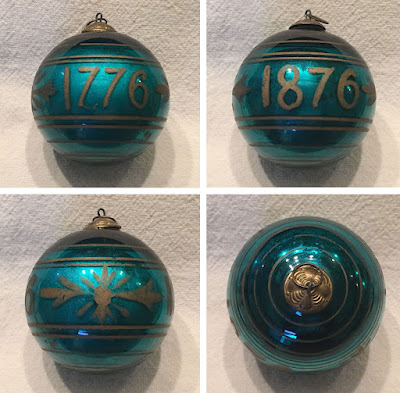
Among the ornaments given to George and his wife Alice, was a special glass piece known as a kugel. Unlike the thin-walled glass ornaments that became popular later on, kugels were heavy glass ornaments usually lined with silver, which gave the glass a deep rich color. The ornament was purchased by the Glessners during their visit to the Centennial Exposition in Philadelphia during the summer of 1876. It is painted with simple gold decoration, and features the dates of 1776 and 1876, denoting the centennial of the United States. The kugel was passed down through several generations of George’s family, before being returned to Glessner house in 2018. It is the only original family ornament in the collection today.


With the Glessner children married and away from home, Frances Glessner usually selected friends – often the age of her children – to decorate the Christmas tree. Favorites included the architect Hermann von Holst, whom the Glessners unofficially “adopted” as a young adult after his parents returned to Germany; he always spent the holiday with the Glessners. In 1900, Hermann “trimmed our Christmas tree and staid all night to see the fun in the morning.” After he married, his wife Lucy joined in the annual tradition. Other favorites to assist with the tree trimming included the principal harpist of the Chicago Symphony, Enrico Tramonti, and his wife Juliette. The Glessners’ grandchildren start participating in the decorating activities by 1905.

The Glessners had switched to a larger tree by 1902, when Frances Glessner wrote in her journal, “the children all came home Christmas morning at ten o’clock when we lighted the tree which stood in the hall. All of the family and household were in the hall.” The tree was still lit with candles at this point, so the lighting was a major part of the celebration with everyone gathered to observe the tree briefly illuminated with its lit candles (perhaps 15-20 minutes) before the candles were extinguished.

Electric lights were first incorporated on the Glessner Christmas tree in 1911, and the display was quite elaborate. Few people had electric lights at this time, the first strings being introduced by General Electric in 1903, although Frances Glessner noted seeing individual electric lights on the tree of a friend in 1900. Strings of lights were initially quite expensive, and, as few people had electric outlets, were designed to screw into a light bulb socket of a nearby wall sconce or chandelier.

The festivities around the Christmas tree for 1911 began with the arrival of the fresh tree from The Rocks, the Glessners’ summer estate in the White Mountains of New Hampshire. John Glessner noted that five trees were delivered for use in their home, and the homes of their son George, daughter Frances, sisters-in-law Helen and Anna (who shared an apartment), and neighbors James and Narcissa Thorne (later known for her meticulous Thorne Rooms, on permanent display at the Art Institute).


Three of the trees from The Rocks were delivered to these Prairie Avenue homes: (L-R) James and Narcissa Thorne (1708), George and Alice Glessner (1706), and Blewett and Frances Lee (1700).


John Glessner wrote that an electrician with International Harvester was recruited for the special electric light display:
 

“Cheney the electrician spent all of Saturday and Sunday over our Christmas tree and it was wonderfully pretty. The tree came from The Rocks and was placed in an alcove made of curtains in the main hall, had many and various colored lights that “flashed” and twinkled; there were spotlights of various colors thrown on it and snow fell from the canopy over it.

“It was lighted first at 9 pm for our company at Sunday (Christmas Eve) supper – 19 in all at the table, and again at 10 o’clock on Christmas morning for the benefit of the children and our guests and servants – 36 or 37 in all, so that the tree blazed for about two hours on Sunday night and about two hours on Monday morning and then was taken down. It had its day and was no more. And before evening we were back to the original condition with only the memory.”

Despite the elaborate preparations for the tree, it was not photographed, but we know what the bulbs on the tree would have looked like. The earliest bulbs were pear-shaped, like early Edison bulbs, but in 1910 General Electric switched to a round bulb with a small “exhaust tip” at the end. This shape was used until 1919, when the cone shape resembling a flame was adopted; this remained the standard version until the 1970s and is now popular again as a “vintage style” bulb. The photos below show a light kit produced by General Electric in 1910. (To learn more about the history of electric Christmas tree lights, visit Old Christmas Tree Lights, from which the images below were retrieved.)


In 1978, Frances Glessner Lee’s two surviving children, John Glessner Lee and Martha Lee Batchelder, donated The Rocks Estate to the Society for the Protection of New Hampshire Forests, with the stipulation that a crop always be grown in the fields. Christmas trees were the chosen crop, and for more than three decades, a tree was shipped from The Rocks each year to decorate the main hall at Glessner House. That tradition ended in 2019, when the building housing the shipping operation burned to the ground; since that time a tree has been sourced locally.


In order to tell the full story of Christmas at the house, two trees are decorated each year. A small three-foot tree sits on the table in the schoolroom – this is where the original kugel is hung. A larger tree is displayed in the main hall. There are no electric lights on either tree, interpreting the period prior to the grand electric light display of 1911.


Tuesday, November 16, 2021

Controversy Upon the Stage: The Ballet Russes Comes to Chicago, 1916


The idea for this month’s article began with a postcard. Among recently acquired Glessner family items was a framed real photo postcard from 1916 featuring a portrait of the Swiss conductor Ernest Ansermet, with a short message in French on the reverse addressed to Frances Glessner Lee. A quick review of Frances Glessner’s journal confirmed how Frances Glessner Lee and Ansermet met. A deeper dive into Ansermet’s reason for coming to Chicago that year uncovered a long-forgotten story of one of the most controversial performances to ever take place upon the Chicago stage.

The Ballet Russes


Sergei Diaghilev (Leon Bakst, 1906)

The Ballet Russes was the brainchild of the great Russian impresario Sergei Diaghilev. Formed in Paris in 1909, the ballet company created a huge sensation with its boundary-pushing performances that combined modern music, innovative choreography, and stunning visual arts. Among those engaged by Diaghilev were Igor Stravinsky, Claude Debussy, Sergei Prokofiev, Maurice Ravel, Vasily Kandinsky, Pablo Picasso, Henri Matisse, Leon Bakst, and Coco Chanel. The company, which gained broad exposure during tours through Europe and North and South America from 1909 through 1929, has long been regarded as the most influential ballet company of the 20th century.


In 1916, New York’s Metropolitan Opera Company arranged for the Ballet Russes to undertake a multi-city U.S. tour. That tour included a two-week residency at the Auditorium Theater in Chicago, to be managed by Frederick J. Wessels and Henry E. Voegeli, the business manager and assistant manager, respectively, of the Chicago Symphony Orchestra. The company, which comprised about 200 “artistes direct from Russia” arrived in Chicago on February 13 aboard a special train on the Michigan Central. Opening night, scheduled for the next day, was reserved as a special benefit performance for the Eli Bates Settlement House. The controversy, however, started before the curtain went up on that Valentine’s Day performance.

The Afternoon of a Faun

An article, which ran in the Chicago Tribune the day of the opening, recounted the controversy over the troupe’s New York and Boston performances, noting that Chicagoan’s would have a chance to see the performances as originally intended and make up their own minds:

“In New York the police authorities were shocked by ‘L’Apres-Midi d’un Faune’ (The Afternoon of a Faun) and ordered changes in one scene. As it was originally played the faun seizes a part of the girl’s lingerie and then goes to sleep, using the garment as the covering for a rock on which he reposes. The New York authorities considered this bad form and the faun thereafter had to sleep on a bare rock. Boston went New York one better and officially frowned on the harem scene in ‘Scheherazade.’ Mayor Curley said bare feet were right, but bare legs could not be tolerated. Accordingly, the legs were covered.

“Chicago is going to be given the original uncensored, unexpurgated versions of Serge de Diaghileff’s Ballet Russe – that is, provided Maj. Funkhouser doesn’t order excisions. Mr. Diaghileff upon his arrival yesterday with his company of dancers from the imperial Russian theater let it be known that Chicago will be permitted to judge for itself whether or not the scenes are ‘improper.’ ‘Art has nothing to do with morality,’ it was explained on behalf of the producer. ‘The esthetic test is the only one that can be applied, but what do the police know about art?’”

(Note: Major Metellus Lucullus Cicero Funkhouser was an interesting character. In 1912, he was appointed head of the newly formed Chicago censorship board, which primarily targeted the burgeoning film industry in the city. A veteran of the Spanish-American War and a Second Deputy Superintendent in the Chicago Police Department, he was known for his corruption, taking bribes from the studios, and breaking his own censorship rules. For example, he would take the “naughty” portions of movies he had censored and then host private screenings of those scenes for friends in his home. His actions seriously hurt the local film industry, and he was fired in 1918.)


Bakst design for The Afternoon of a Faun

The eagerly anticipated The Afternoon of a Faun was scheduled for February 16, when “the sophistication of this primitive frontier will be tested by an unexpurgated performance.” A review noted that “the details of an appetent satyr’s voluptuous stupor were again observed with appropriate lenity and there was some applause following the revolting end.” As was the case in previous cities, the company was asked to make changes to the choreography. A review following the February 24 performed noted:

“The news of the Ballet Russe is that yesterday ‘The Faun’ was presented without its final phallic sting and that it seemed to give more pleasure thus than when it had the audacious emphasis of continental bravado. That is to say that the faun indicated himself as a primordial voluptuary instead of visualizing the thing that everybody knew about. It was much more exquisite yesterday, dim, dreamy, primitive, and suggestive in its fascinating profiles and attitudes, with vague, mythical inferences and postures. It was very beguiling.”

Controversy, which can often increase attendance, had just the opposite effect in this case, and audiences remained small throughout the engagement. Critic Percy Hammond questioned why the situation seemed to be worse in Chicago than in other cities:

“Other American communities have not been indifferent to the beauty of these performances and to the munificence of those who make them possible; so why, it is asked, does this center regard their ministrations with a stubborn apathy like that of Caliban to the practices of Ariel?”

(Note: Caliban and Ariel were two servants in Shakespeare’s The Tempest, Ariel being submissive, while Caliban is portrayed as rebellious and showing a lack of gratitude.)

Is it controversial or does it just require a new way of thinking?

Although The Faun received the most pointed attacks, several of the ballets were seen as controversial, or at the very least, difficult for the audience to understand. But some critics realized the significance of what was taking place and opened their minds to what had been laid before them. One example was the first performance of Stravinsky’s ‘Petrouchka’ which elicited the following:

“Strange though it may seem, the Russian ballet at the Auditorium really includes music. Some of last night’s audience may have doubted the assertion, after hearing Stravinsky’s score for ‘Petrouchka,’ but they had in mind archaic sounds like Beethoven symphonies or Wagner music dramas, or Debussyisms of the moment. If the organized cacophony arising from the orchestra pit didn’t reassure them, the sight of an orchestra should have. It was there and it was busy, under the masterly conducting of M. Ansermet.

“Based upon the gospel that dissonance is just as much a part of music as consonance, the score translates the story’s grotesqueries into a tale funnier than Bernard Shaw and Mark Twain together. But this score is not extravagance. It is eminently sober as to logic, and the creation of a skilled and imaginative mind. Some day, when the ‘dead line’ is less like a ravening wolf, we may be moved to consider these sequences of strange intervals and chord combinations, the tone-colors dizzying to the ear, and the esthetic prophecy of their scientific scheme.”


Scheherezade


Another writer, encouraged the audience to free themselves of previously held inhibitions and try to enjoy the ballet for what it was:

“It is a good deal to ask an American audience, at least an audience handicapped by Anglo-American culture, not to be bewildered by the Russian ballet. Our culture, which is rather thin and excessively self-conscious, prevents us usually from any frank and expansive surrender to sheer sensuous beauty. We are bullied alike by our conscience and by our fear of what has been labeled good in art. We deprecate the free gesture. Our motto is Safety First, and Mrs. Grundy never leaves our elbow.

“This is a poor background for enjoying the Russian ballet, which is a gorgeous flower of the east, growing from a life of the imagination never touched by puritanism, freer in impulse, richer in instinct than our own. Yet, after all, we are human, and the appeal of wondrous color and strangely compelling rhythm is so strong in this case that we must yield to it, even be carried away by it.”

(Note: “Mrs. Grundy” is a colloquial term referring to a person with very conventional standards of propriety).


Caroline Kirkland, a friend of Frances Glessner who wrote a society column for the
Chicago Tribune under the pseudonym “Madame X,” went the farthest by praising those who embraced everything the Ballet Russes had to offer:

“The question of the moment among the elect is ‘How did you like the Russian ballet?’ If you respond with hyperbolic praise then you are set apart from the common herd; you belong to the Brahmins; you show yourself a true cosmopolite, one who can at will adopt the mood of the Russ, the French, and all others who represent the latest word in supreme culture.

“It is an enviable status. The modern admirers and supporters of the Russian ballet show themselves the true descendants of that small, select group who in the seventies boldly went to see the world’s greatest actress of her day, Sarah Bernhardt, and still more boldly acclaimed her genius to a community that preached against her from every pulpit and fireside as the prototype of the scarlet woman.

“It is to be deplored that of the splendid heritage left us by our Puritan forefathers – a heritage that included frugality industry, self-denial, piety, stern sense of duty, and moral courage – little remains to us today except self-righteousness, false modesty, and a strange reluctance to recognize and enjoy the beautiful.”

Leon Bakst

The sets and costumes were as important to the productions as the music and choreography. Several were designed by Leon Bakst, a Russian painter and designer who first came into contact with Diaghilev when the latter organized a show of Russian painters in 1898. Four years later, Bakst’s star had risen, and he was commissioned to undertake a work for Tsar Nicholas II. He went to work for the Ballet Russes in 1908, the collaboration lasting until 1922 when he came to Baltimore to work under his American patron, Alice Warder Garrett (the daughter of John Glessner’s business partner, Benjamin H. Warder).


Bakst's design for The Afternoon of a Faun


Bakst’s work received praise during his years with the ballet, a Chicago journalist writing:

“In Chicago for the last ten days there has been disclosed in the scenes and costumes of the Russian ballet the work of the Russian painter, Leon Bakst. There has never been anything like his achievements in the splendor and harmonies of color available to the Chicago public, and it is a great pity conditions have been such that few have taken advantage of the opportunity to see them. Bakst is a great genius in color, and he offers us his wonderful eyes to see visions gorgeous beyond our imagining. Bakst comes from a world where color is brilliant, and contrast sharp. In America our color in nature, and, therefore, in art, is more reticent, and for that reasons Bakst discovers for us a new world, inundating our senses, matching the myriad tones and thunderous power of the modern orchestra with tones as overwhelming in power and combination.

“The Russian master already has enriched the color sense of Europe, and even America sees a little with his eyes, as the increased strength and daring of color in costume shows. And this, as we began by saying, is the supreme service of the creative artist, that he creates not only, or even chiefly, the objective beauty of his master works, but a new beauty of the world.”


Bakst costume for The Firebird


Bakst’s work was considered so significant that Marshall Field & Company held a special show of costumes from selected productions, as noted in the advertisement below.


The Glessners and Ernest Ansermet

Frances Glessner Lee appears to have been enchanted by the Ballet Russes, attending several performances. On Saturday, February 19, she invited conductor Ernest Ansermet to supper at her home, along with Henry Voegeli and his wife, CSO harpist Enrico Tramonti and his wife, and a Dr. Richardson. The Glessner journal notes that “the Tramontis and Frances Lee have been much pleased with Mr. Ansermet.”

The press shared their admiration for Ansermet’s conducting. In spite of what was being said about the choreography or the music itself, reviews consistently praised Ansermet’s mastery of the works.


His postcard to Frances Glessner Lee, written on May 5, 1916, from New York, was in thanks for the supper at her home, his brief message being “with respectful and grateful memories of E. Ansermet.”

(Note: Kudos to the U.S. Post Office of 1916. Ansermet addressed the postcard: Mrs. Frances Lee, Prairie Avenue, Chicago, Michigan. A postal worker corrected the state to Illinois and added “1700” in front of Prairie Avenue.)


Ernest Ansermet was born in Switzerland in 1883, so was just 32 years old at the time he first came to Chicago. After several years teaching mathematics at the University of Lausanne, he turned to conducting, accepting the position to lead the Ballet Russes orchestra in 1915. During the period, he had the opportunity to meet Debussy, Ravel, and Stravinsky, and he became a champion of modern music. He founded his own orchestra, the Orchestre de la Suisse Romande in 1918 which toured the U.S. and Europe, making many recordings for Decca Records. Ansermet returned to Chicago in 1936 to open the inaugural season of the Chicago Symphony Orchestra at the Ravinia Festival and was still actively conducting at the time of his death in 1969. The Orchestre is regarded as the premier orchestra in Switzerland.

John Glessner notes in the journal that Ansermet called on his wife during the CSO matinee concert on Friday February 19. They subsequently attended the Ballet Russes matinee performance on its last day, February 26:

“Frances and I went to Russian ballet on Saturday afternoon at Auditorium. The house was filled – many were children. This was only the second good house of the two weeks engagement – the other being the opening night which was taken by the Eli Bates Settlement House. Wessels and Voegeli, the managers, may lose a considerable sum on the engagement.”

No further comment is made as to what they thought of the performances, although they would have been fully aware of the controversy surrounding them. They saw four ballets performed that afternoon:


Cleopatra: Music by Anton Arensky and others, choreographed by Michael Fokine, sets and costumes by Leon Bakst


Petrouchka: Music by Igor Stravinsky, choreographed by Michael Fokine, sets and costumes by Alexandre Benois


Spectre de la Rose (The Spirit of the Rose): Music by Carol Maria von Weber as orchestrated by Hector Berlioz, choreographed by Michael Fokine, sets and costumes by Leon Bakst


Soleil de Nuit (Midnight Sun): Music by Rimsky-Korsakov, choreographed by Leonide Massine (his first ballet), sets and costumes by Mikhail Larionov

The Ballet Russes leaves Chicago

The final performance took place the evening of February 26. It had been rumored that The Faun would be presented in its original pre-censored iteration, “but nothing of the sort happened. The faun was as chaste as a cold mutton chop.” Attendance had improved slightly during the second week, but not nearly enough to avoid large financial losses. Many praised “the New York banker, who backed the enterprise financially, knowing that he would probably lose in the venture, but anxious to give Americans a chance to see these Russian chef d’oeuvres.”


Bakst's design for Cleopatra

The Ballet Russes left Chicago and continued its U.S. tour. The conversation no doubt continued long after they had left, and, as had been the case three years earlier when the Armory Show at the Art Institute raised the question of “what is art?” their appearance in Chicago forever made people consider what ballet should be in the 20th century.

Related Posts Plugin for WordPress, Blogger...