Showing posts with label Frances Glessner. Show all posts

Tuesday, October 18, 2022

Frances Glessner is introduced into Chicago society


Frances Glessner was introduced into Chicago society in the fall of 1897, exactly 125 years ago. Events unfolded quite rapidly following her return in July from a grand tour of Europe. She soon met and fell in love with her future husband while at her parents’ summer estate, The Rocks, in New Hampshire. After returning to Chicago in October, plans were finalized for her debut, which took place the day before Thanksgiving. Exactly one month later, her engagement was announced. She was married in February 1898, and by the end of that year had given birth to her first child.

The planning of a formal debut for girls turning 18 grew in popularity during the 19th century. In England, members of the aristocracy spent months planning for the event which culminated in presentation at court before the Queen. In America, the rituals could be almost as elaborate, with the dress (always white to portray purity), flowers, reception, and guest list all carefully considered. Autumn was the most popular time for the debut as it introduced the young woman at the beginning of the social season, providing the opportunity for countless dinner parties and dances at which to meet potential suitors. The goal was to secure a proposal of marriage by the end of the first or second social season.

Frances was actually 19-1/2 when her debut took place, due to the fact her parents sent her on a grand tour of Europe in May 1896, just two months after she turned eighteen. Accompanied by her maiden aunt, Helen Macbeth, the tour lasted fourteen months and upon her return to the United States on July 29, 1897, she joined her family to spend the remainder of the summer at The Rocks. A letter from her mother, penned on July 4, hinted at her change of status – she was no longer the girl Fanny, but the young woman Frances. Her mother wrote, in part:

“You are grown up now – are no longer a child – we shall be good friends now. I shall depend upon you, and you will help me and let me rely upon you. You are through with the school room and are ready to take your place with me and to take on responsibilities. Heretofore, your father and I have planned for you. Now you can take the liberty which belongs to a young lady and to our daughter.”

Frances and her family at The Rocks, summer 1897

It was while at The Rocks that she came to know Blewett Lee, her future husband. He was eleven years her senior and had come to know the family through his friend Dwight Lawrence, one of George Glessner’s closest friends. Blewett was a promising young attorney and a professor of constitutional law and equity at Northwestern University, and quickly endeared himself to Frances, and the rest of her family. On October 17, less than a week after the family had returned to Chicago, he asked the Glessners for Frances’s hand in marriage.


Although they readily consented, the decision was made to postpone the announcement of the engagement until after her debut. During the first week of November, invitations were mailed out, and soon after, the society columns of the Chicago newspapers announced the event, the following from
The Chicago Chronicle being typical:

“Mrs. John J. Glessner and Miss Glessner of 1800 Prairie avenue will give a large reception on the afternoon of Nov. 24 from 3 until 6 o’clock. The affair will serve to introduce Miss Glessner.”

The date would have been carefully considered to avoid any conflicts, as Frances Glessner’s journal notes numerous debut parties during the month to which she was invited. On November 23, just one day before her daughter’s debut, she recorded attending the debut for Marion Thomas, the daughter of Chicago Orchestra conductor Theodore Thomas, where she formed part of the receiving party.

Frances Glessner carefully recorded the details of her daughter’s debut in her journal:

“Wednesday, the day was given up to the debut party. The flowers commenced to come in early in the morning. I had two men here from eleven o’clock on arranging them. We massed them on the library table and book shelves. There were huge vases of American beauties which reached almost to the ceiling and these were put on the south and east end of the table and the bouquets graduated down toward the door. It was a splendid sight. She had flowers from sixty persons.

“Frances’s dress was white crepe de chine with an embroidered polka dot all white. She wore a bunch of lilies of the valley which Mr. Lee sent her and three pink rosebuds from my bouquet in her hair. Miss Hamlin wore a blue and white silk and carried a bunch of white roses and one of crimson sent by John and George.

“I wore a green watered silk and velvet. There was a large number of guests. Frederick ran the dining room and hall and did it splendidly. We had three bunches of white chrysanthemums in the hall and one on the piano, American beauties on the sideboard and one on each side of the table in the dining room. We had a small narrow table across the bay window. This had a white cloth which reached to the floor. This was festooned with delicate green and pink rosebuds. We had no assistants and no one to preside at the table. It was a pronounced success in every way.”


The account of the event in the newspapers was brief, which was typical of the Glessners who preferred not to have long detailed descriptions of their social events published.
The Chicago Chronicle wrote:

“Miss Glessner, the only daughter of Mr. and Mrs. J. J. Glessner of 1800 Prairie avenue, made her debut in society yesterday afternoon at a tea from 3 until 6 o’clock. Mrs. Glessner was assisted by her guest, Miss Hamlin of Springfield, O. Mrs. Glessner and Miss Glessner will be at home Tuesdays during the winter.”

(Notes: “Miss Hamlin” was Alice Mary Hamlin, who would become George Glessner’s wife in June 1898. “Frederick” was Frederick Reynolds, who had served as the Glessners’ butler since October 1891. The Tuesday “at homes” referred to the social custom of Frances Glessner and her daughter being at home every Tuesday afternoon to receive callers.)

The day after the debut was Thanksgiving Day, and in a distinct step away from formal society, Frances and her brother and their friends attended a 1:00pm football game between the Universities of Michigan and Chicago held at the Coliseum, 1513 S. Wabash Avenue. A dinner for sixteen took place in the evening.


Friday was marked by attendance at the regular concert of the Chicago orchestra, the family enjoying a performance of Schumann’s
Rhenish Symphony and Mendelssohn’s A Midsummer Night’s Dream Overture. Frances Glessner noted that many people called on her debutante daughter in their box during intermission. The next day, she hosted a “young ladies luncheon” before mother and daughter attended the debut party for Margaret Avery, a childhood friend, and the granddaughter of Thomas M. Avery, president of the Elgin National Watch Company.

On Friday, December 10, Frances attended her first formal ball:

“In the evening, Frances went to her first ball. She wore a charming gown of white tulle with a delicate garnishing of pink roses and green leaves. A pink rose in her hair. She was sweet as a peach. Mr. and Mrs. Chauncey Blair took her. John went after her at 12-30. Unie too went to help her. Mr. Lee went. Frances danced every time and was not very enthusiastic over balls when she came home.”

(Note: “Unie” was Unie Iverson, a servant).

Just six days later, the Glessners hosted a dinner dance for their daughter, with elaborate preparations requiring the relocation of much of the first floor furniture.

“Thursday we gave our dinner dance. We cleared the dining room and parlor of every piece of furniture – took down the curtains, took off doors, etc. The side board and piano were put in the hall and covered with old embroideries and brocades and used for favor tables. We arranged the favors on them and then covered them all up with Japanese parasols opened. The dining room was hung with festoons of green wild smilax and at the lowest point of each festoon we pinned a big bow of pink satin ribbon with long ends. Small rosettes of the same ribbon were put in the greens between the bows. These bows were given the dancers for their last favor.

“Johnny Hand and his orchestra of eleven pieces were in the hall between the stairway and the fireplace. Mr. Bournique came himself and brought his man to put the floors in the best condition. Our bedroom was used as a store room for furniture. The guests came in the drive way and up the winding stairs. There were forty two at dinner. We seated them at small tables in the parlor and dining room. We had a bunch of pinks on each table. After dinner, these pinks were put on the parlor mantel. The camp chairs were all covered with white muslin covers. The chairs were paired off and the numbers were painted on good sized cards and tied on the chairs.

“The dining room was absolutely clear. The red curtains were dropped and the green drapery and bows were on those. Mattie Williamson helped us all day. We had a nice dinner and at twelve o’clock a nice supper. The party broke up at two o’clock. We have been very much complimented over the party.”

The Inter Ocean reported the next day:

“About thirty young people were entertained at dinner by Mrs. J. J. Glessner of No. 1800 Prairie avenue last evening. Later, the cotillon was danced. The affair was in honor of Miss Frances Glessner, a recent debutante.”

The social events for Frances continued, the week leading up to Christmas being representative.

Monday, December 20

Frances and her mother paid calls on the North side. In the evening, Frances attended a dinner at the Lake Shore Drive home of Mrs. E. F. Lawrence and then the first of the Marquette dances. The dance took place at the Germania Club on Clark Street, just south of North Avenue. Attended by 150 people, the dance was considered one of the important events in the social calendar for the winter and inaugurated the season of subscription dances. The club hosting the dance was composed of “young married people and young maids and bachelors who are prominent socially on both the North and South Sides.” Frances’s father went after her at midnight, at which time supper was served and the evening concluded with a german. They came home about 3:00am, Frances noting she had “a fine time.”

(Note: A german, also known as a cotillon, was a popular group dance, usually performed to waltz music. It incorporated elaborate props and favors, such as those mentioned in the Glessner dinner dance of December 16.)

Germania Club

Tuesday, December 21

Mrs. William W. Kimball, 1801 S. Prairie Avenue, gave a luncheon for Frances. In the afternoon, mother and daughter had about thirty callers.

Wednesday, December 22

Frances hosted a “young ladies luncheon” for twelve. In the evening, Mr. Isham gave her a dinner at his North side home.

Thursday, December 23

Mrs. A. A. Sprague, 2710 S. Prairie Avenue, gave a luncheon for Frances.

Friday, December 24

Frances dined at the home of Norman Ream, 1901 S. Prairie Avenue. His daughters, Marian and Frances, would both serve as bridesmaids at her wedding. Frances’s engagement was announced to the extended family.

Frances Glessner’s time as a debutante was active, but short lived. On February 9, 1898, just two and a half months after she was introduced into Chicago society, she married Blewett Lee. A future article will detail the events leading up to and including their nuptials, which took place in the parlor of her parents’ Prairie Avenue home.

Tuesday, September 20, 2022

A Summer with Birds, Bees and Blossoms - Part II


INTRODUCTION
 

Last month, we introduced a delightful paper, A Summer with Birds, Bees and Blossoms, which Frances Glessner prepared for a presentation at The Fortnightly of Chicago in November 1903. Recording the idyllic summers spent at her beloved summer estate, The Rocks, in the White Mountains of New Hampshire, she focused on her keen observations of the endless varieties of birds which called the estate home (the topic of Part I), and her many years of caring for her bee colonies (the topic of this article).

Frances Glessner began keeping bees at The Rocks in May 1895 as noted by this entry in her journal:
“Friday, Mr. Goodrich brought out my bees – two colonies. They were set up in the summer house in front of the house. We watched him open the hives. He showed us all through the hives and clipped the queen’s wings.” 

The record of her endless labors caring for the hives fill many pages of the journal over the next fifteen years. Also tucked into the journal are countless letters from friends and family who were the grateful recipients of the treasured jars of honey. By the summer of 1909, it was determined that the physical exertion in maintaining the hives was becoming too much for her to handle. Dr. James B. Paige from the University of Massachusetts at Amherst, upon her invitation, came to inspect the hives and accepted them for the school. (Beekeeping is still taught there).

A SUMMER WITH BIRDS, BEES AND BLOSSOMS

The following excerpts are taken directly from Frances Glessner’s paper.

Many, many hours of daylight are spent in the little bee house on the gentle slope of our home hill near where the rainbow rested. This bee house was built for me by a dear friend, a friend who had a poet’s soul if not a poet’s song. Carved on the beams by his own hands are sentiments which belong with the place and its uses.

“As bees fly hame wi’ lades of treasure,
The minutes wing their way wi’ pleasure.”
(Robert Burns) 


“Tis sweet to be awakened by the lark, or lulled by falling waters,
Sweet the hum of bees, the voice of girls, the song of birds,
The lisp of children, and their earliest words.”
(Lord Byron) 

And again towards the east –

“But, look! The morning sun in russet mantle clad
Walks o’er the dew of yon high eastern hill.”
(Shakespeare, Hamlet) 

And last –

“To business that we love we rise betimes and go to it with delight.”
(Shakespeare, Antony and Cleopatra) 

Many, many times have I been asked whatever put the honeybee in my bonnet.

One of my very earliest recollections is of Aunt Betsy’s garden. Dear old Aunt Betsy and her dear old garden, with paths to get about in, and all of the rest of it roses, and tulips and daffodils, and altheas, and gooseberry and currant bushes, and a long grape arbor, and peach trees and lilac bushes . . . There were no weeds, but there was a glorious tangle.

Off in one corner was a row of white beehives. Under the grape arbor stood a huge bee palace. The bees were the greatest fascination to me, and when Aunt Betsy* took me into the inner cupboard of a closet in one corner of the sitting-room, where was kept not only the best white and gold china, but also her whole precious store of white and gold honey, and allowed me to cut off all I wanted for my supper, I then and there inwardly vowed “when I grow up I will keep bees.”


My opportunity for cultivating the science of apiculture did not come until nine years ago. I had no notion of how to go about it, but consulted the book-store – the place one generally goes for information. There I found there were bee journals published, and books about bees to be had, and incidentally learned that there were beekeepers’ conventions, and dealers in beekeepers’ supplies, and other sources from which one could get more or less correct information. I subscribed for four bee journals, bought two big bee books, and during that first winter read everything on the subject I could lay my hands on. Later on I joined an association of beekeepers.

I bought two fine colonies from a beekeeper in Vermont, who came over with them himself, shipping the bees by express, the hives carefully closed up so the bees could not escape, the bee man traveling on the same train with them in order to look after them at stations where they were they were transferred. When the old man said good-bye and left me the real owner of two colonies of Italian bees, I felt quite overwhelmed with doubt and responsibility; for reading a theoretical book by the cosy fire in one’s library is a very different proposition from the practical manipulation of a seething, boiling mass of bees.

Was it Pliny the elder who said long ages ago before it became a Dutch proverb, “He who would gather honey must brave the sting of bees.” Am I often stung? Many, many, many times, but there is this comfort – the sting is acutely painful, but one gets inoculated with the poison, so after frequent stinging, beyond the first hour’s pain, there is no swelling nor irritation, and then bee stings are said to be a cure for rheumatism.


Nectar has a raw, rank taste, generally of the flavor and odor of the blossom from which it is gathered. Formic acid is added to this raw product by the bees before it is stored in the cells; it is then evaporated by the fanning of the wings of that portion of the colony whose duty it is to ventilate the hive. After the honey is evaporated and the cells filled to the brim, they are then sealed up or capped over with wax. Wax is a secretion from the bee itself, a little tallow-like flake which exudes from the segments of the abdomen.

Bees do not make honey, they simply carry it in from the blossoms. Not all plants are honey plants. Many of the best and richest blossoms are small and insignificant. In the region of the White Hills, there are about forty varieties of plants which produce honey. Each kind of honey has its own distinct flavor if the plant producing it is in sufficient quantity for the bees to work upon that plant alone, such as raspberry, clover, linden, buckwheat. When no great honey yielder is in bloom, the bees will carry nectar from all available blossoms, giving a very agreeable mixture. We grow a large bed of borage and another of mignonette for the exclusive use of the bees, the mignonette giving a most marked flavor of the flower from which it is gathered. Goldenrod honey is as yellow as the flower itself, and very strong in flavor and sweetness.

Bees fly in a radius of about two miles from their own home. Many times have I jumped from the buckboard when driving and examined the bees on the blossoms by the roadside to find they were members of my own family. My bees are the only Italians in the neighborhood, so we know them by their color, and I think know them by their hum.


A worker bee in its whole life will carry in one-thirtieth of an ounce of honey – that is, it is the life work of thirty bees to carry in one ounce of honey – that of all the foods in the world this is the most poetic, delicious, and natural, a pound of honey has never realized its value in money. The gathering of a one-pound section would wear out the lives of five hundred bees. Bradford Torrey asked me last season if I had any commercial return from my honey. I told him that I gave it to my friends. “Oh, then you have!”

Working with and manipulating bees has been made possible by the invention and use of a smoker. Smoke from old dry wood burning in this is puffed in at the entrance of the hive, alarming and subduing the bees, so that they may be handled with comparative comfort. A veil of black net is worn over the hat and face to protect one from stings.

I said in my haste all men are cowards about working among bees, but that isn’t quite so. They are by no means brave. It is the duty of some special workman to keep an eye on my bees during June and July to watch for swarms while I am forced to be away. Let any commotion arise among the hives, the man usually rushes to the house, with his eyes fairly bulging out of his head, tells me as quickly as possible that the bees are swarming, and then he seems to melt into the earth. While I rarely need the services of a man in doing any of the work, it is amusing to a degree to see them take to their heels and run like kill deer if any of my bees so much as makes a tour of investigation about their heads. A man who faces a bear with delight will turn pale with terror at the thought of a bee sting.


There is very much labor connected with an apiary, and constant confinement in daylight. My best honey record for one season was a fraction over one thousand pounds from six colonies. Seven hundred and seven of these were sections of comb honey; the balance was extracted honey. By this, I mean that honey which had been stored in brood frames was uncapped on both sides with a sharp knife, the frames then placed in a large barrel-shaped extractor, which held three frames at one time, the wire baskets containing the frames were turned rapidly, and the honey thrown from the cells by centrifugal force, and then drawn off below into glass jars.

In September, each one of my little families is carefully weighed. Those which do not tip the beam at fifty pounds or more, are fed with sugar-syrup or honey until the weight is sufficient to ensure them abundant food during the long winter. When settled for the winter they cluster in an oval mass, one bee over-lapping another, the food being passed from one to the other. They are not dormant in the winter but are quiescent.

Tell me when you taste your tea biscuit this afternoon, spread with nectar stored by my New Hampshire pets, and which has in it a touch of wild rose, flowering grape, red raspberry, a dash of mignonette, and all the rest gathered from luscious heads of white clover, did not these patient little workers find for you and me the pots of gold which were hidden where the rainbow rested on the hillside one smiling and tearful day in June twenty years ago.


PRESENTATION AND RECEPTION

Frances Glessner completed her paper by the time she returned to Chicago from The Rocks in October. Postcards were sent out to members of The Fortnightly announcing the program. Soon after, she became seriously ill, so much so that she was unable to deliver her paper.


Nathalie Sieboth Kennedy (above), the reader for the Monday Morning Reading Class (and later president of The Fortnightly), was asked to deliver the paper, and the program proceeded as planned in The Fortnightly rooms at the Fine Arts Building (below).


The paper was well received by the members, as recorded in the numerous letters Frances Glessner received afterwards. From these we learn that she also provided an observation hive, enclosed in a glass case. Her cook, Mattie Williamson, prepared her award-winning biscuits which were enjoyed with honey from The Rocks. Members of the Reading Class provided yellow chrysanthemums which were arranged around the observation hive; following the talk they were sent to Frances Glessner along with sincere wishes for a speedy recovery.

A few quotes from the letters speak not only to the quality of the paper prepared, but also of the high esteem in which Frances Glessner was held by her many friends.

“I must tell you, though I am sure you know it without words of mine, how the rare, delicate beauty of your paper satisfied and charmed me. It was so unusual, so simple and natural, so exquisite, that I can not express the joy it gave me. It gave everyone the same pleasure. I never saw the Fortnightly so full of a sweet genuine delight. Every word rang so true, called up such pure beauty, revealed such lore of nature, and brought us all to the natural world, as a ramble in the very haunts that you described might bring us.”
(Kate P. Merrill)

“How did you write of your own experience and out of your own full heart and still keep yourself in the background so completely and throw into the foreground the little creatures you so dearly love so that we who listened felt that we were partakers with you in their joys and sorrows?”
(Louise T. Goldsmith) 

“I feel very humble for not having known all the things you could do. I knew you were angel-good, as the Germans say, to all your world (as well as that of the other half) about you and that there are many, many of us to whom you make life much pleasanter and happier by your thoughtfulness. But I didn’t know that you could put words together to make really true literature as much as Olive Thomas Miller or John Burroughs or any of the rest of them.”
(Emma G. Shorey) 

CONCLUSION

During her ongoing illness, Frances Glessner reworked the paper into a book which she presented to her five grandchildren. The dedication reads:

“To my five grandchildren, whose prattling tongues and toddling feet are now bringing the same joy and sunshine into my summer home as did their mother and father, my own girl and boy, at their age a generation ago, this little book is lovingly dedicated.”

The original paper was delivered again many years later, at some point after World War I, as indicated by an addendum to the paper:

“You know about the ‘proof of the pudding.’ Well, we did not have many puddings in war times, but there never was any restrictions on the use of honey. My work in the apiary taught me that honey is a delicious and practical sweet for making puddings and ice creams, and in any kind of cooking.”


The bee house returned to its original use as a “summer house” after the hives were taken away in 1909. In 1937, the year after John Glessner died, his daughter-in-law Alice had a large in-ground pool constructed next to the bee house, which was converted into a pool house. In 2003, several Glessner descendants funded the restoration of the bee house, and it remains today as one of the most beautiful structures at The Rocks.

The bee house, and the manuscripts for both the Fortnightly paper and the book version prepared for the Glessner grandchildren. serve as tangible links to this important chapter in Frances Glessner’s life.

Wouldn’t she be pleased to learn how popular beekeeping is today?

Monday, August 15, 2022

A Summer with Birds, Bees and Blossoms - Part I


In May of 1903, Frances Glessner was asked to prepare a paper about her summer estate in New Hampshire, known as The Rocks. The request came from The Fortnightly of Chicago, a private women’s club founded in 1873 to enrich the intellectual and social lives of its members; Frances Glessner had been a member since 1879. Entitled “A Summer with Birds, Bees and Blossoms” (with a subtitle of “A Summer Idyll of a busy woman and an idle man"), the paper was delivered on November 12, 1903. Beautifully written, it focuses mostly on her close observation of birds and her devotion to beekeeping. As it is rather lengthy, and we wish to quote extensively from its pages, we will present this topic in two articles, with Part I devoted to birds and Part II dealing with bees and the paper’s reception as recorded in letters from her friends.

The idea for a summer estate had its origins in son George’s severe hay fever. When he was about seven years old, his doctor suggested that he be sent to the White Mountains of New Hampshire for relief, as were other sufferers from around the country. Accompanied by his mother’s sister, Helen Macbeth, George’s symptoms disappeared upon arrival, and the family soon made the decision to summer in the healthful environment of New Hampshire’s North Country. In 1882, after spending several summers at the Twin Mountain House in Carroll, the Glessners purchased their first tract of 100 acres nestled between the towns of Littleton and Bethlehem. They completed their home, known simply as the Big House, in August of the following year. It was significantly remodeled and enlarged by Shepley, Rutan and Coolidge in 1899, as seen below.


The Glessners would continue to spend summers at The Rocks until their deaths in the 1930s, and both George and his sister, Frances Glessner Lee, eventually made the estate their permanent home. In 1978, most of the property, which had grown over time to more than 1,500 acres, was donated to the Society for the Protection of New Hampshire Forests by Frances Glessner Lee’s two surviving children. One portion of the estate is still owned and occupied by a great-granddaughter of George and Alice Glessner.

(The remainder of this article is entirely in Frances Glessner’s own words.) 

Let me say in passing that this paper of mine is not a literary effort, but simply a little group of stories and happenings within my own experience – “all of which I saw, part of which I was.”


After much consideration and a deal of search, we bought a farm – a rough and almost barren hilltop, - thin soil covered with stones, somewhat forbidding in itself, but with a genial summer atmosphere; an old red farm house, and the most magnificent panorama spread out in every direction. The glorious White Hills of Starr King*  - white till the late springtime, and with streaks of snow far into the summer, and verdure and gray rocks everywhere marking the sky line, and the picture filled in by valleys with green meadows divided by silver streamlets, the railroad track of civilization on the far away edge, where we watch the train crawling along, three sleeping villages, and the bluest sky and fleeciest clouds, with play of sunshine chasing fleeing shadows over the whole, and the approach, the passing, and retreat of sudden storms in the distance – all visible from our sunlight.

(*Note: Starr King, 1824-1864, was an American Universalist and Unitarian minister who, in 1859, published The White Hills: their Legends, Landscapes, and Poetry.)

It is a trite saying that the spring air is vocal with bird music, “caressed with song,” but it is a true one throughout the White Hills. Why were these ever degraded to mountains? Save, perhaps, for that monarch of all, Washington, and his lesser mate, Lafayette. And it is true also that these hills are bright with one color following another, each in its own season, as the summer progresses.


My own little eminence is white with winter’s snows, tender green with early spring, blue with violets and star grass, white again with clouds of blossoms on old apple trees, pink in June with cinnamon and wild roses, later gay with masses of yellow roses and scarlet poppies blooming together, and always and everywhere soft warm gray with huge weather-beaten, lichen-covered boulders.


The big window and its view. Note two sets of field glasses on the table.
(Photo by George Glessner)


In front of the big window of the big house, grows a goodly clump of stout young birch trees which in midsummer is completely covered and bowed over with the weight of a wild grapevine that has been encouraged to ramble thus over these little trees; indeed the vine is given full possession, truthfully having its own sweet will, for when in bloom the whole hillside is odorant with its fragrance.

Early in the season and before the leaves are grown, there are many branches of this vine sticking out in every direction, tough as wire, and most inviting to the birds as perches. Here they sit and sing and swing, and swing and sing, and there is no danger of the stiff fiber breaking or giving way. One morning in early June the little lisp of an old friend announced the arrival of the cedar bird, and after watching a while here was a pair of them lilting on the grape vine in the very ecstasy of love, one of the pair with a bunch of twigs in her mouth.


Frances Glessner's contributions of yarn can be seen in this nest
(Photo by George Glessner)


A bunch of coarse blue yarn cut in lengths of about six inches was then hung out on the family tree. Another pair of birds appeared. Blue wool went streaming by in another direction. This second pair we watched, and with field glasses traced them to a spruce tree on the opposite side of the house. From one window we watched them gather the wool; from the other we could see them putting it in place in the nest.

A pair of robins raised an early brood in a spruce tree. Grievous to tell, the young did not leave the nest alive, but furnished breakfast for some ravenous crows.


This disaster sent the birds nearer the house for the second family. Mrs. Robin searched about the vine on the porch. She would nestle down in a thicket of leaves and branches, evidently trying if it were well supported, secure from interruption, and well hidden. A pair of these friendly little creatures built a nest one spring in the cornice of the bee house. They were quite an interruption to the work among the bees, for although tame and unafraid, still I had to pop inside the closet when the mother came home with her mouth full. Then, after she had fed her young, I would come out and go on with my work.

Some days before her babies were ready to fly, I found in the walk a young robin, far too callow to take care of himself; and, to make matters worse, he had swallowed a little, stiff, prickly spear of growing grass. This stuck in his throat and pinioned him to the ground. He was in anything else than a happy condition. It was but the work of a moment to relieve him of the blade of grass, - but what next? Well, I carefully tucked him in the nest in the bee house with the four birds already there. When the old mother came home with her mouth full, she looked the situation over carefully and thoughtfully, hesitated a bit, then adopted the foundling, fed him, and was in a few days rewarded by his being the first nestling to fly from home; he a big, strong, healthy robin, for which he had his foster mother to thank.


Frances Glessner painted this china bowl. It no doubt depicts a nest she was observing at The Rocks.


For many years, some human member (not humane member) – some human member of my family has been in the habit of putting hemp seed on an old rock by the door, but usually not until late in the season. This year, the rock has been strewn with seed all summer and spring, and we have been rewarded by gay scenes; indigo birds, purple finches, goldfinches, white-throated and striped sparrows, and other seed-eating birds come there constantly and are growing quite tame.

And with them comes the chipmunk, or “hackey,” familiar, friendly, bold, confident in his quickness, ever alert and ready to fly from the first intimation of danger. But he is a glutton, a miser, and a wasteful spendthrift. He fills the pouches of his jaws with seed, a teaspoonful at a time, carries it off, buries it for future use, and promptly forgets where he buried it. Presently, I find little tufts of hemp growing up all over the plantations.

The fly-catching warbler’s dart through the porch and almost under my chair, the chimney swift’s beautiful flight and its sudden drop straight down into the chimney, which is the only place he ever alights, the red-headed woodpecker’s cling to a mullein stalk while I walk slowly up – confiding acts like these make the birds a part of my family.


Chimney swift nests preserved by Frances Glessner
(Photo by George Glessner)


These same chimney swifts are a great anxiety as well as pleasure. At the first whirr of wings in the chimney out goes the fire in that room, comfort indoors or discomfort. They persist in raising two or more broods in the same nest, and likely on account of the nest becoming weak from age and use, one brood is sure to tumble down into the sitting-room fireplace to the parents’ sorrow and mine. It is said that the young birds can clamber up the chimney sides unaided, but ours have not done so.
 

To tell you about all of these feathered friends would be like repeating the check list of birds of Northern New Hampshire, as this region is a great and favorite breeding ground for many birds. Dr. Prime, Mrs. Slosson, Bradford Torrey, and Mr. Faxon have found and checked one hundred and twenty distinct varieties in the neighboring town of Franconia, and we have checked about ninety-six on our own hill.


These White Hills are teeming with memories of Starr King, Henry Ward Beecher, Phillips Brooks, Dr. Prime, Charles Dudley Warner, and other literary folk. Mrs. Slosson’s Fishin’ Jimmy whipped the streams about Franconia. The scene of Jacob Abbott’s Franconia stories of Beechnut and Malleville is said to be here. Hopkinson Smith’s Jonathan Gordon lived but a few miles away. Artists and scientists, men of letters and of affairs, soldiers and statesmen, and financiers and ministers of Christ, travelers and home-keepers, have broken bread in my dining-room, poets have sung under my shingles, invalids have wooed and regained health, tired men and women have sloughed off weary cares here, and never a one of them all but has succumbed to the witchery of the place. Oh, the luxury of loafing, the delight in the absence of responsibility, the comfort of sitting still in sun or shade, or yet in rain.

(Part II will be posted in September)

Tuesday, December 1, 2020

A Toast to the Glessners - Christmas 1924


Framed Deed of Gift, December 1, 1924

Today, December 1, 2020, marks the 96th anniversary of the Glessners deeding their beloved Prairie Avenue home to the Chicago Chapter of the American Institute of Architects (CCAIA), to ensure its preservation. A beautiful toast noting that act of generosity, written and delivered by architect Hermann V. von Holst at the Glessners’ Christmas dinner later that month, was recently acquired for the house collection. Clearly, it was a celebratory month for the Glessners as their friends and the architectural community thanked them for their magnificent gift. In this article, we will reconstruct the month of December 1924, ending with von Holst’s touching tribute to his long-time friends.

THE HOUSE IS GIFTED TO THE CCAIA
During the 1910s and early 1920s, the Glessners witnessed the enormous change that was happening all around them, as families left Prairie Avenue and their homes were demolished or converted into boarding houses or business offices. In 1922, Richardson’s only other house in Chicago, built for Franklin and Emily MacVeagh at 1400 North Lake Shore Drive, was razed and replaced with a high-rise apartment house.

The Deed of Gift between the Glessners and the CCAIA, signed on December 1, 1924, represented the best way to ensure the preservation of their house, and its continued use by the architectural community that understood its significance. The Deed was specific – Richardson’s portrait must always remain on the wall, and his monogram on the façade must never be altered – but the use of the house would change dramatically. This was no house museum – the building was to be repurposed for the uses of the CCAIA to include offices, meeting rooms, gallery space, and an atelier.


Chicago Tribune, December 3, 1924

The announcement of the gift was published in the Chicago newspapers, and within weeks newspapers from across the country covered the story, a clear indication of how important the house was considered even at that time. Among the many notes of appreciation the Glessners received was one from Julia “Lula” Shepley, daughter of Henry Hobson Richardson and the wife of George Shepley, one of the three men, who, following Richardson’s death in 1886, reorganized his office as Shepley, Rutan and Coolidge.


Page 1 of Lula Richardson Shepley's letter to Frances Glessner

HERMANN V. VON HOLST
An important member of Chicago’s architectural community in 1924 was Hermann V. von Holst, and he was among the Glessners’ closest friends. (Read this 2012 blog article for more information on his life and career). Hermann, just 18 years old when he arrived in the U.S. in 1892, accompanied his father, Dr. Hermann E. von Holst, who had accepted an appointment at the new University of Chicago. The Glessners quickly formed a friendship with the von Holst family, which also included Hermann’s mother and sister. Dr. von Holst was forced to retire in 1900 due to ill health. He returned to Germany with his wife and daughter and died in 1904.


Hermann V. von Holst (from 1924 passport application)

Son Hermann, who by this point was chief draftsman in the Chicago office of Shepley, Rutan and Coolidge, stayed behind and was quickly “adopted” by the Glessners. He starts showing up regularly in Frances Glessner’s journal, attending Sunday suppers or joining them at the symphony. For the first Christmas apart from his family, Hermann was invited to trim the Glessners’ tree on Christmas Eve, and he stayed the night, so that he could “see the fun in the morning.” In a letter from Hermann’s mother to Frances Glessner, dated February 1, 1901, she noted:

“Yes, he is lonely and we, too, miss him greatly. In almost every letter, indeed in every one now, he speaks of your kindness to him and of the enjoyment he receives from his visits with you. It was so very kind of you to have him with you just at Christmas time, for a Christmas spent alone is about the most doleful thing imaginable.”

The Glessners greatly enjoyed surrounding themselves with architects, artists, authors, and musicians, so the friendship is no surprise. But in the case of Hermann, it may well have had added significance. Hermann was born in 1874, the same year as the Glessners’ son, John Francis, who had died at the age of just eight months. In a meaningful way, the young and talented architect may have been a surrogate for the lost son, especially in those first years after George and Frances had both married and were preparing for the holiday in their own homes. (In 1902, on the anniversary of the birth of the infant son, Frances Glessner noted in her journal that he would have been 28 years old had he lived, so his memory always remained with her).

Hermann traveled to Germany to help care for his ailing father in April 1901, remaining for three years, but upon returning to Chicago, he was welcomed again to share in the Glessners’ Christmas festivities, as noted in his reply to Frances Glessner’s invitation for Christmas Day 1904:

“To begin and to close Christmas Day at Mr. and Mrs. Glessners’ – nothing finer could Mr. von Holst wish, and, as the best wishes are so seldom realized, he looks forward with pleasure to the fulfillment of this one: to Breakfast at 8, to Supper at 7.”

His Christmas card from 1909 contains a short but heartfelt greeting:

“To Mrs. Glessner – a Merry Christmas. I know of no truer heart or better friend. Hermann”

It appears Hermann was present every Christmas for decades, even after his marriage to Lucy Hammond in 1911. Soon after, Hermann published Modern American Homes, and one of the first copies was presented to Frances Glessner for Christmas in 1912, with the following, thoughtful inscription:

“To Mrs. Glessner – Your ideals and ideas for the American Home have ever been an inspiration, to seek and strive for beauty along simple straightforward lines.”


Dining room, 1923

CHRISTMAS 1924

Frances Glessner’s journal stops in 1917, but various other documents left behind help us to reconstruct what Christmas would have been like in 1924. The guest list shows that seventeen people joined the Glessners for dinner. 

Frederick and Elizabeth Stock – Music director of the symphony since 1905. On his photo above, which he presented to the Glessners for Christmas in 1907, he notes that they are his “best friends.”


(From left) Frederick Wessels, Henry Voegeli, Eric DeLamarter

Frederick and Minnie Wessels – The orchestra’s business manager, and treasurer of the Orchestral Association, of which John Glessner was a trustee. 

Henry and Frances Voegeli – The orchestra’s assistant business manager, and assistant treasurer of the Orchestral Association. He took over as business manager upon Wessel’s retirement in 1927.

Eric DeLamarter – Assistant conductor of the symphony since October 1918.

Enrico and Juliette Tramonti – They came to Chicago in 1902 when he accepted the position of principal harpist with the symphony; he continued in that position until 1927.


William Bernhard with "Jerry" (Ephraim Historical Foundation)

William and Svea Bernhard – A Chicago architect who later designed the summer home for the Stocks in Ephraim, Wisconsin.


Lucy von Holst (from 1924 passport application)

Hermann and Lucy von Holst – Records indicate that Lucy von Holst, Juliette Tramonti, and Svea Bernhard were regularly asked to decorate the Glessners’ Christmas tree. All would have been about the age of the Glessners’ children.

Nathalie Sieboth Kennedy – Reader for Frances Glessner’s Monday Morning Reading Class from 1902 until it was disbanded in 1930. During the 1890s and early 1900s, she was co-principal of the Sieboth-Kennedy School for Girls with her sister Marie (Sieboth) Gookin. It was considered one of Chicago’s finest finishing schools, the graduates “marrying well and early.”

Nathalie Gookin – Mrs. Kennedy’s niece, and the daughter of Frederick and Marie Gookin. Frederick was a close friend of John Glessner, and the long-time curator of Japanese prints and drawings at the Art Institute of Chicago.

Alfred and Vera Wolfe – Vera was the only child of Frederick and Elizabeth Stock. This was the couple’s first Christmas as husband and wife, having been married at Fourth Presbyterian Church in April 1924.

In addition to the guest list, we also have Frances Glessners’ seating chart. Frederick Stock occupied the place of honor to her right; Eric DeLamarter sat to her left. The two youngest female guests, Nathalie Gookin and Vera Wolfe, sat to either side of John Glessner.

The menu was not as elaborate as it would have been in the late 1800s, this time including just four courses (as opposed to eight).

First course
Soup, served with crackers, olives, and celery. Crackers would have been baked by the cook (no saltines here), and celery was still quite popular, with special dishes designed to hold the crudité. 

Second course
Turkey, sausage, cranberries, jelly, sweet potatoes, corn, beans, and radishes. The sausage was most likely from Deerfoot Farms, the finest and most expensive sausages at the time; it is frequently identified by name on other dinner menus. Jelly referred to a gelatin dish, i.e. a “Jello mold,” all the rage at the time. 

Third course
Tomato and lettuce salad, with cheese balls and crackers. Menus consistently show that salad was always served after the entrée. 

Fourth course
Plum pudding, ice cream, cake, candy, fruit, nuts, and raisins. Plum pudding was a standard on the Glessners’ Christmas table, and ice cream was served at almost all dinner parties. 

Beverages
This being Prohibition, no alcohol was served. During dinner, guests consumed cider and White Rock, the most popular mineral water of its day. Coffee was served with dessert.

HERMANN’S TOAST
The toast read by Hermann at dinner is significant in that it combines a bit of history of his relationship with the Glessners, how meaningful the years of friendship were to him, and a first-hand account of how the Glessners’ “spirit” impacted all those around them. 

He begins the toast by noting that in 1896, he received his first independent commission as an architect from the Glessners – a bronze tablet commemorating their horse Jim, who had died earlier that year at The Rocks, where he was buried beneath a huge boulder.


Jim's memorial plaque, 2013

The remainder of the toast makes note of the Glessners’ gift of their Prairie Avenue home and how that act embodied and reflected their generous spirit. The toast reads:

“A few weeks ago, the Chicago papers announced that this home was presented in perpetuity to the (Chicago) Chapter of the American Institute of Architects. The same spirit that remembered the faithful horse with a bronze table dedicated this beautiful structure to posterity, a gift which will have untold influence for good on generations of followers of the art of building. 

“The young draughtsman of 1896 has been under the influence of this spirit for 28 years and knows what it has done for him.

“You assembled here know too what a wonderful enlightening factor it has been in your lives. It is a spirit for good and it will outlast this glorious, lovable building. It is the spirit of Christmas that lasts 365 days in the year. Mrs. Glessner and Mr. Glessner are the embodiment of this spirit. They have given the inert materials composing this structure a mighty soul.

“Let us rise and wish them in unison A MERRY CHRISTMAS.”


And with those carefully chosen words, Hermann V. von Holst preserved the special spirit of this house and its occupants for all of us to appreciate nearly a century later, when the true spirit of Christmas is needed more than ever.


POSTSCRIPT
After dinner, the party traveled down to Orchestra Hall, where Stock led one of his “popular concerts” consisting of lighter works, with tickets priced from 15 to 50 cents, making the concerts available to a wide audience. 

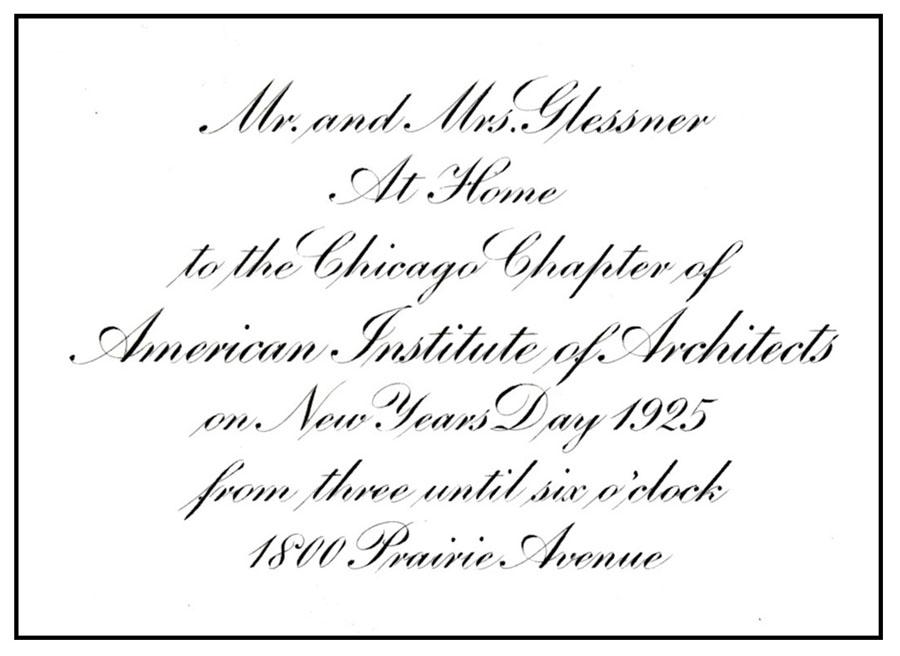
On January 1, 1925, to conclude the celebratory month, the Glessners hosted a reception for the members of the Chicago Chapter of the American Institute of Architects, assisted by the Chapter president, Alfred H. Granger. That day was also Frances Glessner’s 77th birthday.


Related Posts Plugin for WordPress, Blogger...