Showing posts with label William Rainey Harper. Show all posts

Tuesday, December 10, 2019

The Monday Morning Reading Class, Part III


During the year 1905, the Monday Morning Reading Class, which had been meeting for more than a decade, planned a very special gift to be presented to Frances Glessner on her 58th birthday, January 1, 1906.  A large leather-bound calendar, contained pages prepared by class members, friends, and family members, to be read daily throughout the year.  The book itself measured 12-1/2” x 17” and was four inches thick.  With its case, it was designed to fit exactly, when opened, on the library table in the second-floor hall.  The individual pages, one for each day of the year, were mounted two to a page, and measured 5” by 8”.  The calendar remains one of the most extraordinary items in the house collection.


Frances Glessner recalled the receipt of the calendar in her journal:

“January 1st I had several pretty gifts from embers of the family, flowers from friends, when a box came in beautifully done up, everything in the choicest and most attractive manner – box of green leather with gold letters monogram etc. a standard of the same, in all a very remarkable calendar prepared for me by members of the Reading class.  It is in four sections – each one has an original title page, one done by Mr. Gookin, one by Fred Bartlett, one by Herman von Holst, one by Mr. Scott – all exceedingly beautiful.”


Frances Glessner was deeply involved in the civic and social life of the city, so it is not surprising that many of the pages were contributed by names still recognized today – Daniel Burnham, Hermann V. von Holst, Frederic Clay Bartlett, Frederick Stock, Charles Hutchinson, Bryan and Helen Lathrop, Harold and Edith McCormick, Frank Lowden, and William Rainey Harper.  Friends from outside Chicago contributed as well, including Frederick Law Olmsted Jr., Isabella Stewart Gardner, and Julia Shepley (the daughter of H. H. Richardson).  The result is an assemblage of beautifully designed and executed pages that convey the profound respect in which Frances Glessner was held by all who knew her.


When the Reading Class met the following week, Frances Glessner asked her daughter-in-law, Alice, to read a thank you letter to the class which read in part:

“How could you think of it?  How could you accomplish it?  How did you know there were so many choice people in the world with big hearts, willing wits and loving thoughts?  How could anything so exquisite in every detail, so perfect in workmanship, so dainty so refined be put together?

“Fairies and elves could conceive nothing which would give me greater pleasure, more lasting delight than that tribute of your affection . . . The first thought each morning is what does the calendar bring today?  What old friend speaks, what dear face looks out, what poem, what song, what picture, what sacred association?

“Not all of the lovely women in the world are in this class, but there is not one here who is not lovely . . . my heart swells with pride to see a splendid room filled with charming matrons in becoming garb, no introductions needed, all friends, all clever, all intellectual, with high ideals.  This circle is something to be proud of, and I am proud of it and of every individual in it.

“I have one small confession to make.  I have peeped ahead a little in the calendar – only a little – members of my family interfered in the most officious manner and told me I was dishonorable.  Now I have come to a conclusion of my own.  What if I should die before I see it all?  So after today I fling honor to the breeze and establish a code of my own, I am going to peep.”

Reproductions of 104 pages were put on exhibit at Glessner House in early 2007.  Rick Kogan featured the calendar in an article entitled “Ghostly Writers: City Giants of Long Ago Send Messages Through Time at Glessner House” in his weekly Sidewalks column in the Chicago Tribune Magazine on February 18, 2007.  Below we present a few select pages from the calendar, it was most hard to choose, indeed!

January 12, 1906: William Rainey Harper
The first president of the University of Chicago, whose suggestion led to the formation of the Reading Class in 1894, was fluent in several ancient languages, and wrote his message in both English and cuneiform.


January 18: Helen Macbeth
The sister of Frances Glessner, Helen was a talented painter and created an artwork showing the Macbeth family home in Springfield, Ohio, where John and Frances Glessner were married on December 7, 1870.


February 23: Frederick Stock
Second conductor of the Chicago Symphony Orchestra.  Among the Glessners closest friends, a few years later he would dedicate his first symphony to them, much of it having been composed at their New Hampshire summer estate, The Rocks.


March 7: Charles L. Hutchinson
Hutchinson was the long-time president of the Art Institute of Chicago, and he and his wife Frances were frequent guests to the Glessner House.  For his page, he selected a print by the well-known English etcher and printmaker, Sir Francis Seymour Haden.


March 31: William G. Hibbard
Part of the large Hibbard clan which occupied several house on Prairie and Calumet Avenues, he provided a detailed landscape plan for his summer home in Winnetka, then under development.


April 25: Susan Follansbee Hibbard
Hibbard’s wife, a member of the Reading Class, had the architect of their summer home, A. Lincoln Fechheimer, based in Cincinnati, draw out the floor plan for Frances Glessner to study and enjoy.


July-September title page: Frederic Clay Bartlett
Bartlett designed the title page for the third section of the calendar.  Using his typical pre-Raphaelite style at the time, he depicted the Reading Class, its monthly lunches, and Frances Glessner’s interest in music and beekeeping.


October 11: Theodore Thomas memorial
The first conductor of the Chicago Symphony was among the Glessners closest friends and had died in January 1905.  The beautifully illustrated page was one of two commissioned by the orchestra for inclusion in the calendar.


November 4: Daniel H. Burnham
Architect Daniel Burnham and his wife Margaret both contributed pages.  Daniel Burnham’s page features a quote about the satisfaction of doing good work, a reflection of his interest in the Swedenborgian faith.


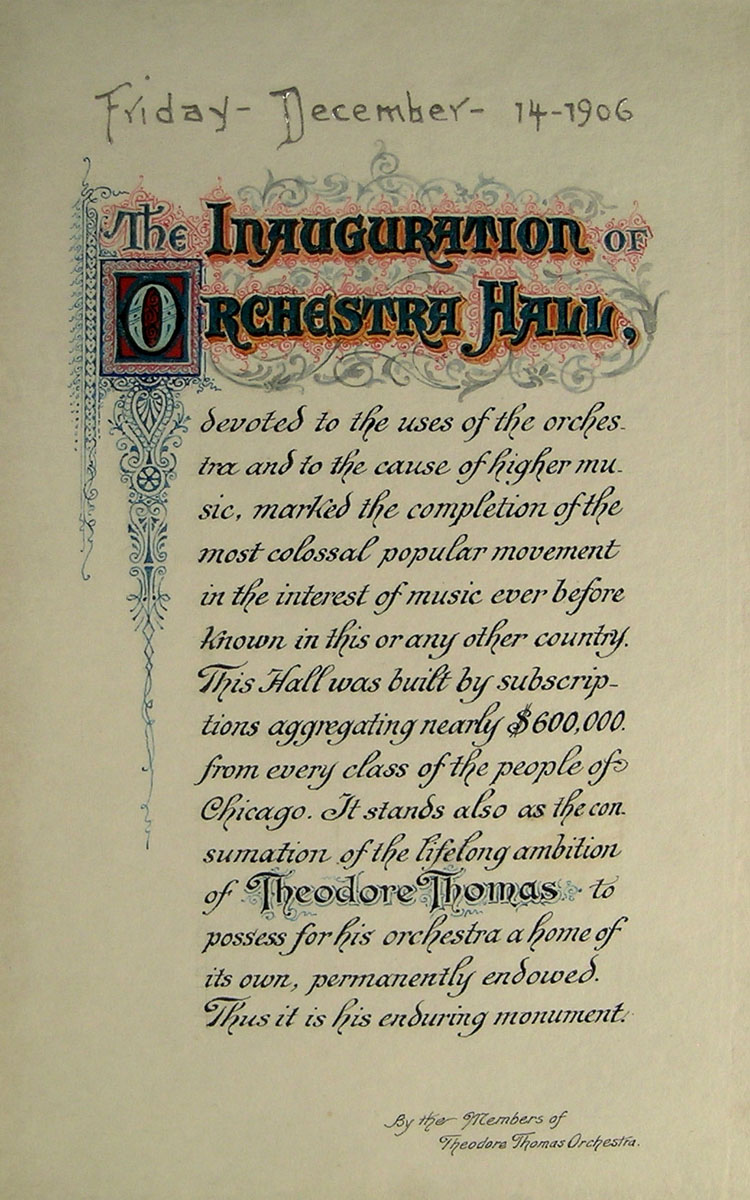
December 14: Inauguration of Orchestra Hall
The second of two pages contributed by the orchestra, this page commemorated the second anniversary of the opening of Orchestra Hall in December 1904.  The Glessners personally raised much of the funding to construct the hall.


Thursday, November 21, 2019

The Monday Morning Reading Class, Part I


Monday Morning Reading Class, May 5, 1902
(Photo by George Glessner)

Today marks the 125th anniversary of the first meeting of Frances Glessner’s Monday Morning Reading Class on November 21, 1894.  As her husband John noted in a tribute written shortly after her death in 1932, “Perhaps the Monday Morning Reading Class was her choicest activity and the one in which she took most pride and pleasure.”  In this first of several articles about the class, we will explore the origins of the class and how it was structured.

In his tribute, John Glessner noted that the idea for the class originated in an activity begun several years earlier, while the family was residing in their home at the northeast corner of Washington and Morgan:

Library of Washington Street house

“While living on Washington Street, Mrs. Glessner arranged a series of meetings of ladies in our library and parlors to listen to talks and readings about the latest books by scholars and experts, which were well attended and interesting and became the nucleus and forerunner of the Monday Morning Reading Class, so that that afterwards vigorous society had its origination and beginning then and there.”

Addie Hibbard Gregory, a member of the class for its entire 36 years of existence, recalled in her book, A Great-Grandmother Remembers, that Frances Glessner renewed the idea of her earlier meetings at the request of William Rainey Harper, first president of the newly formed University of Chicago:

“Early in the nineties, President Harper of the University of Chicago had asked Mrs. Glessner how the newly arrived wives and families of the university faculty could become acquainted with Chicago women, and we with them.  This class was Mrs. Glessner’s answer.  We were all grateful for the opportunity of meeting as soon as we did those delightful and clever women.”

John Glessner painted the picture of the University families arriving and his wife’s response in more colorful terms:

“When the University of Chicago was started and the staff drawn from all over the world with their families, all cultivated people but strangers to each other, found living conditions almost unbearable in crudely finished houses, with seas of mud in street and sidewalks, she made life more bearable by social attentions.”

In her journal entry for November 18, 1894, Frances Glessner wrote, “I have invited some of the young matrons on the south side to come here once a week for a reading class this winter.  The first reading is on Wednesday next – when they will lunch with me.”  The following week’s journal entry noted, “Wednesday my twenty-five ladies came for the reading aloud.  Miss Gaylord read to us.  We had Meneval’s Memoirs of Napoleon the first hour and The Memories of Dean Hole for the second hour.  Then we had our luncheon.”

Memoirs of the Baron de Meneval

Membership in the class was by invitation only - with two rules set in place.  One was that only married ladies would be invited, although a few exceptions were made through the years.  Secondly, and equally important, was the requirement that the ladies reside on the south side of the city.  In an informal history of the class written by John Glessner in 1925, he humorously noted:

“Membership was confined to the South Side – the mudsills of the North were frowned upon and taboo – only the South Side aristocracy of letters and beauty and gracious manners were drawn upon.  (Alas how the mighty haven fallen!  Our best people have been driven over the divide and we, the saving remnant, are merely permitted in tolerance to enter the sacred regions of north latitude beyond the river.)”

Members would have been residents of the south side at the time they were invited to join the class but were permitted to remain in the class if they later moved elsewhere, as many had by the 1920s.

Library at 1800 Prairie Avenue

The structure of the first class was set – the first hour would consist of more serious reading, usually of a historical nature, the second hour would feature lighter reading.  A paid professional reader would read selections from the books.  John Glessner, in his history of the class, noted “the labor the reader must give to find what to omit, what to explain, what to emphasize.  Every book has some dull pages and pages of indifferent interest that must be cut out to make for speed and to avoid tediosity.”   The selection of The Memories of Dean Hole also shows how current the book selections often were.  The book had just been published in 1894 by the Rev. Dr. Samuel Reynolds Hole, an English Anglican priest, horticulturalist, and leading expert on roses.  As Louise Goldsmith, another life-long member of the class noted, “he had visited Chicago the previous winter and we were all anxious to hear what he said about it.”

A few adjustments were made as well.  The first class was held on a Wednesday, but the class shifted to Monday the following week, and soon after the name “Monday Morning Reading Class” was adopted.  Invitations were extended to additional women, and the class quickly grew to fifty.  Additionally, it was soon determined that Miss Gaylord was not the ideal reader to lead the class.  Louise Goldsmith recounted:

“Miss Gaylord’s reading was very good; but she was young and could not have the broad knowledge and experience necessary for a full understanding of the erudite books she was proposed to read, so Mrs. Glessner looked about for someone who had the lighted torch of knowledge with which to illuminate the printed page revealing the thought of the writer in all of its clearness and strength.”

Miss Ann Trimingham

The new reader for the class, starting on December 17, was Miss Ann Trimingham, a former teacher at the West Side High School, and a sister of Louise Goldsmith.  She remained the reader until May 1902, “missing only one of the two hundred or more meetings.” 

Regarding the selection of the books, it was a democratic process from the start.  Louise Goldsmith recalled:

“Mrs. Glessner has always consulted the class with regard to the books, the one thing insisted upon by her and our reader was that they should be good literature worth spending time on.  Usually at the beginning of each year, a list of books has been presented to the class from which to select.  These books have been recommended by some outsider of known literary ability, by our own members, or by our reader.  A vote has then been taken and the choice of the majority has decided the question.”

The Glessner library (Photo by Chris Tyre)

Regarding the selection of the books, Addie Hibbard Gregory noted, “I, for one, am most grateful for glimpses into books which I should not have dared even to begin, in my busy life.”  She also recorded a delightful barb from New York, “We surely did not deserve the comment (or inuendo) of the eastern society journal which stated that it was ‘glad that Chicago women were learning to read, for Mrs. J. J. Glessner has organized a class for that purpose.’”

On the first Monday of each month, the class was followed by a luncheon, which frequently included musical entertainment.  A typical menu, recorded in 1895, featured sandwiches, baking powder biscuits buttered, sweetbread patties, coffee, hot chocolate, ice cream, and cake.”  The ladies would sit at tables of six, set up in the parlor and dining room.  Frances Glessner purchased a special set of luncheon china in a delicate blue and white pattern, which was reserved for the use of the monthly class luncheons.  (The maker of the hard paste porcelain with transferware decoration is unknown, as the pieces are unmarked).

Reading Class china

The first season of the class concluded on May 13, 1895, shortly before Frances Glessner left Chicago for her summer estate, The Rocks, in New Hampshire.  She recorded in her journal:

“Monday, the Reading Class came to luncheon.  Each lady came walking in carrying a bunch of large long-stemmed American Beauty roses for me.  There were thirty ladies – and it was a lovely sight to see them coming in processions of six or eight carrying these roses.  Frederick and John (butler and footman) arranged them in large vases in the dining room – all on the table, sideboard and side table.  It was very beautiful to look at and certainly a lovely attention to me.  We read our Fyffe for an hour and then Miss Trimingham read her last Fortnightly paper to us – on Sydney Smith and his friends.  After that we had luncheon, then a little music, then goodbye for the summer.”

(Fyffe is a reference to Volume I of The History of Modern Europe by Charles Alan Fyffe, which by the third class had replaced Meneval’s Memoirs of Napoleon, as class members had found it to be “rather dry.”  Sydney Smith (1771-1845) was an English humorist, writer, and Anglican cleric).

Related Posts Plugin for WordPress, Blogger...