

During the last two decades of the 19th century, Charles H. Smiley secured a position as one of Chicago’s most prosperous and successful African-American businessmen. Born into humble beginnings, he built a business which served Chicago’s wealthiest families, earning him their patronage and deep respect. In this article, we will explore his origins, how he built his business, and his commitment to providing business and educational opportunities for members of Chicago’s growing African-American community.
Origins
Charles H. Smiley was born on October 5, 1850, in St. Catharines, Ontario, Canada to freedom seekers who had escaped the bonds of slavery in Virginia. St. Catharines, located immediately west of Niagara Falls on the south shore of Lake Ontario, was the final terminus on the Niagara Freedom Trail of the Underground Railroad for hundreds of former slaves from the 1820s through the American Civil War.
In 1850, the year of Smiley’s birth, the United States passed the Fugitive Slave Act, which permitted escaped slaves living in the northern states to be apprehended and returned to their owners. This led to a huge exodus of freedom seekers into various parts of Canada. By the mid-1850s, the population of St. Catharines had grown to 6,000 of which more than 800 were of African descendent.
Harriet Tubman, one of the most important Underground Railroad conductors and abolitionists, made St. Catharines her home throughout the 1850s, making numerous trips back into the United States at significant personal risk, to help additional freedom seekers make the final leg of their journey into Canada. The center of abolitionist activity for Tubman and others was the Bethel Chapel, associated with the African Methodist Episcopal Church. In 1855, a larger chapel was built which stands today as Salem Chapel. Two plaques on its exterior denote its designation as a national historic site, and for its connection with Harriet Tubman, designated a national historic person.
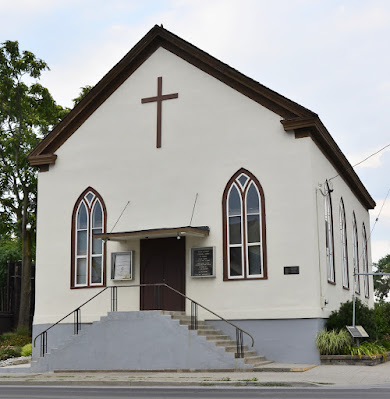
Young Charles would have been keenly aware of the arrival of the freedom seekers, following in the steps his parents had taken years earlier. It is quite likely that his family attended services at the chapel, as Smiley’s funeral decades later in Chicago took place at an African Methodist Episcopal Church.
Philadelphia
Few educational opportunities were available to Charles and at an early age he engaged in hard manual labor for minimal pay. He turned 15 just months after the end of the Civil War, and his family, hoping to find better opportunities back in the United States, settled in Philadelphia. Smiley took whatever jobs he could find, ranging from driver to janitor, and in his extra time served as a waiter at dinners and parties. Many years later, his friend Booker T. Washington said of him, “he had a resolute character, good powers of observation, ambition, and brains.” With those traits in hand, Smiley quickly saw the potential in the catering business.
In 1899, the civil rights activist W. E. B. Du Bois wrote:
“To the more pushing and energetic Negroes only two courses were open: to enter into commercial life in some small way, or to develop certain lines of home service into a more independent and lucrative employment. In this latter way was the most striking advance made; the whole catering business, arising from an evolution shrewdly, persistently and tastefully directed, transformed the Negro cook and waiter into the public caterer and restaurateur, and raised a crowd of underpaid menials to become a set of self-reliant, original business men, who amassed fortunes for themselves and won general respect for their people.”
John S. Trower, Philadelphia’s most successful African-American caterer and a life-long friend of Smiley, echoed this sentiment during an address at the National Negro Business League, held at Chicago in 1901:
“Catering was all ours. We were America’s acknowledged cooks, butlers, waiters, and caterers. But a few years ago, white men were unknown in many of these kinds of work. Colored men once controlled this work in Baltimore, Washington, Philadelphia, Boston, New York, Chicago and the great Northern cities. As a result of this control, the wealthiest colored citizens were caterers.”
The 1880 census, taken just as Smiley turned 30 years of age, shows him engaged in the catering business, with a wife and two sons – John Hockley age 6 and William S. age 4. The next year, he left Philadelphia and moved to Chicago, where he felt the rapidly growing city and burgeoning wealthy class provided even more opportunities for an energetic and ambitious businessman to make his fortune.
Chicago
By 1881, Prairie Avenue had established itself as Chicago’s most exclusive residential street with dozens of mansions standing in the six blocks between 16th and 22nd streets. Smiley set up his new catering business nearby, first on Indiana Avenue and then on 22nd Street (now Cermak Road) near Michigan Avenue, less than two blocks west of Prairie Avenue. Within a few years he moved to larger facilities literally at the back door of a Prairie Avenue mansion.
Like most businessmen, he had his ups and downs in his early years. At the time of his death, his longtime friend, Judge Jesse A. Baldwin, wrote:
“I knew him for many years and he was one of the squarest men I ever knew. A good many years ago, while I was practicing law, he came to me and told me that he was tied up financially and that he would have to come to some understanding with his creditors. He gave me a list of his creditors, with the amount he owed each one, and he gave me an account of his assets. He asked me to make the transfer. He came in a few days later, after I had seen his creditors, feeling downcast.
“Charlie, your creditors feel sorry for you and I can settle with them for 50 cents on the dollar. With tears rolling down his face he said: ‘I couldn’t do that, Mr. Jesse. My mother borns me poor, but she borns me honest. Pay them every cent. I don’t care if there ain’t any left.’ I never had a client yet who was more insistent on being honest.”

In 1907, Booker T. Washington published The Negro in Business, discussing the advances many African-Americans had made in the business world since the end of the Civil War. His good friend Charles Smiley is the only Chicagoan included in the book, represented by a portrait, a picture of his handsome business block, and a brief summary of his business life. From this we learn why Smiley found such success in his new city:
“Mr. Smiley’s success seems to have been due, in great part, to the enterprise he displayed in meeting every new want that manifested itself in connection with his business. As caterer for a wedding, he did not merely provide the wedding cake but was ready, if required, to furnish appropriate floral decorations, canopies, calcium lights, pillows, ribbons and kneeling altars, - even ushers. He advertised that he was willing to deliver invitations, to guard wedding presents with male and female detectives, in fact to take entire charge of the social function at which his services were required.”
By expanding his business, Smiley was also providing more opportunities to help others in his community as noted by Washington who went on to say:
“Mr. Smiley is said to give employment to more colored men than any other man of his race in the West. He uses sixteen horses for his delivery wagons.”
He became a citizen of the United States in 1886, the newspapers noting that he was the first African-American to be naturalized in Chicago.
His impeccable reputation and reliability earned him the business of many of Chicago’s leading families. Journalists, reporting on the elaborate parties he catered, soon realized that adding “Smiley served” to their newspaper column was as important as listing the guests in attendance.

The Glessners
John and Frances Glessner utilized Smiley’s services for many years, as noted in his 1911 obituary:
“Smiley served the family of J. J. Glessner, 1800 Prairie avenue, more than three decades. He used to tell the story of one of his first affairs, when he was located at Indiana avenue and Twenty-fourth street. The entertainment took place on a stormy winter night. The caterer was forced to hire a hansom to take his small outfit to the Glessner residence. The outfit was so meager that it contained only one coffee boiler. Years after, at one of his correspondingly big entertainments, he chartered a special train to carry his help and his supplies to the scene of a great wedding.”
The first time Smiley is mentioned in Frances Glessner’s journal is in January 1888, less than two months after the family had moved into their new Prairie Avenue home. They hosted an evening musicale to which 35 guests had been invited.
“After the music we had supper served in the hall and dining room – hot oysters, salad, coffee, sandwiches, cake and ice cream. Charles Smiley served the supper. We have had the very pleasantest things said about the evening.”
In November 1891, a period in which Frances Glessner went through several cooks in quick succession, she noted “I had Annie Smiley come in to cook our dinner,” a reference to Smiley’s wife and partner in the business.
Most significantly, the journal entry for the wedding of the Glessners’ daughter Frances to Blewett Lee at the house in February 1898, notes that the cook Mattie Williamson baked the wedding cakes, but they “were taken away to be iced by Smiley.”
Prominence grows

In 1893, Smiley constructed an elegant three-story stone front building to house his growing business, along with a large dining room and ballroom that could be rented out. The building stood at 76 22nd St. (later 220 E. 22nd Street), immediately west of the mansion of Northern Trust founder and president Byron Laflin Smith at 2140 S. Prairie Avenue. The new building also served as his residence, and his unique position within Chicago’s society is noted by the fact that the census shows he and his family to be the only African-Americans living in the area.

The Smith house at 2140 S. Prairie Avenue. The silhouette of Smiley's building can be seen at far left.
Provident Hospital
In 1891, Provident Hospital was organized as the first African-American owned and operated hospital in the United States. The hospital was open to everyone, regardless of race, and patients were only asked to pay what they could afford. Smiley was among the group of successful Chicago businessmen, both black and white, that supported the effort from its inception. The hospital achieved prominence in 1893, when its surgeon, Dr. Daniel Hale Williams, performed the first successful heart surgery. He operated on a stabbing victim, using a new type of suture to sew up the heart, which resulted in a complete recovery for the patient. It was the first private hospital in Illinois to provide internship opportunities for black physicians, the first to establish a school of nursing to train black women, and the first black hospital to be approved by the American College of Surgeons for full graduate training in surgery.
In 1895, the Chicago newspapers announced that Charles and Anna Smiley were to host a charity ball at their facility to benefit the hospital, which had quickly outgrown its original building at 29th and Dearborn streets. Over 300 guests attended, many from Chicago but a good number from other parts of the country as well. Plans had already been drawn up for a larger three-story stone and brick building at 36th and Dearborn streets, and the ball was to aid in the fundraising efforts for that project.

The new Provident Hospital
The newspaper accounts of the ball, held on July 3, read like any other society event, except for the headline which noted “Ball in Behalf of Charity – Colored People Dance for Benefit of Provident Hospital.” Smiley’s new building was “lavishly decorated with ferns, palms and smilax” and music was provided by Johnny Hand’s Orchestra for dancing and by Tomaso’s mandolin orchestra during supper. Anna Smiley “wore a handsome gown of black grenadine with white point lace trimmings” and carried lavender sweet peas, and her married daughter wore “a delicate pink silk gown, with Dresden ribbon and wide lace bertha.” Supper, served at elaborately decorated tables in the first floor dining room, was followed by dancing on all three floors “until the small, wee hours of the glorious Fourth had set in.”

Later years
Smiley became active in the National Negro Business League, founded by Booker T. Washington in 1900, and financed by philanthropist Andrew Carnegie. The goal of the organization was “to promote the commercial and financial development of the Negro” and was “composed of Negro men and women who have achieved success along business lines.” Smiley was a leader in the Chicago chapter and attended the annual conventions, held in various cities across the country.
He retired from active business in 1906, at which time Francis Angela established the catering firm of Angela & Co. in Smiley’s building, although Smiley still held considerable stock in the new corporation. He moved into a rented house across the street at 229 E. 22nd Street, directly behind the stately home at 2200 S. Prairie Avenue built for Dr. Edwin M. Hale, a leading homeopathic physician in Chicago.

Dr. Hale's house at 2200 S. Prairie Avenue. Smiley's house at 229 E. 22nd Street is shown at far right, with the steeply pitched front-facing gable.
Family
In spite of considerable business success, Smiley’s personal life encountered difficulties in the first decade of the 1900s. He and his wife Anna divorced in 1903, and a few years later he found himself estranged from his two sons, although his son’s ex-wife is listed as living with Smiley in the 1910 census, along with her new husband, a most unusual living arrangement!
Anna later married A. T. Ponder and opened her own catering operation at 2111 S. Indiana Avenue. Son John Hockley Smiley was a well-known reporter and, in 1910, became the first paid staffer hired by John S. Abbott for the Chicago Defender, serving as managing editor until his death in 1915.
Death

Charles Smiley died on March 25, 1911, at the age of 60 in his 22nd Street home. Headlines included “Caterer to Society is Dead,” “C. H. Smiley, Who Served Chicago’s Best Families, Succumbs,” and “Society Grieves for Smiley.”
A lengthy article in the Chicago Tribune, published on March 28, noted in part:
“The home of a negro . . . was the vortex into which all day yesterday Chicagoans of prominence poured a flood of condolences. The occupant of that residence was Charles H. Smiley. He is dead now, and society, in telegrams, letters, and personal calls, is paying tribute to his memory. Smiley was society’s favorite caterer.
“Tomorrow Smiley will be given a funeral such as will delight the old negro’s spirit if he can see it. There will be flowers there from the city’s ‘oldest families” and its ‘best people.’ Many a social climber would give his ears to attain the social recognition that Caterer Smiley will achieve at his obsequies. The service will take place at the African Methodist church and the interment will be at Oakwoods cemetery.
“He had courtesy, dignity, and efficiency. And with all this he had that indefinable ‘air’ which gives to the good negro servant a distinction that is the joy of the man who knows and appreciates superlative living.
“He had the reputation of being one of the best caterers in the United States. He served at most of the big functions in Chicago society for many years. He directed the entertainment of presidents and princes. He was personally acquainted with almost all the large Chicago entertainers. For nearly thirty years he stood at the top of the list of Chicago caterers.
“A few of the people who hired Smiley for years are John J. Herrick, Byron L. Smith, J. J. Glessner, Judge Jesse A. Baldwin, Dr. Robert H. Babcock, Harry M. Higinbotham, Mrs. Charles W. Brega, Carter H. Harrison, Mrs. A. B. Dick, Mrs. Nelson Morris, Mrs. Edson Keith, Edward Morris, Mrs. P. D. Armour, F. W. Peck, Paul Morton, and many others.”

Smiley's neighborhood as it appeared in 1911. The red star marks the location of his business at 220 E. 22nd St. The blue star marks the house at 229 E. 22nd St. where he died.
University of Chicago
Smiley’s will was published in the Chicago Defender the next month, the newspaper noting it was the first time the entire will of any Chicago citizen was ever published in a “race paper.” His estate was estimated at $11,000 (the equivalent of $325,000 today).
Notable is the fact that the two sons are not mentioned, and that a sizable portion of the estate was given to Smiley’s ex-daughter-in-law. The most significant bequest was to the University of Chicago with the following stipulation:
“I direct that my said Executor and Trustee shall pay to the University of Chicago, the sum of Three Thousand Dollars ($3,000), as and for Endowment, creating a scholarship, to be known as the “Charles H. Smiley Scholarship,” which shall be administered by the Board of Trustees of said University, as they may from time to time decide wise, hereby expressing the preference that the proceeds of such scholarship shall be used for the benefit of poor but promising students, preferably of the colored race, though not at all intending this as any limitation upon their right to use the same as they see fit. I am making this bequest because of my limited opportunity to acquire an education, and my desire to aid others in acquiring an education.”
The bequest was received in June 1912. To close this article, we quote from an article published by the University in 1919:
“About $150 a year has
been awarded to poor but promising students of the colored race as often as
such students have made application. And thus, this humble black man has made
his life a fountain of perennial blessing to his race and to the world.”


