Showing posts with label Frederick Stock. Show all posts

Tuesday, December 1, 2020

A Toast to the Glessners - Christmas 1924


Framed Deed of Gift, December 1, 1924

Today, December 1, 2020, marks the 96th anniversary of the Glessners deeding their beloved Prairie Avenue home to the Chicago Chapter of the American Institute of Architects (CCAIA), to ensure its preservation. A beautiful toast noting that act of generosity, written and delivered by architect Hermann V. von Holst at the Glessners’ Christmas dinner later that month, was recently acquired for the house collection. Clearly, it was a celebratory month for the Glessners as their friends and the architectural community thanked them for their magnificent gift. In this article, we will reconstruct the month of December 1924, ending with von Holst’s touching tribute to his long-time friends.

THE HOUSE IS GIFTED TO THE CCAIA
During the 1910s and early 1920s, the Glessners witnessed the enormous change that was happening all around them, as families left Prairie Avenue and their homes were demolished or converted into boarding houses or business offices. In 1922, Richardson’s only other house in Chicago, built for Franklin and Emily MacVeagh at 1400 North Lake Shore Drive, was razed and replaced with a high-rise apartment house.

The Deed of Gift between the Glessners and the CCAIA, signed on December 1, 1924, represented the best way to ensure the preservation of their house, and its continued use by the architectural community that understood its significance. The Deed was specific – Richardson’s portrait must always remain on the wall, and his monogram on the façade must never be altered – but the use of the house would change dramatically. This was no house museum – the building was to be repurposed for the uses of the CCAIA to include offices, meeting rooms, gallery space, and an atelier.


Chicago Tribune, December 3, 1924

The announcement of the gift was published in the Chicago newspapers, and within weeks newspapers from across the country covered the story, a clear indication of how important the house was considered even at that time. Among the many notes of appreciation the Glessners received was one from Julia “Lula” Shepley, daughter of Henry Hobson Richardson and the wife of George Shepley, one of the three men, who, following Richardson’s death in 1886, reorganized his office as Shepley, Rutan and Coolidge.


Page 1 of Lula Richardson Shepley's letter to Frances Glessner

HERMANN V. VON HOLST
An important member of Chicago’s architectural community in 1924 was Hermann V. von Holst, and he was among the Glessners’ closest friends. (Read this 2012 blog article for more information on his life and career). Hermann, just 18 years old when he arrived in the U.S. in 1892, accompanied his father, Dr. Hermann E. von Holst, who had accepted an appointment at the new University of Chicago. The Glessners quickly formed a friendship with the von Holst family, which also included Hermann’s mother and sister. Dr. von Holst was forced to retire in 1900 due to ill health. He returned to Germany with his wife and daughter and died in 1904.


Hermann V. von Holst (from 1924 passport application)

Son Hermann, who by this point was chief draftsman in the Chicago office of Shepley, Rutan and Coolidge, stayed behind and was quickly “adopted” by the Glessners. He starts showing up regularly in Frances Glessner’s journal, attending Sunday suppers or joining them at the symphony. For the first Christmas apart from his family, Hermann was invited to trim the Glessners’ tree on Christmas Eve, and he stayed the night, so that he could “see the fun in the morning.” In a letter from Hermann’s mother to Frances Glessner, dated February 1, 1901, she noted:

“Yes, he is lonely and we, too, miss him greatly. In almost every letter, indeed in every one now, he speaks of your kindness to him and of the enjoyment he receives from his visits with you. It was so very kind of you to have him with you just at Christmas time, for a Christmas spent alone is about the most doleful thing imaginable.”

The Glessners greatly enjoyed surrounding themselves with architects, artists, authors, and musicians, so the friendship is no surprise. But in the case of Hermann, it may well have had added significance. Hermann was born in 1874, the same year as the Glessners’ son, John Francis, who had died at the age of just eight months. In a meaningful way, the young and talented architect may have been a surrogate for the lost son, especially in those first years after George and Frances had both married and were preparing for the holiday in their own homes. (In 1902, on the anniversary of the birth of the infant son, Frances Glessner noted in her journal that he would have been 28 years old had he lived, so his memory always remained with her).

Hermann traveled to Germany to help care for his ailing father in April 1901, remaining for three years, but upon returning to Chicago, he was welcomed again to share in the Glessners’ Christmas festivities, as noted in his reply to Frances Glessner’s invitation for Christmas Day 1904:

“To begin and to close Christmas Day at Mr. and Mrs. Glessners’ – nothing finer could Mr. von Holst wish, and, as the best wishes are so seldom realized, he looks forward with pleasure to the fulfillment of this one: to Breakfast at 8, to Supper at 7.”

His Christmas card from 1909 contains a short but heartfelt greeting:

“To Mrs. Glessner – a Merry Christmas. I know of no truer heart or better friend. Hermann”

It appears Hermann was present every Christmas for decades, even after his marriage to Lucy Hammond in 1911. Soon after, Hermann published Modern American Homes, and one of the first copies was presented to Frances Glessner for Christmas in 1912, with the following, thoughtful inscription:

“To Mrs. Glessner – Your ideals and ideas for the American Home have ever been an inspiration, to seek and strive for beauty along simple straightforward lines.”


Dining room, 1923

CHRISTMAS 1924

Frances Glessner’s journal stops in 1917, but various other documents left behind help us to reconstruct what Christmas would have been like in 1924. The guest list shows that seventeen people joined the Glessners for dinner. 

Frederick and Elizabeth Stock – Music director of the symphony since 1905. On his photo above, which he presented to the Glessners for Christmas in 1907, he notes that they are his “best friends.”


(From left) Frederick Wessels, Henry Voegeli, Eric DeLamarter

Frederick and Minnie Wessels – The orchestra’s business manager, and treasurer of the Orchestral Association, of which John Glessner was a trustee. 

Henry and Frances Voegeli – The orchestra’s assistant business manager, and assistant treasurer of the Orchestral Association. He took over as business manager upon Wessel’s retirement in 1927.

Eric DeLamarter – Assistant conductor of the symphony since October 1918.

Enrico and Juliette Tramonti – They came to Chicago in 1902 when he accepted the position of principal harpist with the symphony; he continued in that position until 1927.


William Bernhard with "Jerry" (Ephraim Historical Foundation)

William and Svea Bernhard – A Chicago architect who later designed the summer home for the Stocks in Ephraim, Wisconsin.


Lucy von Holst (from 1924 passport application)

Hermann and Lucy von Holst – Records indicate that Lucy von Holst, Juliette Tramonti, and Svea Bernhard were regularly asked to decorate the Glessners’ Christmas tree. All would have been about the age of the Glessners’ children.

Nathalie Sieboth Kennedy – Reader for Frances Glessner’s Monday Morning Reading Class from 1902 until it was disbanded in 1930. During the 1890s and early 1900s, she was co-principal of the Sieboth-Kennedy School for Girls with her sister Marie (Sieboth) Gookin. It was considered one of Chicago’s finest finishing schools, the graduates “marrying well and early.”

Nathalie Gookin – Mrs. Kennedy’s niece, and the daughter of Frederick and Marie Gookin. Frederick was a close friend of John Glessner, and the long-time curator of Japanese prints and drawings at the Art Institute of Chicago.

Alfred and Vera Wolfe – Vera was the only child of Frederick and Elizabeth Stock. This was the couple’s first Christmas as husband and wife, having been married at Fourth Presbyterian Church in April 1924.

In addition to the guest list, we also have Frances Glessners’ seating chart. Frederick Stock occupied the place of honor to her right; Eric DeLamarter sat to her left. The two youngest female guests, Nathalie Gookin and Vera Wolfe, sat to either side of John Glessner.

The menu was not as elaborate as it would have been in the late 1800s, this time including just four courses (as opposed to eight).

First course
Soup, served with crackers, olives, and celery. Crackers would have been baked by the cook (no saltines here), and celery was still quite popular, with special dishes designed to hold the crudité. 

Second course
Turkey, sausage, cranberries, jelly, sweet potatoes, corn, beans, and radishes. The sausage was most likely from Deerfoot Farms, the finest and most expensive sausages at the time; it is frequently identified by name on other dinner menus. Jelly referred to a gelatin dish, i.e. a “Jello mold,” all the rage at the time. 

Third course
Tomato and lettuce salad, with cheese balls and crackers. Menus consistently show that salad was always served after the entrée. 

Fourth course
Plum pudding, ice cream, cake, candy, fruit, nuts, and raisins. Plum pudding was a standard on the Glessners’ Christmas table, and ice cream was served at almost all dinner parties. 

Beverages
This being Prohibition, no alcohol was served. During dinner, guests consumed cider and White Rock, the most popular mineral water of its day. Coffee was served with dessert.

HERMANN’S TOAST
The toast read by Hermann at dinner is significant in that it combines a bit of history of his relationship with the Glessners, how meaningful the years of friendship were to him, and a first-hand account of how the Glessners’ “spirit” impacted all those around them. 

He begins the toast by noting that in 1896, he received his first independent commission as an architect from the Glessners – a bronze tablet commemorating their horse Jim, who had died earlier that year at The Rocks, where he was buried beneath a huge boulder.


Jim's memorial plaque, 2013

The remainder of the toast makes note of the Glessners’ gift of their Prairie Avenue home and how that act embodied and reflected their generous spirit. The toast reads:

“A few weeks ago, the Chicago papers announced that this home was presented in perpetuity to the (Chicago) Chapter of the American Institute of Architects. The same spirit that remembered the faithful horse with a bronze table dedicated this beautiful structure to posterity, a gift which will have untold influence for good on generations of followers of the art of building. 

“The young draughtsman of 1896 has been under the influence of this spirit for 28 years and knows what it has done for him.

“You assembled here know too what a wonderful enlightening factor it has been in your lives. It is a spirit for good and it will outlast this glorious, lovable building. It is the spirit of Christmas that lasts 365 days in the year. Mrs. Glessner and Mr. Glessner are the embodiment of this spirit. They have given the inert materials composing this structure a mighty soul.

“Let us rise and wish them in unison A MERRY CHRISTMAS.”


And with those carefully chosen words, Hermann V. von Holst preserved the special spirit of this house and its occupants for all of us to appreciate nearly a century later, when the true spirit of Christmas is needed more than ever.


POSTSCRIPT
After dinner, the party traveled down to Orchestra Hall, where Stock led one of his “popular concerts” consisting of lighter works, with tickets priced from 15 to 50 cents, making the concerts available to a wide audience. 

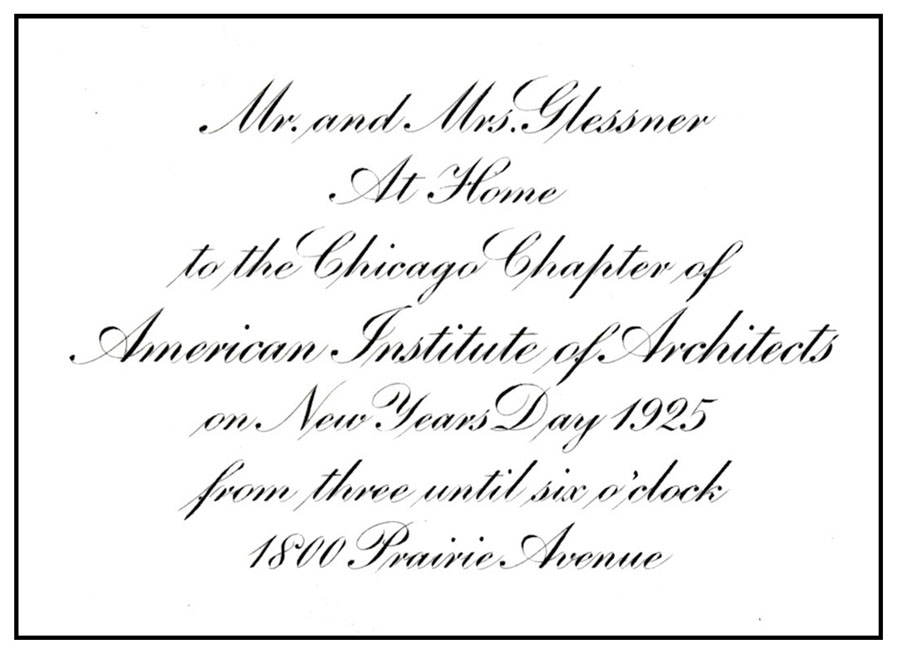
On January 1, 1925, to conclude the celebratory month, the Glessners hosted a reception for the members of the Chicago Chapter of the American Institute of Architects, assisted by the Chapter president, Alfred H. Granger. That day was also Frances Glessner’s 77th birthday.


Tuesday, December 10, 2019

The Monday Morning Reading Class, Part III


During the year 1905, the Monday Morning Reading Class, which had been meeting for more than a decade, planned a very special gift to be presented to Frances Glessner on her 58th birthday, January 1, 1906.  A large leather-bound calendar, contained pages prepared by class members, friends, and family members, to be read daily throughout the year.  The book itself measured 12-1/2” x 17” and was four inches thick.  With its case, it was designed to fit exactly, when opened, on the library table in the second-floor hall.  The individual pages, one for each day of the year, were mounted two to a page, and measured 5” by 8”.  The calendar remains one of the most extraordinary items in the house collection.


Frances Glessner recalled the receipt of the calendar in her journal:

“January 1st I had several pretty gifts from embers of the family, flowers from friends, when a box came in beautifully done up, everything in the choicest and most attractive manner – box of green leather with gold letters monogram etc. a standard of the same, in all a very remarkable calendar prepared for me by members of the Reading class.  It is in four sections – each one has an original title page, one done by Mr. Gookin, one by Fred Bartlett, one by Herman von Holst, one by Mr. Scott – all exceedingly beautiful.”


Frances Glessner was deeply involved in the civic and social life of the city, so it is not surprising that many of the pages were contributed by names still recognized today – Daniel Burnham, Hermann V. von Holst, Frederic Clay Bartlett, Frederick Stock, Charles Hutchinson, Bryan and Helen Lathrop, Harold and Edith McCormick, Frank Lowden, and William Rainey Harper.  Friends from outside Chicago contributed as well, including Frederick Law Olmsted Jr., Isabella Stewart Gardner, and Julia Shepley (the daughter of H. H. Richardson).  The result is an assemblage of beautifully designed and executed pages that convey the profound respect in which Frances Glessner was held by all who knew her.


When the Reading Class met the following week, Frances Glessner asked her daughter-in-law, Alice, to read a thank you letter to the class which read in part:

“How could you think of it?  How could you accomplish it?  How did you know there were so many choice people in the world with big hearts, willing wits and loving thoughts?  How could anything so exquisite in every detail, so perfect in workmanship, so dainty so refined be put together?

“Fairies and elves could conceive nothing which would give me greater pleasure, more lasting delight than that tribute of your affection . . . The first thought each morning is what does the calendar bring today?  What old friend speaks, what dear face looks out, what poem, what song, what picture, what sacred association?

“Not all of the lovely women in the world are in this class, but there is not one here who is not lovely . . . my heart swells with pride to see a splendid room filled with charming matrons in becoming garb, no introductions needed, all friends, all clever, all intellectual, with high ideals.  This circle is something to be proud of, and I am proud of it and of every individual in it.

“I have one small confession to make.  I have peeped ahead a little in the calendar – only a little – members of my family interfered in the most officious manner and told me I was dishonorable.  Now I have come to a conclusion of my own.  What if I should die before I see it all?  So after today I fling honor to the breeze and establish a code of my own, I am going to peep.”

Reproductions of 104 pages were put on exhibit at Glessner House in early 2007.  Rick Kogan featured the calendar in an article entitled “Ghostly Writers: City Giants of Long Ago Send Messages Through Time at Glessner House” in his weekly Sidewalks column in the Chicago Tribune Magazine on February 18, 2007.  Below we present a few select pages from the calendar, it was most hard to choose, indeed!

January 12, 1906: William Rainey Harper
The first president of the University of Chicago, whose suggestion led to the formation of the Reading Class in 1894, was fluent in several ancient languages, and wrote his message in both English and cuneiform.


January 18: Helen Macbeth
The sister of Frances Glessner, Helen was a talented painter and created an artwork showing the Macbeth family home in Springfield, Ohio, where John and Frances Glessner were married on December 7, 1870.


February 23: Frederick Stock
Second conductor of the Chicago Symphony Orchestra.  Among the Glessners closest friends, a few years later he would dedicate his first symphony to them, much of it having been composed at their New Hampshire summer estate, The Rocks.


March 7: Charles L. Hutchinson
Hutchinson was the long-time president of the Art Institute of Chicago, and he and his wife Frances were frequent guests to the Glessner House.  For his page, he selected a print by the well-known English etcher and printmaker, Sir Francis Seymour Haden.


March 31: William G. Hibbard
Part of the large Hibbard clan which occupied several house on Prairie and Calumet Avenues, he provided a detailed landscape plan for his summer home in Winnetka, then under development.


April 25: Susan Follansbee Hibbard
Hibbard’s wife, a member of the Reading Class, had the architect of their summer home, A. Lincoln Fechheimer, based in Cincinnati, draw out the floor plan for Frances Glessner to study and enjoy.


July-September title page: Frederic Clay Bartlett
Bartlett designed the title page for the third section of the calendar.  Using his typical pre-Raphaelite style at the time, he depicted the Reading Class, its monthly lunches, and Frances Glessner’s interest in music and beekeeping.


October 11: Theodore Thomas memorial
The first conductor of the Chicago Symphony was among the Glessners closest friends and had died in January 1905.  The beautifully illustrated page was one of two commissioned by the orchestra for inclusion in the calendar.


November 4: Daniel H. Burnham
Architect Daniel Burnham and his wife Margaret both contributed pages.  Daniel Burnham’s page features a quote about the satisfaction of doing good work, a reflection of his interest in the Swedenborgian faith.


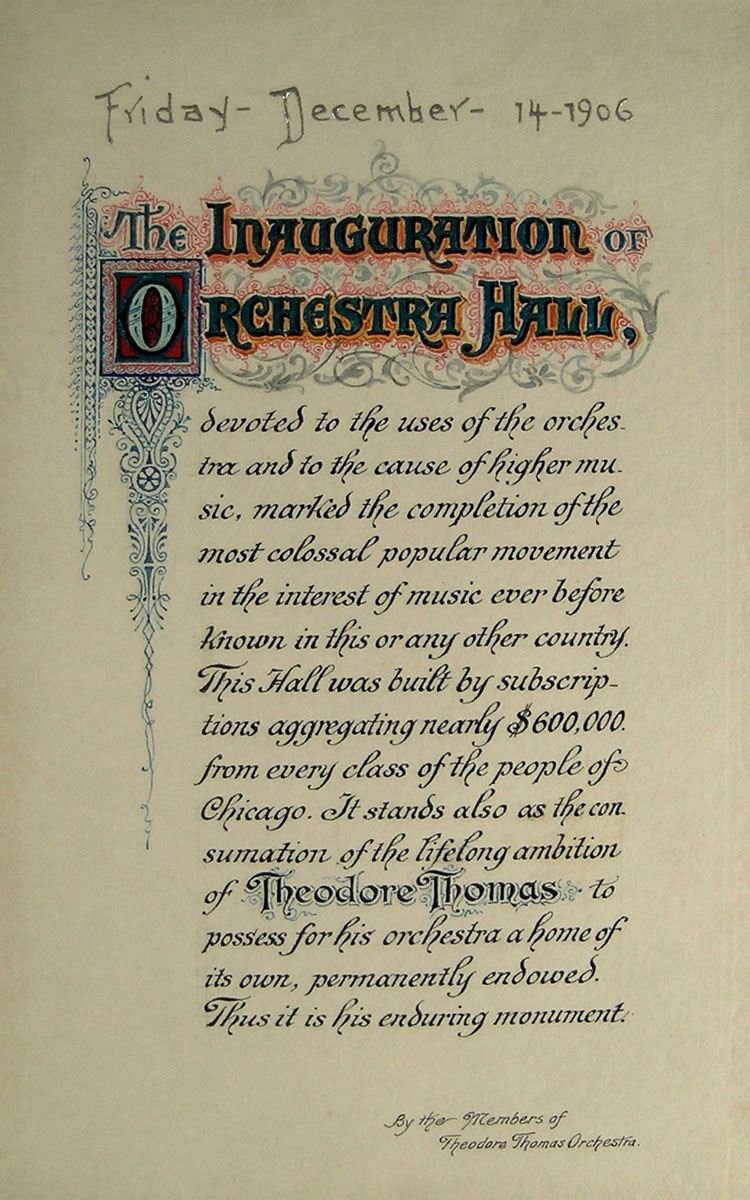
December 14: Inauguration of Orchestra Hall
The second of two pages contributed by the orchestra, this page commemorated the second anniversary of the opening of Orchestra Hall in December 1904.  The Glessners personally raised much of the funding to construct the hall.


Monday, January 18, 2016

John J. Glessner and the CSO


On January 21, 1936, the Chicago Tribune reported the death of two men well known in their circles – King George V of England and John Jacob Glessner.  Glessner had died the previous day in his beloved Prairie Avenue home just six days before his 93rd birthday.   In the weeks that followed, tributes were written and published by a number of organizations in which he was prominently involved, including International Harvester which he had helped to found in 1902, and Rush Medical College, where he served as president emeritus. 

One of the most heartfelt tributes came from the Chicago Symphony Orchestra which had been at the center of John Glessner’s life for 45 years.   The full-page tribute was written by Charles H. Hamill, president of The Orchestral Association, and placed opposite the program page for the concerts of January 23 and 24, 1936.  In remembrance of the 80th anniversary of John Glessner’s passing, we reprint Hamill’s beautiful tribute in its entirety.

John J. Glessner

On the 20th of January, 1936, came the end of the long and useful life of John J. Glessner.  To no one man has The Orchestral Association been more beholden.  He was one of the small group of men who in the Association’s first years of struggle were loyal in their support and generous in their gifts.  The depression following 1893 made the early years a time of great difficulty for both the Association and its friends, but Mr. Glessner never flinched.  During those years before Orchestra Hall was built he contributed over $12,000 and then was one of the largest contributors to the building and the later reduction of the mortgage.  Only last year he made his latest gift, bringing his total to nearly forty-five thousand dollars.  But it was not only by his contributions he showed his interest.  Since 1898 he has served as a Trustee and by his constant attendance on meetings and his sound judgment has brought much needed help to his associates.  Modest to the point of self-effacement, he was clean of thought, and, when occasion required, vigorous in expression, and always with the Association’s welfare vividly in mind.

He and his devoted wife while she lived were always in their box to delight in the music their generosity made possible, and in their hospitable home men of the Orchestra and their musical friends found frequent and charming entertainment.  The loss to the Association of his wise counsel and the loss to his fellow Trustees of his fine companionship find their only comfort in the reflection that he has been discharged from the pains and penalties of extreme old age.

Charles H. Hamill,
President.

The tone poem “Death and Transfiguration” by Richard Strauss was played in Glessner’s memory at the concert on Tuesday February 11, 1936, conducted by the Glessners’ dear friend, Frederick Stock.  In the program for January 7 and 8, 1937, The Orchestral Association gratefully acknowledged the receipt of a $50,000 bequest under the will of John J. Glessner. 


BELOW:  Two photos showing one of the Glessners’ great-great-great granddaughters exploring their box at Symphony Center during Glessner House Museum’s 125th Anniversary Gala on September 13, 2012.  (Photos by Tim Walters)


Monday, December 21, 2015

Guess Who's Coming to Dinner

Seating chart prepared by Frances Glessner

The Glessners celebrated Christmas in 1915 by hosting a dinner for 24 people at 1:00pm on Christmas Day.  Although the menu served was not recorded, the Glessner journal (by this time being written by John Glessner), and Frances Glessner’s dinner book both list the guests who were present.  Their dining room table was designed to accommodate 18; Frances Glessner noted, however, that the carpenter could extend the table to seat 24 when needed.

Mrs. Enrico (Juliette) Tramonti

Two of the dinner guests, Mrs. Tramonti and Mrs. Bernhard, had come on Christmas Eve to decorate the Christmas tree.  Regarding Christmas Day, John Glessner wrote:

“Mr. and Mrs. Tramonti came to breakfast, then went elsewhere, and our Christmas party came at 12 to see the tree lighted.  Our dinner was at one and the party broke up about 4 p.m.  There were Frances Lee and her children, Mr. and Mrs. Stock, Mr. and Mrs. Tramonti, Mr. and Mrs. Wessels, Mr. and Mrs. Voegeli, Mr. and Mrs. Bernhard, Mr. and Mrs. von Holst, Helen and Anna, Mrs. Kennedy, Frank Baird, Vera Stock, Nathalie Gookin.  In the evening we went to the orchestra concert and had Frances Lee and Frank Baird in our box.  To list the presents is beyond me.”

So who were the guests invited to dine with the Glessners?  Not surprisingly, the Chicago Symphony Orchestra was well represented, and in fact there were more people at the table with CSO connections than there were Glessner family members.  It is also interesting to note that a number of the guests were the ages of the Glessners’ children, such as Hermann von Holst and Enrico Tramonti, something that was actually quite typical when examining the dinner books.  Here is a synopsis of those present:


Mr. and Mrs. Frederick Stock and daughter Vera – Stock was appointed music director of the Theodore Thomas Orchestra (later the Chicago Symphony) in 1905, following the death of founding director Theodore Thomas.  Stock first came to the symphony in 1895 as a violist and was promoted to assistant conductor in 1899.  The Stocks were intimate friends, and in 1907, Stock had given a large portrait of himself to the Glessners for Christmas, inscribing it “to my best friends” (shown above).


Mr. and Mrs. Frederick J. Wessels – Wessels was the business manager of the Chicago Symphony Orchestra and the treasurer of The Orchestral Association.


Mr. and Mrs. Henry E. Voegeli – Voegeli was the assistant manager of the Chicago Symphony Orchestra.  The Voegelis and the Wessels were both frequent guests at the Glessners’ summer estate, The Rocks, in New Hampshire.


Mr. and Mrs. Enrico Tramonti – Tramonti was appointed principal harpist with the Symphony Orchestra in February 1902, continuing in that position for 25 years.  He and his wife Juliette were close friends of the Glessners, frequently spending holidays with the family. (See blog posting dated September 30, 2013 for more information).

Mr. Frank T. Baird – Baird was a prominent vocal teacher and taught in Chicago for over forty years, in addition to serving as the long time organist at Third Presbyterian Church.  He was the accompanist for a number of well-known singers including Adelina Patti, Clara Louise Kellogg, and Annie Louise Carey.  Among his many students was the prominent actress and singer Lillian Russell.

Mr. and Mrs. Hermann von Holst – Von Holst was a prominent architect best remembered today for taking over Frank Lloyd Wright’s architectural practice when Wright left for Europe in 1909.  Von Holst designed a number of buildings at the Glessners’ summer estate, The Rocks, including his first commission after opening his own office in 1905.  (See this 2012 blog article for more information).

Mr. and Mrs. Wilhelm Bernhard – Bernhard was also an architect, a graduate of the polytechnic academy in Dresden.  He specialized in city planning and in 1913 won the first prize in the City Club competition for his layout of a model quarter section of land in Chicago.

Mrs. Nathalie Sieboth Kennedy – Kennedy had served as the reader for Frances Glessner’s Monday Morning Reading Class since the fall of 1902.  A lecturer and tutor, she served as president of The Fortnightly from 1910 to 1912, and was the daughter of Joseph Sieboth, a pupil of Felix Mendelssohn.  Her late husband, Prof. Horace Milton Kennedy of Rensselaer Polytechnic Institute in Troy, New York, had died in 1885.

Miss Nathalie Gookin – 16 year old niece of Nathalie Kennedy.  Her father, Frederick William Gookin, also a good friend of the Glessners, was the long time curator of Japanese prints at the Art Institute of Chicago. 

Miss Helen Macbeth and Mrs. Anna Robertson – Frances Glessner’s sisters

Frances Glessner Lee – The Glessners’ daughter (she had divorced by this time)

John Lee (age 17), Frances Lee (age12), and Martha Lee (age 9) – children of Frances Glessner Lee and grandchildren of John and Frances Glessner

Note:  The CSO program for December 25, 1915 consisted of the following:
Pastorale from "Christmas Oratorio" - Bach
A Short Serenade for String Orchestra (Köchel 525) - Mozart
Sonate, "The Flute of Pan" - Mouquet
Symphonic Poem "La Belle au Bois Dormant" - Bruneau
Symphony No. 2, D Minor, Opus 70 - Dvořák
The Mouquet was orchestrated and performed by Alfred Quensel, principal flutist with the CSO from 1896 to 1926.  It was the first performance of this piece in Chicago. The Dvořák Symphony No. 2 is now listed as Symphony No. 7.
(Thank you to Frank Villella, CSO archivist, for providing this information)


Monday, November 9, 2015

The Singing Bowl


One of the first objects visitors notice upon entering the Glessner house is a large bronze bowl set upon a table in the main hall.  Displaying a dark patinated finish, the bowl measures 9-1/2 inches in height and 14 inches in diameter.  The piece is yet another example of the Glessners’ interest in Japanese design.

Known as a singing bowl, the piece is a standing bell positioned with its bottom surface resting on a cushion.  The rim of the bowl vibrates to produce a beautiful tone, thus the origin of its name.  John Glessner makes mention of the bowl in a manuscript describing the contents of the house:

“ . . . a Japanese temple gong of sweet tone, from the celebrated Captain Binkley collection.”

Postcard showing a Japanese temple gong
Morse Museum, Warren, New Hampshire (closed 1992)

Although the reference to Captain Binkley and his celebrated collection has been lost to time, the reference does verify that the piece is Japanese in origin.  These bowls, or gongs, are found in all Japanese temples.  An important part of Buddhist worship, the bowls are rung to signal the beginning and ending of periods of silent meditation.  They are also used during chanting, and are an important element in traditional Japanese funeral rites and ancestor worship.


The bowls were also widely made and used in Tibet, Nepal, and China.  Accompanied by a mallet (seen in the foreground of the photo at top), they could be rung in two ways.  One was to strike the rim of the bowl with the padded end of the mallet, producing a deep tone.  The other was to slowly rub the wooden end of the mallet around the exterior perimeter of the bowl, gradually producing a sweet higher pitched tone that “sung.” 

Wear on the mallet would indicate that the Glessners rang their singing bowl in both manners.  In addition to using their bowl to call their guests in to dinner, entries in Frances Glessner’s journal would indicate that they also rung the bowl as part of their New Year’s celebrations.

Frances Glessner made the following journal entry for December 31, 1893:

“At nine some invited friends commenced to come.  Then Mr. and Mrs. Thomas and Marion came.  Mr. Thomas brought a trio of the best from the orchestra – and the harpist Schuecker.  We had a bright drift wood fire in the hall and turned the lights all out.  There were about thirty guests in all.  We all sat about this lovely fire…The music the trio played was all from Beethoven and Mozart – it was as it was originally written – and was of the most exquisite character.  The harpist played beautifully.  We had him come out in the hall for one number and sit in the fire light.  At midnight Mr. Thomas struck the hour on our Japanese gong.  We all congratulated each other.  John proposed my health in a beautiful toast to me – all drunk it in some hot mulled claret.  Mrs. Stevenson made a very flattering toast.  Then we had more sweet, sweet music – and all went home half after one. It was very rare artistic evening.”

(Notes:  “Mr. Thomas” was Theodore Thomas, first music director of the Chicago Orchestra – later the Chicago Symphony Orchestra – and a very close friend of the Glessners.  Frances Glessner’s birthday was January 1, hence the toast from her husband). 

Frances Glessner herself had the honor of striking the gong on December 31, 1909:

“We had our dinner at 8 o’clock.  The Stocks, Johnsons, Wessels, Anne, Mrs. Kennedy, Mrs. Morron were here.  Frances had a dinner for 10 – all came here at ten o’clock and we had Miss Reid who imitated a passé prima donna, Will Collins who sang songs and told stories, and McConnick who brought his trained dog Bronte.  He also gave clever imitations of bird songs.  We all laughed until we ached.  At midnight we had champagne and claret cup, ice cream and cake and I struck twelve on the gong.  We circled round and sang Auld Lang Syne – hoch etc. etc.  John proposed a beautiful toast to Mr. Stock and another to me at midnight.  I gave Mr. Stock a letter from Mendelssohn, one from Jenny Lind and an old engraving of Jenny Lind.”

(Note:  Frederick Stock, one of the Glessners’ most intimate friends, served as music director of the Chicago Symphony Orchestra from 1905 until his death in 1942.  The New Year’s Eve celebration followed the afternoon premier of his Symphony No. 1 which he dedicated to John and Frances Glessner). 


Singing bowl shop in Nepal

Singing bowls are now widely available and are commonly used in meditation, although most of these are much smaller than the Glessners' bowl so that they can be held in the palm of the hand.  

Monday, October 5, 2015

The Chicago Symphony Orchestra 125th Anniversary Season

Chicago Symphony Orchestra, 1926

Over the weekend of September 18-19, 2015, the Chicago Symphony Orchestra launched its 125th anniversary season.  John and Frances Glessner were deeply involved with the orchestra from the time of its inception in 1891, raised considerable funds for the erection of Orchestra Hall in 1904, and were generous supporters throughout their lifetimes.  Theodore Thomas and Frederick Stock, the first two music directors who led the symphony for more than 50 years, were intimate friends.

John J. Glessner

Mayor Rahm Emanuel issued a proclamation in August 2015 honoring the symphony for its 125th anniversary.  Appropriately, the proclamation acknowledged the significant support provided by John Glessner in the first decades of the symphony’s history.  In honor of the CSO 125th anniversary season, we reprint the proclamation in its entirety below.

OFFICE OF THE MAYOR
CITY OF CHICAGO

RAHM EMANUEL
MAYOR

PROCLAMATION

WHEREAS the Chicago Symphony Orchestra performs its annual free Concert for Chicago in Millennium Park this year on Friday, September 18, 2015, and the Symphony Ball gala at Symphony Center on Saturday, September 19, 2015, as it launches its 125th Anniversary season; and

WHEREAS the first meeting for the incorporation of The Orchestral Association was held at the Chicago Club on December 17, 1890, during which a board of five trustees was elected to serve and a group of fifty-one businessmen, including Chicago pioneers Armour, Field, Glessner, McCormick, Potter, Pullman, Ryerson, Sprague and Wacker volunteered to serve as guarantors, each pledging their continued financial support; and

Theodore Thomas, Music Director, 1891-1905

WHEREAS Theodore Thomas, then the most popular conductor in America, was engaged as the Orchestra’s first music director and led the Chicago Orchestra’s first concerts at the Auditorium Theatre on October 16 and 17, 1891, conducting music of Wagner, Beethoven, Tchaikovsky, and Dvořák; and

Fundraising brochure for the new Orchestra Hall, 1903

WHEREAS Orchestra Hall, designed by CSO trustee and Chicago architect Daniel H. Burnham and completed in 1904 at a cost of $750,000, saw its dedicatory concert, led by Thomas, on December 14 of that year; and

Frederick Stock, Music Director, 1905-1942
Photo inscribed "To my best friends,
Mr. and Mrs. J. J. Glessner"

WHEREAS the Chicago Symphony Orchestra is a long-standing international cultural ambassador for Chicago and the United States of America having completed 58 international tours, performing in 29 countries on five continents, and

WHEREAS in 2011 the CSO and the Chicago Symphony Chorus’s recording of Verdi’s Requiem led by Maestro Muti won two Grammy awards, and, to date, recordings by the CSO have earned a total of 62 Grammy awards from the National Academy of Recording Arts and Sciences; and

WHEREAS the Chicago Symphony Orchestral Association has been an active collaborator with the Chicago Department of Cultural Affairs and Special Events in the development and execution of a Cultural Plan for Chicago, and the Chicago Symphony Orchestra’s Judson and Joyce Green Creative Consultant, Yo-Yo Ma, and the CSO’s Negaunee Music Institute continually work to share live classical music with all;

NOW, THEREFORE, I, RAHM EMANUEL, MAYOR OF THE CITY OF CHICAGO, do hereby proclaim September 18-19, 2015 to be CHICAGO SYMPHONY ORCHESTRA 125TH ANNIVERSARY SEASON OPENING WEEKEND CELEBRATION and encourage all Chicagoans to participate.

Dated this 3rd day of August, 2015.

Rahm Emanuel

Mayor
Related Posts Plugin for WordPress, Blogger...