Showing posts with label Daniel Burnham. Show all posts

Tuesday, December 10, 2019

The Monday Morning Reading Class, Part III


During the year 1905, the Monday Morning Reading Class, which had been meeting for more than a decade, planned a very special gift to be presented to Frances Glessner on her 58th birthday, January 1, 1906.  A large leather-bound calendar, contained pages prepared by class members, friends, and family members, to be read daily throughout the year.  The book itself measured 12-1/2” x 17” and was four inches thick.  With its case, it was designed to fit exactly, when opened, on the library table in the second-floor hall.  The individual pages, one for each day of the year, were mounted two to a page, and measured 5” by 8”.  The calendar remains one of the most extraordinary items in the house collection.


Frances Glessner recalled the receipt of the calendar in her journal:

“January 1st I had several pretty gifts from embers of the family, flowers from friends, when a box came in beautifully done up, everything in the choicest and most attractive manner – box of green leather with gold letters monogram etc. a standard of the same, in all a very remarkable calendar prepared for me by members of the Reading class.  It is in four sections – each one has an original title page, one done by Mr. Gookin, one by Fred Bartlett, one by Herman von Holst, one by Mr. Scott – all exceedingly beautiful.”


Frances Glessner was deeply involved in the civic and social life of the city, so it is not surprising that many of the pages were contributed by names still recognized today – Daniel Burnham, Hermann V. von Holst, Frederic Clay Bartlett, Frederick Stock, Charles Hutchinson, Bryan and Helen Lathrop, Harold and Edith McCormick, Frank Lowden, and William Rainey Harper.  Friends from outside Chicago contributed as well, including Frederick Law Olmsted Jr., Isabella Stewart Gardner, and Julia Shepley (the daughter of H. H. Richardson).  The result is an assemblage of beautifully designed and executed pages that convey the profound respect in which Frances Glessner was held by all who knew her.


When the Reading Class met the following week, Frances Glessner asked her daughter-in-law, Alice, to read a thank you letter to the class which read in part:

“How could you think of it?  How could you accomplish it?  How did you know there were so many choice people in the world with big hearts, willing wits and loving thoughts?  How could anything so exquisite in every detail, so perfect in workmanship, so dainty so refined be put together?

“Fairies and elves could conceive nothing which would give me greater pleasure, more lasting delight than that tribute of your affection . . . The first thought each morning is what does the calendar bring today?  What old friend speaks, what dear face looks out, what poem, what song, what picture, what sacred association?

“Not all of the lovely women in the world are in this class, but there is not one here who is not lovely . . . my heart swells with pride to see a splendid room filled with charming matrons in becoming garb, no introductions needed, all friends, all clever, all intellectual, with high ideals.  This circle is something to be proud of, and I am proud of it and of every individual in it.

“I have one small confession to make.  I have peeped ahead a little in the calendar – only a little – members of my family interfered in the most officious manner and told me I was dishonorable.  Now I have come to a conclusion of my own.  What if I should die before I see it all?  So after today I fling honor to the breeze and establish a code of my own, I am going to peep.”

Reproductions of 104 pages were put on exhibit at Glessner House in early 2007.  Rick Kogan featured the calendar in an article entitled “Ghostly Writers: City Giants of Long Ago Send Messages Through Time at Glessner House” in his weekly Sidewalks column in the Chicago Tribune Magazine on February 18, 2007.  Below we present a few select pages from the calendar, it was most hard to choose, indeed!

January 12, 1906: William Rainey Harper
The first president of the University of Chicago, whose suggestion led to the formation of the Reading Class in 1894, was fluent in several ancient languages, and wrote his message in both English and cuneiform.


January 18: Helen Macbeth
The sister of Frances Glessner, Helen was a talented painter and created an artwork showing the Macbeth family home in Springfield, Ohio, where John and Frances Glessner were married on December 7, 1870.


February 23: Frederick Stock
Second conductor of the Chicago Symphony Orchestra.  Among the Glessners closest friends, a few years later he would dedicate his first symphony to them, much of it having been composed at their New Hampshire summer estate, The Rocks.


March 7: Charles L. Hutchinson
Hutchinson was the long-time president of the Art Institute of Chicago, and he and his wife Frances were frequent guests to the Glessner House.  For his page, he selected a print by the well-known English etcher and printmaker, Sir Francis Seymour Haden.


March 31: William G. Hibbard
Part of the large Hibbard clan which occupied several house on Prairie and Calumet Avenues, he provided a detailed landscape plan for his summer home in Winnetka, then under development.


April 25: Susan Follansbee Hibbard
Hibbard’s wife, a member of the Reading Class, had the architect of their summer home, A. Lincoln Fechheimer, based in Cincinnati, draw out the floor plan for Frances Glessner to study and enjoy.


July-September title page: Frederic Clay Bartlett
Bartlett designed the title page for the third section of the calendar.  Using his typical pre-Raphaelite style at the time, he depicted the Reading Class, its monthly lunches, and Frances Glessner’s interest in music and beekeeping.


October 11: Theodore Thomas memorial
The first conductor of the Chicago Symphony was among the Glessners closest friends and had died in January 1905.  The beautifully illustrated page was one of two commissioned by the orchestra for inclusion in the calendar.


November 4: Daniel H. Burnham
Architect Daniel Burnham and his wife Margaret both contributed pages.  Daniel Burnham’s page features a quote about the satisfaction of doing good work, a reflection of his interest in the Swedenborgian faith.


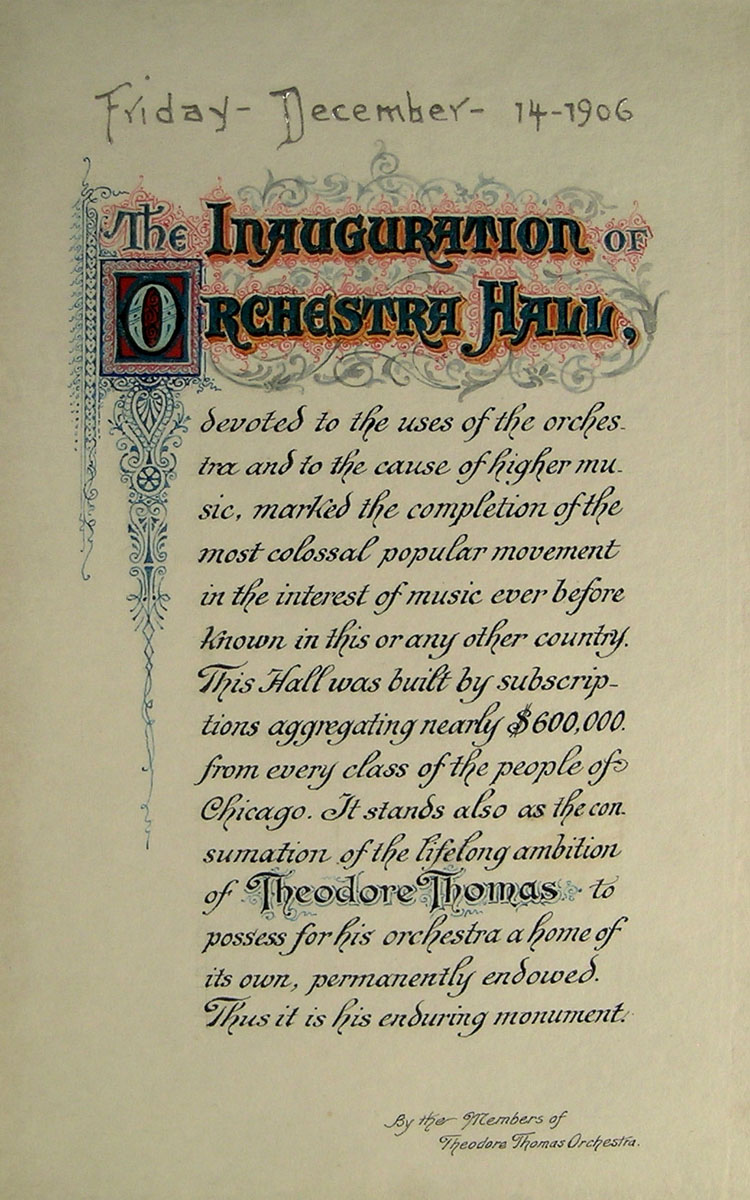
December 14: Inauguration of Orchestra Hall
The second of two pages contributed by the orchestra, this page commemorated the second anniversary of the opening of Orchestra Hall in December 1904.  The Glessners personally raised much of the funding to construct the hall.


Monday, January 11, 2016

The Death of John Wellborn Root -- January 15, 1891


January 15, 2016 will mark the 125th anniversary of the death of one of Chicago’s greatest architects – John Wellborn Root.  His unexpected passing sent shock waves through the city and the architectural community.  Not only had Root just turned 41 years old five days earlier, but he and partner Daniel H. Burnham were in the early stages of planning the World’s Columbian Exposition – by far the largest and most important project their firm had ever undertaken.

The tragic story of Root’s death has oft been retold.  As recounted in the death notice published in the Chicago Tribune on Friday January 16th:

“Chicago will be shocked at the news of the untimely death of John W. Root, easily its most distinguished designing architect, if indeed he had his superior in the whole country.  In the prime of his life, his vigor, and his usefulness; in the midst of his invaluable services to the World’s Columbian Exposition, he seemed to be the man of all others who would be sure to continue for many a day one of its most esteemed and beloved citizens.  In the flower of his days pneumonia has suddenly ended his life, as it has during late years ended the lives of so many men young and strong like him.  Less than a week ago he was in the best of health.  Saturday he took a Turkish bath and later at his own house thoughtlessly stepped into the street to hand a friend to her carriage, becoming slightly chilled in so doing.  During Sunday he received at his hospitable home a visit from the Eastern architects visiting the scene of the World’s Fair, and that night he was seized with a severe chill, which proved the beginning of a fatal illness.  Even as late as noon of that day of his death he seemed in a fair way of recovery, but death came suddenly last evening.”

Daniel Burnham, an intimate friend and business partner of nearly 20 years, paced the floor of Root’s house, waiting for each update from the doctor.  When the end came, Burnham is supposed to have responded “Damn, damn, damn!”  considering not only life without his talented partner, but how he would proceed alone with the monumental task of planning and executing the World’s Fair.  Root had been appointed as the “consulting architect” for the Fair, which gave him supervision over all architectural related matters.  Lyman Gage, one of the directors of the Fair, noted that “In general it may be said that there is no man in any profession whose place cannot be filled.  But it really seems to me that John Root was an exception.”


The funeral took place on Sunday January 18th from the family home at 56 Astor Street (now 1310 N. Astor Street.)  Root had designed the house in 1888, one of a series of four charming Queen Anne row houses for James L. Houghteling.  


Following the service, conducted by Bishop Cheney, the casket was sealed and the remains taken to Graceland Cemetery for internment.  Pall bearers included Burnham, Art Institute president Charles L. Hutchinson, and William Pretyman, a talented English designer and close friend of Root (who would later execute the hand-painted wallcovering in the Glessner parlor).

PRAIRIE AVENUE CONNECTIONS


Burnham and Root were responsible for the design and remodeling of more than a dozen residences on and around Prairie Avenue.   Their first commission on the street in 1873, the residence for John B. Sherman, president of the Chicago Union Stockyards, was the second commission ever received by the new firm.   (Burnham met and married Sherman’s daughter Margaret during construction and the couple moved into the house upon its completion).


In 1880, Root married Mary Louise Walker, a daughter of James M. Walker of 1720 S. Prairie Avenue.   The newly married couple took up residence with the Walkers, but Mary Root died a month later at the age of 21. 

GLESSNER CONNECTIONS

The Glessners were long-time friends of Daniel Burnham and would have known Root through that friendship.  Frances Glessner and Root’s wife were both members of The Fortnightly.  She sent flowers and a note of condolence to Root’s widow, which were acknowledged with the following note on March 18th:

“Dear Mrs. Glessner
I thank you from my heart for the beautiful roses, and above all for the sweet sympathy which I know accompanied them.  I shall never forget that you thought of me when I most needed help.
Always faithfully yours,
Dora Louise Root”


John Root and John Glessner were also fellow members of the Chicago Literary Club.  At the time of Root’s death, the Club occupied rooms on the third floor of the Art Institute, a Burnham and Root designed building at the southwest corner of Michigan and Van Buren.  At the meeting of the Club on February 16, 1891, the following resolution was read, which sums up in a few words Root’s importance to the architectural community, as well as his value as a friend and Club member.

“In the death of JOHN WELLBORN ROOT the Literary Club has lost a valued member and Chicago has lost a gifted man.

“Everybody knew him as an architect and artist.  Our city is full of his work; his great buildings tower above our business streets, monuments of the strength and breadth of his genius; and quiet homes along our residence streets bear witness to his grace and refinement.  All of us and all of the members of his chosen profession knew his ability as a writer.  But the full scope and range of his versatile nature were less well known.  Only a few knew him as a musician, and yet he had rare musical gifts.  Many surpassed him in mere brilliance of execution, but he had few equals in interpreting the spirit of the great composers.  To hear him play from memory Mendelssohn’s “Songs Without Words” was a revelation.  It stirred the deepest emotions.

“He died at the age of 41, young even for his years, doing the best work of his life, and giving promise of still greater development; like all true artists, dissatisfied with what he had accomplished, and hoping yet to do something great.


“As our fellow member and our friend has gone from us, and we shall never see another design from his hand, it is a pleasure to remember that this home of our club is all his work, the building, which was perhaps his most artistic creation, and the decoration and arrangement of these rooms, to which he gave much loving thought and much of his precious time.


“We shall remember him not only as a great architect and a versatile genius; but as a modest gentleman, a delightful companion, and a faithful friend.

Bryan Lathrop,
William L. B. Jenney,
Irving K. Pond,
Committee”


NOTE:  Among those who gathered in Chicago in January 1891 for the planning of the World’s Columbian Exposition was landscape architect Frederick Law Olmsted, who planned and supervised the landscape design for the fairgrounds.  Frances Glessner noted in her journal on January 12th, “At dinner time Mr. Olmsted came with his satchel to stay with us.”  He remained with the Glessners until January 18th, leaving Chicago after Root’s funeral. 


Monday, October 28, 2013

The World's Columbian Exposition

Palace of Fine Arts, caryatid porch

On Wednesday November 6, 2013, the museum will present a lecture entitled “The World’s Columbian Exposition – a 120 Year Perspective.”  The speaker is Diane Dillon, director of scholarly and undergraduate programs at the Newberry Library and a frequent lecturer on Chicago’s two World’s Fairs.  A small exhibit of Fair-related objects from the museum collection will also be on display.  Tickets are $10 and reservations may be made by calling Glessner House Museum at 312.326.1480.

Marine Cafe

The World’s Columbian Exposition remains a truly legendary event in the history of Chicago and is even commemorated with a star on the official city flag.  The statistics on the Fair are almost unbelievable – nearly 200 “temporary” buildings spread across more than 600 acres of land, and more than 27 million visitors in just six months.   The fair grounds were dedicated on October 21, 1892 and officially opened to visitors on May 1, 1893.  The Fair closed very quietly on October 30, 1893 just two days after the city was shaken by the assassination of Mayor Carter Harrison Sr.  Only two buildings from the Fair survive in Chicago today – the Palace of Fine Arts (now the Museum of Science and Industry) and the World’s Congress Auxiliary Building (now the Art Institute of Chicago).  A few other structures were dismantled and rebuilt in other parts of the country.

The masterminds behind the Fair were architect Daniel Burnham and landscape architect Frederick Law Olmsted, both of whom were close friends of the Glessners.  Due to that fact, the Glessners followed the design and construction of the fair closely and were afforded special access to the grounds both before and during the run of the fair.  Their son George also took a large number of photos, three of which are reproduced in this article.  We present a few excerpts from Frances Glessner’s journal indicating their interest and participation in Fair activities.


Inaugural Reception of the World’s Columbian Exposition - October 19, 1892:
“Wednesday I shopped and in the evening went to the grand ball at the Auditorium.  I wore a yellow brocade, the dress was made up after the fashion of a morning glory – the idea carried out all over.  There were forty one patronesses, about thirty three were there, all beautifully dressed.  We were taken to our places on one side of the auditorium.  The whole place was floored in back as far as the boxes go. . . Mr. Lathrop took me to my place.  The Vice President came in on Congressman Durborrow’s arm.  A military escort preceded him.  He was followed by members of the Cabinet, Senators, Judges of the Supreme Court, foreign diplomats – everyone in court dress, uniform, and full dress.  All presented to us.  Ex-president Hayes stood and talked a minute with me as others did.  After the presentation we were taken to our boxes where we had seats . . . I sat next to Mrs. Palmer.  We came home at half past eleven.  The ladies were each given a bouquet of red and yellow roses tied with red and yellow ribbons.”

Opening of the Fair – May 1, 1893:
“The weather was cloudy but it did not rain.  We drove out to the Exposition in the carriage.  When we went inside of the grounds we met Mr. and Mrs. Walter Peck and Mr. and Mrs. Rice.  We walked with them up to the Administration Building and a letter which Mr. Peck showed the guards took us to Mr. Higinbotham’s room and out of his window on to the grandstand where we had a full view of all of the crowd, the President, and all of the foreign officials – the Duke of Veragua, etc.  When President Cleveland opened the fair, the statue of the Republic was unveiled, the fountains played, the flags from every pinnacle and turret were unfurled, the orchestra played America.  It was a grand and touching sight.  It is estimated that there were three hundred and forty two thousand people there.”

Reception for Princess Eulalie – June 16, 1893:
“In the evening John and I went to Potter Palmer’s to a reception to the Princess Eulalie.  It was a very large reception.  The drawing room and reception room were separated by a red ribbon from the guests.  When the Prince and Princess came, Mr. and Mrs. Palmer met them at the door.  A heavy thunderstorm raged all the evening.  The Spanish party sat on a little dais in the parlor and the guests filed by in pairs and were presented.  We did not go.  After the presentation the royal party left at once.  Mrs. Palmer had set a supper for a certain number of distinguished guests but the Princess left – the party was shut off from the guests alone.  It was not a pleasant occasion.”

Japanese Ho-o-den

Private tour of the fairgrounds with Daniel Burham – June 17, 1893:
“We all went out to the Exposition to see the illumination and dine with Mr. Burnham.  We drove out then met in the service building.  Then we took Mr. Burnham’s launch.  We sailed around the lagoon – then some of the gentlemen got out but we declined – so they sailed around again.  They we drove in the wagonettes to the German village where we dined.  I sat between Mr. McKim and Frank Millet – besides these Mr. and Mrs. Peabody, Mr. and Mrs. Mead (architect), Mr. Coleman, Mr. Atwood, Kate Field, Mr. and Mrs. Burnham, Mr. and Mrs. Graham.  There were eighteen at table.  We had toasts.  After the dinner we drove again to the launch and sailed all of the evening.  It was a night to remember.  In the afternoon we all went by invitation to a glorious concert given in honor of Eulalie.  We were invited to the Thomas’ box.  Edward Lloyd sang.  The Apollo Club sang and the children’s chorus sang – the Princess came in for five minutes.  At the dinner that night Millet proposed the first toast, ‘down with royalty.’”

Assassination of Mayor Harrison - Saturday October 28, 1893:
“John and I went together to the Exposition.  We saw many things which we had not seen before.  John made an offer to John Wells for the beautiful silver tea set there.  John went to the Commercial Club dinner.  The dinner was interrupted and adjourned on account of the assassination of Carter Harrison at his home.”

Purchase of punch bowl – Monday October 30, 1893:
“I went to the Exposition with John.  We bought a beautiful punch bowl from Siam – silver and gold.”

The Fair is over – Wednesday November 1, 1893:
“We went to the Exposition.  It was exceedingly interesting to see the wonderful change that had come over everything.  It looked as though death had struck it.”

Monday, March 4, 2013

Lorado Taft, Sculptor

On Tuesday March 12, 2013 at 7:00pm, the museum will host author Lynn Allyn Young, who will present a lecture on her recently published book, Beautiful Dreamer: The Completed Works and Unfulfilled Plans of Sculptor Lorado Taft.  (Tickets are $10 per person and $8 for museum members.  For more information or to make reservations, call 312.326.1480.)

Lorado Taft (1860-1936) was a prominent American sculptor, respected writer and educator, teaching for many years at the Art Institute of Chicago.  His massive Fountain of Time, located in the southeast corner of Washington Park at the west end of the Midway Plaisance is among Chicago’s best known public works of art. 

Taft was born in Elmwood, Illinois and received both his bachelor’s and master’s degrees (1879 and 1880 respectively) from the University of Illinois, where his father was a professor of geology.  Taft later attended the École des Beaux-Arts where he received high praises for his work and twice was asked to exhibit at their annual Salon.  After returning to Chicago in 1886, he accepted a position to teach at the Art Institute of Chicago, a post he retained until 1929. 

During the planning of the World’s Columbian Exposition, Daniel Burnham approached Taft about his concerns that the sculptural decorations on the various buildings would not be completed in time.   Taft suggested the use of a number of his female students to work as assistants to which Burnham famously replied “Hire anyone, even white rabbits if they’ll do the work.”  Several of the female sculptors, who became known as the “White Rabbits,” achieved later fame, and Taft is generally credited with helping to advance the status of women as sculptors.

In 1903, Taft published a comprehensive survey of American sculpture entitled The History of American Sculpture.  The study was revised in 1925 and remained the standard reference on the subject until the late 1960s.  In 1921, he published Modern Tendencies in Sculpture, a compilation of various lectures given at the Art Institute, still regarded as an important work in recording the perspectives on American and European sculpture in the first decades of the 20th century. 

In 1906, Taft moved his main studio to a converted carriage house at what is now 6016 S. Ingleside Avenue, immediately south of the Midway Plaisance (entrance shown above).  The firm of Pond & Pond was hired to significantly expand the building, known as the Midway Studios, to include a total of thirteen studios and dormitory spaces for Taft and other sculptors.  (The complex, designated a National Historic Landmark in 1965, is now used by the University of Chicago as studio and gallery space for its studio art program.)

Taft’s commissions were numerous and not surprisingly several of them can be found today in Chicago.  His Fountain of the Great Lakes, completed in 1913, stands in the south courtyard of the Art Institute of Chicago.  Two prominent monuments at Graceland Cemetery, Eternal Silence (Dexter Graves monument, 1909) and The Crusader (Victor Lawson monument, 1931) remain favorites on walking tours of the cemetery, the latter being used as the cover image of the new guide to the cemetery, written by Barbara Lanctot for the Chicago Architecture Foundation. 

But it is the massive Fountain of Time in Washington Park, 110 feet long and 24 feet high, that remains Taft’s most famous work in Chicago.   (A detail of the fountain is shown on the book cover at top).  It is interesting to note that John Glessner was involved in the planning for this project as noted in an entry in the Glessner journal dated February 2, 1913:

“I have had several meetings with the committee to help place Lorado Taft’s monument, The Passing of Time, on the Midway, in commemoration of 100 years of peace between the U.S. and England, for which the Art Institute gave Taft the commission.  Now the South Park Commissioners must agree to the placing of it.  At least five years will be required to complete the model.”

World War I intervened in the planning and execution of the fountain, so it was not officially dedicated until November 1922.  A $2 million restoration of the fountain and reflecting pool was completed in 2005, returning this treasure to its original glory.

Monday, September 24, 2012

The White City - Chicago's 1893 World's Columbian Exposition

On Friday September 28, 2012 at 7:00pm, the museum is proud to host a production of “The White City.”  This original musical, produced by Lost and Found Productions and playwright June Finfer, focuses on one of the most legendary events in Chicago history – the World’s Columbian Exposition.

When Chicago wins the right to host the 1893 fair, the first great fair in the United States, the architect chosen to design and build it in record time – Daniel Burnham – finds that ambition is not enough.  He needs a lot of help from even those who oppose him.  In the three-year period of construction of the mile square fairgrounds and dozens of buildings, a vast canvas of characters vie with fate, death, and love to achieve the impossible.  Original music by Elizabeth Doyle that could have been written in the Gay 90s brings color and humor to a story of “making no little plans.”  This musical explores the politics and passions behind a unique national event, in many ways the first and last of its kind.

June Finfer is an award-winning writer, and a producer of documentaries.  Her film about the architecture of Mies van der Rohe has been broadcast on A&E and PBS and won a first prize at the American Film Festival.

Pre-paid tickets are $25.00 per person and may be purchased by calling 312.326.1480.  The production will take place in the coach house of Glessner House Museum, located at 1800 S. Prairie Avenue in Chicago’s South Loop neighborhood.

John and Frances Glessner made numerous trips to the fairgrounds, which are recorded in Frances’ journal.  Daniel Burnham, the fair’s Director of Construction, was a close friend of the family, so they were given special privileges, like access to the grounds in advance of its official openings and the opportunity to visit private viewing areas. 

In a manuscript entitled “Ghosts of Yesterday,” John Glessner recalled some of the individuals who visited 1800 S. Prairie Avenue during the Fair.  We herewith present a few excerpts from that manuscript.

“Other dear and delightful friends were Mr. and Mrs. Frederick Law Olmsted.  Our families were on very intimate terms.  George and young Frederick were classmates in College (Harvard).  During the World’s Fair Mr. and Mrs. Olmsted visited us.  He was America’s first and leading landscape architect, really settled the location of the Fair and laid it out.  In many warm discussions with the architects Mr. Olmsted always kept still until everyone else had talked, and then quietly would say – ‘Why don’t you do so and so?’ and that invariably settled it.  Mrs. Olmsted was a quaint little body, wore a white lace cap built over a rather high frame and tied under her chin in a large bow knot of wide muslin strings, and was a lovely picture.”

“It was (Charles) Hutchinson, too, who first brought Sir Caspar Purden Clarke, Director of the Metropolitan Museum of Art, New York, possessing a great and thorough knowledge of art but never forcing his knowledge or position on one – another cultured Englishman, with all that that implies.  As he left our dining room he said to Hutchinson – ‘You ought to keep you eyes on that punch bowl.  That’s a museum piece.  You ought to have it in your Art Museum.”  (Hutchinson was the long-time president of the Art Institute of Chicago.  The Glessners purchased their silver niello punch bowl from the Siam exhibit at the close of the fair.)

“The World’s Fair brought us many pleasing experiences with men and things, both in the early days of preparation and later in the installing of exhibits and the display itself.  It brought, also, some official representatives from abroad that our authorities treated very well, better than some of them deserved.  Special attention was paid to the Spanish representative.  I think the Duke of Veragua was never in my house, but I had some small connection with his entertainment – once at a horse show on the Dunham farm at Wayne, where Arthur Caton was in charge and asked my help; and again at South Bend, where the first Clement Studebakers were entertaining the “royal” party at luncheon, where I witnessed the most marvelous exhibition of hospitality.  We went from Chicago, a train load of men.  Unfortunately the house had taken fire that morning and the roof and part of the upper storeys burned, but the Studebakers spread tarpaulins under the ceiling of the dining room and gave us a magnificent luncheon on a beautifully decorated table just as if nothing had happened or as if that was the way they always did it, while water trickled down the walls of the room and leaked through spots in the tarpaulin.  Again it was my lot to help entertain the Duke in a theater box at a play.  Perhaps my total ignorance of Spanish and his imperfect knowledge of English combined with the inanities of the play at least account partially for the lack of spontaneous hilarity that marked the evening for both of us.”

“Perhaps it was not only the Chatelain that brought these World’s Fair men to us.  There was the daughter of the house – only a child then, it is true, but good company even then.  (Fanny Glessner was 15 years old at the time of the Fair).  There was the freedom of the house, a man might come or go as he pleased, he might talk or merely listen, he might read or merely sit and contemplate; there was a willing ear to hear and a heart to sympathize in their troubles, and there were creature comforts as well – always a good Sunday supper, and as with the proverbial stage or street car, there was at table always room for one more.  This house was a haven of refuge for many, the shadow of a great rock in a weary land, and these friends brought many amusing tales.  One gay young visitor came home one day from the Fair to say that going into one building she met an elderly man coming out who apparently had no one to talk with and who was oppressed by the size of the thing and the short time at his disposal, and perhaps encouraged by her winning smile broke out with, “I can’t see the damned thing in a month.” 

“And we had the World’s Fair architects – Burnham, and John Root, before his untimely death, and Charles Follen McKim, and Robert Swain Peabody, and William R. Meade, and (John Goddard) Stearns and George B. Post, and Charles Coolidge, who built the present Art Institute for religious and other conferences during the Fair, and who restrained his impatience one night until everybody else had gone that he might tell us of his love romance that had culminated in acceptance the day before in St. Louis.”

Tuesday, May 8, 2012

Joseph Sears and his Prairie Avenue roots

On Sunday May 6, 2012, members of the Kenilworth Historical Society journeyed down to Prairie Avenue  for a private tour of the street and Glessner House Museum.  The destination was far from random.  Joseph Sears, the founder of the beautiful planned community of Kenilworth on Chicago’s North Shore, had been a long time resident of Prairie Avenue during its heyday in the last quarter of the nineteenth century.  Members were anxious to learn more about the community that Sears called home before moving permanently to Kenilworth in 1892.

Joseph Sears was born on March 24, 1843 and was educated in the Chicago public schools.  In 1868, he married Helen Barry and began working as superintendent of a new plant for N. K. Fairbank, manufacturers of lard, oil, soap, and candles.  Within five years he was admitted as a junior partner in the firm.

By that time Sears had already moved to the Prairie Avenue neighborhood, originally living in a house on Prairie south of 22nd Street.  One of the attractions of the area no doubt was the Swedenborgian church, known as the “New Church Hall,” located at the southeast corner of Prairie Avenue and 18th Street.  The church had been built there in 1872, after their previous building was destroyed in the Chicago Fire.  In 1879, Sears purchased a lot less than 100 feet south of the church property, and soon after hired Burnham and Root to design his home.  (Architect Daniel Burnham was a fellow Swedenborgian).  During construction in 1881-1882, Sears and his growing family rented a house at 1919 S. Prairie Avenue, now known as the Marshall Field Jr. house.  (It is one of only seven surviving mansions remaining on Prairie Avenue today).

In 1880, the church sold their property and moved to a more central location in downtown Chicago, where Sears continued to attend.  By coincidence, the church property was acquired by Sears’ business partner, Nathaniel K. Fairbank.  In 1892, William W. Kimball, manufacturer of pianos and organs, completed his Chateauesque style mansion on the site, and that mansion remains today as well, now used as the national headquarters for the U. S. Soccer Federation.

Shortly after completing his home at 1815 S. Prairie Avenue, Sears’ traveled to England, where he became entranced with the beautiful planned communities there.  He came back to the U.S. and purchased a large tract of land on Chicago’s north shore, where he soon after established the community of Kenilworth.  In 1892, he left Prairie Avenue and took up permanent residence in a new home at Kenilworth, where he lived until his death in 1912. 

When Sears moved to Kenilworth he brought an interesting item with him.  After moving into the Prairie Avenue home in 1882, he had a log cabin playhouse built for his children.  The structure was carefully dismantled and reconstructed at Sears’ Kenilworth home.  In 1945, the family dismantled it yet again and moved it to a new family home in Northbrook.  In 1968, it was dismantled for the third time and moved back to Kenilworth, where it can be seen today adjacent to the Kenilworth Club.

Sears leased his Prairie Avenue home for a number of years.  For much of that time it was occupied by Levy Mayer, a prominent Chicago attorney and general counsel for Armour, one of the largest meatpackers in the country.  In 1902, the house was sold to Arthur Meeker, the European representative for Armour.  Meeker had the house significantly remodeled from plans prepared by architect Arthur Heun.  After Meeker moved to the north side, the building was occupied by various publishing houses, including D. C. Heath and Company.  It was razed in 1967.
Related Posts Plugin for WordPress, Blogger...