Showing posts with label Jack Simmerling. Show all posts

Monday, March 30, 2015

Unearthing Hanford


During the last twenty years, as the Prairie Avenue District has been reborn as a desirable residential neighborhood, bits and pieces of its history have been unearthed as construction equipment disturbs the sites of long vanished houses.  In many cases, the sites have laid undisturbed for decades beneath a thick layer of asphalt for a parking lot, or a concrete slab for a warehouse.  Such was the case of the former site of the long vanished Philander C. Hanford house.

Built in 1883 at 2008 S. Calumet Avenue, the home of the oil magnate and art collector was the largest on that street, and rivaled the finest homes on Prairie Avenue and the entire city.  Designed by architect Henry S. Jaffray, the massive pile was faced in Connecticut brownstone and featured beautifully designed interiors from the hand of Isaac Scott.  But the history of the house was not a happy one.  Just ten years after moving into his palatial home, Hanford committed suicide due to business reverses, and his family abandoned the house and city, leaving a caretaker to care for the property.  After sitting unoccupied for decades, the structure was seriously damaged by fire before succumbing to the wrecker’s ball in 1953. 

Rubble from the structure was used to fill in the basement before the site was paved over for a parking lot for employees of the nearby R. R. Donnelley & Sons printing plant.  But soon after, a section of the parking lot caved in, taking several cars along with it.  It was discovered that the Hanford house had been constructed with a double basement, and only the top level had been filled in during demolition - the added weight of the cars causing the large sinkhole. 


After that incident, the house was largely forgotten until 2001, when the site was excavated in preparation for a development of new townhouses that occupy the site today.  As bulldozers peeled away the asphalt and began digging, they uncovered the thick limestone walls of the Hanford house foundation, still largely intact.  Rubble and dirt was hauled away until the huge footprint of the house was fully revealed.


Jack Simmerling, who had been fascinated with the house since first touring it more than 50 years earlier, was on site, capturing these images.  For the first time since the early 1950s, huge blocks of brownstone saw the light of day, providing onlookers with a glimpse of the former grandeur of the house.  Remnants of chimneys that served the many fireplaces were uncovered as were countless smaller fragments ranging from window glass to tiles, and metal hardware to bottles and china.


An interesting find was a large locked safe brought to the surface – the source of much conversation amongst the demolition crew.  Like all the other pieces being unearthed however, it was loaded onto a truck and sent off only to be reburied as landfill, without ever being opened.  The secrets of any treasures it might have contained going with it.

Simmerling was able to salvage some small pieces as seen in this image and the one below.  One wonders how he must have felt walking amongst the bits and pieces of the house he had known so well, glimpsing the shattered remnants that he thought had been lost to time.  Fortunately, however, these are not the only pieces of the fabled house to survive.  Before the building was demolished, Simmerling, then just 17 years old, salvaged dozens of tiles, carved wood mouldings, and pieces from the elaborate windows, some of which are now displayed in the Simmerling Gallery of Prairie Avenue History at Glessner House Museum.  Viewing these pieces today, along with paintings and building models created by Simmerling, one can get a sense of the exquisite craftsmanship that went into the building of this house.  During 2001, the site of the house was stripped of all traces of the building that once stood there, but we are fortunate that Jack Simmerling had the foresight to rescue what he could so that future generations will always be able to appreciate this home and the many others that made the Prairie Avenue neighborhood the finest in the city.


NOTE:  On Tuesday March 31, 2015 at 7:00pm, Glessner House Museum will host “Unearthing Chicago,” a program of Clarke House Museum featuring Eric Nordstrom, owner of Urban Remains.  He will discuss several recent digs at locations throughout the city including Wolf’s Point and the former site of the c. 1855 John Kent Russell house, explaining what layers of trash and debris from prior generations reveal about the development of the city we know today.  The program is free, for more information call 312.326.1480.  

Thursday, December 11, 2014

Fire damages Chicago Firehouse Restaurant

Chicago Tribune photo

Fire tore through the landmark structure housing the Chicago Firehouse Restaurant at 1401 S. Michigan Avenue in the South Loop on Wednesday December 10, 2014.  The fire began accidentally about 10:20am by workmen making repairs to the roof.  It quickly spread and the roof eventually caved in.  Everyone was safely evacuated from the building.

Exterior in 1912

The structure was built in 1905-1906 to house Engine Company 104 of the Chicago Fire Department.  Architect Charles F. Hermann designed the distinctive structure in the Romanesque Revival style, utilizing yellow brick and limestone in its construction.   Two bays facing Michigan Avenue accommodated the horse-drawn equipment, and the large second floor provided living quarters for the firefighters on duty.   

Interior circa 1948

The back portion of the second floor was used as a hayloft for the horses.  After motorized equipment was introduced, that space was converted to a handball court.  Portions of the 1991 movie Backdraft, directed by Ron Howard, were filmed in the structure.

The fire house operated until 1999 when the property was sold to investor Matthew O’Malley, who opened the restaurant the following year.  Careful attention was paid to preserving many of the original details of the building.  The restaurant interior retained the tin ceiling, glazed brick walls, and two brass fire poles.  The metal spiral staircase up to the living quarters was removed and reinstalled in the new courtyard, created from the space formerly occupied by the horse stables.  

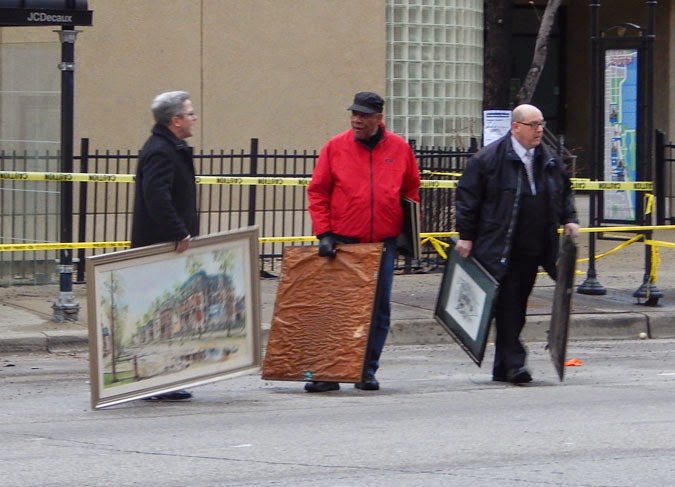
Simmerling paintings being removed from the building

The sense of history was enhanced by artist Jack Simmerling who created several large watercolor paintings to decorate the dining room.  These included scenes of nearby Prairie Avenue, as well as the Potter Palmer “castle” and the Cyrus McCormick mansion on the city’s north side. 


On October 1, 2003, the building was designated a Chicago Landmark.  The plaque installed on the front of the building reads:

“The design of this firehouse incorporated many innovations aimed at achieving quick departures and providing more comfortable quarters for firefighters.  Its Romanesque Revival-style details also make it one of the more distinctive and handsome firehouses in the City.  Through their history and architecture, Chicago’s historic firehouses show how ideas about fire protection and the firehouse itself evolved over time.”

After the fire had been extinguished

The restaurant was a favorite of former Mayor Richard M. Daley, who lived nearby on Indiana Avenue.  In July 2006, he hosted a dinner for then President George W. Bush, who celebrated his 60th birthday in the private banquet room on the second floor.  

The owners announced almost immediately their intentions to rebuild and reopen as soon as possible.

NOTE:  Historic images from "History of Chicago Fire Houses of the 20th Century 1901-1925" by Ken Little and John McNalis, published in 2000.


Monday, December 8, 2014

The Auditorium and Ferdinand Peck


Tuesday December 9, 2014, marks the 125th anniversary of the opening of Chicago’s Auditorium Theatre.  Much has been written about the Auditorium Building, its magnificent theater, the architects Adler & Sullivan who designed it, and its importance in the history of American architecture.  In this article, the 200th published to our blog since we began in January 2011, we shall look at the home of Ferdinand Wythe Peck, the driving force behind this monumental undertaking. 

Peck’s family was among the earliest to arrive in what would become the city of Chicago.  His father Phillip F. W. Peck, and mother Mary Kent Peck, arrived at the settlement of 250 inhabitants at the mouth of the Chicago River in 1831 aboard the schooner “Telegraph.”  Phillip Peck became a successful merchant in the rapidly growing city, and by the time of Ferdinand’s birth in 1848, was residing in a fine home at the corner of LaSalle Street and Jackson Boulevard, later site of the Continental Illinois National Bank and Trust Company.


Ferdinand Peck studied law and was admitted to the Chicago bar, but with the advantages of a privileged upbringing, devoted most of his efforts to civic affairs and becoming a promoter of his native city.  He was one of the founders of the Art Institute and a major backer of Chicago’s first opera festival in 1885, which led directly to the idea for the new Auditorium.  He incorporated the Chicago Auditorium Association in 1886 and served as its president.  Peck envisioned not just a grand theater, but the largest and most expensive theater in the world.  The complex would include a hotel and office block to help support the lavish productions anticipated for the theater.  Fellow board members included Marshall Field, George Pullman, Edson Keith, and many other business and social leaders who lived on and around Prairie Avenue on the city’s near South side.

As work continued on the Auditorium Building, Peck engaged William LeBaron Jenney to design a new home for him at 1826 S. Michigan Avenue, in the exclusive residential district where many of his board members resided.  The imposing structure, faced in Vermont granite, featured a massive four-story square tower over the entrance way at the north end, balanced by a three-story rounded tower to the south.  The overall design was Romanesque Revival, later known as Richardsonian Romanesque in honor of its chief practitioner, Henry Hobson Richardson.  Richardson had three structures underway in Chicago at the time including the Marshall Field Wholesale Store, and large homes for Franklin MacVeagh on North Lake Shore Drive, and the Glessner House at 1800 S. Prairie Avenue. 


Mr. and Mrs. Peck were anxious to host President Benjamin Harrison at their new 30-room home for dinner following the opening of the Auditorium Theater on December 9, 1889; however the house was far from finished as the time approached.  In the three days leading up to the opening, crews worked 24 hours a day to finish painting the rooms, installing furniture and draperies, and making sure everything was in order to welcome the presidential party.  Friend and neighbor Marshall Field loaned furniture, draperies, and rugs from his store.


The dinner party at the house went off as planned, with guests including President Harrison, Vice President Levi P. Morton, members of his cabinet, and Adelina Patti, the opera star who had sung “Home, Sweet Home” at the Auditorium dedication.  An oft repeated story states that when President Harrison arrived at the house and exited his carriage, he looked up at the façade of the house, which did bear a strong similarity to the Auditorium Building, and referred to it as the “Auditorium, Jr.”

"The Exposition Out of Debt"

Ferdinand Peck, known for years as “Commodore Peck” due to his interest in yachting, remained active in civic affairs, although the Auditorium would always be considered his greatest achievement.  He served as first vice-president and chairman of the finance committee of the World’s Columbian Exposition – one of the few world’s fairs ever to make a profit.  Many important guests were entertained at the Peck home during the Fair, including the Infanta Eulalia of Spain.

A few years later came another president – President William McKinley – who in 1900 appointed Peck as the American commissioner-general to the Paris exposition of that year.  In the years following, many European dignitaries Peck met during that Fair were entertained in his home.

Peck continued to live in his Michigan Avenue house until his death on November 4, 1924, even though the character of the street had significantly changed by that time.  In the early 1900s Michigan Avenue saw a rapid transformation from a fine residential street into what became known as “Motor Row,” with more than 100 automobile dealerships lining the avenue both north and south of the old Peck house.  At least one of those buildings, a beautiful Second Empire style white terra cotta clad building at 1925 S. Michigan, was financed by Peck as an investment in 1911, and was leased to B. F. Goodrich.  (It still stands today and is now part of the Motor Row Historic District). 

Photo by Jack Simmerling

Peck’s widow and son, Ferdinand Jr. remained in the house for several more years, later moving to a spacious apartment at 2238 Lincoln Park West.  The house was sold to another family and was eventually cut up into numerous small apartments.  The last mention of the old house in the Chicago Tribune was in November 1967 when the Auditorium Theater was reopened after a major restoration.  Arthur Johnson, a reporter for the Tribune wrote, in part:

“The mansion, massive and majestic, still stands, as tho in defiance of the commercial buildings surrounding it.  Weeds grow in the front and side yards.  Several windows are cracked or broken and a ‘rooms for rent’ sign is nailed to a post on the front porch.  Ghosts must have walked there last Tuesday night, waiting for the President’s carriage to roll up the side drive after the opening performance at the Auditorium.  The night passed, however, with nothing to disturb the pigeons that roost under the canopy at the stately side entrance but a stray dog or perhaps a derelict looking for a place to sleep.”


From an original sketch by Jack Simmerling, 1974

The house fell to the wrecker’s ball two years later, in 1969.  Today the site is part of a large townhouse development known as Michigan Avenue Gardens, constructed in 1998.  Peck’s house may be gone, but his greatest achievement – the Auditorium – is his lasting and enduring legacy to his beloved city of Chicago.

Tuesday, December 2, 2014

Simmerling Gallery Opens


On Monday December 1, 2014, more than 100 people gathered in the coach house of Glessner House Museum to celebrate the opening of the John J. ‘Jack’ Simmerling Gallery of Prairie Avenue History.  Three generations of the Simmerling family were on hand to welcome guests, some of whom came from as far as New York to be present. 

Simmerling family members in the new gallery

The event opened with a festive reception where guests from all facets of Jack’s life gathered to share memories of Jack, on what would have been his 79th birthday.  Guests travelled from Blue Island where he was born and raised, Beverly/Morgan Park where he lived and owned The Heritage Gallery for more than 50 years, and Ogden Dunes where he maintained a summer resident.  Representatives from the Ridge Historical Society, Beverly Art Center, Smith Village, Smith Senior Living, Historic Pullman Foundation, and the Beverly Art Walk were all on hand, showing the breadth of Jack’s community involvement and the high regard in which he was held by all who knew him.

Bill Tyre, Executive Director and Curator of Glessner House Museum, opened the program, quoting Theodore Roosevelt, who once said “What a man does for himself dies with him.  What he does for his community lives long after he is gone,” noting how the quote could well have been written with Jack in mind.  He recounted how Jack became fascinated with Prairie Avenue when just a young teenager and how he could see beyond the dingy facades of the surviving houses and clearly picture what the street had been in its prime in the late 19th century.  Bill shared stories of R. W. Eyster, a dear friend and mentor to Jack, and Herma Clark, long time columnist for the Chicago Tribune, both of whom were major influences on Jack in his formative years. 


A very special guest for the evening was Tim Samuelson, Cultural Historian for the City of Chicago.  Jack and Tim shared a close bond, and often said that they were twins separated at birth, given their similar passion for Chicago history and trying to preserve it however they could.  He recounted their many visits together and how they were truly kindred spirits.

After Tim spoke, two of Jack’s daughters, Mary and Meg, shared stories of their introduction to Prairie Avenue, with endless Sunday drives up and down Prairie and Calumet, their father retelling all of his favorite stories about the houses and the residents who had lived there.  They pointed out how the event was not really an opening, but a homecoming, as the treasured pieces of these homes that their father had carefully salvaged were finally back home on Prairie Avenue for all to see, along with his incredible collection of paintings and pen and ink sketches depicting all of his favorite houses.


The current gallery is a temporary space measuring just under 300 feet, and containing highlights from Jack’s vast collection.  The long-term vision of the museum is to convert a 1,250 foot space over the coach house into a much large permanent gallery where the full collection can be put on display.  Architects Krueck + Sexton have drawn up plans for the new gallery, projected to cost $422,000, with another $50,000 needed for artifact and art conservation and the construction of custom display cases and mounts.


Architects renderings of the proposed permanent
gallery, courtesy Krueck + Sexton Architects

The fundraising campaign received a welcome boost with the announcement of the inaugural gift to the new permanent gallery.  Jim Blauw and Krista Grimm, long-time friends of Jack, presented the museum with a check for $5,000 in memory of their dear friend, and to help ensure that his collection and memory would always be preserved at Glessner House Museum.


After the presentation was complete, Simmerling family members and selected guests travelled up to the second floor where Jack’s wife of 55 years, Margie, assisted by her granddaughter Eliza, cut the red ribbon officially opening the gallery.  Guests then spent the remainder of the evening marveling at the collection of objects – from tiles and carved wood mouldings to oil paintings and buildings models created by Jack.  One of the items that received the most attention was a hand painted poster announcing talks of Old Chicago to be given by 16-year-old Jack Simmerling in 1952.


The evening came to a close with attendees sharing more stories of Jack as artist, story teller, historian, and friend.  Although Jack is longer with us, the event showed that many continue to carry Jack in their hearts, and the new gallery at Glessner House Museum will ensure that his irreplaceable contributions in preserving Prairie Avenue will always be available for present and future generations to enjoy.


TOURS
Special one-hour tours of the gallery led by Bill Tyre will be offered at 10:00am on Saturdays December 13, 20, and 27.  Cost is $10 per person, $8 for museum members, with all proceeds going toward the new permanent gallery.  Prepaid reservations are required, call 312-326-1480.  Additional gallery tours will be scheduled on a regular basis beginning in early 2015.

DONATIONS

For those interested in making a gift to the John J. ‘Jack’ Simmerling Gallery of Prairie Avenue History, please click here to download a donation form.  

Monday, November 24, 2014

Jack Simmerling - 1951

"Jack Simmerling Jr., Blue Island, works on one of the
many paintings he has done of old Chicago houses."
(Tribune photo by William C. Loewe)

In anticipation of the opening of the John J. ‘Jack’ Simmerling Gallery of Prairie Avenue History on Monday December 1, 2014, we look back 63 years to 1951, when Jack Simmerling was just 15 years old.  On October 14, 1951, the Chicago Sunday Tribune ran a cover story about Jack in their Neighborhood Section.  The article included the photo shown above, photos of seven of Jack’s paintings (two of which will be displayed in the new gallery), and a lengthy article, reprinted below.  It is most interesting to note how fully developed Jack’s passion for old houses was at this young age, and what a prolific artist he had already become.

NOTE:  Due to overwhelming response, the opening celebration on December 1st is now sold out.  However, special one-hour tours of the Simmerling Gallery will be offered at 10:00am on the following Saturdays – December 13, 20, and 27.  Tickets are $10.00 and prepaid reservations to 312-326-1480 are required as group size is limited to 15.  Additional tours will be scheduled in 2015, check the website, www.glessnerhouse.org for more details.

Youthful Artist of Blue Island Preserves Flavor of Old Chicago Houses on Canvas

Young Artist is Authority on City’s Gay Days

Puts Vanished Splendor Into Old Homes

by Gordon Winkler

On first meeting Jack Simmerling Jr. of Blue Island it is not easy to believe that he is becoming an authority on the Victorian era.  Jack is 15, likes to swim and fish, and his favorite article of apparel is his Blue Island High school sweater.

One usually associates those whose interests are steeped in the ‘90s with museum curators or sentimental old timers who wistfully remember the lush way of life.  But in the last two years this high school youth has been making a study of Victorian life and architecture in Chicago.

Castle Makes Impression

Jack’s interest in the era began when he and his mother visited the famed Potter Palmer estate in Lake Shore dr. just before it was razed to make way for an apartment building.  “I was tremendously impressed by the splendor of the old castle and felt that paintings of the structure should be made.”

Jack, who has painted since he was able to hold a brush – he won a first award in a state contest sponsored by the Illinois Federation of Women’s Clubs in 1948 – began to reproduce the building on canvas.  He spent many days at the Lake Shore dr. site making sketches.  His project, so far as the Potter Palmer mansion was concerned, was not limited to one picture.

Jack has a series of five paintings which show stages of the castle’s demolition.  His interest in old homes, whetted by the Potter Palmer house, made him move on to the Cyrus McCormick mansion in nearby Rush Street.  “In order to obtain the true color of the building and even preserve some of it, I pulverized some bricks from the house and mixed the dust with my paint,” Jack said.

Since then Jack has painted dozens of old Chicago homes.  Many of the paintings have been done from photographs of houses which have been razed; others have been painted from the homes themselves.

Must Imagine Scenes

Jack, who recently began lecturing on the subject of old Chicago homes, tells his audiences that in almost all cases his paintings are his own impressions of how these homes appeared in the days of lavish parties and posh living.  “When I am able to paint from the actual house it is usually in a state of disrepair and I have to put in what I feel the house actually looked like,” he said.

While his paintings lack the preciseness of an architect’s rendering, Jack has done painstaking research on the houses so his reproductions will resemble as much as possible the originals.

He can talk about the famed Mikado ball held before the turn of the century in the Marshall Field home in Prairie av. with as much authority as he can discuss the architecture of the period.  His interest in the houses has branched off into a study of their interiors and he is now working on a cardboard model of the rooms of the McCormick house complete with chandeliers, inlaid floors, and hand carved mantels.

“I can’t tell you the number of days he has spent roaming around that house,” his mother said.

Jack also haunts old homes being razed.  Wrecking crews have become accustomed to his requests for stained glass windows, mantelpieces, and other items.  The Simmerling basement is becoming cluttered with such objects.

The young artist plans to take some courses at the Art Institute soon, and after high school he hopes to go on to the University of Chicago.  “I am not sure what I want to do eventually,” he said.  “Right now I think I would like to be a newspaper reporter.”


Fortunately for all of us, Jack soon abandoned his idea of becoming a newspaper reporter (although he remained an incredible storyteller), devoting his full efforts to become an accomplished and, in time, nationally-recognized artist.  The new Simmerling Gallery at Glessner House Museum will showcase selected artworks in oil, watercolor and pen and ink, along with architectural fragments from some of the great homes of Prairie Avenue, personally salvaged by Jack Simmerling in his quest to preserve the Victorian era he saw rapidly disappearing before his eyes.

Monday, July 22, 2013

Jack Simmerling (1935-2013): A Tribute


On Thursday July 18, 2013, the life of Jack Simmerling drew to a close.  Jack impacted the hearts and lives of many through the years, and all who met him were deeply touched by his gentle manner, generous nature, and his deep passion for the Victorian era and Chicago’s historic architecture.  A talented artist, his watercolors and pen and ink drawings grace the walls of many homes, libraries, museums, and schools, and now form an important part of his legacy.  He was a devoted friend and supporter of Glessner House Museum for many years, and we offer this tribute in his honor.

John Joseph Simmerling, Jr. was born on December 1, 1935 to John and Esther (Bargerbush) Simmerling and was raised in the family home at 2456 W. 122nd Street in Blue Island, Illinois.  It was not long at all before he made his first trip to the Prairie Avenue neighborhood – his first baby picture was taken in the Gibson Studio at 217 E. Cullerton Street.  (Given Jack’s later love of Chicago history, it was only appropriate that the photographer, J. J. Gibson, had been the official photographer at the 1893 World’s Columbian Exposition).

Jack took up painting around the time he turned 11, although he had no formal training.  He learned about mixing colors from Blue Island artist Hazel Pronger, but for the rest, he relied on natural talent.  It was also about this same time that he began to play the piano, a hobby that would bring him much joy throughout his lifetime.  And it was shortly after World War II that his grandfather George Washington Bargerbush started his grandson on a life-long love affair with Prairie Avenue.

George Bargerbush in earlier years had worked as an office boy for Marshall Field.  He maintained a friendship with Gus Clemm, Field’s coachman who had stayed on as caretaker of the old Field mansion at 1905 S. Prairie Avenue.  Bargerbush brought young Jack along on one of his visits to the Field house, and Jack enjoyed exploring the huge old residence – admiring the beautiful cut stone on the façade and walking through the tunnel that connected the house to the coach house.  (The interior of the house had been largely modernized in the late 1930s when Laszlo Moholy-Nagy opened his New Bauhaus school in the building).  Those visits to the Field house had a lasting impression on the young boy, who was able to look beyond the deterioration of the once elegant neighborhood and envision what it had been in its heyday.

In 1949, Jack’s mother took him to visit the Potter Palmer castle on Lake Shore Drive before it was demolished.  As a Tribune article later reported, “he was shocked at the sight of what he considered a hallowed tradition disappearing before his eyes.”  When demolition began in January 1950, Jack undertook a series of five paintings showing the stages of the castle’s demolition.  By this time, he was working out of a log cabin studio he had built in the backyard of his family home, the walls of which were soon filled with his canvases.

Jack became acquainted with Chester Good, who worked for a wrecking company tearing down many of the Gilded Age mansions in the city.  Good would alert Jack when an interesting old house was being torn down, and Jack would come to visit, making sketches and creating paintings of the buildings before they were lost to the wrecker’s ball.  It was at this time that he began to salvage fragments from the old houses – stained glass, mantels, balusters, and carved mouldings that otherwise would have been thrown into the fire and burned or bulldozed into the building’s foundations to level the ground.  On one occasion, he found an authentic Tiffany floor lamp and convinced Chester to strap it onto the top of his car and drive it back to Jack’s house in Blue Island.  Good complied but encouraged the young boy to take lead pipe if anything because that, at least, could be sold to a junk dealer for profit!


In June 1950, Jack had the opportunity to work on the demolition of the Clapp-Gorton house at 2120 S. Prairie Avenue, designed in 1877 by Burnham & Root.  The first house on Prairie Avenue in which he was directly involved, he salvaged a significant number of artifacts from the house and spent time wandering through the neighborhood looking at other houses.  One house in particular intrigued him – a huge vacant stone-clad house at 2008 S. Calumet Avenue. 


He found out that the house was owned by Raymond W. Eyster who lived and operated his linen business from the houses at 2003 and 2005 S. Prairie Avenue directly west of the Calumet house.  He wrote to Eyster and asked if he could see the inside of the house.  Eyster complied and provided him with a tour he would never forget.  The house was enormous, nearly 85 feet deep with an imposing entry hall in the Moorish style, and an elegant ballroom on the third floor.  Eyster said he had bought the house with the idea of creating a museum there in partnership with his friend Robert Ripley (of Ripley’s Believe It Or Not).   The house was full of original furnishings left behind by the Hanford family when they moved to New York following the suicide of the head of the family, Philander C. Hanford, in July 1894. 


Jack and R. W. Eyster formed a close friendship and Jack enjoyed his visits and seeing Eyster’s collection of antique light fixtures, rugs, and Egyptian artifacts.  Eyster treated Jack to lunch at his club downtown when Jack turned 16 on December 1, 1951, which is when the photo above was taken.  Tragically, Eyster died just six months later when the old elevator in the Hanford house failed and he fell to his death. 


By 1951, Jack was developing a reputation as an artist and as an expert on Old Chicago.  He began giving lectures, using his paintings to illustrate the houses he loved to talk about.  As an article in the Commonwealth Edison employee magazine stated “One can’t help but listen open-mouthed as Jack Simmerling, Jr., a 15-year old Blue Island high school student, talks authoritatively about ‘old Chicago’ when Prairie Avenue and the Gold Coast was in flower.  To further the eye-rubbing stage, his collection of oil paintings depicting the rise and fall of the lush Victorian era adds emphasis to Jack’s interest in the subject which he enthuses as though he had been peeking through Chicago keyholes himself more than a half-century ago.”  (Jack’s dad -pictured above - and grandfather Joseph Simmerling both worked for Commonwealth Edison).

It was in 1951 that Jack received his first paid commission to design a Christmas card for the Pullman Bank.  Jack selected one of the street scenes in the historic neighborhood for the card, and was hired for several years following to design the bank’s Christmas card.

The Chicago Tribune published two illustrated articles about Jack and his paintings in 1951 and 1952 referring to him as an authority on the Victorian era.  The articles increased the demand for him to speak to groups around the city about the Gilded Age.  At one of those meetings, he met Florence Gibson, whose father-in-law had taken young Jack’s photograph when he was just a baby.  Mrs. Gibson resided in the old family home at 217 E. Cullerton St., which was filled with antiques from the Columbian Exposition and the late 1800s.  She would become a cherished friend.


Another important acquaintance Jack would make at this time was journalist Herma Clark, who wrote the weekly “When Chicago Was Young” column in the Chicago Tribune, chronicling the lives of Chicago’s wealthy in the late 19th and early 20th centuries.  Although old enough to be his grandmother, they formed a close bond, and he enjoyed his visits to her “Keepsake Cottage” in Princeton, Illinois where she would share her first-hand stories of Chicago’s rich and famous. 

In August 1953 Jack purchased his first piano, an old square piano that had come into the shop of Malcolm Franklin, Inc. where he was working.  Franklin was buying the old pianos and converting them into desks, but Jack found one he wanted to preserve.  This led to a lifelong hobby of collecting historic pianos and pianofortes.


Jack headed off to the University of Notre Dame where he earned a Bachelor of Fine Arts degree.  He was away at school in 1955 when he learned the Marshall Field house on Prairie Avenue was about to be demolished.  He requested special permission to be excused from classes for a few days so he could travel back to Chicago to witness the demolition.  Needless to say, the request was one of the more unusual the school had heard for why a student needed to miss classes, but knowing Jack, the request was honored.

While at Notre Dame, Jack became the principal student of artist Stanley Sessler, who earlier in his life had been the last studio assistant for the great artist John Singer Sargent.  Jack credited Sessler as having had a great influence on him and his work, and considered Sargent to have been the finest 19th century artist.  Sessler later gave Jack a palette used by Sargent, and it remained a treasured piece.  After graduating from Notre Dame in 1957, Jack continued his studies in Art History at The University of Chicago.

In September 1957, the Chicago Tribune ran yet another article on Jack which began “Any girl dated by Jack Simmerling is apt to be asked if she likes Victorian architecture, for the future Mrs. Simmerling will have to share the young artist’s passion for late 19th century American design.”  It didn’t take long – Jack and Marjorie MacCartney were married the next year – and she was soon put to the test. 


On the way back from their brief honeymoon in Indiana, Jack insisted on stopping by the house at 2016 S. Calumet Avenue which was then being demolished.  In the photo above, Margie is seen standing in her high heels and new coat, amidst the rubble of the former parlor in the house.

It was also in 1958 that Jack opened his Heritage Gallery to showcase his artwork.  It was originally located at 1973 W. 111th Street, and later moved to 1915 W. 103rd Street.  The gallery provided a perfect opportunity to build his reputation as an artist, and soon commissions to paint portraits of buildings were coming in from the Beverly neighborhood and throughout the city.  Jack also taught, one of his best known students being the Pulitzer Prize winning Chicago Sun Times editorial cartoonist Jack Higgins.  Through the years Jack’s clients included the City of Chicago, the Chicago Symphony Orchestra, Notre Dame University, Biltmore Estate, and many of the country’s top corporations and private businesses. 


The Simmerlings had seven children and eventually moved to a huge historic house, known as the Blackwelder House in Beverly.  The house became filled with children, pets, keyboard instruments, artwork, and architectural fragments, and in time was restored and brought to landmark status.  One of Jack’s great pleasures was sharing his house and collection with visitors who would regularly come to see his “museum” of Old Chicago. 

In 1995, Jack published a book on his beloved Chicago houses.  Entitled Chicago Homes: Facts and Fables, it was co-authored by long-time friend Wayne Wolf.  The book is filled with photographs and stories of the houses Jack knew in his younger years, many of which were unfortunately no longer standing.  The book was so popular that it was expanded and reissued in 1997 as Chicago’s Old Houses: Lore and Legend.  In the dedication, he lists several individuals who inspired him including his grandfather George Bargerbush, Herma Clark, R. W. Eyster, his grandmother Dena Diedesch, and Sister Annie Schaudnecker (a teacher at Rosary College).

Jack always maintained a strong interest in Prairie Avenue and was delighted to see the neighborhood reborn as a popular residential neighborhood in the 1990s and early 2000s.  He was quoted in 2008 as saying “I’m so happy with what Prairie Avenue is now.  In the 1950s, I thought this was my own private sorrow.”  In 1999, as the site of the old Hanford house on Calumet Avenue was being cleared for townhouses, Jack was on site watching as the foundation reappeared for the first time in 46 years.  He salvaged bits and pieces of the old house that had so intrigued him as a teenager, and even had the two huge stone bollards removed from the front of the property and reinstalled in front of his Beverly home.

Jack was featured in an article which appeared in the Fall 2001 issue of Watercolor magazine.  (The photo of Jack at the top of this posting is from that article).  In the article, he details step-by-step how he creates a watercolor painting. 


The subject for the painting was the Glessner House, one of Jack’s favorite houses on Prairie Avenue.  He first visited the house in the 1950s when it was still occupied by the Lithographic Technical Foundation and he always maintained an active interest in the house.  At one point in the 1960s he even considered purchasing the house to use as his residence.


In September 2008, during the Festival on Prairie Avenue, celebrating the 30th anniversary of the creation of the Prairie Avenue Historic District, Jack was honored for his years of dedication to the neighborhood.  A certificate, presented jointly by Glessner House Museum and the Prairie District Neighborhood Alliance, read in part: 

“In recognition of more than fifty years of dedication to preserving the extraordinary history of Chicago’s Prairie Avenue neighborhood – through the creation of numerous works of art capturing the unique history and architecture of the street, and through the careful salvaging and preservation of numerous architectural fragments from its residences.” 


Mayor Richard M. Daley was on hand to personally congratulate Jack, who also brought a collection of his artwork and artifacts for display.


Jack continued to work closely with Glessner House Museum, hosting a “Prairie Avenue Night to Remember” at his gallery later that year, and loaning artifacts from his collection for an exhibit commemorating the centennial of Daniel Burnham’s Plan of Chicago in 2009.  The next year, the museum hosted an exhibit of fifteen new artworks he painted showcasing the neighborhood, including the watercolor of the house at 2801 S. Prairie Avenue shown above.


He was present for the celebration in December 2011 commemorating the 125th anniversary of the Glessners christening their new home.  He attended the celebratory dinner with his daughter Cathy, who sadly passed away in January 2013.

A series of health issues cut back on Jack’s activities, but never his interest in and passion for Prairie Avenue.  He last participated in an event at Glessner house in December 2012, when the 125th anniversary of the Glessners moving into their new home was celebrated.  (Jack was proud of the fact that he was born on December 1st – the same day that the Glessners moved into their new Prairie Avenue home in 1887). 


As part of that celebration, Jack completed one of his last artworks – a beautiful pen and ink drawing of the fireplace in the Glessners’ library which they had lit as part of the ceremony dedicating their home.  The drawing was reproduced as Christmas cards and note cards.

To close our tribute, we quote from an editorial entitled “Learning from Jack” which appeared in the September 4, 2008 issue of the Chicago Journal.  It sums up nicely why Jack Simmerling was so passionate about preserving the architecture of Chicago’s Gilded Age, and what we can all learn from him:

“After a tour of his home/museum, Jack Simmerling, the historic preservation scavenger of Prairie Avenue profiled in this week’s paper, paraphrased for a Chicago Journal reporter a quotation from the architectural historian Lewis Mumford: with architecture, we rebel against our fathers and revel in what our grandfathers found compelling.
“So it was with Prairie Avenue in the 1950s, when Victorian style was out of sync with the clean modern building going up most dramatically downtown, with Mies van der Rohe’s stark black office and residential towers.  On Prairie Avenue, beautiful mansions crumbled and were demolished – often times for parking lots.
“Simmerling, of course, worked on wrecking crews as the buildings came down, saving bits and representative pieces from the long-past gilded age.  He thought the decaying structures were beautiful, and as a precocious teenager found ways to save elements from the homes, like fire place mantels and lamps.
“Retrospect is easy, and smashing such structures seems crazy today.  But Simmerling was an oddball at the time.  Some of his instructors in college were happy to let the homes of Prairie Avenue go.
“The lesson of Simmerling’s scavenging, to us, is to take the long view about architecture and find ways to appreciate each era’s buildings.  We might even want to keep a couple of cookie cutter McDonald’s around to show future generations how low we once sunk to get a hamburger.”


Farewell good and faithful friend, and thank you for preserving and sharing an era of Chicago’s history that those of us today find compelling and could never have experienced without your dedication and foresight. 
Related Posts Plugin for WordPress, Blogger...