Tuesday, May 5, 2020

Preservation Month Part I - The Dining Room


Dining room, 2010 (Photo by James Caulfield)

During Preservation Month 2020, we will explore four rooms within Glessner House, examining the history of the spaces, their reuse after the Glessner occupancy ended in 1936, and most importantly, an overview of the restoration work undertaken to return them to their original appearance. The focus will be on the architecture and decoration of the rooms, with less emphasis on the furnishings and decorative arts.

Dining room, circa 1888 (Photo by George Glessner)

We begin with the dining room, the largest room in the house, and one of the very first to be restored. The room measures 18 by 29 feet, encompassing nearly 500 square feet of space, with an eleven-foot ceiling. Richardson’s original plan for the house called for a much taller room extending into the second story. When the ceiling height was lowered, presumably so the Glessners could have a more intimate environment for entertaining, a conservatory was created out of the space above.


Three boxed beams form the primary structure of the ceiling, these hollow beams each containing a rolled iron I-beam. Rows of smaller solid wood beams divide the ceiling into 36 sections. Each of these plaster sections was covered with gold leaf, a detail the Glessners saw in Richardson’s office. With no central chandelier planned for the room, the gold helped to reflect the light from the five wall sconces on to the dining table.

Fireplace, 1936 (Photo by Kaufmann & Fabry)

The north wall of the room is centered by a large wood-burning fireplace, set between fluted pilasters, and covered by stunning 16th-century Iznik tiles acquired from the interior designer Lockwood de Forest. There is no distinct mantel or mantel shelf, the fireplace is simply surrounded by the large panels of quarter-sawn red oak that cover all the walls of the room up to the height of the plate rail. The frieze above the plate rail was filled with a gilt and painted Japanese leather paper.

Wall sconce, 1948 (Photo by Robert Florian)

Five five-arm wall sconces illuminated the space. Originally gas, they were converted to electricity in 1892, at which time the glass shades were added. The next year, the Glessners’ good friend, Isaac Scott, proposed removing the sconces and installing a series of hanging pendant lights around the perimeter of the room. The unrealized plan also called for replacing the Japanese leather frieze with elaborately carved wood panels.

Isaac Scott's unrealized lighting plan, 1893

Architect Charles Coolidge designed most of the furniture in the room, all of which was made by A. H. Davenport & Co. The table, which measured six feet in diameter, could be extended to seat eighteen people; the five-windowed bay at the south end of the room added sufficient length to the room to accommodate the table when fully extended.

Dining room, 1923 (Photo by Kaufmann & Fabry)

The dining room table, eighteen chairs, and elaborately carved sideboard were left in the room when the house was donated to the Armour Institute on March 31, 1938. The Institute was anxious to remove the house from the tax rolls, as the property taxes at that point were nearly $1,000 per year. The day the deed was filed for record, Prof. Joseph B. Finnegan, director of the department of fire protection at the Institute, was sent to the house along with several students so that photos could be taken showing that the house was being used for educational purposes.
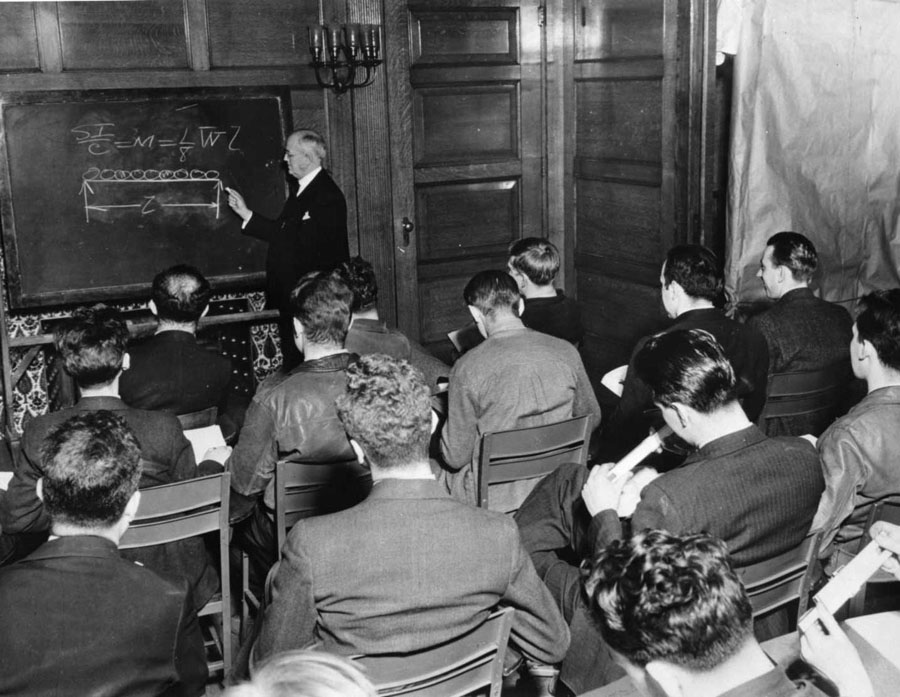
Armour "class," March 31, 1938 (Photo by Foto-Ad Studio)

In reality, classes were never held in the dining room or anywhere else in the house. In May 1938, the Human Engineering Laboratory, a division of the Armour Research Foundation, opened in the house to conduct vocational testing. In 1945, the Lithographic Technical Foundation took over occupancy, making necessary renovations to accommodate its use as research laboratories. Changes to the dining room included the addition of fluorescent lighting fixtures, laying down a linoleum floor, painting over the gold leaf ceiling, and removing the Japanese leather to create a gallery space for showcasing printed materials.


Lithographic Technical Foundation laboratory in dining room, 1946

(Photo by Hedrich Blessing)


By 1965, the Lithographic Technical Foundation had moved to Pittsburgh, and the house was put up for sale. The original dining room table, fourteen of the eighteen chairs, and the sideboard, were sold off at this time; their present whereabouts are unknown. Among those involved in saving the house was Richard Nickel, who documented the condition of the interior, including two views showing the dining room (shown below), and the equipment left behind. During early meetings of the Chicago School of Architecture Foundation, which was formed in 1966 to purchase the house, the equipment and furniture were broken up and burned in the fireplaces, as the central heating system in the building no longer functioned.

Dining room looking southwest, 1965 (Photo by Richard Nickel)

Dining room looking east, 1965 (Photo by Richard Nickel)

Several architecture and preservation organizations moved their offices into the house, and for a time, the dining room was occupied by the Midwest office of the Historic American Building Survey (HABS). By 1969, however, the dining room and parlor were converted into galleries for a regular series of exhibitions, curated by Robert Peters, a design partner at Skidmore, Owings & Merrill.

McCormick Place exhibition in the dining room bay, 1971

Among the exhibitions held in the rooms was “McCormick Place on the Lake: Innovations in Architecture” which opened on January 12, 1971, just nine days after McCormick Place itself opened. In March 1973, “The Arts & Crafts Movement in Chicago” exhibition premiered, to coincide with a similar exhibition at the Art Institute of Chicago.

Arts & Crafts exhibition, 1973

The focus of activity up to this point had been on a successful reuse of the house, rather than restoration of its interiors. The exhibition program was so popular that plans were drawn up for tearing down the west wall of the dining room and combining it with the kitchen and pantries to create a much larger space. Lack of funds, Peters departure and a scaling back of exhibitions, plus the return of original furnishings by Glessner descendants, shifted the focus toward the restoration of selected rooms.


Doorway leading into the butler's pantry, with a grill from the

Chicago Stock Exchange installed for the 1973 Arts & Crafts exhibition.


The first aspect of the dining room to be restored was the swinging door leading into the butler’s pantry. The Lithographic Technical Foundation had removed the door, cut it down, and reused it in a new entrance cut through the wall from the cold closet to the coach house stairwell. In 1973, John Thorpe, an early docent, made the discovery. Master carpenter John Valenta restored the door, including rebuilding the right-hand stile, and reinstalled it in its original location.


The next year, architect John Vinci designed the reproduction wall sconces, the originals having been stolen in the 1960s when the house stood vacant. They were made by New Metal Crafts. 


That same year, research revealed that the frieze had been covered with Japanese leather, long since removed. Through a fortunate chain of events, original unused rolls of Japanese leather were located in the attic of Chateau-sur-Mer, a “cottage” in Newport, Rhode Island. The material was purchased and installed in the dining room, no small task as it had been tightly rolled for nearly a century, requiring steaming and meticulous care to successfully flatten it for installation.

Fireplace, 2018 (Photo by John Rouse)

A major restoration project involved the recreation of the Iznik fireplace tiles, which Frances Glessner Lee had removed in April 1938 for use in her cottage in New Hampshire, just after donating the house to the Armour Institute.  Utilizing two original tiles which had been returned by Lee’s children, Leonard Currie, head of the Art and Architecture Department at the University of Illinois in Chicago, volunteered to obtain new tiles. He engaged the services of a student, Paula Garrett Ellis, who hand painted the twenty-eight reproductions. In 1977, Currie installed the reproductions and the two original tiles on the fireplace.

Dining room, 1977 (Photo by Steve Grubman)

In the early 1980s, the twelve-light double casement windows, which had been installed about 1945 on the inside of the bay windows, were removed, and reproductions of the red velvet drapes installed. The red color was documented in the inventory of the house taken after John Glessner died in 1936. Additionally, his granddaughter Martha Lee Batchelder, confirmed the color and even accompanied the curator to the Merchandise Mart, where she pointed out fabrics that were similar to those she recalled being used in various rooms in the house.

Silver closet prior to restoration

The butler’s silver closet was fully restored in 2013. The project involved refinishing the wood, repainting the walls in the historic color, and adding LED lighting and a glass enclosure to showcase and protect the Glessners’ large collection of silver. A highlight of the display is six pieces of silver handcrafted by Frances Glessner.

Restored silver closet

In 2015, Glessner House was presented with a wonderful opportunity to recreate the gold leaf ceiling. (An earlier attempt had been made in 1989, when aluminum leaf was installed, over which a gold-pigmented varnish was applied.) The Society of Gilders was planning to hold its annual conference in Chicago in June 2015 and was looking for the opportunity to donate the services of its members to a non-profit. The ceiling project was a perfect fit, as it could be completed during the period members would be in the city. The gold leaf, enough to cover 240 square feet of plaster ceiling, was funded by a generous gift from the Richard H. Driehaus Foundation. Over five days, a crew of 8-10 gilders from several countries completed the project.

Gold leaf installation, 2015

Today, the fully restored dining room presents an accurate window into the past, allowing visitors to experience the space, during tours and selected dining events, as it was envisioned for use by the Glessner family and their guests more than a century ago. To take a virtual tour of the room, click here.

Dining room, 2010 (Photo by James Caulfield)


Tuesday, April 28, 2020

The Glessner Family Arrives in America - Part II


In last week’s article, we retraced the steps of John Glessner’s immigrant ancestor, Henry Glessner, from Bingen am Rhein, Germany, to the wilderness of western Pennsylvania in 1763 and followed the events of his life over the next half century until his death in early 1814. In this installment, we will look back at visits to Pennsylvania made by various descendants through the years, anxious to learn more about their German roots in the United States.

1888 – John Glessner and Jacob Glessner

Jacob Glessner

In May 1888, John Glessner accompanied his father Jacob on a trip to Somerset, Pennsylvania where the elder Glessner had been born in 1809 but had not visited since his marriage and removal to Ohio in 1837. Immediately after his return to Chicago, John Glessner penned an eight-page report of their visit, excerpts of which follow:

“To increase my knowledge of family antecedents and confirm the statements heretofore made to me by others, I went to Somerset, Pa. with my father on May 14th, reaching there about noon May 15th, 1888.

“The country in the vicinity is broken but the farms are beautiful, well cleared up and cultivated and stocked with fine cattle and horses and sheep. Five large barns are the rule, but the dwellings are neither large nor fine, and are without architectural pretense. The village occupies the highest ground of any county seat in Pennsylvania, but is a sleepy old place, and the people are conservative in every sense of the word.


“In the two days we spent at the Somerset House, my father found and called upon and received calls from several schoolmates and friends of his boyhood . . . (Cousin) Anna Maria Baer, widow of Solomon Baer and now in her 90th year is quite an erect though small body with good hearing and sight, a good memory, and altogether a bright and cheerful old lady. She was delighted to see us, and from her I gained much information about the family, or more correctly, confirmation of what I had already heard.

“On Wednesday, Father and I drove over to Berlin, a village 9 miles away, passing a gypsy camp by the roadside. My grandfather Glessner was born here and married here, and my great-grandfather and great-grandmother died here, and were buried in the old cemetery. Here we found another schoolmate of my father’s, Samuel Philsen, the banker and principal merchant of the eastern part of the county, and in company with him we visited the old cemetery and deciphered the inscriptions – some in German – upon the old headstones. The cemetery is not a beautiful spot – no trees and almost no shrubbery, but the turf was green and fine. He pointed out the house still standing where my great uncle Ludwick Baker had lived, and the spot where my grandmother had lived as the adopted daughter of her uncle, Rev. George Giesy, and where she was married; also the spot where my grandfather’s uncle Jacob Glessner was murdered by Rev. Spangenberg etc. etc.

“Returning to Somerset, my father showed me the lot where he was born and lived, but the old house has disappeared and another stands in its place. The old stable is still there, small and low, and three of the old apple trees. On the next lot, Chauncey Forward had lived, my grandfather’s warm friend, and there his daughter was married to Judge Jere. S. Black* the great lawyer, afterwards of President Buchanan’s cabinet, a playmate of my father’s, and here Black lived years after my father left Somerset. I also saw the old Academy site where grandfather’s boys went to school – the old brick building is gone but replaced by one of similar style – the place where my father learned to be a printer and where he afterwards published the Somerset Whig, a democratic paper, my grandfather’s furniture shop, the old “coffee spring” the place of 4th of July celebrations and picnics of 50 years ago, etc.

“I am happy in knowing Father enjoyed his old friends, these old scenes, and the reminiscences and events they recalled, but even he was ready to leave, and on Thursday morning we said goodbye to the old place and the old friends, and started homewards.”

*Jeremiah S. Black served as Attorney General from 1857 to 1860 and as Secretary of State from 1860 until President James Buchanan left office in March 1861.

1955 – John J. Glessner II


John J. Glessner II with his wife Martha and
children John J. III and Ellen, 1934


In 1955, John and Frances Glessners’ grandson, John J. Glessner II, made a visit to Somerset and Berlin, Pennsylvania with his wife Martha to research the Glessner family. He relayed their findings to his sister, Frances Glessner Mathey, in a lengthy letter, which included the following excerpts:

“We arrived on Friday, April 15, and put up at the Roof Garden Motel (Somerset, by the way, is known locally as the roof garden of Pennsylvania).

“In registering, I printed GLESSNER in large letters and then asked the proprietor if he had ever seen that name before. For answer, he flipped open the phone book under the letter G and at the same time allowed as how, if we were looking for Glessners, we had come to the right place. I then went into my routine which consisted in telling the story of how my grandfather, when a boy, had visited Somerset with his father and had seen some old gravestones in a field, inscribed in a language that he could not read but that was said to be German, this visit having occurred shortly after the Civil War. Could he tell me where I might find these stones, etc.?

“His advice was of a general kind; to go out to certain outlying towns: Brotherton, Shanksville, and Berlin (Glessners in all of these towns) and to enquire further there. Later, I talked to the proprietor of Schweinberg’s Somerset Pine Grill, where we had dinner and was advised to call on Mr. Roger Glessner at the County Bank; that Roger would be able to give the information I was after.

“Roger proved to be the black sheep of the family and certainly not worthy to bear the name, He knew little, and cared less . . . After this brush-off, he proceeded to give us the run-around by referring us to his brother, Mr. Alvin T. Glessner, who, he said, was both keenly interested in the family history and also very knowledgeable about such matters.

“So, we went at once to Alvin’s house only to find the house locked up and Alvin clearly out of town. My strong suspicion is that Roger knew this all along, and that is what I mean by the run-around.”

John and Martha were then referred to an Earl Austin, maker of tombstones, whose wife referred them to Walter Johnson, a mortician and furniture dealer in Berlin. Johnson’s brother referred them to a J. Jacob Glessner who knew nothing of family history but directed them to Willard E. Glessner in Roxbury. The letter continues:

“Here we talked to Willard and to Willard’s wife, both of them, interested and intelligent. He gave us the location of the original Glessner homestead and also told us that there were old family gravestones and, in particular, the gravestone of Jacob, the (presumed) progenitor of our branch of the family, in the Reformed cemetery in Berlin.”

There then follows an inaccurate accounting of the Glessner brothers, Jacob and Henry, as having been Hessian soldiers who fought for the British during the Revolution, afterwards settling in Pennsylvania. Jacob and Martha Glessner ended up at the old cemetery in Berlin, but, guided by misinformation, identified the headstones of Jacob and Catherine Glessner as being those of his great-great-great grandparents.  In closing the letter, he notes:

“Mr. Johnson of the Berlin furniture store stated that a Miss Thelma Saylor, 702 Main Street, Berlin, had a lot of papers pertaining to the Glessner family which had been left her by her father who was something of an antiquary.”

It is interesting to note that in the archives of Glessner House are several letters regarding Glessner family history between John Glessner and Dr. E. C. Saylor of Berlin from the 1920s; this is no doubt the above-mentioned father of Thelma Saylor.

Whatever plans John J. Glessner II may have had for continuing his genealogical research are unknown, as he died the following year at the age of 54.

1971 – John Glessner Lee and Percy (Maxim) Lee

John Glessner Lee in the Reformed cemetery at Berlin, PA, 1971

John Glessner Lee was the oldest son of Frances Glessner Lee. In preparation for the 1971 publication of Family Reunion, a history of many of the branches of the Glessner, Lee, Maxim, and Hamilton families, John and his wife Percy visited Berlin in early 1971, noting the following in their book:

“In April of 1971 (we) visited the area and found the Reformed cemetery, which is two short blocks behind the Berlin post office. We found the same stones mentioned above, although the inscriptions on them are now becoming hard to read. This is almost certainly the cemetery visited by (my) grandfather and his father nearly 100 years ago. However, it is my guess that these stones mark the graves of relatives, not in the direct line, as they do not fit with John J. Glessner’s account, given earlier.”

2019 – William Tyre

Reformed cemetery gates, Berlin, PA, 2019


During my biennial trip to The Rocks in October 2019, I decided to stop in Berlin to see for myself the cemetery that so many Glessners had visited previously. The cemetery was easily located in the small town, and the headstones identified, photos of which were included in last week’s article. I was also interested in visiting the Reformed church, which I had previously determined survived as the Trinity United Church of Christ, located just a couple of blocks from the cemetery. The historian of the church was very helpful in locating a Bible that I had found reference to, which had been donated to the church by Henry Glessner sometime around 1800.


It was a large pulpit Bible with a tooled leather cover reinforced with metal fittings at the corners, the pages printed on a durable rag paper. The German language Bible was published in Nuremberg in 1788. Of greatest interest was the inscription, written on the first page:

“This Bible was presented to The Reformed Church at Berlin, Pa. by Henry Glessner during the pastorate of the Rev. H. Giesey.”


A penciled notation underneath noted Henry Glessner’s death in Somerset in 1814. Farther down on the page, one of Henry’s grandsons, Lewis Knepper, an elder in the church, attested the record in 1886.

Reverend Henry Giese (the spelling varies in early accounts) came to the church in 1795, after the previous minister, Cyriacus Spangenberg, was arrested and executed for the murder of Henry Glessner’s brother Jacob. Giese remained with the congregation until 1832 and, through marriage, is found in the Glessner family tree. John Glessner’s grandmother, Margaret Young, lost her father when she was ten; her mother, also named Margaret, later married Rev. Giese, after his first wife had died. Giese presided at the marriage of Margaret Young (the daughter) to Jacob Glessner I in 1802.


Old Testament illustrations from the Glessner Bible
Clockwise from top left: Adam and Eve,
Noah, Moses and Aaron, and Abraham


The Bible was an exciting find, as the library of Glessner House contains large Bibles presented to John Glessner, his father Jacob, and his grandfather Jacob, upon their marriages in 1870, 1837 and 1802, respectively. The discovery of the Henry Glessner Bible continued the line of preserved Glessner family Bibles back to the original immigrant ancestor.

A final note

The Glessner name can still be seen in the vicinity of Berlin today.  Less than ten miles to the northeast is the town of Shanksville, the location of a beautiful covered bridge constructed across the Stonycreek River in 1881 by Tobias Glessner. Tobias was a great-grandson of Henry Glessner’s brother Jacob, and therefore a third cousin of John Glessner. Utilizing king post truss construction, it is one of ten covered bridges in Somerset County listed on the National Register of Historic Places in December 1980. 

Glessner bridge (Wikimedia, Allen C., posted 2012)

On a sad note, the bridge is located immediately west of the Flight 93 National Memorial, which commemorates the site where that plane crashed during the terrorist attacks on September 11, 2001.

Tuesday, April 21, 2020

The Glessner Family Arrives in America - Part I


John Glessner had a long-standing interest in genealogy. In 1881, he purchased a large leather-bound journal in which to record his findings, making entries for nearly half a century. Although John Glessner was only the third generation born in America, he noted that details of the Glessner family emigration from Europe were sketchy. He penned “An Account of the Early Glessners” in 1881, but what he wrote we now know to be only partially correct. Fortunately, work by other Glessner descendants and resources made readily available through Ancestry.com make a more accurate and complete account possible.

The story of the Glessner family begins in Bingen am Rhein (Bingen on the Rhine), located in what is now the Mainz-Bingen district of the Rhineland Palatinate in southwestern Germany. For hundreds of years, the town, located at the confluence of the Rhine and Nahe rivers, was controlled by the Elector of Mainz, who served as both Archbishop and prince. The economy of the town was supported by its function as a port, and by the surrounding region known for its winemaking.

Bingen am Rhein, Germany (Wikipedia, posted by Fourdee, 2006)


Today, the town is a popular tourist destination, as it sits at the southern end of the UNESCO Rhine Gorge World Heritage Site. Many people go specifically to visit the Mouse Tower, an ancient Roman structure rebuilt by Hatto II, Archbishop of Mainz, whose legend involves the cruel leader being eaten to death by mice there in 970 A.D. Bingen was also the home of Hildegard von Bingen, a 12th century Benedictine abbess, important composer of sacred music, and the founder of scientific natural history in Germany.

In the summer of 1763, two brothers, Johann Heinrich Glasener (John Glessner’s great-grandfather, hereafter referred to as Henry) and Jacob Glasener, made the decision to immigrate to America. Henry was born in 1728 or 1730 (sources vary) to Johann Georg and Barbarae Glaesener; Jacob was born in 1732. Their mother died just as her sons were preparing for their voyage.

Why they chose to leave Bingen at this time is unknown, but they made the journey of more than 250 miles to Rotterdam, The Netherlands, where they booked passage on the Richmond. Henry was accompanied by his wife Anna Elizabeth (Adam) who he had married in 1760, and their daughter Maria Margaret, born in 1761. Jacob was also married by this time. The ship picked up additional passengers in Portsmouth, England and arrived in Philadelphia, Pennsylvania on October 5, 1763. During the voyage, Anna gave birth to a healthy baby boy, which they named Henry. The passenger list for the Richmond shows the last name as Glasener, but the brothers thereafter adopted the spelling of Glessner that we know today.

Philadelphia waterfront, circa 1760 by George Heap (New York State Library)


By 1766, and perhaps earlier, the brothers had settled in Cumberland County in southwestern Pennsylvania. George Washington had passed through this area in 1753 during the French and Indian War and five years later Forbes Road was cut through to Pittsburgh, being one of the two great western land routes through the “wilderness”. Forbes Road made the area accessible for settlement and was later used for pioneers traveling west to the Ohio country (where later generations of the Glessner family would move in the 1830s).

The area in which the Glessner brothers arrived was incorporated as Brothersvalley Township in 1771, the same year Bedford County was carved out of the original much larger Cumberland County. The main town of Berlin was laid out in 1784, reflecting the dominant presence of German immigrants, and the present-day Somerset County was created in 1795.

Aerial view of Berlin, Pennsylvania
(Berlin Area Ministerium Facebook page)

Henry and Jacob both purchased large tracts of land for farming, John Glessner noting that his great-grandfather was a farmer, as Henry’s father had been in Germany. Henry purchased over 230 acres. The land was gradually cleared of timber and used for growing crops as opposed to pastureland, as a tax list from 1783 notes that Henry only owned three horses, four head of cattle, and six sheep. Jacob owned considerably more land and also operated a grist mill and a sawmill.

Henry and Anna had a total of nine children – four daughters and five sons – including a son Jacob born on July 8, 1774; this was John Glessner’s grandfather.  All of the children spoke both German and English and survived into adulthood, quite remarkable for the time, with John Glessner noting:
“The Glessner men were all large, frequently standing a full head above other men – they were all kind-hearted and mild mannered and all respected, not all educated, but all of ability and character.”

The family was active in the Reformed church, with ministers of that faith visiting the area as early as 1770. In 1777, Henry and Jacob Glessner were among the original members and first officers of the Berlin Reformed Church which built a combination log church and schoolhouse that year. The first record of a baptism is dated October 9, 1777 when Sophia, a daughter of Henry and Anna Glessner, was baptized.

A notable and tragic event took place at the church in March 1794. At this time, the congregation was led by Rev. Cyriacus Spangenberg, whose character and credentials as a minister were both brought into question, causing a faction in the congregation. A meeting was held on March 19, with a vote to be taken on whether or not to retain the services of Spangenberg. According to a recounting of the incident in the Bedford Gazetteer in May 1883:

“Jacob Glessner, brother of Henry, was an Elder in the Reformed Church in Berlin, Pa. and ‘one of the most prominent members of the church, of unimpeachable character and possessed of great influence with his fellow members’. . . Jacob Glessner remained silent until just before the ballot was to be taken. He then rose and made a strong speech in favor of a change of ministers. Whereupon Spangenberg, ebullient with rage, sprang to his feet, drew his knife from beneath his clerical robes (the ‘sheep’s clothing’ under which he concealed his wolfish nature) and rushing upon the Elder, drove the glittering blade to his heart. With blood gushing from his wound, he fell to the floor beside the altar and there expired.”

Another account, considered more accurate, noted that after Glessner’s speech, Spangenberg invited him into his home, where he stabbed him three times, and that Jacob Glessner expired two days later. He was buried in the Reformed Church cemetery, with a Biblical passage, Acts 7:58-59, engraved on his slate headstone, recounting the stoning of Stephen and his asking God for forgiveness for his killers.

Jacob Glessner's headstone in the Reformed Church Cemetery, Berlin, PA. (The newer ground level stone in the foreground was added in recent years to commemorate his service during the American Revolution)

Following the attack, Spangenberg hid in the marshland outside of Berlin, but was quickly apprehended, and subsequently tried and found guilty of murder. The Gazetteer article concluded:

“On Saturday October 11, 1795, Spangenberg was led from his jail and the unfortunate man, seated upon his coffin, was driven to the place of execution. A scaffold was erected on the commons and upon it he expiated his crime before a large crowd.”

The year of 1794 was important for another reason in the town of Berlin. In 1791, the federal government had imposed a tax on all distilled spirits, the first time the new government had taken such action. The response from farmers in western Pennsylvania, who typically distilled their excess rye, barley, wheat, and corn, was significant, leading to what became known as the WhiskeyRebellion. In June 1794, following subpoenas being issued for sixty distillers who had not paid the tax, a riot took place at the Berlin schoolhouse.  By fall, the Pennsylvania state militia was sent to the area, and Governor Thomas Mifflin set up his headquarters in the home of a Berlin physician. Washington rode at the head of the army to put down the insurrection, but the rebels went home before the army arrived, so there was no confrontation. (An annual Whiskey Rebellion Festival is held in Washington, Pennsylvania, which includes the “tarring and feathering” of the tax collector.)

Whiskey Rebellion, showing the tax collector tarred and feathered

Henry Glessner’s wife, Anna, died in March 1802. 

Anna Glessner's headstone

In November of that year, their son Jacob married Margaret Young of Hagerstown, Maryland, in a ceremony at the Berlin Reformed Church. Jacob and Margaret Glessner moved to the town of Somerset, nine miles north of Berlin, where their thirteen children were born and raised. One of those children, Jacob II, was born in 1809 – he was the father of John Glessner, who said of his grandfather:

“He was a cabinet maker by trade and followed the business all his life. He was devoted to the religion of his church (the Presbyterian minister was Rev. Ross and was likely the source of this name which occurs in the family), domestic in his habits and tastes, was a lover of music and in early and middle life performed creditably on the flute and violin. He also sang sacred music in his family a great deal. He owned the first piano that was brought into Western Pennsylvania and for a great many years the only one known in that section of the country . . . His was a quiet and comparatively uneventful life.”

Henry Glessner's headstone

Henry Glessner died early in 1814 and he was buried near his wife at the Berlin Reformed Church cemetery. His estate was filed for probate on March 9 of that year, with his sons Jacob and Peter being listed on the administration bond.

Administration bond for Henry Glessner, deceased, dated March 9, 1814

In May of 1839, Jacob and Margaret Glessner moved to Norwich, Ohio to be near their son, Jacob II, who had moved to nearby Zanesville upon his marriage to Mary Laughlin in 1837. After a period of more than seventy-five years, this ended John Glessner’s ancestors’ residency in southwest Pennsylvania. Descendants of other branches of the Glessner family continued to live in the area, and there are still Glessners living in the county to this day.

Jacob and Margaret Glessner in the 1850s. The cane upon which he
rests his hands was passed down to his grandson, John Glessner,
and is displayed today in his dressing room at Glessner House.

Next week: John Glessner and his father visit Berlin in 1888 to learn about their immigrant ancestors. Plus, the surprise discovery of an artifact left behind by Henry Glessner.

Note added March 2021: The Jacob Glessner house, probably built around 1770, still stands at 501 Main Street in Berlin, Pennsylvania.

Tuesday, April 14, 2020

John Maxim Lee - A Tribute


It is with great sadness that I report the passing of John Maxim Lee on Easter Sunday, April 12, 2020 at the age of 93. Jack, as he was known throughout his life, was the first grandchild of Frances Glessner Lee, and the eldest great-grandchild of John and Frances Glessner. Being eight when John Glessner died, he was also the last of the line to have distinct memories of his great-grandfather, thus forming a link to the earlier generation that is now broken. This tribute to Jack is a bit more personal than most of my articles, for in addition to recording the facts of a life well lived and one worthy of celebrating, I also wish to record my personal memories of him and my gratitude for the opportunity to get to know him over the past nine years.
                                                 Bill Tyre, Curator & Program Director


Notation of John Maxim Lee's birth in

John J. Glessner's pocket calendar for 1927

John Maxim Lee was born in Hartford, Connecticut on April 5, 1927 to John Glessner and Percy Maxim Lee, who were residing in Amityville, New York at the time. His parents had accomplished careers and will be the subject of future blog articles. His father, John Glessner Lee, at his retirement, was the director of research at United Technologies (formerly United Aircraft Corporation), was one of the six men who designed the well-known Ford tri-motor plane, and was a co-founder of the University of Hartford. Mother Percy Maxim Lee served as president of the National League of Women Voters from 1950 to 1958, working with several U.S. presidents in various roles with the League from the 1940s into the 1960s.

Jack with his sister Percy, May 1930

Jack with his mother and sister Percy, 1932

By the time Jack was nine, he had been joined by three siblings – sisters Percy and Frances (Nan), and brother Hamilton (Tony). 

Applethorne, the Lee family home in Farmington, CT, circa 1936

The Lees built their new home, Applethorne, in Farmington, Connecticut in 1934; it was designed by the well-known Hartford architect Carl J. Malmfeldt. It would remain the family home for the next forty-one years.

Jack with his grandfather, Blewett Lee, at left, 1936. Jack's father,
John Glessner Lee is at right.

Jack was proud of his Glessner heritage, but also the other lines from which he was descended. This included his paternal grandfather, Blewett Lee (who married Frances Glessner in 1898), a distinguished attorney, general counsel for the Illinois Central Railroad, and the only son of General Stephen Dill Lee, the first president of Mississippi State University.

Jack and Percy at the Maxim summer home, Bill Hill, in Lyme, CT, September 1931.
His mother noted on the back, "Jack is flying a glider, hence the attitude."

His middle name, Maxim, was his mother’s maiden name. Her father's father was Sir Hiram Stevens Maxim, the inventor of the Maxim machine gun, and her mother’s father was William T. Hamilton, governor of Maryland from 1880 to 1884. Her father, Hiram Percy Maxim, invented the Maxim silencer and motor cars/horseless carriages. Jack spent part of his summers at the Maxim summer home, Bill Hill, in Lyme, Connecticut. Built in 1766, it was one of the oldest houses in the state.


Jack, being held by his father at right, holding the

left cuff of the coat of his great-grandfather, John J. Glessner,
at The Rocks, August 1932. Jack's sister Percy stands
in front of John Glessner.


Jack also spent time at the Glessners’ summer estate, The Rocks, in Littleton, New Hampshire, and it was here that he came to know his great-grandfather. His clearest memory was of John Glessner peeling an orange at the dinner table, holding it on a fork at its base, and then removing the peel in one long piece, after which he distributed the sections on separate forks to each person around the table.

In 1937, the Lee family purchased land on Mason’s Island in Mystic, Connecticut and this became an important part of Jack’s world for the remainder of his life, instilling a passion for sailing.

Jack presenting the Maxim trophy at a gasoline model plane meet,
July 1936. His father, John Glessner Lee, looks on at left.

Jack had many memories of “Grandmother Lee,” i.e. Frances Glessner Lee. As a child, he proudly helped produce maple syrup at The Rocks, and then gave some to his grandmother. Soon after, he heard his parents discussing the fact that all her hair had fallen out, and he feared his maple syrup was the culprit! (It was not). He also remembered seeing her diligently at work on her Nutshell Studies, and he treasured the drill press he used, which had come from her Nutshell workshop.

Drill press in Jack Lee's workshop, originally used
in the construction of the Nutshell Studies

As World War II was raging in Europe, the Lee household was suddenly expanded. Anne and Daphne James, the daughters of an Oxford University professor were sent to the United States and lived with the family until the war ended. Additionally, the Lees also took in the Wohl family, who had escaped Nazi Germany.

In 1941, Jack was admitted to Phillips Academy in Andover, Massachusetts. It was here that he met his future wife, Rosalie Benton, the daughter of his Latin professor. He graduated in May 1945, just days after V-E Day, earning a $50 prize for showing the most improvement during his four years at the Academy. He immediately joined the Army Air Corps, being stationed at Keesler Field in Biloxi, Mississippi, and then at Buckley Field in Denver, Colorado. This was most convenient, as Rosalie Benton was by this time a sophomore at the University of Colorado at Boulder. He was promoted to sergeant shortly before being discharged in November 1946.

He applied for, and was admitted to, the Massachusetts Institute of Technology on the GI Bill, and on February 11, 1948 he and Rosalie were married in Boulder. He earned a BS in economics and chemical engineering and it was during this period that his first two children, Virginia (Gigi) and Stephen were born. His sister Percy recalled an amusing incident:

“It was when Jack was at MIT that Grandmother Lee pulled up in front of Jack and Rosalie’s little army house in what my mother called ‘her 27-foot-long Packard.’ She said it took up the whole street and was very impressive, but embarrassing, I think, for Jack and Rosalie. But they had tea . . . Grandmother always sat in front with the chauffeur because it was too bouncy in the back.”

Rosalie recalled on one of these visits that Grandmother Lee brought a box of chocolates as a gift, but requesting that Rosalie return the white quilted liner paper atop the chocolates, as she thought it would work well for the ceiling in one of her Nutshells.

Jack presenting a gift to his grandmother, Frances Glessner Lee,
on the occasion of her 80th birthday, March 25, 1958

In 1951, Jack accepted a position with the DuPont Corporation in Wilmington, Delaware, working as an engineer specializing in developing a process for extracting refractory metals from their ores. In 1954, the Lees’ third child, a daughter Martha (Molly) was born. It was also during this time that Jack and Rosalie were invited to attend a luncheon of the Harvard Associates in Police Science, as a surprise for Grandmother Lee. She was surprised indeed, and they noted the enormous respect that the police officers had for her.

After a short stint at the National Research Corporation working on vacuum processes and equipment, Jack accepted a new position with Pratt & Whitney Aircraft in East Hartford, Connecticut, remaining there until his retirement 30 years later. He worked on the development of alternative energy systems such as solar, wind, and thermal conversion, but his most significant work was with the space program. In 1960, Pratt & Whitney became involved in the planning and development of the Apollo Fuel Cell program to land a man on the moon. Jack worked on the development, design, manufacture, and testing of the fuel cells, being promoted to the Program Manager of Pratt & Whitney Aircraft Fuel Cells, which provided power for the Command and Service Modules on all the Apollo missions.

Apollo fuel cells

Later, Jack also led the development of the fuel cells used for the space shuttle. One day, while looking at a framed photo of the space shuttle in his home, I asked about this work. His comment was that he remembered vividly the day that the last space shuttle mission ended successfully, noting with pride that the fuel cells had performed perfectly on every single mission.

Fuel cell for the space shuttle

Throughout these years, Jack was actively involved in his community, serving as a corporator of the Renbrook School, and as the first president of the Board of Friends of Public Television. He also served as the president of the Hartt School of Music and on the Mystic Harbor Commission.

Upon retirement, Jack and Rosalie were able to fully pursue their passion for sailing. They spent four years sailing the Caribbean in their ketch, Aurora, both becoming Commodores in the Seven Seas Cruising Association. They then spent five years aboard their motor sailor, Aurora II, exploring the rivers and canals of Europe.

In 2002, they built a home on Mason’s Island in Mystic on a portion of the property his parents had acquired in the 1930s.

Jack at the 2011 groundbreaking ceremony

My first opportunity to meet Jack and Rosalie took place on June 1, 2011 when they traveled to Chicago for the recreation of the groundbreaking ceremony for Glessner House, which had occurred exactly 125 years earlier to the day. The original ceremony in 1886 included his grandmother and her brother George each digging a shovel full of dirt to officially start the construction of the house. Jack, using a special spade, dug two holes before a large assembled crowd, into which were planted heirloom roses.

Rosalie and Jack Lee (bottom row, 4th and 5th from left), with
Glessner family reunion attendees, August 2012

Jack and Rosalie returned to Glessner House the next year for a Glessner family reunion. He was one of seventeen direct descendants of the Glessners to attend from around the country, many of the attendees having never met previously.

Rosalie and Jack at their home in Mystic, CT, April 14, 2013

In April 2013, exactly seven years ago this week, I headed to The Rocks estate with Glessner docent/board member John Waters. The Lees had invited us to visit them at their home in Mystic, and we were warmly welcomed, enjoying their hospitality overnight before continuing our journey. We were fortunate to return to Mystic for visits in 2015 and 2017.

Presenting Jack and Rosalie with a certificate honoring
Frances Glessner Lee, from the Chicago Chapter, DAR, April 2015


Jack examining the "Three Room Dwelling" Nutshell Study,
Baltimore, MD, October 28, 2015

In 2015, the 70th annual Frances Glessner Lee Seminar in Police Science was held in Baltimore at the Office of the Chief Medical Examiner for the State of Maryland. I was asked to come and speak on the life and career of Frances Glessner Lee, and Jack and Rosalie, along with other family members came for the day, enjoying the opportunity to see the famous Nutshell Studies. We were all treated to a fine dinner that evening, reminiscent of the elaborate banquets Frances Glessner Lee would plan for the seminar attendees.

Jack Lee at the dinner following the opening of the "Murder is Her Hobby" exhibit
at the Renwick Gallery in Washington, D.C., October 19, 2017.
Top row (L-R): sister Percy Lee Langstaff, brother-in-law Richard Heminway,
sister Frances Lee Heminway, wife Rosalie Lee.

October 2017 found Jack and Rosalie and many other family members gathered in Washington, D.C. for the opening of the exhibit “Murder Is Her Hobby: Frances Glessner Lee and the Nutshell Studies of Unexplained Death” which opened at the Renwick Gallery of the Smithsonian American Art Museum.  What a special day that was, seeing how much interest people took in Frances Glessner Lee’s career, and her amazing craftsmanship of the Nutshells. A family dinner followed, and I was honored to be invited, the only non-family member included in the festivities.

Bronze medal awarded to Warder, Bushnell & Glessner
at the 1900 Paris Exposition

During these visits, Jack and Rosalie generously donated several items to the house. These included wonderful pen and ink sketches of Glessner house and Blewett Lee’s ancestral home in Columbus, Mississippi, executed by John Glessner Lee. A bronze medal awarded to the Warder, Bushnell & Glessner company at the Paris Exposition of 1900, and several books including one which was the assembled patents issued to John Glessner Lee over the decades, were among additional donations.

Soon after the 2017 exhibit opening, Jack and Rosalie, aided by their daughter Virginia, made arrangements for Fanny’s bed, which had been used by generations of their family, to be returned to Glessner House, and thus the project to restore her bedroom was begun.

My last visit with Jack and Rosalie took place in October 2019. I was quite surprised and pleased when they announced their intention to return the remaining three pieces of furniture to complete Fanny’s bedroom – two side chairs and a side table – and I was most relieved to find that they all fit into my car! Although Jack’s health had declined since I last saw him in 2017, I was still able to enjoy his gentle nature, sharp mind, and quiet sense of humor.

One of the two side chairs returned by Jack and Rosalie Lee,
as it appeared after reupholstering, April 8, 2020

Ironically, the two side chairs for Fanny’s bedroom were returned from the upholsterers on April 8th, and I immediately took pictures of the room and sent them off to Jack, who by this point was at a skilled nursing facility. I do not know if he saw the pictures before he passed away just four days later. But I do remember specifically how pleased he and Rosalie were that the pieces were coming back home to Prairie Avenue, where they would be cared for and appreciated by visitors.

Jack died on Easter Sunday, April 12, 2020, exactly one week after his 93rd birthday. By coincidence, his great-grandfather, John Glessner, died one week before his 93rd birthday, so Jack outlived him by just two weeks. He leaves his wife of 72 years, Rosalie, his two daughters, four grandchildren, and four great-grandchildren.

Jack and Rosalie in the main hall of Glessner House, June 2011

I will always consider one of the highlights of my years with Glessner House to be the opportunity to have known Jack and to have shared many happy times with him and Rosalie here in Chicago, at their home in Mystic, and in Baltimore and Washington, D.C. He first came to me as a descendant of the Glessners, but over the years, I came to have a great deal of respect for his character, his many accomplishments both in his career and in service to his community, and for the fine family he left behind. I mourn his loss, but celebrate a life well lived.

Related Posts Plugin for WordPress, Blogger...