Monday, November 9, 2015

The Singing Bowl


One of the first objects visitors notice upon entering the Glessner house is a large bronze bowl set upon a table in the main hall.  Displaying a dark patinated finish, the bowl measures 9-1/2 inches in height and 14 inches in diameter.  The piece is yet another example of the Glessners’ interest in Japanese design.

Known as a singing bowl, the piece is a standing bell positioned with its bottom surface resting on a cushion.  The rim of the bowl vibrates to produce a beautiful tone, thus the origin of its name.  John Glessner makes mention of the bowl in a manuscript describing the contents of the house:

“ . . . a Japanese temple gong of sweet tone, from the celebrated Captain Binkley collection.”

Postcard showing a Japanese temple gong
Morse Museum, Warren, New Hampshire (closed 1992)

Although the reference to Captain Binkley and his celebrated collection has been lost to time, the reference does verify that the piece is Japanese in origin.  These bowls, or gongs, are found in all Japanese temples.  An important part of Buddhist worship, the bowls are rung to signal the beginning and ending of periods of silent meditation.  They are also used during chanting, and are an important element in traditional Japanese funeral rites and ancestor worship.


The bowls were also widely made and used in Tibet, Nepal, and China.  Accompanied by a mallet (seen in the foreground of the photo at top), they could be rung in two ways.  One was to strike the rim of the bowl with the padded end of the mallet, producing a deep tone.  The other was to slowly rub the wooden end of the mallet around the exterior perimeter of the bowl, gradually producing a sweet higher pitched tone that “sung.” 

Wear on the mallet would indicate that the Glessners rang their singing bowl in both manners.  In addition to using their bowl to call their guests in to dinner, entries in Frances Glessner’s journal would indicate that they also rung the bowl as part of their New Year’s celebrations.

Frances Glessner made the following journal entry for December 31, 1893:

“At nine some invited friends commenced to come.  Then Mr. and Mrs. Thomas and Marion came.  Mr. Thomas brought a trio of the best from the orchestra – and the harpist Schuecker.  We had a bright drift wood fire in the hall and turned the lights all out.  There were about thirty guests in all.  We all sat about this lovely fire…The music the trio played was all from Beethoven and Mozart – it was as it was originally written – and was of the most exquisite character.  The harpist played beautifully.  We had him come out in the hall for one number and sit in the fire light.  At midnight Mr. Thomas struck the hour on our Japanese gong.  We all congratulated each other.  John proposed my health in a beautiful toast to me – all drunk it in some hot mulled claret.  Mrs. Stevenson made a very flattering toast.  Then we had more sweet, sweet music – and all went home half after one. It was very rare artistic evening.”

(Notes:  “Mr. Thomas” was Theodore Thomas, first music director of the Chicago Orchestra – later the Chicago Symphony Orchestra – and a very close friend of the Glessners.  Frances Glessner’s birthday was January 1, hence the toast from her husband). 

Frances Glessner herself had the honor of striking the gong on December 31, 1909:

“We had our dinner at 8 o’clock.  The Stocks, Johnsons, Wessels, Anne, Mrs. Kennedy, Mrs. Morron were here.  Frances had a dinner for 10 – all came here at ten o’clock and we had Miss Reid who imitated a passé prima donna, Will Collins who sang songs and told stories, and McConnick who brought his trained dog Bronte.  He also gave clever imitations of bird songs.  We all laughed until we ached.  At midnight we had champagne and claret cup, ice cream and cake and I struck twelve on the gong.  We circled round and sang Auld Lang Syne – hoch etc. etc.  John proposed a beautiful toast to Mr. Stock and another to me at midnight.  I gave Mr. Stock a letter from Mendelssohn, one from Jenny Lind and an old engraving of Jenny Lind.”

(Note:  Frederick Stock, one of the Glessners’ most intimate friends, served as music director of the Chicago Symphony Orchestra from 1905 until his death in 1942.  The New Year’s Eve celebration followed the afternoon premier of his Symphony No. 1 which he dedicated to John and Frances Glessner). 


Singing bowl shop in Nepal

Singing bowls are now widely available and are commonly used in meditation, although most of these are much smaller than the Glessners' bowl so that they can be held in the palm of the hand.  

Monday, November 2, 2015

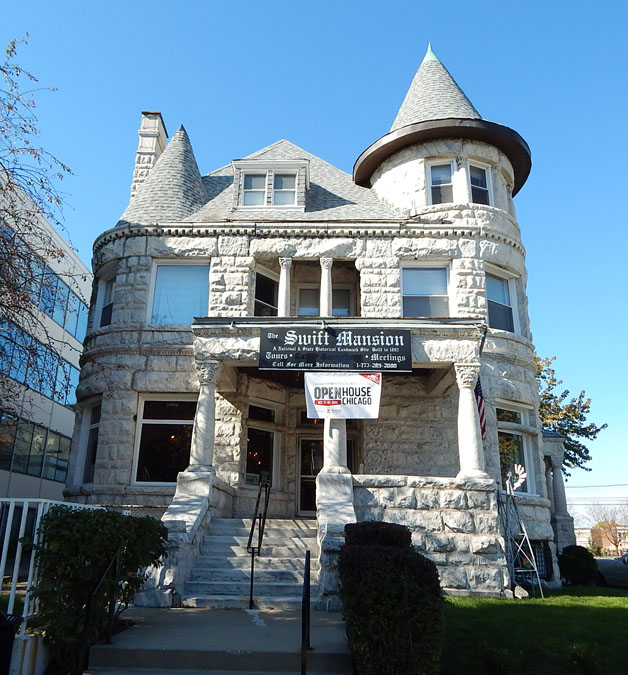
The Swift Mansion


Like the Glessner house, the Swift mansion at 4500 South Michigan Avenue is a reminder of the period in the late 19th and early 20th centuries when the South Side was home to many of Chicago’s business and social leaders.  A rare survivor of that era, now set amidst apartment buildings, business blocks, and vacant lots, the mansion’s history reflects the changes that the community has undergone since it was constructed more than a century ago.


On October 2, 1890, Chicago newspapers carried a detailed account of the marriage of Helen Swift and Edward Morris, which had taken place the previous evening at the home of the bride’s parents, 4502 S. Emerald Avenue.  The event was not merely another society wedding – it represented the union of two of the most powerful families in Chicago.  At the time, Chicago was a meatpacking city, and the three largest businesses were operated by the Swift, Morris, and Armour families.  Helen was the daughter of Gustavus Swift and Edward was the son of Nelson Morris.  Swift presented his daughter with a check for $5,000 “with a goodly sum in gold coin to act as a weight for the paper” and the happy couple set off for an extended honeymoon in Europe.


Swift planned another gift for his daughter and new son-in-law as well – a new house.  In 1892, plans were announced for a substantial marble-clad residence at the southwest corner of Michigan Avenue and 45th Street.  At the time, this portion of Michigan Avenue was lined with large mansions, set along what was considered one of the most beautiful streets in the entire city.  


The exterior exhibits elements of both the Romanesque and Queen Anne styles and features columns with elaborately carved capitals, dormers, a three-storey turret, and a large porte cochere along 45th Street.  Inside the rooms were richly finished with wood paneling, beamed ceilings, a beautiful carved staircase, and numerous fireplaces.


The architect of the house has not been confirmed, but the nomination form submitted when the building was listed on the National Register of Historic Places in 1978 indicated that the house may well have been the design of Willett & Pashley.  The partnership of James R. Willett and Alfred F. Pashley produced a number of distinctive residences in the city during that period.  Several of their published designs are very similar in scale and detail to the Swift mansion.  They are remembered today chiefly for their work with the Catholic Church in Chicago.  Willett befriended Patrick Feehan during the Civil War, and Feehan went on to become the first Archbishop of Chicago, serving from 1880 until 1902, during which time Chicago was elevated to an Archdiocese.  The firm designed his summer residence and St. Mary’s Training School for Boys, both located at “Feehanville” in present day Mount Prospect.  However, their most significant commission was the Archbishop’s elaborate Queen Anne style residence at 1555 N. State Street which still stands today.


Helen and Edward Morris moved into their home just as Chicago was preparing to host the World’s Columbian Exposition in 1893.  Newspapers note that Mrs. Morris gave dances and other parties in her beautiful new home.  Four children were born to the couple, two sons – Nelson II and Edward Jr., and two daughters – Ruth and Muriel.  In 1904, Edward Morris purchased a large lot, measuring 198 by 212 feet at the southwest corner of Drexel Boulevard and 48th Street, and spent nearly $100,000 building a new home, designed by Howard Van Doren Shaw.  It was here that he died on November 3, 1913 at the age of 47, leaving an estate estimated at $20,000,000.  Helen later married Francis Neilson, an English actor, and died in 1945.


After Helen and Edward Morris moved from their Michigan Avenue home, it was given to her brother Herbert and his wife, who died in 1911 and 1912 respectively.   The house was then acquired by John W. White. 

When he died in 1916, the Chicago Tribune gave an extensive account of the contents of the house when it was opened by the public administrator.

A “tomb” of art curios in musty surroundings was revealed yesterday when the house of the late John W. White, recluse and connoisseur, was opened by the public administrator, James. F. Bishop.

In the old house, 4500 Michigan avenue, there hung what is pronounced a Gainsborough.  A cathedral clock was standing among Roman bronzes and Italian marbles.  Violins of a bygone age reposed on teakwood carvings.

Mr. White died recently at the age of 75.  He had been ailing for more than a year.  So far as is known he had but one relative.  She is his daughter, the wife of Dr. Charles Chesman of Seattle, Wash., and she is coming to Chicago to close up the estate.

P. H. O’Donnell who for years was the legal adviser to Mr. White, described the art objects that adorn the lonely house which Administrator Bishop now has in charge.

“Mr. White was a man of genius,” said Mr. O’Donnell.  “He was a native of Kansas and at the time of his death had interests in Lyon, Kas.  He had held offices of trust and was a lawyer of ability.  He came to Chicago about fifteen years ago and established the Bankers’ Record Publishing house.  It netted Mr. White and his associates large returns.

“He was intent upon making money only that he might gratify his desires to possess objects of art.  He bought the old Herbert Swift mansion at 4500 Michigan avenue that he might have a model home on his own ideas.  He lived alone.

“So far as I know, no one but myself ever entered his home as a guest.  He employed an old man as a bodyguard and who came in once a day and attended to the housework.  The entire lower floor was given over to his art collection.  This extended to every form of rare object.  He was fond of violas and cellos.  Of these he had about a half dozen of rare make.

“There is a piano which he bought in Germany for $10,000.  It is capable of reproducing the tones of almost every instrument ever made.  Mr. White brought it to American that American piano makers might study it.

“There is a collection of cathedral clocks.  They are all huge, hand carved and wrought.  When Mr. White had them all running they would reproduce for him the chimes heard in the cathedrals of Europe.  One of these clocks alone had twenty-eight chimes.  The clock collection cost more than $100,000.

“He was fond of Irish ware and of this there is a rare collection.  One big rose jar is said to be valued at $15,000.  There is a tea set that cost $2,500.

“Along the walls are pieces of Roman statuary.  One of these is an interlacing of marble and bronze of surpassing handiwork.  He had no American paintings.  All the ten or fifteen paintings are old works, none more modern than a Gainsborough.  There is a room full of paintings, Japanese teakwood carvings, and Japanese vases of great value.

“The rosewood bedroom set used by Mr. White was hand carved and made for the late John Alexander Dowie, overseer of Zion.  Mr. White bought it after the death of the prophet.

“In the great room of the first floor is the cabinet of Otto, the ‘mad king’ of Bavaria.  It was brought to America by Mr. White years ago.  It is hand carved and opens in a peculiar fashion.

“All doors to the house are of oak and heavily barred.  The windows are all double barred.  Mr. White liked to be alone with his collection.  His companion was a little dog that always was with him.

“At the same time he was extremely fond of children and he bought a large sweep of lawn to the south of the mansion which he planned to make into a playground.  He already had expended $10,000 in preliminary work on it.

“It would be too bad to permit this collection of art to be thrown broadcast in an auction sale.  It should become the property of the city of Chicago.  There should be a corner for the collection in the Art Institute.”

Mr. White died alone, save the little dog that was always with him.

Public Administrator Bishop, under the law, where one dies intestate, forced an entry to the house to prepare for the disposal of the property.  This, however, will not be done, as Mr. White’s daughter will soon be in Chicago.

A suit of armor inside the front door greets visitors.
Is this a survivor from the White collection?

After White’s collection was cleared from the house, it was sold and occupied by various individuals including John Powers, who served for nearly 40 years as an Alderman in the City of Chicago.  The house was later used as a funeral home.


For decades following, the mansion served as the headquarters of the Chicago Urban League.  In 1995, it was acquired by the Inner City Youth and Adult Foundation, which occupies the building today.  


The Foundation, which provides many services to the community including transitional housing to formerly incarcerated men, graciously opened its doors for curious visitors during Open House Chicago, sponsored by the Chicago Architecture Foundation over the weekend of October 17th and 18th.  Tours were provided by the residents, who proudly shared their home with the throngs of visitors who came to view this relic of Chicago’s early South Side Gold Coast.  

Monday, October 26, 2015

The Cordon Club

Fine Arts Building, 410 S. Michigan Avenue
Home of the Cordon Club

In the first decades of the 20th century, the norm was for men and women to have their own separate clubs.  This did not mean, however, that the clubs for the opposite sexes might not have similar purposes.  Such was the case with The Cliff Dwellers and Cordon Clubs.

A well-known fixture in Chicago for more than a century now is The Cliff Dwellers Club.  Founded in 1907 as the Attic Club, and renamed two years later, the goal of the club was to bring together men engaged in and supportive of the fine arts.  John Glessner was a member, as were leading artists, authors, and architects including Louis Sullivan.  For decades the Club occupied quarters on the top floor of Orchestra Hall (now Symphony Center); since 1996 they have been perched atop the office building at the southwest corner of Michigan Avenue and Adams Street.

Forgotten to many is the fact that the women of Chicago had a similar club that occupied nearby rooms in the Fine Arts Building at 410 S. Michigan Avenue.  This week marks the 100th anniversary of the opening reception of the Cordon Club, of which Frances Glessner was a member. 

Caroline Kirkland, the long-time society columnist who wrote under the name “Madame X” for the Chicago Tribune (she was a close friend of Frances Glessner) provided a good overview of the opening of the club in her article dated Sunday October 24, 1915.

“The much discussed Cordon, the feminine counterpart of the Cliff Dwellers, is to have its opening reception next Thursday afternoon in its highly artistic rooms on the seventh floor of the Fine Arts building.  It is an interesting and promising undertaking, purporting to be a club for purely social purposes and consisting largely of women with some profession or definite calling in life.

Under this caption Mrs. Hobart Chatfield-Taylor is entered on the lists as a bookbinder, Mrs. Tiffany Blake as an expert landscape gardener, Mrs. Robert McGann as a painter, and Miss Helen Birch as a musical composer.

The membership is limited to 400.  It is full now, with a long waiting list of candidates.  It is about evenly divided between women who “do something” and those who lead merely domestic and social lives.  Perhaps the professional women predominate.

The club aims to provide a pleasant gathering place for the members and their friends where they can meet and have luncheon, dinner, or afternoon tea.  The rooms are decorated in the style of the Italian renaissance, modified by modern ideas of comfort and convenience. 

In choosing this period of art as the background for the club’s social life, its president, Miss Clara E. Laughlin, was governed by the thought that in the time of the Italian renaissance women played a larger, more important part in Italian life than ever before – or ever since, one might safely say.  They exercised a sway in politics and the world of learning which makes this period to the student one of the most interesting in history.

So, as far as possible, the ideas that governed the furnishing of interiors at that time are carried out in the rooms of the Cordon.  They have a fine copy of a cinque cento fireplace; also an excellent production of a medieval Italian doorway is one of the features of the main club room.  High, somber wainscoting is the background, and the general effect is rich and harmonious.

The name was chosen because the French word “cordon” means many strands woven together.

Writers, musicians, artists, actresses, business women, reformers, and women of wealth and leisure (if there is such a thing as leisure) are on the club roster.  Besides those already mentioned other well known names are the Mesdames Ogden Armour, Arthur Aldis, Chauncey Blair, Hobart Chatfield-Taylor, John Carpenter, Jacob Baur, Benjamin Carpenter, Robert Peattie, Joseph T. Bowen, Archibald Freer, John J. Glessner, John M. Clark, Kellogg Fairbank, Cyrus H. McCormick, Horace Martin, William J. Calhoun, Potter Palmer, Fannie Bloomfield Zeisler, Ella Flagg Young, and the Misses Grace and Edith Abbott, Edith Wyatt, Louise Burnham, Jane Addams, Mary Bartelme, Anna Morgan, Harriet Monroe, Alice French (Octave Thanet), Mary McDowell, Mabel Talliafero, and Frances Starr.  A shining galaxy!”

The club maintained their quarters in the Fine Arts Building for decades.  An article in the Chicago Tribune dated October 20, 1948 noted that the club rooms had been recently redecorated:

“Coral predominates in the new color scheme, and charcoal gray and mist green have been used for accent.  Old furniture has been transformed with slip covers, and several new pieces have been added, including mirrors, lamps, and tables.”

The Cliff Dwellers Club began admitting women many years ago, and in fact, the club has had a woman president.  So the idea of a separate club just for women seems a bit foreign to many of us today.  But in its day, the Cordon Club filled an important niche in the social and artistic life of Chicago.


Note:  The first president of the club, Miss Clara E. Laughlin was a prominent writer, editor, and later a radio personality.  Born in New York City in 1873 she lived most of her life in Chicago, graduating from the Chicago High School in 1890.  She wrote over three dozen books including biographies of Sarah Bernhardt, Ferdinand Foch, and James Whitcomb Riley, as well as her autobiography.  In addition, she wrote extensively for the Ladies Home Journal.  She died in 1941.

Monday, October 19, 2015

Glessner House Museum receives Driehaus Award


On Saturday October 17, 2015, Glessner House Museum was presented with the President’s Award for Stewardship from Landmarks Illinois during the annual Richard H. Driehaus Foundation Preservation Awards.  The award recognized five decades of stewardship for the building since its rescue from demolition in 1966. 

Landmarks Illinois President Bonnie McDonald, in presenting award, noted how the museum serves as a model for its work in restoration, preservation, and interpretation.  Accepting the award on behalf of the museum was William Tyre, Executive Director and Curator, whose acceptance speech is presented in full below.

On behalf of the board of directors and the staff of Glessner House Museum, I would like to thank the Richard H. Driehaus Foundation and Landmarks Illinois for this award and the recognition of the many people who have served as stewards of Glessner House for half a century.

Fifty years ago, Glessner house sat vacant and for sale and there was a very real threat of demolition.  In spite of its national significance and its designation as a Chicago landmark, which at that time was purely honorary, the building could easily have been lost to the wrecker’s ball.

But 1966 was also the year of passage for the National Historic Preservation Act and it was in that year that a small group of individuals came together with a dream not only to preserve the building but also to preserve the architectural legacy of Chicago, which was disappearing at an alarming rate at that time.

In the late 60s and early 70s, Glessner House was truly at the heart of the preservation movement in Chicago and the state.  Within its walls could be found the first offices of Landmarks Illinois, as well as those of the Chicago Chapter AIA, Inland Architect, and the Chicago School of Architecture Foundation which had been formed specifically to save the building.  The concept for the first historic landmark district in the city was born there as well, when the idea of preserving the surrounding Prairie Avenue district was considered.

In time, the function of the building changed and the idea of an accurately furnished historic house museum evolved.  Glessner descendants returned not only furniture and decorative arts, but also an amazing archive of materials to help interpret the house and its broader context within Chicago history.  Chicago’s oldest building, the Clarke House Museum, came under our purview as well. 

During all these years, countless individuals have contributed to the success and vibrancy of the institution.  Dedicated volunteers have done everything from coordinating fundraising events to clearing rubbish out of the house and from organizing our archival collection to stuffing envelopes.  Enthusiastic docents have given thousands of tours as the “public face” of the museum, and numerous individuals and foundations have stepped forward to provide financial support as members and donors. 

Talented craftsmen have lavished attention on every detail of the house.  They often donate their talents because they feel it is a privilege to work on such a significant structure.  The board and staff have shaped the vision for the institution from education and interpretation to programming and restoration. 

It has been my privilege every morning for the past eight years to enter through the front doors of this extraordinary building.  Not a day goes by that I don’t marvel at the architecture, the collection of decorative arts, and the remarkable lives of the Glessner family.  Nothing gives me greater pleasure than sharing those treasures with our visitors.  We look forward to sharing them with all of you as we embark upon our next fifty years.  Thank you.


The award, which is based on terra cotta ornament from the Methodist Book Concern building at 12-14 W. Washington St. (Harry Bergen Wheelock, architect, 1899) will soon be placed on display in our visitor’s center for all to enjoy.  

Monday, October 12, 2015

Arnold Arboretum


Exactly 125 years ago this week, Frances Glessner noted in her journal a trip to the Arnold Arboretum in the Forest Hills section of Boston, while traveling from her summer estate in New Hampshire back to Chicago.  Of the visit on October 13, 1890, she wrote:

“Yesterday morning (Isaac) Scott called early and took Lettie and me to see the Arnold Arboretum.  We went by train to Forest Hills and walked over the Arboretum.  It was most interesting and delightful.  The roads are all beautifully laid in this suburb with a nice side walk, beautiful winding roads, great trees and green grass.”


Arnold Arboretum was established in 1872 when the executors of the estate of whaling merchant James Arnold donated a portion of his estate to Harvard College for the establishment and support of an arboretum.  Charles Sprague Sargent (1841-1927) was appointed the first director the following year and served for 54 years, creating an institution that became a model for other cities across the United States and the world.  


Sargent was responsible for the 1,000 year lease whereby Harvard retained ownership of the land, but the arboretum became part of the Boston park system known as the “Emerald Necklace,” a seven-mile-long network of parks and parkways laid out by Frederick Law Olmsted between 1878 and 1892.  The design of the arboretum itself was a result of Sargent working closely with Olmsted, who laid out the general plan of paths and roads, and the groupings of plants. 


The arboretum covers 281 acres and includes nearly 15,000 accessioned plants, as well as an herbarium collection of more than 1.3 million specimens and an important research library containing in excess of 40,000 volumes.   Two years after Frances Glessner’s visit, the administration building was designed by Alexander Wadsworth Longfellow, Jr. of the firm of Longfellow, Alden and Harlow.  Longfellow was working in the office of H. H. Richardson at the time the Glessner house was designed, and was later a guest of the Glessners in their Prairie Avenue home. 

Forest Hills is a part of the Jamaica Plain neighborhood of Boston, noted for its hilly terrain and wooded areas.  The area south of Walk Hill Street in particular is characterized by curving tree-lined streets laid out in irregular patterns, the result of the gradual transformation of the area from country estates to a “streetcar suburb.”  Forest Hills is surrounded by the three final “links” of the Emerald Necklace – Arnold Arboretum, Arborway, and Franklin Park.  In addition, it is home to the sprawling 275 acre Forest Hills Cemetery, considered one of the finest 19th century rural cemeteries in the country. 

A section of Forest Hills, known as the Woodbourne Historic District, was listed on the National Register of Historic Places in 1999 and features a plan laid out in part by Frederick Law Olmsted, Jr., who would have been attending Harvard as a classmate of George Glessner at the time Frances Glessner visited the area in 1890. 


For more information on the arboretum, visit http://www.arboretum.harvard.edu/.  

Monday, October 5, 2015

The Chicago Symphony Orchestra 125th Anniversary Season

Chicago Symphony Orchestra, 1926

Over the weekend of September 18-19, 2015, the Chicago Symphony Orchestra launched its 125th anniversary season.  John and Frances Glessner were deeply involved with the orchestra from the time of its inception in 1891, raised considerable funds for the erection of Orchestra Hall in 1904, and were generous supporters throughout their lifetimes.  Theodore Thomas and Frederick Stock, the first two music directors who led the symphony for more than 50 years, were intimate friends.

John J. Glessner

Mayor Rahm Emanuel issued a proclamation in August 2015 honoring the symphony for its 125th anniversary.  Appropriately, the proclamation acknowledged the significant support provided by John Glessner in the first decades of the symphony’s history.  In honor of the CSO 125th anniversary season, we reprint the proclamation in its entirety below.

OFFICE OF THE MAYOR
CITY OF CHICAGO

RAHM EMANUEL
MAYOR

PROCLAMATION

WHEREAS the Chicago Symphony Orchestra performs its annual free Concert for Chicago in Millennium Park this year on Friday, September 18, 2015, and the Symphony Ball gala at Symphony Center on Saturday, September 19, 2015, as it launches its 125th Anniversary season; and

WHEREAS the first meeting for the incorporation of The Orchestral Association was held at the Chicago Club on December 17, 1890, during which a board of five trustees was elected to serve and a group of fifty-one businessmen, including Chicago pioneers Armour, Field, Glessner, McCormick, Potter, Pullman, Ryerson, Sprague and Wacker volunteered to serve as guarantors, each pledging their continued financial support; and

Theodore Thomas, Music Director, 1891-1905

WHEREAS Theodore Thomas, then the most popular conductor in America, was engaged as the Orchestra’s first music director and led the Chicago Orchestra’s first concerts at the Auditorium Theatre on October 16 and 17, 1891, conducting music of Wagner, Beethoven, Tchaikovsky, and Dvořák; and

Fundraising brochure for the new Orchestra Hall, 1903

WHEREAS Orchestra Hall, designed by CSO trustee and Chicago architect Daniel H. Burnham and completed in 1904 at a cost of $750,000, saw its dedicatory concert, led by Thomas, on December 14 of that year; and

Frederick Stock, Music Director, 1905-1942
Photo inscribed "To my best friends,
Mr. and Mrs. J. J. Glessner"

WHEREAS the Chicago Symphony Orchestra is a long-standing international cultural ambassador for Chicago and the United States of America having completed 58 international tours, performing in 29 countries on five continents, and

WHEREAS in 2011 the CSO and the Chicago Symphony Chorus’s recording of Verdi’s Requiem led by Maestro Muti won two Grammy awards, and, to date, recordings by the CSO have earned a total of 62 Grammy awards from the National Academy of Recording Arts and Sciences; and

WHEREAS the Chicago Symphony Orchestral Association has been an active collaborator with the Chicago Department of Cultural Affairs and Special Events in the development and execution of a Cultural Plan for Chicago, and the Chicago Symphony Orchestra’s Judson and Joyce Green Creative Consultant, Yo-Yo Ma, and the CSO’s Negaunee Music Institute continually work to share live classical music with all;

NOW, THEREFORE, I, RAHM EMANUEL, MAYOR OF THE CITY OF CHICAGO, do hereby proclaim September 18-19, 2015 to be CHICAGO SYMPHONY ORCHESTRA 125TH ANNIVERSARY SEASON OPENING WEEKEND CELEBRATION and encourage all Chicagoans to participate.

Dated this 3rd day of August, 2015.

Rahm Emanuel

Mayor

Monday, September 28, 2015

Fannie Bloomfield Zeisler

Glessner parlor, photo by James Caulfield

On Sunday October 4, 2015, George Radosavljevic, a member of the faculty at the DePaul University School of Music, will perform a recital on the Glessners’ 1887 Steinway grand piano.  Featuring works by Beethoven, Liszt, Chopin, Rachmaninoff, and Prokofiev, the performance is reminiscent of the many musical entertainments hosted by the Glessners.  In this week’s article, we will look at a musical given by Frances Glessner in 1890, at which the great pianist Fannie Bloomfield Zeisler was the performer.

FANNIE BLOOMFIELD ZEISLER
Fannie Blumenfeld was born in Bielitz, Austria (now part of Poland) in 1863 to Jewish parents.  When she was four years old, her family emigrated to the United States, and in 1870 they relocated to Chicago, where her father opened a dry-goods store.  She began her piano studies at that time and in February 1875, at the age of 11, gave her first public performance.  Three years later she travelled to Vienna with her mother to study under Theodore Leschetizky; she remained there for five years.

In 1883 she returned to Chicago by which time she had changed her name to Bloomfield.    She gave her first full concert in Chicago in 1884 and made her debut in New York the following year, the same year that she married attorney Sigmund Zeisler.  (Also a native of Beilitz, he earned his law degree at Northwestern University.  In 1886-1887, he served as the associate counsel for the defense of the Haymarket anarchists.)


Fannie Bloomfield Zeisler was one of the featured solo artists at the World’s Columbian Exposition in 1893, receiving praise for her performances.  She then toured German cities, her first European tour, earning the reputation as a first-rank pianist.  Of her abilities, the Britannica Online Encyclopedia says, “Acknowledged as one of the foremost concert pianists in the world, she combined flawless technique with a fiery and powerful expressiveness that enabled her to render the classical and Romantic masterworks with entire authority.”

She made several additional tours through Europe and made annual tours of the United States, performing each season with Theodore Thomas and the Chicago Symphony Orchestra.  Together they championed the German repertoire.

She gave her final performance in Chicago in 1925.  Her program included Beethoven’s Andante favori which she had played at her first public performance 50 years earlier, as well as concertos by Chopin and Schumann.  She died in Chicago on August 20, 1927.

A biography, entitled Fannie Bloomfield Zeisler: The Life and Times of a Piano Virtuoso, written by Beth Abelson Macleod, was published by the University of Illinois Press in July 2015. 


THE PERFORMANCE
In late November 1890, Frances Glessner wrote to Fannie Bloomfield Zeisler asking her to give a recital in her Prairie Avenue home.  She received the following reply, dated December 4th:

Mrs. John J. Glessner,

Dear Madam:

I received your kind letter and turned it over to my manager, who will write you about dates and terms.

I am not in the habit of accepting such engagements, but I do so at rare intervals and should be pleased to play in your home, as I know you to be one of the few really musical patronesses of my art in Chicago.

Yours sincerely,
Fannie Bloomfield Zeisler

The musical was set for Friday December 19, 1890.  Frances Glessner sent invitations to 103 ladies, of which 75 attended.  As Glessner noted in her journal:

Fanny Bloomfield Zeisler played most splendidly – I never heard better playing.  She said she was inspired by the audience – they were most appreciative – she played a half hour then took a short rest, then played another half hour, then we had our breakfast – it was all prepared in the house and was delicious.

Unfortunately Frances Glessner did not record the program but she did note the breakfast menu:

Chicken broth – eggs a la crème – breasts of partridge – potatoes mashed with cream and browned – jelly – brown and white bread – rolls, olives, pickles – hen – risotto – frozen oranges – sand tarts – coffee and tea

Tables seating six were set up throughout the first floor and were presided over by Mrs. Carpenter, Mrs. O. R. Keith, Mrs. Edson Keith, Mrs. A. A. Sprague, Mrs. Otho Sprague, Mrs. Charles Hutchinson, Mrs. Dudley, Mrs. Potter, Mrs. William Armour, Mrs. George Armour, Miss Lunt, and Mrs. Stone.  The ladies “all were beautifully dressed, wore no hats – and, helped me to make everything go smoothly.”  Fannie Bloomfield Zeisler sat to Frances Glessner’s right at the main table.  The flowers were live violets, a large dish on the main table, and a pot on each of the smaller tables, wrapped in green crinkled paper and tied with violet ribbons.

Drawing by Harold R. Heaton, 1896

LATER YEARS
Fannie Bloomfield Zeisler became a good friend and was a frequent guest in the Glessners’ home, and, of course, the Glessners attended her many performances with the Chicago Symphony Orchestra.  In February 1896 she presented Frances Glessner with a signed drawing done by Harold R. Heaton, cartoonist for the Chicago Daily Tribune.  Frances Glessner hung the picture on the wall along with other photos and drawings depicting many of the musicians she welcomed into her home through the years.
Related Posts Plugin for WordPress, Blogger...