Showing posts with label Fanny Glessner. Show all posts

Wednesday, March 25, 2020

Frances Glessner Lee - the early years

Today, March 25, 2020, marks the 142nd anniversary of the birth of Frances Glessner Lee, known as Fanny in her younger days. It was to be a day of great celebration - reopening her fully restored childhood bedroom after a two-year, $100,000 restoration made possible by the generosity of many members and friends of Glessner House and the dedicated work of several talented craftsmen.

In the near future, we look forward to rescheduling this milestone event in the history of the House, along with welcoming author Bruce Goldfarb for a talk and book signing of his new biography of Lee, 18 Tiny Deaths: The Untold Story of Frances Glessner Lee and the Invention of Modern Forensics. Until we are able to do so, however, we present a selection of our favorite images of Fanny from the first decade of her life. These images were all taken between the time of her birth in 1878 and the move of the family into their new home at 1800 S. Prairie Avenue in December 1887, just a few months before her tenth birthday. Enjoy this step back into the days of childhood innocence - filled with wonder, excitement, and taking joy in the simplest of things. Hopefully you can find a few moments today to do the same.

The earliest photo of Fanny, taken June 26, 1878, age 3 months and 1 day.

Fanny, as she appeared at six months, taken September 22, 1878. What exactly was her mother feeding her??


Fanny, shown with her mother and brother George in February 1880. George was 6-1/2 years older than his sister. 

Fanny and George enjoying a moment in the garden of their home on West Washington Street at Morgan Street, circa 1881.

Fanny, age 5, taken March 1883.

This photo of Fanny was taken in June 1883. Her mother sent it to an artist in Florence, Italy, who created the crayon sketch shown below, which Frances Glessner presented to her husband as a Christmas gift that year.

This stereoview shows George and Fanny with their pet lamb, named "Fanny Lamb." The image was taken in September 1883, one month after the family moved into their new house at their New Hampshire summer estate, The Rocks. It was taken by Benjamin Kilburn, one of the country's largest producers of stereoview cards; his business was based in Littleton, NH.

Fanny's sixth birthday party, March 25, 1884. Fourteen neighborhood children attended the party and enjoyed a Punch & Judy show. Fanny's father "excused himself from the office" to attend.


Fanny in the library of her family home on Washington Street, circa 1884. She had three dolls which she named Ethel, Julia, and Isaac Scott, the last after a close family friend who was an important part of Fanny's childhood.

Fanny, enjoying a popular Victorian game known as hoop rolling, circa 1884.

Fanny with her mother, circa 1885.

Fanny in April 1886, age 8.

Fanny with her father, circa 1887.

Fanny in a reflective mood, taken the same day as the photo above.


Monday, June 20, 2016

A Letter to George and Fanny - 1881


The art of writing a letter is quickly fading into obscurity, but in the late 19th century, it was the predominant form of communication.  The museum collection contains thousands of letters written to the Glessners, including many written to each other during times of separation.  In this article, we will examine one of the most fascinating – a letter written by John Glessner to his children George and Fanny in 1881.

What sets this letter apart from others in the collection is John Glessner’s clever use of illustrations to depict words or phrases.  In some cases the substitution is literal – a picture of a bottle of medicine in place of the actual word.  But often, the illustration is more creative – a picture of a lion representing the words “lie in.”  Other illustrations depict what Glessner is writing about – a picture of a boy feeding a duck – as he imagines what his children are doing in his absence.

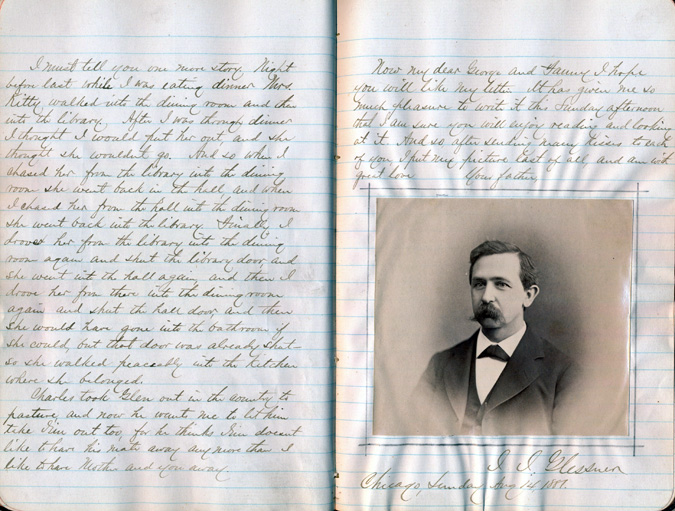
The letter sent to Glessner’s children in August 1881 is 36 pages long and is set within a leather bound journal stamped “A LETTER TO GEORGE AND FANNY.” on the cover.  It clearly took up a full Sunday afternoon to create the contents including selecting and pasting all of the illustrations from newspapers and periodicals.  A few illustrations are hand drawn, and two photographs of family members are included as well. 

John Glessner penned the letter to George (age 9) and Fanny (age 3) shortly after they left to spend the summer at the Twin Mountain House in New Hampshire with their mother and two female servants, Katy and Lizzie.  (Their own summer home, The Rocks, was not built until 1883).


The letter begins “My dear children” and continues:

“I have intended writing you a letter but so many people have called to see me about so many things in the evenings and on Sundays that I couldn’t write before, and now I send my letter in a book.

“When I come home there is no little boy and no little girl to meet me, and I miss you very much; but I think of you both very often – first of George and then of Fanny, and then of Fanny and then of George, and cannot tell which one I love the best, and so conclude I love you both the best.

“After you have read this far you must do what this boy is trying to do – “

(referring to a hand drawn illustration of a boy doing a hand stand).


He then goes on to recount their departure and the reason for their trip:

“First I’ll show you how you looked to me when I last saw you.  And then how I looked as I walked away from the station.  The reason why I look so much the largest is because I was so near and you were so far away.

“Why did I send you from home when I couldn’t go too?

“THE WISE ENJOY GOOD HEALTH – That is why!

“And that you might not be compelled to take MEDICINE.”

Health and medicine are references to George’s severe allergies and the relief he experienced when spending time in the White Mountains of New Hampshire.


A few pages later, Glessner pondered what his children might be doing:

“I thought of you both fishing and I wondered what else you would do.

“Perhaps – George might sail a boat, perhaps Fanny might scrape up acquaintance with somebody’s nice little dog.”


A bit later on, Glessner writes:

“And when I go to bed I sometimes dream of you.  And one night I dreamed that I saw you leaving Boston for the Twin Mountain House; and if you will turn over the page you will see . . .

“How you looked.  First was Mother at the head of the procession, and George holding on to her, and Fanny holding on to George, and Katy holding on to Fanny, and Lizzie holding on to Katy, and a whole string of bundles and baskets and band-boxes and satchels and trunks holding on to Lizzie.

“Bear in mind this was only a dream, but perhaps you really did look a good deal like that picture.”


A reminder to be well-behaved follows:

“You see I think of you in every way, but love most to think of George as a good big boy who is kind to and takes good care of his little sister, and of Fanny as a sweet, well-behaved little girl, and of both as loving Mother and doing as she says, and of all of you eager to see me, and then I imagine you look just like this.

“I can’t make a picture of Mother alone; if I could she should be at a table, writing to me.

“She must lie in (lion) the bed and rest all she can, and you must not disturb her, for she must get strong and well, too.”


He spends a good deal of time describing what he is observing at their Chicago home:

“Georgie’s farm or at least some of its products.

“And some of our flowers, but these are not as pretty as ours.  There were eight of these large lilies on one stalk at one time.  The pansies are beautiful.  And nearly every evening five or six humming-bird moths come to the phlox bed.”


Glessner was well aware of his son’s interest in fire engines, so included the following:

“Last night I heard a fire alarm and began counting as I knew George would do, and pretty soon I heard a steam fire engine go by on Randolph street, and thought if George were here wouldn’t he run to look at this!

He also includes illustrations of the servants left at home:

“You like to think of your friends at home I know.

“Here’s Alice when she sets the table (not often).

“And here’s Mary when she clears it off.

“You must look very closely or you’ll not be able to distinguish one from the other.”

(The two illustrations are identical).


Glessner remembered to include illustrations of the pets and animals at home as well:

“Here are some of your friends whom you will be glad to see when you come home – Tom, Ned, Jim, Glen.”


The letter draws to a close with a long story about their cat, Mrs. Kitty, and later a bit about their horses Glen and Jim.  In closing, Glessner writes:

“Now my dear George and Fanny I hope you will like my letter.  It has given me so much pleasure to write it this Sunday afternoon that I am sure you will enjoy reading and looking at it.  And so after sending many kisses to each of you, I put my picture last of all, and am with great love, Your Father, J. J. Glessner.  Chicago, Sunday Aug. 14, 1881.”


The letter is a charming relic of an era when the written word was cherished as the main mode of communication.  Although written 135 years ago, it still clearly conveys the love a father had for his children, and the delight it must have given them upon receipt.

Tuesday, March 29, 2016

The Glessner House School Room

Photo by Hedrich Blessing, 1987

The last stop on a tour of Glessner House Museum is the school room.  Situated at the southeast corner of the house, it is the only family space located at the basement level.  Although more simply finished than other spaces within the house, in some ways, the school room most effectively shows Richardson’s brilliance in executing the floor plan for the house, and how carefully he considered function and circulation.  In this article, we will examine those issues, as well as taking a look at the room as its function changed over the course of the last 129 years.

A SCHOOL ROOM FOR THE CHILDREN


As originally designed, the room was to serve as the school room for the Glessners’ two children, George and Fanny, who were aged 16 and 9 respectively at the time the family moved into the house in December 1887.  It is the only room in the house to be finished in pine.  This does not reflect a desire to cut costs, for even the servants’ bedrooms are trimmed in quarter sawn oak.  The pine is more a reflection of the overall design of the room, which incorporates many features of the Colonial Revival that became popular following the centennial of the United States in 1876.  The room is dominated by a huge paneled fireplace faced in dark brick.  Dentil trim, a beamed ceiling, and fluted pilasters all reflect Richardson’s interest in using Colonial detailing, and pine was considered the most appropriate choice for these types of interior spaces.


What is most impressive about the room, however, is how it is accessed.  Located just inside the main entrance of the house, three doorways enable the room to function as an independent space within the larger house.  The entrance way leading from the main hall down six steps can be closed off with a paneled pocket door, making the doorway all but invisible to visitors going up and down the main stair case.  Having the room located at the front of the house allowed for the friends of the Glessner children to easily come and go without disrupting activity elsewhere in the house.

A second doorway, up two steps at the southwest corner of the room, leads to the entrance from the porte cochere.  In this way, the children and their friends would have had direct access to the courtyard when the weather was favorable for outdoor activities.  This doorway also opens to the base of the three-story spiral staircase, which allowed the children easy access to their bedrooms and bathrooms on the second floor. 

The third doorway, at the northwest corner of the room, leads into the basement, accessed by going up two stairs.  The floor level of the basement is 24” higher than in the schoolroom – which was dug deeper to permit greater ceiling height in the room.  The first room in the basement off of the school room was possibly used by George Glessner as a dark room.  It is known that he did develop some of his negatives at home, and the proximity of this space to the schoolroom, combined with the fact there is only one small window, would have made it an ideal space for this purpose.  Continuing through this room, one has access to the full basement and then the staircase leading to the kitchen.  In this way meals could easily be taken to the children and their tutor, again without disrupting other activities in the household.

It is interesting to note that all three doors in the room are solid oak.  In each case, however, the door has been faced in pine on the school room side – even the door leading into the basement has the more expensive oak on the basement side of the door – clearly a sign that pine was not used to save money!

The room had central heat, as did the rest of the house, but in this space, which is nearly 50% below ground level, a large radiator was hung on the north wall of the room, and then covered with a huge brass panel.  Presumably that system worked well.  The radiator has long since been disconnected, and, as a result, the room continues to be the coolest in the house during the winter months.


In addition to the large work table in the middle of the room (originally the dining room table in the Glessners’ previous home), ample bookshelves held the children’s books and other items related to their school work.  Numerous cardboard boxes, carefully numbered, held hundreds of George’s glass plate negatives.  Of particular interest, along the north wall beneath the radiator, was a table which held various pieces of George’s equipment including a telegraph that connected to several of his friends in the neighborhood, and a fire alarm that was connected directly to the Chicago Fire Department.  (For more information, see the blog article “George Glessner and His Love of Technology” dated January 2, 2012).


Not surprisingly, the room functioned as the center for Christmas celebrations when the children were young.  In December 1888, George photographed the small table-top tree displayed on the school room table, decorated by the children on Christmas Eve.

THE CHILDREN ARE GROWN


Both children married in 1898, at which time the Glessners made the decision to convert the school room into a sitting room.  The central table and its chairs were given to George and his wife Alice, who returned them to their originally intended use in their dining room.   Plans originally called for an extensive redecoration of the room, and in January 1899, Frances Glessner noted that Louis Comfort Tiffany had been consulted about ideas for the space; those plans were never executed.  


The Glessners commissioned A. H. Davenport, the Boston-based firm that had made numerous pieces of furniture for the house when they first moved in, to make new pieces for the room.  The furniture included a sofa and adjustable back chair, copies of pieces in their library, both covered in the same cut-velvet fabric, Utrecht, by Morris & Co.  A sofa table was designed with a removable panel on the top to hold books.

LATER HISTORY
The Lithographic Technical Foundation occupied the house from 1946 until the mid-1960s.  Ironically, they returned the room to its original function as a class room.  In the image below, taken in 1946 by Hedrich Blessing, the room is furnished with a series of student desks, suitable for the seminars and other training sessions held in the house.


After the house was rescued from demolition in 1966, the school room took on a new use.  Given its proximity to the front door, it functioned perfectly as an office, the executive director and her assistant easily able to answer the door when visitors arrived, often for impromptu tours.


By the mid-1970s, significant work was needed in the room, including the floor which was badly rotted due to there being only a dirt floor beneath.  The entire maple floor and chestnut sleepers beneath were removed, concrete poured, and a new maple floor installed.  


Missing sections of bookcases were recreated, and repairs were made to the staircase and fireplace. 


Eventually, the offices were moved elsewhere in the building, and the room was restored to its original appearance as the school room.  Many of the original items, including a Morris Sussex chair, vases, pictures frames, and numerous books, were returned to the museum by the Glessner family and were put back into the room, based on the historic photos taken by George Glessner.


Today, the school room, with its books and writing tablets spread across the table, gives the appearance George and Fanny have just stepped out for a few minutes.  The space is of special interest to the many children who visit the house – unable to imagine the idea of their teacher coming to them, and having a classroom in their own home.  It reinforces the importance of education that the Glessners placed on their children, prompting John Glessner to recall:

“Over the threshold of this has passed a regular procession of teachers for you – in literature, languages, classical and modern, mathematics, chemistry, art, and the whole gamut of the humanities and the practical, considerably beyond the curricula of the High Schools. . . Of this I am sure, that it gave to each of you a great fund of general information, a power of observation and of reasoning, an ability and desire for study, and to be thoroughly proficient in what you might undertake.  If ever there was a royal road for that, you had it . . .”


Monday, December 22, 2014

The Christmas Pie


With Christmas just three days away, we take a look at a Glessner Christmas tradition that delighted George and Fanny in the first years they lived in their home on Prairie Avenue.  The custom was known as the “Christmas pie.”

Glessner house tree, 1888

Frances Glessner references the pie in her entry for Christmas 1888:
“We all hung up our stockings and trimmed our pretty little tree just three feet high.  It stands on the table in the school room.  I filled the stockings.  Christmas morning we were roused by Fanny bringing in our stockings . . . We had a lovely Xmas pie covered with holly and smilax.  The presents were buried in the tin pan in rice.  We had a great deal of sport pulling them out, the labels hung out.  There were rhymes on each one.”

The idea of a Christmas pie was not unique to the Glessners.  The tradition dates back to the early 1700s if not earlier as referenced in the well known English nursery rhyme “Jack Horner’s Christmas Pie”:
Little Jack Horner
Sat in the corner,
Eating a Christmas pie;
He put in his thumb,
And he took out a plum,
And said,
What a good boy am I!

Mother Goose, 1901

The idea was further popularized in a book entitled “Christmas Pie” published in 1879 by Ella Maria Baker.  Many of the references to other Christmas pies indicate that it was a more traditional pie made to be eaten, with toys baked inside.   A story by Mrs. Etta Austin Blaisdell McDonald published in “Rhyme and Story Primer” in 1916 indicates that the main purpose of the pie may have actually been the toys inside, and not so much as a dessert.  She wrote:
“Jack Horner’s grandmother made a big pie for him.  It was a Christmas pie.  She put the pie on the table.  The pie was not good to eat.  It was in a big dish.  Jack’s grandmother put toys in the Christmas pie for the children.”

Some pies were clearly made not to be eaten.  In 1908, the educational guide “Primary Plans” published ideas for a Christmas pageant in which it was suggested that a Christmas pie be made in a large washtub and filled with toys, fruit, and candies.  It was large enough to hold a small child, dressed as a fairy, who would pop out at the appropriate moment.  The pie was covered with heavy brown paper painted to look like the actual top of a pie. 

In 1889, John Glessner wrote a poem about the Christmas pie:
“Dear Christmas pie –
The pie’s the thing
Its praises sing
All you and I.

And song birds in pride overweening
Their poetical plumage are preening
There’s Browning and Whiting and Blueing and Greening –

In depths of rice
Are many things nice
Pray put in your thumb
And pull out a plum
And read what is writ without changing its meaning.”

Glessner cleverly included the names of two poets in his poem.  Browning is a reference to the great English poet Robert Browning (1812-1889) who had died just days earlier.  Whiting is a reference to William Whiting (1825-1878), an English writer and hymnist, who also published two collections of poetry.  He is best remembered today for his 1860 hymn “Eternal Father, Strong to Save” which in the late 1870s was adopted by the U.S. Navy as their official hymn.  Blueing and Greening were simply added in humor as the names of the two poets were also the names of colors.


Today, a recreated Christmas pie occupies a place of honor every year in front of the small table top Christmas tree in the Glessner schoolroom.  Next time you visit the museum, be sure to notice it and reflect on this charming custom from Christmas past.

Monday, September 1, 2014

Tableaux Vivants

Fanny Glessner as Yum Yum

Exactly 125 years, on August 31, 1889, Frances Glessner noted in her journal, “Isa (Coolidge) went to town with George to buy some articles for the evening – they were getting up some tableaux.”  The family was in residence at their summer home, The Rocks, in the White Mountains of New Hampshire, and the tableaux were to provide the evening entertainment.

The term tableau vivant (tableaux vivants plural) means “living picture” in French, and refers to amateurs or professionals dressed and posed to represent works of art or other scenes.  During each tableau, the people on display do not speak or move.  This form of entertainment became very popular in the 19th century, before the widespread availability of color reproductions of artwork.  The tableaux might be presented in a drawing room following dinner, as a sideshow at a county fair, or elaborately staged in a theatre, one following another to tell a story.  The idea was similar to the “magic lantern shows” that became popular during the Victorian era.

The tableaux vivants to be presented at The Rocks were announced by a formal notice, as indicated in the journal:

“We found a notice put up in the hall that an entertainment would be given for the benefit of The Rocks.  John pinned another one above it saying the proceeds would be used to provide water for the great unwashed heathen visiting The Rocks.”

The latter reference being a humorous acknowledgement of the house guests then in residence, a few of whom were forced into participating.  Elizabeth Sprague and Caroline Kirkland both “rebelled strongly at being put on exhibition” but only Miss Kirkland was able to get out of it. 

The tableaux drew upon characters ranging from opera to ancient civilizations.  Fanny portrayed two characters – Yum Yum from Gilbert and Sullivan’s The Mikado, and Brunhilde from Richard Wagner’s opera cycle, The Ring of the Nibelung.

Fanny Glessner as Brunhilde

The entertainment proceeded thusly:

“The first tableau was of Fanny as Yum Yum – bound up in a window curtain and bed quilt.  Then Miss Coolidge as an Indian with a drawn bow made of a barrel hoop.  This one they called a truthful savage.  Then Elizabeth in a white Grecian costume (cheese cloth), “the modern liar,” all to illustrate something I said about civilization making people lie.  Then Miss Scharff was an Egyptian princess – then all four together.  Then came Fanny as Brunhilde stretched out on the lounge which was covered with my shawl – her dress was of cheese cloth – both arms bare – hair down – a wing affair on her head (turkey wings) a spear of paste board and the Brown’s boiler cover laid over her dear little stomach and lungs.  George stood by her – with a bare arm, one of the fur rugs bound over him, a blonde wig, made of rope, on his head.  He awakened Fanny with a kiss – we pelted them with flowers which had been thrown out in the afternoon.”


And thus drew to a close a charming evening of entertainment, forever preserved in Frances Glessner’s journal and in these two photographs taken by her son George.

Monday, March 10, 2014

The Jekyll Island Club


On Thursday March 13, 2014 at 7:00pm, Executive Director and Curator William Tyre will present a lecture in the museum coach house entitled “Glessner Travelogue 1889 – Florida and Cuba.”  Exactly 125 years ago, the Glessner family escaped the Chicago winter and embarked on a month long journey to Florida and Cuba.  In this lecture, attendees will retrace their steps using Frances Glessner’s detailed and often humorous account of the trip, accompanied by period photographs and illustrations.  Tickets are $10 per person and $8 for museum members.  For more details, or to make reservations, call 312.326.1480. 

During the Glessners’ journey back to Chicago, they stopped for three nights at the Jekyll Island Club, located off the Georgia coast at Brunswick.  The legendary club was one of the most exclusive ever constructed in the United States, with members including the Rockefellers, Vanderbilts, and J. P. Morgan. 

The Club was founded in 1886 by a group of New York businessmen who purchased the island for $125,000.  Shares were sold and membership was strictly limited to 100 families, with the largest number of members coming from New York.  Chicago ranked second in membership; early members included Prairie Avenue neighborhood residents Marshall Field, Norman Ream, Nathaniel Fairbank, Colonel John Mason Loomis, Samuel Allerton, John Wesley Doane, and Wirt Dexter.  George Pullman was elected to membership in 1888 but never officially joined.


Attorney Wirt Dexter, who resided at 1721 S. Prairie Avenue, was especially prominent in the affairs of the club and was named chairman of the building committee.  Fellow Chicago attorney Ezra McCagg served as chairman of the committee on landscape engineering.  Dexter’s committee selected Charles A. Alexander, a well-known Chicago architect, to design the club house, and McCagg’s committee chose H.W.S. Cleveland to lay out the grounds.  (Cleveland had been hired by Chicago’s Graceland Cemetery to undertake significant improvements to the landscape, so was also well known in the city).  The clubhouse was completed in January 1888 at which time the Club officially opened and the first guests arrived. 

The Club was family oriented and activities included hunting, riding and camping – and ladies were encouraged to participate.  A gamekeeper was hired to keep the island stocked with deer, turkeys, pheasants, and quails.  Many of the families built large “cottages” and a large golf course was laid out.  The Club thrived through the 1920s but the Depression caused significant changes and resulted in the creation of a new level of associate membership to attract younger members and keep operations afloat.  But it was World War II that ultimate sounded the death knell of the club, and the island was purchased by the State of Georgia in 1947.  It operated for many years as a public resort and in 1985 opened as the Radisson Jekyll Island Club Hotel.  It still operates as a hotel today, although no longer under the management of Radisson.

During their 1889 visit, the Glessners were the guests of Murry Nelson, a Chicago neighbor who resided at 1623 S. Indiana Avenue.  Nelson had arrived in Chicago in 1856 and established a grain commission and shipping business, Murry Nelson & Co.  Prominent in politics, he was the “doorkeeper” of the 1860 Republican convention held in Chicago that nominated Lincoln for president, served as a member of the Cook County board of commissioners, and was the first president of the county drainage board. 

The Glessners arrived on Friday March 22, 1889.  Following are several excerpts written by Frances Glessner in her journal:

We met Mrs. Pearsall of New York at Jekyl Island, and Mr. Renwick, architect of the New York Cathedral, Mr. and Mrs. Woodruff of Toronto and a few others.  I arranged my things in my room – and after dinner we sat in the parlor.  Going over in the boat from Brunswick, Mrs. Schley, wife of the manager of the Club, came and sat by me and told me about the different points of interest.


Saturday morning we drove on the beach in a one horse wagon with seats for four persons.  We first drove through the woods and visited the old (Horton) house.  It is a very interesting old ruin built of “Tabby” or coquina made of oyster shells and cement.  There was a large fig tree near by and plum or cherry trees – large tress have grown up inside the house – on the hearth stone and crowding the fireplace a large tree came, and all was overgrown by vines and foliage.  The game keeper showed us the pheasants and quail.

The beach is twelve miles long, very hard and broad when the tide is low.  We drove over in high tide.  We picked up shells and drove home the shell road.  At Jekyl the guests breakfast very late, lunch at two or half past, and dine between seven and eight.

In the afternoon Saturday we (John and I) walked to the beach with Mr. Nelson – we walked about four miles.  In the evening we sat in the parlor and talked.  Sunday we walked in the morning, and in the afternoon drove again to the beach.  We sat in the hall in the evening.

The Glessners' daughter Fanny celebrated her eleventh birthday on March 25.  A special cake was presented during her birthday breakfast in the club dining room and the following poem, written by her father, was read:

Here’s a sweet little girl aged 11
Who thinks Jekyl Island a heaven
Till her 12th birthday
She’ll continue to say –
This dear little maid of 11 –
That Jekyl Island is best
For a birthday breakfast
And she’ll want to come back to the heaven.
She’s careless of freckles
Our dear friends at Jekyl’s
Have made us at home on the isle of the sea
To celebrate here this 11th anniversaree.


To learn more about the Jekyll Island Club, see The Jekyll Island Club: Southern Haven for America’s Millionaires by William Barton McCash and June Hall McCash (The University of Georgia Press, 1989).
Related Posts Plugin for WordPress, Blogger...