Monday, May 9, 2022

The Story of "Meditation" by Paul Dubois


In 1968, the Glessners’ grandchildren, John Glessner Lee and Martha (Lee) Batchelder, returned 143 items of furniture and decorative arts to the house, the first of many donations which have allowed us to restore the interior to its appearance during the Glessner family occupancy (1887-1936). Among the items in the first donation was a bronze sculpture of a seated man deep in thought which until recently was misidentified in the museum database. The record has been corrected. This is the story of that sculpture.

When the artwork was first accepted for the house in 1968, the donor record listed it simply as a bronze sculpture entitled “The Thinker.” The next year, an appraisal referred to it as the “Scholar.” In 1971, a curator with the Art Institute identified it as “The Thinker,” misattributing it to the Belgian sculptor, Paul Du Bois (1859-1938). Two additional appraisals in 1984 and 1991 identified the sculpture as the “Seated Philosopher,” artist unknown (somewhat surprising given that the name of the artist, P. DUBOIS, is written in large letters on the back side of the sculpture). It is no wonder that there has been some confusion over the years!


Paul Dubois

The actual artist is Paul Dubois, born in Nogent-sur-Seine, France in 1829. Known primarily as a sculptor, he also achieved later success as a portrait painter. He initially studied law at the request of his father and did not begin his training as a sculptor until the age of 26. Dubois first exhibited at the Paris Salon in 1857, the salon being the official art exhibition of the Academy des Beaux-Arts in Paris, and widely regarded as the greatest annual art event in the Western world at the time. The year after the salon, Dubois entered the atelier of Armand Toussaint at the Ecole des Beaux-Arts.


In 1859, he moved to Italy, which would become his home base for four years, studying and copying great sculptures in Rome, Naples and Florence, leading to his work often being described as neo-Florentine. It was during this time that he created plaster models for two of his best-known works, Saint John the Baptist as a Child and Narcissus, both of which were exhibited at the Paris Salon in 1863. Narcissus was awarded a second prize medal, and the model was purchased by the State. A version executed in marble was later added to the façade of the Louvre Palace.

Bronze copies of both works were made and sold in Europe and the United States. The Glessners acquired a 30-inch copy of Saint John, which they displayed atop a cabinet on the landing of the main staircase, as seen in this image from 1923.


Of St. John, an 1888 article in Harper’s Magazine noted:

“M. Dubois’s St. John, if the allusion may be permitted, was a forerunner in sculpture. By his inspired movement, by the prophetic ardor of his gesture, by his delicate boyish head, with fixed eyes and speaking lips, he carried with him all the young French sculptors, and led them to Florence, where they proclaimed Donatello to be the honored ancestor of modern plastic naturalism.”

Other works by Dubois include Le Chant, installed on the main façade of the Opera Garnier in Paris, and the equestrian statue, Joan of Arc, commissioned by Reims Cathedral and first presented at the Paris Salon in 1889. In addition to the bronze version placed in front of the cathedral, additional copies were made for placement in front of Saint-Augustin Church in Paris and St. Maurice’s Church in Strasbourg. The final copy, a slightly reduced version, was installed in Meridian Hill Park in Washington, D.C. in 1923.

Dubois received many honors in his lifetime and was named a Knight of the Legion of Honor in 1867; in 1889 he was decorated with the Grand Cross of the Legion. In 1873, he was appointed curator of the Luxembourg Museum, and five years later became director of the Ecole des Beaux-Arts, a position he held until his death in 1905.

Tomb of General Christophe Léon Louis Juchault de Lamoricière

Lamoricière was born in Nantes in 1806 and rose in the military ranks during the Algerian campaigns in the 1830s, being appointed a major-general in 1840 and a general of division three years later. He served as minister of war in 1848, but, as a vocal opponent of Louis Napoleon, was arrested and exiled in 1851 after refusing to give his allegiance to Emperor Napoleon III. He was allowed to return to France in 1857 and died at Prouzel in 1865.

The year after his death, a subscription was raised to erect his tomb at Nantes Cathedral. (Officially the Cathedral of St. Peter and St. Paul, work on the building continued for 457 years, commencing in 1434 and finishing in 1891.) The architect of the tomb was Louis Boitte, and Dubois was engaged to design four allegorical statues positioned at each corner of the monument.

Meditation at far left, facing the back wall
(Andrew Dickson White Architectural Photographs Collection, Cornell University)

The 1888 Harper’s Magazine article, quoted earlier, provides a glowing review of Dubois’s work on the tomb:

“(At) the Salon of 1878, M. Dubois exhibited the tomb of General Lamoricière, the result of twelve years’ labor. The work won its author by acclamation the first place amongst living sculptors and classed him on a level with some of the greatest of the past. In this magnificent monument bronze and marble are married with perfect art. The martial figure of the general, draped in his shroud like a soldier in his cloak, rests under a pillared canopy of marble, guarded, as it were, by four seated figures at the angles of the tomb – Faith, Charity, Meditation, and Military Courage.

“Faith, a virginal and pure figure of a maiden, raising with fervor her clasped hands heavenward; Charity, holding in her lap two nurslings, seems like a vision of Andrea del Sarto or of Bernardino Luini realized in sculpture; Meditation, in the guise of an old man with finely intelligent features furrowed by reflection; Military Courage, clad in the armor of a warrior, resting on his sword, pensive and resolute, calm, superb, and strong.

“The Cathedral of Nantes possesses in this monument a work as fine as the finest work of the Renaissance, as fine as the tomb of Louis XII at St. Denis, as fine as the tomb of the Dreux-Brézé at Rouen. Nay, it is even finer, for the life in M. Dubois’s statues is more intense, the moral expression more profound. . . I have compared these statues, to Renaissance statues, but the comparison is only just so far as style and purity of conception are concerned, for M. Dubois’s work is animated by modern sentiment, and impressed with the character of contemporary life and thought.”

The Glessners’ copy of “Meditation”


The tomb was completed in 1879, so reduced versions of Dubois’s four statues were presumably made and offered for sale soon after. The Glessners acquired their copy by 1888, when it shows up on the west bookcase in the library, as circled in red in the photo above. Although the exact circumstances of their acquisition are unknown, several markings on the piece, which measures 13.75” in height, provide clues to its production.


As noted earlier, the artist’s name, P. DUBOIS, is prominently featured on the back side of the stone on which the man is seated. The piece was retailed through Tiffany & Co., the great New York retailer, as noted by its name being stamped in two places on the left side of the base.


The name of the Barbedienne Foundry in Paris can also be found on the left side of the base. 


The foundry was started by Ferdinand Barbedienne (1810-1892) in partnership with Achille Collas (see below). The business focused on selling miniature versions of statues from museums across Europe, seeking to democratize art by making it more widely accessibly. Later on, the firm started reproducing works by living artists, most notably Auguste Rodin. Following Barbedienne’s death in 1892, the firm was carried on for another six decades by his nephew, Gustave Leblanc.


Achille Collas


Achille Collas (1795-1859) was an important French engineer and inventor who developed a way of mechanically copying sculptures on a reduced scale, a process he called “réduction méchanique” or mechanical reproduction. The resultant popularization of small sculptures and statues literally transformed the bronze industry.

He perfected his mechanical reproduction machine in 1836, and two years later formed his partnership with Barbedienne. Copies could be produced in plaster, wood, ivory, and bronze, the latter being the most common. They soon produced a version of the Venus de Milo, but business remained slow until the firm displayed their work at the Great Exhibition of 1851 in London (also known as the Crystal Palace Exhibition), where it received a special medal. Collas was also awarded a medal in 1855 at the Exposition Universelle in Paris. Business thrived, and the firm had 600 employees by the early 1890s.

The official mark of Collas is set into the back side of the base as shown below. Collas is shown in side profile with REDUCTION MECANIQUE around the perimeter, and his name A. COLLAS below with the added word BREVETE meaning “patented.”


Alternate names

Although Meditation is clearly the official name of the sculpture, it was referred to by various names through the years, both in writings and in the plaques that were sometimes affixed to the copies. (The Glessner version has no such plaque). Names applied to the artwork through the years include:
-Etude et meditation (Study and meditation)
-Le Courage civil ou la Meditation (Civil Courage or Meditation)
-Le Penseur (The Thinker)
-Wisdom
-Seated Philosopher 

Later History 


Dubois’s four statues for Lamoricière’s tomb remained popular, and the full-size plaster models continued to be shown. It appears that more than one version in plaster was created, as subtle variations can be detected in surviving historic images. The illustration above is taken from the official illustrated catalogue of 19th century French sculpture exhibited at the Paris Exhibition of 1900. The undated postcard below, showing both Meditation and Faith, was produced when the models were displayed at the Art Institute of Chicago. 


Following Dubois’s death in 1905, his widow donated the 1878 plaster model of Meditation to the municipal museum in Nogent-sur-Seine, France, started by Dubois and fellow sculptor Alfred Boucher in 1902. The museum was decimated by pillagers by the mid-20th century and the artworks were placed in storage for protection. The Musée Dubois-Boucher reopened in 1975 and in 2008 purchased more than 40 artworks by the French sculptor Camille Claudel. Claudel’s childhood home was renovated and expanded, and the current Musée Camille Claudel opened in 2017, housing approximately half of her surviving works, alongside those of Dubois, Boucher, her mentors, and their contemporaries. 


Plaster model as currently displayed at the Musée Camille Claudel

Conclusion 


The Glessners’ copy of Meditation, which sits atop the south music cabinet in the parlor, tells a rich and complex story including the developments in 19th century French sculpture, the Barbedienne foundry (maker of several pieces in the Glessner collection), and the widespread availability of reproduced works of art due to Collas’ invention. The Glessners, who enjoyed studying history and art, would have been well aware of the story, adding to their enjoyment of the piece which occupied a place of honor in their home for nearly fifty years.

Wednesday, April 13, 2022

Richard Nickel and Glessner House


Nickel captured his reflection in this image of a second floor bathroom mirror

April 13, 2022, marks the 50th anniversary of the tragic death of Richard Nickel in the partially demolished Chicago Stock Exchange building at 30 North LaSalle Street, where he was attempting to salvage ornament from the Adler & Sullivan masterpiece. Nickel’s impact on the emerging preservation movement in Chicago was enormous, including his efforts to save Glessner House in the 1960s. A talented photographer, he documented the work of Louis Sullivan and other architects, his outstanding photographs serving as an irreplaceable record of Chicago’s architectural heritage that was disappearing at an alarming rate during 1950s and 1960s urban renewal.

This article will focus on Nickel’s close connection with Glessner House from the time it was threatened with demolition in 1965 until his death in 1972. Selected photographs of the house, from a rich archive of images by Nickel documenting the earliest years of the preservation and restoration of the house, are scattered throughout the article. We will conclude with a look at Nickel’s death, and the tribute service held in the courtyard of Glessner House two months after his passing.


Wheeler house (1812), Keith house (1808), and Glessner house (1800 S. Prairie Avenue), 1967

EARLY YEARS

Nickel was born in Chicago on May 31, 1928, to first-generation Polish Americans. After serving in the U.S. Army, 11th Airborne Division, during its occupation of Japan following World War II, he returned to Chicago to study photography at the Institute of Design, which soon became part of the Illinois Institute of Technology. He was recalled to the Army at the start of the Korean War, serving an additional year before resuming his studies at the Institute.

It was during this time that he enrolled in an architectural history course taught by the eminent landscape architect Alfred Caldwell, who instilled in him an abiding interest in architecture. Nickel began photographing the buildings of Louis Sullivan as part of a school project assigned by photographer Aaron Siskind, and it turned into an obsession.

Quickly discovering that many of the buildings were threatened by demolition, Nickel devoted himself to photographing and documenting them. He received his bachelor’s degree from I.I.T. in 1954 and, three years later, his Master of Science in photography with his thesis topic being “A Photographic Documentation of the Architecture of Adler & Sullivan.”


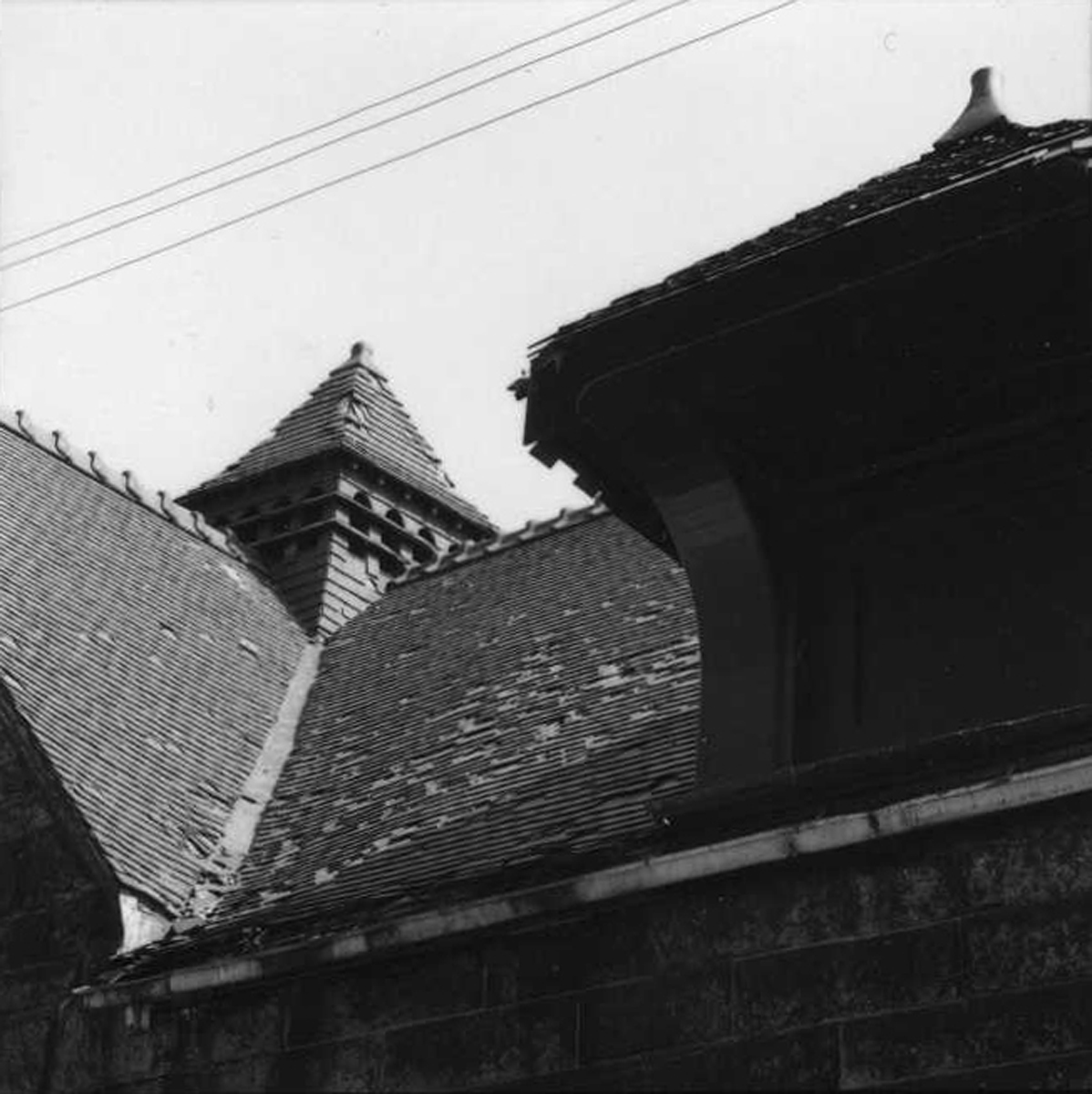
West roof and hayloft dormer

In 1960, Nickel learned that one of Adler & Sullivan’s most important buildings was to be razed – the Schiller Theater Building (later the Garrick) at 64 W. Randolph Street. He joined the picket line in front of the building alongside architects Wilbert Hasbrouck, John Vinci, and Ben Weese, and Alderman Leon Despres, an early champion of preservation and landmarking in Chicago. When it became clear that the building could not be saved, Nickel engaged Vinci and David Norris to assist him with a massive effort to salvage ornament, literally rescuing the plaster and terra cotta fragments as the building was being demolished around them.

GLESSNER HOUSE

The bonds formed during that effort proved valuable a few years later, when the Glessner house was put up for sale in early 1965. This time, the undertaking proved successful, and a resolution creating the Chicago School of Architecture Foundation was signed on April 16, 1966, by Nickel and 18 others. He was appointed a trustee and a member of the executive committee. By December, the new organization had acquired Glessner house for $35,000.


Glessner house for sale

Nickel co-curated the Foundation’s first exhibition, “The Chicago School of Architecture,” which opened in the fall of 1967 at the Chicago Public Library (now the Cultural Center). The next year, he curated the exhibit “The What and Why of Louis Sullivan’s Architecture,” held at Glessner House. In 1970, Nickel co-curated another exhibition at the Chicago Public Library – a photographic exhibit of great Chicago School buildings.

Throughout this period, Nickel used his skills as a photographer to create a valuable record of the Glessner house and Foundation happenings, starting with the condition of the building at the time of its acquisition and continuing through early restoration projects. He also photographed an original copy of John J. Glessner’s 1923 “The Story of a House,” which he then reproduced for the Foundation. (An updated version, incorporating many of Nickel’s copied photographs, remains for sale in the store).


Coach house

In late 1967, Nickel advocated for the recognition of Beatrice Spachner and her heroic efforts in leading the restoration of Adler & Sullivan’s magnificent Auditorium Theater, led by architect Harry Weese, another Glessner house founder. The Foundation sponsored a reception for Spachner, following the reopening of the theater in October, and presented her with a suitable award.

Nickel, along with Jim Schultz and Charles Simmons, came to the house every week to supervise the cleanup effort. A dumpster was placed in the blacktopped courtyard, and equipment left behind by the printing foundation was hauled out until the dumpster was filled, at which point it was removed and another set in its place. The process of emptying the house of objects and equipment unrelated to its original residential use took almost two years to complete.


Sign removal, December 1966

The Foundation was interested in collecting fragments of significant Chicago School buildings, and Nickel shared pieces from the salvage operations he had undertaken for more than a decade. He also helped coordinate the donation of items from existing Sullivan buildings including elevator grills from the Stock Exchange building removed during modernization, and iron balusters from the Carson Pirie Scott store. (A few terra cotta and cast iron fragments, from Sullivan’s Rosenfeld building (demolished 1958), and the Martin Barbe house (demolished 1963), remain at Glessner House, and are on permanent display in the Visitors Center).

STOCK EXCHANGE BUILDING AND DEATH

In 1970, Nickel learned that another of Adler & Sullivan’s most important buildings – the Chicago Stock Exchange – was threatened with demolition. Although he had grown weary of these battles, he couldn’t remove himself from the issue, and actively campaigned for the building’s survival in what became a major preservation fight in Chicago. The effort led to the formation of the Landmarks Preservation Council of Illinois (now Landmarks Illinois), originally headquartered at Glessner House.


Granite arch over female servants' entrance

By October 1971, scaffolding started going up around the building and Nickel found himself immersed in the salvage effort, this time led by architect John Vinci. The work included the complete removal of the original trading room at the behest of the Art Institute, which planned to restore and reconstruct it. That work concluded on January 31, 1972, but Nickel kept going back to the building to photograph the demolition and to remove additional ornament.

In early March, Nickel became engaged to Carol Sutter, with a promise that the Stock Exchange would be the last building for which he would undertake a salvage operation. On Thursday, April 13, he headed to the building to meet up with Tim Samuelson, who was to assist him in removing a piece of the building. Samuelson showed up but couldn’t locate Nickel. He alerted John Vinci and others, and they searched the building with flashlights until midnight. When they found a huge new hole in the middle of the trading room floor, they feared the worst.


Balusters, main staircase

Nickel’s parents reported him missing on Saturday, the same day Nickel’s car was found several blocks away, and a hard hat, tools, and a rope of his were found at the demolition site by Vinci. Police dogs found his briefcase that Monday. The search for his body was called off on Tuesday, and demolition work was allowed to resume. It was not until Tuesday, May 9, almost four weeks after he had disappeared, that his body was found by a Three Oaks Wrecking Co. worker; it took two hours to retrieve the body from the rubble.

On May 12, a funeral mass was held at Mary Seat of Wisdom Roman Catholic Church in Park Ridge, and he was laid to rest in Graceland Cemetery in a plot not far from that of Louis Sullivan. John Vinci and his architectural partner Lawrence Kenny designed the headstone.


On the first day of summer, Wednesday, June 21, 1972, at 8:00pm, “A Tribute to Richard Nickel” was held in the courtyard of Glessner House, attended by nearly 200 people. Speakers included Frederick Sommer, a former teacher of photography at the Institute of Design and a long-time friend of Nickel, and mentor Alfred Caldwell, by this time a professor of architecture at UCLA. Easley Blackwood, composer and Professor of Music at the University of Chicago, was introduced by John Vinci and performed one of Nickel’s favorite Beethoven sonatas, on a piano brought into the courtyard for the occasion. Nickel greatly admired Blackwood, although they had never met. Architect Ben Weese, a co-founder of the Chicago Architecture Foundation and Glessner House with Nickel, served as master of ceremonies.


A favorite quote of Nickel's from the Tribute program

The Richard Nickel Committee was formed to preserve Nickel’s photographic archive, it now resides at the Ryerson and Burnham Art and Architecture Archive at the Art Institute of Chicago. Nickel’s dream to produce the definitive book on the architecture of Louis Sullivan and Adler & Sullivan was realized in 2010 with the publication of The Complete Architecture of Adler & Sullivan.

Glessner House will host “A Tribute to Richard Nickel” on June 21, 2022 – the 50th anniversary of the original event. Look for details on the website in early May.


Female servants' entrance


Tuesday, March 15, 2022

Minna Schmidt and Costumology - An American Success Story


Tucked in amongst the shelves in the Glessner library is a book entitled 400 Outstanding Women of the World and Costumology of Their Time, written and published by Minna M. Schmidt in 1933. The book was prepared to accompany an exhibition of 400 figurines of important women from nearly four dozen countries, which were crafted by Schmidt and displayed at the Century of Progress World’s Fair in Chicago. In honor of Women’s History Month, we share this rags-to-riches story of a German immigrant who came to Chicago in 1886 and turned her passion and talent for costuming into a million-dollar business.


Schmidt through the years - 1886, 1893, 1920, 1924, 1930, and 1933

German origins
Wilhelmine Friederike Moscherosch (always known as Minna) was born on March 17, 1866, in the town of Sindelfingen, located in southern Germany near Stuttgart. She was the eldest of 17 children and from a young age helped her mother care for her younger siblings and their modest home. This left little free time for Minna, but at the age of five she became interested in costuming, carrying on a tradition established by generations of her ancestors who had been involved in the making of clothes.

An October 23, 1927 article in the Chicago Tribune recounted her oft-told story of making her first costumes:
“It was in this little hamlet in Germany that a kindergarten teacher told her pupils the story of Snow White and the Seven Dwarfs. Minna hurried home and made a miniature Snow White. Then she went to her mother, begging for Seven Dwarfs. But her mother reminded her that there was plenty of work to be done, younger brothers and sisters to care for, and that nobody but a foolish dreamer would cry for seven little dwarfs.

“The child’s grandmother saw the tears. Then the old woman got seven small potatoes; they were for the bodies. Some sticks made good legs. You couldn’t beat a nicely carved chestnut for a head, and a bit of gray wool made excellent hair and beard. Minna went back to kindergarten with her Snow White and her Seven Dwarfs and gave the first of her long series of costume pageants.”

Formal schooling ended at the age of 14 when she “ventured out into the high school of life” travelling to Stuttgart and Frankfort to take jobs as nursemaid and governess. During her little bit of free time, she took advantage of being in large cities, visiting libraries, art museums, stage productions, and carnivals. She enrolled in sewing classes, so that she could earn extra money by taking in seamstress work, and also took classes in dance and physical training to hone additional skills.

At the age of 20, she decided to emigrate to the United States, after reading an ad in a local paper which read “Wanted: a healthy young girl who can teach two boys the German language, wait on an invalid lady (85 years old), do the sewing for the family; Wages, $3.00 a week.” She had carefully saved enough money to provide her own passage in steerage, and her grandmother gave her a $5.00 gold piece, noting it was an investment in her future. The beloved grandmother shared words of wisdom Minna never forgot, “Your square hands are beautiful, because they can make things, and you can accomplish whatever you wish if your head and heart are right and hands are willing.” She also reminded Minna that “You have a right to be happy, but you must earn it.”

Early Years in Chicago


In December 1886, Minna arrived at Castle Garden (the immigrant processing facility in New York City prior to the opening of Ellis Island in 1892), and immediately continued on to Chicago to begin her work with the family that had placed the ad. She studied English, took in sewing work, and did everything she could to advance herself. The next year, her childhood sweetheart, Julius Schmidt, came to Chicago and they were married in October. Two sons, Edwin and Helmut, were born over the next several years.

The World’s Columbian Exposition, held in 1893, was a place of wonder for Minna and it “stimulated the girl from Sindelfingen to want to fashion curious, fantastic, beautiful things.” She was captivated by the exhibits, especially those in the Women’s Building, and it renewed her interest in costume and design. The financial depression that started that year impacted her husband’s business, and Minna found herself needing to return to work. She opened the Locust Studio in Chicago’s German community on the north side, where she taught dance, translated German folk tales, and coordinated productions for schools and clubs. Costume rental was expensive, so she utilized her sewing skills to start making the costumes herself in a small attic shop measuring just eight by ten feet in a building at Wells Street and North Avenue. Soon, the demand was so great that she turned over management of the Studio to others, so that she could focus solely on costume making, which expanded from school plays to society costume balls. She rented increasingly larger spaces and in 1905 bought her first building. 

Business Expands


In 1915, with business continuing to grow, Schmidt purchased a lot at 920 N. Clark Street (at the northwest corner of Clark and Locust streets), immediately west of Washington Square Park and just south of the Newberry Library. She hired German-born architect Paul Gerhardt to design a two-story brick and terra cotta building in the Classical style to serve as both business and home. (Gerhardt had just finished his work on Cook County Hospital and would go on to design a number of prominent Chicago high schools, including Lane Tech). She specifically chose a corner lot as it provided ample street frontage, her shop windows filled with seasonal costumes to lure potential customers inside.

“I erected the first building in the country appropriate for, and wholly devoted to, the costume business, with plenty of space, disinfecting cases, the latest time-saving motor machines, and with one hundred fifty feet of parking space on a side street for customers with automobiles.”


An August 1937 article in the Chicago Tribune, entitled “A House of Magic for a World of Make-Believe” captures the experience of stepping inside:
“From the outside it looks like an ordinary two-story building. From the inside it looks like a mixture of a doll’s palace, King Tut’s tomb, a bandana factory, and the ladies’ dressing room in the Savoy Royal hotel of Baghdad during carnival week. Such is a visitor’s first impression of Schmidt’s costume and wig shop. This extraordinary place is at once factory, apartment house, experimental laboratory, museum, warehouse, display room, dressmaker’s shop, and retail store. It was the first building in the United States built especially for a costume business.


“Just inside the entrance are showcases full of magnificent costumes of Indians, costumes of Chinese princesses, suits of armor, gayly colored masks, and wigs. And there is one big case full of the most exquisitely dressed figurines you ever saw, representing famous women of the world during 3,000 years of changing modes of dress. In the rear are large storerooms with shelves rising twenty feet high containing boxes of costumes fit to clothe anybody from Hannibal’s mess sergeant to a green-eyed goblin out of the Red Fairy Book. Nearby is an ironing room, and beside that the factory sewing room, where six power-driven sewing machines daily hum over new getups for women who want to look like Marie Antoinette or for little boys who want to play alligator.”

By the time the new store opened in 1915, her family was fully immersed in the business, providing Schmidt with more time for researching costumes to ensure their accuracy. She embarked on numerous trips to Europe, Egypt, and the Middle East to view museum collections and acquire historic costumes. Husband Julius became bookkeeper, secretary, and administrator; son Edwin specialized in Shakespearean plays; and Helmut, a talented sculptor, headed the art and rental departments. Long-time employee Emily Lundgren, who later married Schmidt’s nephew, was in charge of wigs and headgear.


The 1920s were an extraordinarily successful period for Schmidt. She had 20 employees working for what was now a million-dollar business, renting more than 60,000 costumes per year. A 1953 Tribune article noted that “For decades, Minna’s merchandise was the life of every costume ball . . . She still can tell you what each big Chicago name wore to what costume ball 40 years ago.” She organized the Costumer’s Association of Chicago in 1921. Four years later she purchased an 18-room mansion at 2715 N. Sheridan Road in Evanston for $90,000 (the equivalent of $1.5 million today), although she noted that she really preferred to spend time in the little apartment on Clark Street over her costume shop. 


Law Degree
Schmidt had a long-standing interest in law, extending back to her days in Germany. In 1920, at the age of 54, she enrolled in the Chicago-Kent College of Law, after taking a required 18 months of classes in high school work, to compensate for her German education ending at the age of 14. She devoted five nights a week plus Sundays for four years and graduated with her Bachelor of Law degree in April 1924, noting her motivation:

“I merely took the course in law to improve my mind and make me fit for the many things I plan to do in the future. When I use my knowledge of law it will be in doing simple helpful things for the good of humanity.”


In 1929, she received her Master of Law degree from Kent. Her thesis, “Ancient Laws and Customs and the Evolution of the Status of Women,” carried forward her long-standing interest in women’s history and came at the end of the decade that saw significant advances for women, including the passage of the 19th Amendment guaranteeing all women the right to vote.


Teaching
Schmidt’s extensive study and travels provided her with a vast knowledge of the history of costume, complimented by her substantial library, regarded as one of the largest to ever be compiled on the subject. Utilizing these assets, she opened the Chicago Schmidt College of Scientific Costuming in April 1927 in her Clark Street building. Schmidt gave lectures on period costume, and other members of the family and staff provided instruction on hair styles, headdress, and makeup. During the course of study, each student would be required to construct a historically accurate costume for one of the 16-inch figurines.


Display created for Schmidt's lecture on jewels

Her work in professionalizing the field was recognized by the University of Chicago in 1929 as noted in 400 Outstanding Women:
“The practical lore of costume construction and makeup for the theater has been dignified at the University of Chicago by inclusion in the regular curriculum. The first university laboratory and workshop in the country, for the study and creation of historic and stage costumes, opened October 1, 1929. Its purpose in part is the training of university students for professional costuming work.”

Every period of costumes was covered in the curriculum starting with Egyptian, Assyrian, Grecian, and Roman,continuing through the Middle Ages and the Renaissance, and then finishing with the twentieth century. Laboratory work including the designing, cutting, construction, and fitting of life-size costumes. Elaborate pageants were planned and executed to train on how to stage an event and work within a budget, with every pageant designed to “bring out the woman’s side of the story and make it visual, colorful, splendid.” A museum containing more than 1,000 costumes, 400 wigs, and many accessories, along with Schmidt’s considerable library, were fully available to students for study.


She also taught at Northwestern University for several years, and it was in December 1936 that she was honored for her 50 years of service as a costumer, which  coincided with the 50th anniversary of her arrival in Chicago from Germany. During the tribute held at Thorne Hall on the McKinlock campus, attended by several hundred people, University president Walter Dill Scott praised her as “scholar, artist, lawyer, historian and costumologist.” 


Figurines
Schmidt’s interest in the history of costume led to her desire to create historically correct figurines of women throughout history, honoring those women and showing the development of costume over thousands of years. The figurines, made by her son Helmut, a talented sculptor, were one-quarter the size of an average woman. He would initially model the figurine out of clay from which a plaster mold was made; wax was poured into the mold to create the final figurine. Hair was added while the wax was still warm, and then the face was sculpted and finished with oil paints. Each costume was extensively researched and crafted by Schmidt, “authentic down to the tiniest ruffle of the bustle.” In a 1956 interview, she stressed the serious, scholarly purpose of the figurines and insisted, “Do not call them dolls – dolls are meant to be played with.” The first series of figurines, 3000 Years of Fashion, consisted of 120 historical figures beginning with Eve, who Schmidt referred to as “a somewhat careless dressmaker, using leaves for garments and thorns for pins,” and ending with a 1920s “flapper.”

For her second series, Schmidt wished to honor significant women in her adopted home of Chicago. She asked the staff of the Chicago Historical Society (now the Chicago History Museum) to select the women, but a problem arose when it was discovered that there was a lack of portraits and information on many of them. Working with the Society staff, descendants were located to provide biographies, photographs or paintings, and even clothing or swatches of fabrics the women wore. The Figurines of Historic Chicago Women series, consisting of 72 figures, was officially presented to the Society on March 23, 1924. 

The third series honored important women in Illinois history and consisted of 129 figures, donated to the Illinois State Historical Library in 1929 (and later transferred to the Illinois State Museum). The image below shows three figurines from that collection (left to right): philanthropist and socialite Harriet Sanger Pullman (a Prairie Avenue neighbor of the Glessners), First Lady Julia Dent Grant, and Elizabeth Byerly Bragdon, an Evanston-based patron of music and the arts.


400 Outstanding Women
Schmidt’s largest figurine project was planned for the Century of Progress World’s Fair in Chicago in 1933. When asked a few years earlier about whether she was planning to exhibit any of her figurines at the Fair, she replied:

“I have one great ambition for the 1933 Fair . . . It is something I have longed to do for years. I want to visit or get into communication with all the nations of the world and find out from each one the names of the four or five women who have done the most for their country. I want all the information I can get about these women, and then I shall make figurines to represent them. When I have finished the figurines and dressed them appropriately, I shall exhibit them at the Fair. I want them to be so realistic that they will attract the interest of everyone. They will show what women have done for the race, from the dawn of civilization to our modern times, and they will, I believe, create and foster a friendly feeling among the people of the various nations.”

She followed through on her plan, consulting with Embassies in Washington, D.C. and Consulates in Chicago to assemble a collection of 400 figurines representing more than 40 nations with a concentration from Europe, North and South America, and Australia, with a smaller representation from Asia and Africa. The figurines were displayed in the second-floor rotunda of the General Exhibits Building. Schmidt wrote and published the accompanying book, which included short biographies of all 400 women, several of her lectures, and a detailed history of her own career in costuming.


In the introduction to the book, Schmidt noted:
“It was recommended that the characters be selected from different stations of life, that no living person was to be included, and that they should be judged and chosen for their merit and for the influence for good on their community or country. In the group of miniature women is combined beauty, patriotism, good fellowship, and other qualities as they are reflected in art, religion, commerce, education and science of the world’s history. The records of these chosen ones prove the following assertion. During the past century the status of women in law, politics, economics, and in education, as well as in social life, has made greater strides than in the preceding five thousand years.”


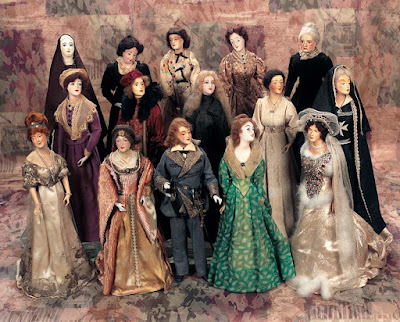
A selection from the "400 Outstanding Women" recently sold at auction

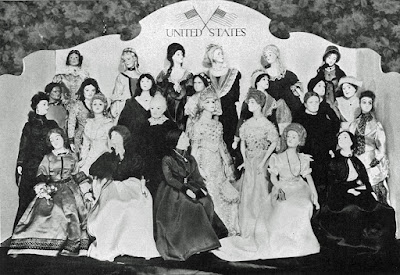
A total of 32 women were selected to represent the United States. Of these, 27 were selected by Helen Dawes, the Official Hostess and Chairman of the Social Committee for the Century of Progress (and wife of the Fair president, Rufus Dawes). The other five, who were all women of color, were selected by Elizabeth Lindsay Davis, an important African-American teacher and activist of the time who was responsible for forming the Phyllis Wheatley Home Association in Chicago to provide housing and services for African-American women excluded from the YWCA.


Among the American women included in the exhibition and book were Pocahantas, Sakakawea, Priscilla Alden, Mary Ball Washington (mother of George), Abigail Adams, Susan B. Anthony, Mary Cassatt, and Nancy Elliot Edison (mother of Thomas). Chicagoans represented included Myra Bradwell (the first woman admitted to the Illinois Bar Association), Frances Willard (president of the Women’s Christian Temperance Union), Bertha Honoré Palmer (President of the Board of Lady Managers of the Columbian Exposition), Sarah Hackett Stevenson (first female member of the American Medical Association), and Alice Freeman Palmer (first dean of women at the University of Chicago). 


Figurines representing Ireland, Norway, Cuba, Bulgaria, and African-Americans

African-Americans included Phyllis Wheatley (first African-American author of a published book of poetry – in 1773), Sojourner Truth (abolitionist and women’s rights activist), Margaret Murray Washington (wife of Booker T. Washington and the principal of the Tuskegee Normal and Industrial Institute), Amanda Smith (evangelist and the first woman to preach in India), and Ariel Serena Hedges Bowen (Professor of Music at Clark University in Atlanta).

After the Fair closed in 1934, the 400 figurines were donated to Trinity College in Washington, D.C. (now Trinity Washington University), the nation’s first Catholic liberal arts college for women, founded in 1897.

Later Years
Over the years, Schmidt educated seventeen of her relatives – brothers, sisters, nieces, and nephews – bringing many of them to the United States. Always mindful of her German heritage, she supported several charities back home and funded construction of Wilhelminenheim, a hospital for women and children in Sindelfingen (shown below).


Ill health necessitated her retirement in the early 1940s. Shortly after the death of Julius, her husband of 63 years, in 1950, she donated her Evanston home to Northwestern University and moved into the Holy Family convent at 1444 W. Division Street. The Minna Schmidt Figurine Room contained hundreds of her figurines which, after a priest inquired as to why they were all women, grew to include prominent men ranging from Eric the Red and George Washington, to Richard Wagner and Charles Lindbergh. One of her final series included all of the First Ladies through Mamie Eisenhower.

In the last few years of her life, she resided at St. Mary’s Hospital, where she died on December 8, 1961, at the age of 95. She was interred beside her husband in Wunder’s Cemetery.


Minna Schmidt’s story is one of inspiration – a young immigrant arriving in a new country, barely speaking English, with only $5.00 in her pocket, but a powerful ambition. She utilized her skills to establish herself as a leading businesswoman in Chicago, an authority on costuming in the United States, and the leader in establishing costume design as a subject taught at leading universities.

NOTES
The 400 Outstanding Women book in the Glessner library did not belong to the Glessners. Frances Glessner died in 1932, and there is no evidence that the 90-year-old John Glessner attended the Fair. It is likely that the book was purchased by Frances Glessner Lee, who would have been interested in how the figurines were created and dressed, given her previous work creating the miniature symphony orchestra, and her later work on the famous Nutshell Studies.

The building that housed Schmidt’s Costume Shop at 920 N. Clark Street was demolished in the late 1980s and replaced by a townhouse development; that block of Locust Street has been renamed Delaware Place. Her Sheridan Road home in Evanston, donated to Northwestern University, was also demolished and replaced by a new home in 1980. 

The figurines of the 400 outstanding women were deaccessioned from the collection of Trinity College and individual figurines and groupings occasionally come up for sale. The collection of figurines depicting prominent Illinois women remains intact in the Illinois State Museum.


Related Posts Plugin for WordPress, Blogger...