Showing posts with label Glessner house. Show all posts

Tuesday, April 15, 2025

Remembering Bob Irving (1931-2025)


Bob Irving, an extraordinary docent who introduced Chicago’s iconic architecture to thousands of people over the course of fifty years, passed away on Monday, April 7, 2025, at the age of 93. A native of New York City, Bob had called Chicago home since 1967, when he came to the city to teach at IIT. Within a few years, he was pursuing his passion for historic architecture, volunteering as a docent with the newly formed Chicago School of Architecture Foundation to lead tours of Glessner House and downtown. Over the years, he also gave of his time and talents with the Clarke House, the Charnley-Persky House, and with Friends of Historic Second Church.

On behalf of his Chicago family – his chosen family – it is my privilege to share some stories of Bob’s life, interspersed with his own witty commentary. He will be greatly missed, but all of those whose lives he touched are richer for the opportunity to have known him and to see Chicago through his eyes.

EARLY YEARS

Robert Francis Edward Irving Jr. was born on June 30, 1931, in New York City. His mother, Gertrude Haggerty (1897-1991) and his father Robert (1899-1975) had both been born in New York City as well. They married in 1927 and welcomed Bob’s only sibling, Ellen, in 1928. His father worked as a textile salesman, and the family resided in the Bronx.

Bob’s parents had given him permission to explore the city on his own when he was around ten years old, and within days, he and a friend had ridden every branch of the New York City subway to the end of the line. In 2023, he recalled his early fascination with old houses:

"I am a bona fide OLD HOUSE NUT! I was reared in a place called ‘Riverdale’ in the North Bronx, on the edge of one of New York City's largest parks, Van Cortlandt Park--dominated by the old "patroon mansion," the Frederick Van Cortlandt Mansion (1748). From my first visit there as a little boy (about 10 years old), I was "hooked" on old home mansions and, as soon as I was old enough, began visiting sites that were open to the public. The Isaac Varion House (1758), the Edgar Allan Poe Cottage (1812), the Billopp House in Staten Island (pre-1680). By my teens, I was traveling to view old houses, like Chalkley Hall in Philadelphia. My parents fortunately were sympathetic to my interests, and when I was 15, treated my sister and me to a week at Williamsburg.”


In 1945, Bob was accepted into the Bronx High School of Science, founded seven years earlier as a specialized science and math high school for boys; it became co-ed in 1946. The school was located in a Gothic inspired building at Creston Avenue and 184th Street, designed by architect Charles B. J. Snyder in 1918. Bob thrived in the rigorous academic environment and initially considered science for a career before settling on English as his focus of study. 


He graduated in 1949 and was a member of Arista, the name for the National Honor Society used in the New York City public schools. (The school continues today and is noted for having produced the most Nobel laureates of any secondary school in the world.)

UNIVERSITY YEARS


In the fall of 1949, Bob enrolled in the New York University Washington Square College of Arts and Sciences. As the name suggests, the campus surrounds Washington Square Park in Greenwich Village and, as such, has long used the triumphal arch in the park as its unofficial symbol. (The marble arch was designed by Stanford White in 1891 to replace a temporary arch erected in 1889 to commemorate the centenary of George Washington’s first inauguration). Bob received his Bachelor of Science degree in 1953, having been elected into both Phi Beta Kappa, the oldest and most prestigious academic honor society in the United States, and Sigma Delta Omicron, the English Honors Society.


He continued his studies at Yale University where he received his Master of Arts in English in 1958, and his Doctor of Philosophy in English in 1961. The 1950s to the 1970s is regarded as the “glory days” of the Yale English department, with the preeminent literary critic Harold Bloom arriving at the university in 1955, and Louis Martz serving as chair of the department from 1956 to 1962. A colleague once wrote of the versatility of Professor Martz, “He was an eminent authority in English literature of the Renaissance and the 18th century, in 20th-century poetry, and in the fiction of D. H. Lawrence and Iris Murdoch.”

Just prior to Bob’s arrival at Yale, Martz had published one of his most important works, The Poetry of Meditation: A Study in English Religious Literature of the Seventeenth Century, for which he was awarded the prestigious Christian Gauss Prize. Other professors serving in the department at the time included medievalist Robert James Menner, Joseph Toy Curtiss who founded Yale’s Humanities program, Shakespearian scholar Helge Køkeritz, and Charles Prouty, the author of A Guide to Chaucer’s Pronunciation.

Bob accepted an appointment to teach English at Georgetown University, where one of his students was the future 42nd U.S. president, Bill Clinton, class of 1968. Clinton recalled Bob’s unique teaching style in his 2004 autobiography, My Life:

“My other two teachers were real characters. Robert Irving taught English to freshmen who were unprepared for his rapid-fire, acid commentary on the propensity of freshmen to be verbose and imprecise. He wrote withering comments in the margins of essays, calling one of his students ‘a capricious little bilge pump,’ responding to another's expression of chagrin with ‘turned into a cabbage, did you?’ My papers received more pedestrian rebukes: in the margins or at the end, Dr. Irving wrote ‘awk’ for awkward, ‘ugh,’ ‘rather dull, pathetic.’ On one paper I saved, he finally wrote ‘clever and thoughtful,’ only to follow it by asking me to ‘next time be a sport’ and write my essay on ‘better paper’!

“One day Dr. Irving read aloud an essay one of his former students had written on Marvell to illustrate the importance of using language with care. The student noted that Marvell loved his wife even after she died, then added the unfortunate sentence, ‘Of course physical love, for the most part, ends after death.’ Irving roared, ‘For the most part! For the most part! I suppose to some people, there's nothing better on a warm day than a nice cold corpse!’ That was a little rich for a bunch of eighteen- year-old Catholic school kids and one Southern Baptist. Wherever he is today, I dread the thought of Dr. Irving reading this book and can only imagine the scorching comments he's scribbling in the margins.” 

After leaving Georgetown, Bob taught for a few years at Miami University in Oxford, Ohio, which he referred to as “darkest Ohio.” His IIT colleague, John Snapper, recalled an amusing incident while Bob was at Miami:

My favorite story from Bob about his Miami years is his discovery that the university prize winning student essay was plagiarized from the book of memoirs that the president gave to all new faculty. Implication: Bob was the only resident who read both items. I do not know if he told this story to poke fun at MU or to poke fun at himself.  Probably both. Two jokes for the price of one.” 

CHICAGO YEARS

In 1967, Bob accepted the position of Associate Professor of English at IIT, a position he would hold for the next 28 years. For several years around 1980, he served as chair of the humanities department. Although his doctoral work had been on a late 19th century poet, many of his courses focused on Chicago in literature.

Bob was never seen without a necktie; he owned hundreds. He once shared that his students gifted him with a plastic necktie, so that he could wear it while showering.


Shortly after arriving at IIT, Bob met George Danforth, who had taken over as chair of the College of Architecture from Mies van der Rohe. Danforth was one of the nineteen individuals who signed a resolution creating the Chicago School of Architecture Foundation in April 1966, for the purpose of purchasing Glessner House. Learning of Bob’s interest in old houses, Danforth suggested Bob visit the house, which was close to the campus.

In 2012, Bob was asked to write about his early memories of Glessner House and meeting its first full-time paid executive director for the book Jeanette Fields: A Community Life. He wrote:

“After several fruitless attempts to visit the house (there never seemed to be anyone there), I tried once more in late 1970. To my surprise and delight, I perceived that there seemed to be someone in the house. Ringing the bell (not then knowing that the bell was disconnected) I got no response, but undaunted, I tapped on the glass of one of the windows and attracted the attention of the person inside. The door was opened by Jeanette Fields.

“In my past experiences with historic houses, I noted that the caretakers of such places often seemed almost as ancient as the shrines they served. Here, on the contrary, was a young, dynamic and highly attractive woman (I later dubbed her ‘the Rita Hayworth of Restoration.’) She was a far cry from the ancient crones with whom I’d been familiar. Indeed, her youth and vitality made the then dark and grim Glessner House seem all the more dreary.

“I asked her whether I might see the interior, and she readily agreed to show me around. Those visiting the restored and gorgeously decorated Glessner House of today would scarcely recognize what the house looked like then. Its façade blackened by years of industrial soot, and largely covered with a veritable jungle of tangled vines, the house presented a looming, ominous face to the world. Within, despite the fine oak paneling and the handsomely proportioned rooms, the same gloom prevailed. Jeanette herself was the sole bright spirit in the vast lowering mansion. She told me that she had just been appointed to be the Executive Director of what was then called the Chicago School of Architecture Foundation, the owner of the house.

“As we walked about the empty rooms she waxed enthusiastic about the future of the house. She was clearly already an articulate advocate for its preservation and restoration. I couldn’t help feeling a bit sorry for her, since the task she was undertaking seemed enormous and unlikely to be achieved. She quickly noticed my interest in the building, however, and told me the Foundation was planning a program under her direction to train volunteer guides to show the house, and to conduct architectural walking tours of our downtown architectural masterpieces. She was herself an experienced tour guide and was working to finalize the training program schedule. She asked me whether I might be interested in joining that first training program and learning to become a docent. Although I said yes and left her my address and telephone number, I remember thinking as I left, ‘I doubt if I’ll ever hear from her again.’ The task seemed so very daunting, and Jeanette seemed very alone in that huge house.

“My misgivings proved groundless, however, and, to my surprise, she contacted me again in January 1971. She had advertised the program and collected a group of possible trainees of whom I was one. We were each of us interviewed by Jeanette and one or two Foundation board members, in my case, Marian Despres and Barbara Wriston. We were asked about our interests in architecture, our favorite Chicago buildings, and what we thought we might be able to bring to the program. About thirty of us formed the first docent class which lasted from the winter of 1970-71 into the early spring. Thanks to the contacts she had and the assistance of Foundation Board members, Jeanette had assembled an outstanding faculty for the program. Among our instructors were Carl Condit, Paul Sprague, and Jack Hartray.”

1971 docent class; Bob Irving standing at upper left, Marian Despres at the microphone

The class graduated on Saturday, June 12, 1971, with the ceremony taking place on the north steps of the Chicago Public Library (now the Cultural Center). That afternoon, Bob led his first official tour of downtown, impressing the participants with both his encyclopedic knowledge and his ability to weave the names and dates into an engaging story.

Bob Irving (at far left) leading his first tour of downtown, June 12, 1971. The entrance to the old John Crerar Library is visible at top center.

He participated fully in the work of the Foundation, being appointed to the first Docent Council and serving as the council representative on the CSAF board, which soon elected him secretary. Bob was one of six individuals who created an exhibit at the Chicago Public Library entitled “The Glessner House Story, from Prairie Avenue Days to the Present” which was seen by thousands of people. When the Glessner descendants returned dozens of boxes of original books to the house, Bob set to work cataloging and shelving the treasured tomes back in their original location in the library. He helped set up a temporary kitchen in the former butler’s pantry, assisted with the installation of another exhibition, this one focusing on the Arts & Crafts movement, and provided commentary for the early morning CBS program, “It’s Worth Knowing About Us.”

Bob Irving, center, regaling docents in the Glessner House library, 1972

Bob quickly became recognized as an authority on Chicago’s architecture and participated in the unsuccessful fight to save Louis Sullivan’s Stock Exchange building. The newly formed Landmarks Commission, which had designated Glessner House one of the first two landmarks in the city in October 1970 (along with Clarke House), called on Bob to recommend buildings for landmark designation, and to testify at the hearings. This was more than a decade before the Chicago Historic Resources Survey got underway to standardize the process for identifying buildings of architectural and historical merit.

Jeanette Fields recalled Bob’s ability to give an entertaining tour of Glessner House:

“The Glessners were remarkable people. They really collected the best! They collected prints, engravings. And they didn’t go for big Impressionist paintings. But they knew what they wanted and that’s what they got, and very much in the arts and crafts movement. There were the (casts of) the hands of Lincoln . . . and many pieces of sculpture that were very well known.

“I’m always amused when I think of the sculpture because there was one piece in the library that was rather erotic and it was obviously a man and a woman embracing, or making love. Anyway, when Bob Irving would give his tour, he’d say, ‘Yes, and this is a family scene!’ He was very funny. He was great. Oh, he’s marvelous. He could talk to you forever because he’s got such a mind that he doesn’t forget anything.”

Shortly after arriving in Chicago in 1967, Bob entered the offices of Waller & Beckwith, owners of the Pattington Apartments on Irving Park Road. The complex of 72 apartments, the largest in Chicago at the time of its construction 1902-1904, was a masterpiece of courtyard design by its architect, David E. Postle. He inquired about renting an apartment but was told none were available, and that units rarely came up for rent, as there was almost no turnover among residents. In 1977, the building was converted to condominiums and Bob acquired his unit, and it remained his home for the next 44 years. He helped in getting the building listed on the National Register of Historic Places in 1980.


Bob was awarded Docent of the Year in 1984 and continued serving on the Board until 1985. But his most valuable contribution occurred just prior to that time. In the early 1980s, he developed a new walking tour called the “Riverwalk” that extended from Michigan Avenue west to the Sears Tower, crossing back and forth across the bridges over the Chicago River. In 1983, during NeoCon, the Foundation was approached by a furniture manufacturer to provide a tour guide for a cruise on a boat along the lake. They agreed but noted there was much to see along the river. Bob provided the tour, and the immensely popular river tour was born.


Bob later recalled the logic in creating the tour. “What could be nicer? You sit on your bottoms and the buildings go by! We have to do this!” In 2020, PBS host Geoffrey Baer confessed, “I stole your river reversal punchline ‘a taste of Chicago’ years ago. It gets a big laugh every time. I learned from the best!”

As new sites across the city opened for tours, Bob was always at the forefront. In 1977, the Clarke House (now known as the Clarke-Ford House), was moved from its location on the 4500 block of South Wabash, 3-1/2 miles north to a new location in the Prairie Avenue Historic District. A full restoration was undertaken by the City of Chicago, with furnishings provided by The National Society of The Colonial Dames of America in the State of Illinois, and it was opened to the public in 1982, with Bob as one of its first docents. (The house was operated by the Foundation, and later Glessner House, until 2015. When the city took over the tour program the next year, it required that all docents have a background check and be fingerprinted. Bob’s fingerprints were rather faint and he was called back, being told that if the new set of fingerprints wasn’t clear, he wouldn’t be able to continue as a docent, despite 34 years of service. His response? “I’m sorry, but I’ve been using my fingers for the past 85 years!” The second set of fingerprints was successful and he was able to continue as a docent.)

In 1994, Seymour Persky donated the Charnley House at 1365 N. Astor Street to the Society of Architectural Historians, which moved their offices into the building in late summer 1995. Elaine Harrington, a former curator with Glessner House who also launched the Clarke House docent program, put together a training program, and once again, Bob Irving was at the head of the docent line, sharing his knowledge of Louis Sullivan, Frank Lloyd Wright, and the “first modern house in America.”

Friends of Historic Second Church was organized in 2006 to oversee the art and architecture of the landmark Second Presbyterian Church at 1936 S. Michigan Avenue. Bob completed the docent training program the next year, and delighted in sharing his knowledge of the Arts & Crafts movement and Tiffany glass to visitors from across the globe.

Bob Irving, at right, with CAF president Lynn Osmond, and fellow docents Dick and Judith Spurgin, 2016

He remained an active Glessner House docent and was a decades-long member of its House & Collections Committee, which oversaw the planning and execution of restoration projects. When the newly developed Mother-Daughter Tea was first announced in 2010, he offered to provide the sixty teacups and five silver tea services needed. When I jokingly noted I was concerned he would now have to go without tea, he quickly noted “oh, no worries, I have another 300 teacups at home, and several more silver tea services!” Bob was also a valued member of the journal reading class, which spent several years reading through the transcribed copy of Frances Glessner’s journal, spanning 1879 to 1917 and filling 5,200 pages. He would carefully note the essential facts of every book and piece of music listed, and would share details on buildings mentioned in Chicago and across the country.

Bob Irving and Pauline Saliga, 2016

In 2016, he was honored with a Lifetime Achievement Award in recognition of his 45 years of service, during the Glessner House gala held at the Chicago Club. Pauline Saliga, executive director of the Society of Architectural Historians, and a Glessner House board member, presented Bob with his award.

LATER YEARS

Ancient Docent luncheon, 2012. Bob Irving is seated at right, Jeanette Fields is seated at center

Bob valued the many friendships he made among his fellow docents and thought of them as his family. He, and fellow class of 1971 docent Bunny Selig, organized the early classes into a group known as the Ancient Docents, which would gather each year, initially at a restaurant, and since 2016, at Glessner House. He was especially saddened by the death of Bunny in 2010 and Jeanette Fields in 2014.

June 12, 2021

In 2021, Glessner House held a celebration to commemorate the 50th anniversary of the docent program. Bob was the last member of his class to still be giving tours at the house. Friends far and wide contributed to a fund to honor Bob for his 50 years of service and to commemorate his 90th birthday that same month. On June 12, 2021, the 50th anniversary of the first docent class graduation, docents gathered in the courtyard, many seeing each other for the first time since the start of the pandemic. During the program, Bob learned that the generosity of his friends had funded the recreation of the tall oak standing screen in the dining room with its embroidered Morris fabric. It was delivered to the house a few weeks later, and long-time friend and fellow docent Allan Vagner brought Bob to the house, so he could be the first one to see the screen in place.


Just a month later, Bob had a fall at his condominium, which led to a hospital stay and his eventual move to assisted living at The Admiral. He returned to Glessner House a couple of times for the Ancient Docent luncheons. His last visit to the house took place on December 3, 2024, when fellow docent Bill Hinchliff accompanied him on a tour. Before they departed, they were photographed by the front doors, recreating the pose they had struck in a photo taken exactly 45 years earlier during a Christmas party.


The photograph captured Bob’s last moments in a house that had been an incredibly important part of his life for 54 years. Bob died peacefully on the morning of April 7, 2025, but his memory will live on, carried by those who were privileged to work beside him, and all those who benefitted from his knowledge. His wish was that he would be remembered for playing an important role in making Chicago the “Architecture City.” The city could not have asked for a better ambassador in sharing its architectural heritage with the world.

Tuesday, January 17, 2023

Early Modern Architecture: Chicago 1870-1910


Exhibition with photo of Glessner House at far right


On January 18, 1933 – exactly 90 years ago – the Museum of Modern Art in New York City opened its second architectural exhibition. Entitled
Early Modern Architecture: Chicago, 1870-1910, the exhibition was curated by architect Philip Johnson, who noted in the official press release that, “Chicago, and not New York, is the birthplace of the skyscraper.” Thirty-one Chicago buildings were featured, including three of H. H. Richardson’s four Chicago commissions – the Marshall Field Wholesale Store, and the Glessner and MacVeagh houses. In this article, we will explore how Johnson came to curate the exhibit, how the buildings included demonstrated the development of “modern architecture,” and how the exhibition helped to restore Richardson’s legacy.

The Museum of Modern Art and Philip Johnson

The Museum of Modern Art (MoMA) had its beginnings in 1929, when a group of seven collectors and patrons decided to challenge the conservative policies of traditional museums, and the Metropolitan Museum of Art in particular. Founding director Alfred H. Barr, Jr., had a vision that it would soon become “the greatest museum of modern art in the world.”

MoMA started out in six rooms in the Heckscher Building at Fifth Avenue and 57th Street. Within months, 1,500 people a day were visiting the galleries, so in May of 1932, the museum moved into a six-story house at 11 West 53rd Street owned by John D. Rockefeller, Jr. (his wife Abby Aldrich Rockefeller was one of MoMA’s founders). Five years later, the site was cleared for construction of the present building.


Museum of Modern Art in 1933

Architect Philip Johnson (1906-2005) attended Harvard University after which he traveled extensively in Europe, becoming exposed to the work of Le Corbusier, Walter Gropius, and Ludwig Mies van der Rohe. In 1930, utilizing a considerable fortune from his father, Johnson financed the architecture department at MoMA. Two years later, he was named curator, and soon arranged for Gropius and Le Corbusier to visit the United States. He also negotiated the first American commission for Mies van der Rohe.


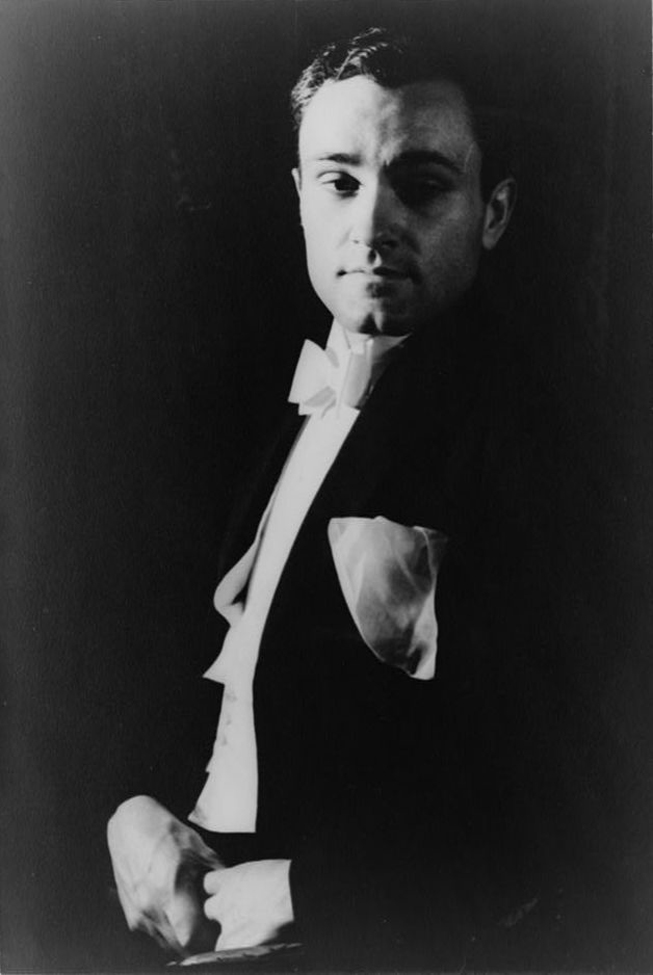
This photograph of Philip Johnson was taken on January 18, 1933, the day the exhibition opened.


In February 1932, working with architectural historian Henry-Russell Hitchcock, Jr., Johnson organized the first exhibition of modern architecture at MoMA, entitled
Modern Architecture: International Exhibition. They simultaneously published the book International Style: Modern Architecture Since 1922, which introduced modern architecture to the American public.

Early Modern Architecture: Chicago 1870-1910

Johnson’s second exhibition for MoMA was announced in early January 1933. The press release quoted Johnson:

“Chicago, and not New York, is the birthplace of the skyscraper. Few people realize that on the ashes of the Chicago fire of 1871 there was built the only architecture that can truly be called American. The great names in the building of the frontier city were three architects, H. H. Richardson, Louis Sullivan and Frank Lloyd Wright, who, with their followers, made the end of the nineteenth century the greatest epoch in the architectural development of our country. They created a native product not indebted to English or continental precedent.

“To these men goes the credit of bridging the gap between the Crystal Palace of steel and glass in London in 1851 and the skyscraper of today. They were the first to take advantage of the shift from masonry to cast iron and from cast iron to steel. This independent American architecture finally succumbed to the wave of classical revivalism which the World’s Fair first brought to Chicago in 1893.”

The press release went on to note that Johnson and Hitchcock had spent the summer of 1932 in Chicago collecting information and photographing important buildings. It also noted that the exhibition would be “the first record of a great architecture which is vanishing rapidly under the sledgehammer of the housewrecker.” This was a poignant statement given that five of the buildings included in the exhibit had already been demolished.

Johnson felt that there were two main reasons why Chicago became the center of architectural development in the late 19th century. The first was its inland location which “removed it from the influence of traditional architecture active on the Atlantic seaboard.” The second was the fire of 1871 which brought countless architects to the city to assist in the rebuilding and finding ways to construct taller structures.  

The exhibition consisted of photographs of 31 Chicago buildings, and one from New York, included to show how backward thinking the latter city was at the turn of the century. Each photograph was accompanied by an explanatory wall label prepared by Johnson and Hitchcock:

“We don’t want people merely to look at this show, we want them to study it and carry away with them a conception of what went into the making of the greatest epoch in our American architecture.”

Glessner House was the only building included for which the plan was displayed, clearly demonstrating how its innovative floor plan was central to the significance of its design. The Auditorium building was the only one for which an interior view was included, which revealed “Sullivan’s power of original design.”


Philip Johnson with the building models; Glessner House is partially visible at far left

The only three-dimensional items included in the exhibition were three models showing the progression from masonry to steel:
-The All Masonry Building
-The Masonry Building with Metal Skeleton
-The Steel Skeleton Building
The models were built by Alfred Clauss (1906-1998) a German architect who, in collaboration with his wife, architect Jane West Clauss, is credited with designing one of the earliest examples of the International Style in the United States. (The development of distinctive split-level homes was known as “Little Switzerland” and was located outside of Knoxville, Tennessee.)

The exhibition catalog included chronologies of both the technical and aesthetic development of the skyscraper, along with selected architect biographies. Johnson’s comments are brief but telling. Of William LeBaron Jenney, he credits him with the first use of steel skeleton construction, but notes he was “a technician rather than a designer.”


Henry Hobson Richardson

He praised H. H. Richardson:
“In his later work the importance of reminiscent elements of design grew less and less, but his originality as an architect was based on the integrity of his use of traditional construction rather than on technical innovations. To the new national architecture, he contributed not methods of building but a formative spirit.”

Louis Sullivan was clearly a favorite:
“Applying the basic stylistic discipline of Richardson’s Marshall Field Wholesale Store to the new skeleton construction, Sullivan first found a dignified clothing for the skyscraper. In his work of the late eighties and early nineties, his designs emphasized the vertical. Soon, however, he found a more logical expression of the underlying construction with a scheme of wide windowed horizontality. Sullivan led for two decades a considerable group of architects known as the Chicago School, but he alone made of the early skyscraper an aesthetic invention.”

Burnham & Root received mixed reviews, Root being noted as “one of the more original Chicago Richardsonians.” But after his death in 1891, “the prolific work of the firm, beginning with the general supervision of the World’s Fair, was rarely original or distinguished in design.”

Johnson made several comments in the catalog noting the negative impact the World’s Fair of 1893 had on the development of modern architecture.

Buildings included in the exhibition

The exhibition included 31 buildings in Chicago, ranging from the 1872 Field Building (architect not identified) to Carl Schurz High School, a design of Dwight Perkins completed in 1910. Most were tall buildings located in downtown, but the range included a synagogue, an armory, a park pavilion, a school, and five houses.

Louis Sullivan was represented with eight buildings, designed in partnership with Dankmar Adler, or from his independent practice. Four buildings represented the work of Burnham & Root and D. H. Burnham and Co. Richardson, Jenney, and Richard E. Schmidt each had three buildings, while Holabird & Roche had two.

A short paragraph described each building. Among the more interesting entries are the following:


Leiter Building I
William LeBaron Jenney, 1879
“An important step toward the skyscraper: the use of cast iron posts between the masonry piers introduces more light. The design is crude, but the general horizontal ordering foreshadows the more finished designs of the later steel skyscrapers.”


Home Insurance Building
William LeBaron Jenney, 1884-85 (demolished 1931)
“The crucial step in the creation of the skyscraper. The metal skeleton supports all the weight of the building except the exterior walls which are partially self supporting. . . In principle, the building has ceased to be a crustacean (chief support by masonry shell) and is already implicitly a vertebrate (chief support by skeleton). Jenney did not yet realize the revolutionary quality of the device he had employed above the second floor.” 


Marshall Field Wholesale Store
H. H. Richardson, 1885-86 (demolished 1930)
“The masterpiece of commercial architecture in masonry, and the strongest single influence on the design of Chicago commercial architecture of the next generation. Even when this influence was no longer direct, the aesthetic discipline of regular and simple design continued.”


Glessner House
H. H. Richardson, 1885-1886
“Here, as in the Marshall Field Wholesale Store, Richardson generalized and recreated the traditional elements of design which he had earlier borrowed directly from the Romanesque. The disposition of the plan with the main rooms opening toward the court rather than toward the street is unusual in America.”


MacVeagh House
H. H. Richardson, 1885 (demolished 1922)
“Less original than the Glessner House this house by Richardson is nevertheless superior to most work of the Richardsonians of the eighties.” 


First Infantry Armory
Burnham & Root, 1890
(Note: located just four blocks from Glessner House)
“The contrast of tiny windows and colossal portal, the avoidance of fussy detail, and the fortress-like scale of the whole, illustrate the possibilities of the free traditional design which existed in Chicago before the World’s Fair. The medievalism is hardly Richardsonian but rather that of the projects of the early nineteenth century in France.” 


Auditorium Building
Adler & Sullivan, 1887-89
“The treatment here of the masonry bearing walls shows strongly the direct influence of the Marshall Field Wholesale Store. The lower portions have been influenced by the Marquis de Vogüé’s publications on early Syrian architecture. Only in the tower appears the beginning of Sullivan’s more personal style.” 


Walker Warehouse
Adler & Sullivan, 1888-89
“Here the flatter surfaces and the more vertical grouping indicate the direction Sullivan’s manner was to take as it freed itself from the influence of Richardson.” 


Carl Schurz High School
Dwight H. Perkins, 1910
“This building owes little specifically to Sullivan. But it indicates the ability of the members of the Chicago School to find a new type of design for new problems. Especially in such a school is the superiority of their inventions over the archaeology of the stylistic revivalists clear.” 


Johnson included one New York building in the exhibition – George B. Post’s Pulitzer Building (also known as the World Building), completed in 1890. He was clear in his disdain for the design:
“Although at its completion the tallest building in the world (349 feet), this New York tower is progressive neither in structure nor design. It has masonry bearing walls on the exterior, 12 feet thick at the base, and only the interior is supported on wrought iron columns. Yet the Home Insurance and Tacoma Buildings had been completed several years earlier. 

“The conventional scheme of academic Renaissance design (the dome of the Invalides has been placed on top of the Louvre) is characteristic of the Eastern architecture of this period and is inappropriate and devoid of scale.”

Chicago’s awareness of the exhibition

Despite Johnson’s praise of Chicago’s architecture, it appears that the exhibition, which ran for five weeks, received little attention in Chicago. The Chicago Tribune carried a brief article entitled “Chicago Architecture in Gotham” two weeks after the exhibit opened.

However, Chicagoans were given the opportunity to see the exhibit for themselves, when it traveled to Chicago that summer. In a move that would be considered unusual today, the exhibition was installed not in a museum, but in the interior decoration galleries at Marshall Field & Co. This was a smart move, and probably resulted in many more Chicagoans being exposed to it than if it had been installed in a traditional setting. Additionally, that was the first summer of the Century of Progress World’s Fair and, for many visitors to Chicago, a trip to Marshall Field’s was an absolute must.


It was an ironic twist of fate that the exhibition ended up at Field’s. Clearly one of Johnson’s favorite Chicago buildings was the Marshall Field Wholesale Store by H. H. Richardson – a structure Field’s had razed just three years earlier.

Conclusion

The 1933 exhibition is the earliest to have brought attention to the innovative design and plan of Glessner House. Richardson had slipped into obscurity by this time, and with Prairie Avenue in significant decline, few would have an opportunity to see the house in person. If they had, they would have seen it blackened with soot and surrounded by empty lots, shuttered houses, and factories.

Three years later, Henry-Russell Hitchcock, Jr. curated The Architecture of H. H. Richardson and His Times at MoMA, to commemorate the 50th anniversary of Richardson’s death. (Johnson had abruptly resigned as curator in late 1934). The exhibition opened on January 14, 1936, just six days before John Glessner’s death at the age of 92. Hitchcock’s accompanying book was instrumental in restoring Richardson’s legacy, and even made the case that the distant roots of European Modernism were actually found in the United States.

Of the 31 Chicago buildings featured in the exhibition, five had been demolished by 1933. An additional 13 have since been razed, leaving 13 survivors (listed in chronological order):
-Glessner House
-Auditorium Building
-Leiter Building II
-Monadnock Building
-Anshe Maariv Synagogue (Pilgrim Baptist Church, some exterior walls remain)
-Charnley House
-Winslow House
-Reliance Building
-Schlesinger-Mayer Building (Carson, Pirie, Scott)
-Gage Building
-Nepeenauk Building (Chapin & Gore Building)
-Humboldt Park Pavilion
-Carl Schurz High School 


Philip Johnson at Glessner House, 1995

When Glessner House went up for sale in 1965 and was threatened with demolition, Philip Johnson became one of the most outspoken advocates for its preservation. In an interview with the
Chicago Daily News, Johnson referred to it as “the most important house in the country to me.” He stood behind his words and provided $10,000 toward the $35,000 purchase price. His appreciation for Glessner House extended back more than three decades to his 1933 exhibition, a time when he probably would have never imagined the critical role he would one day play in its preservation.

Tuesday, December 20, 2022

The original, odd, quaint, queer, Dutch, Mexican, Spanish fortress on Prairie Avenue

By the time the Glessners moved into their new house at 1800 South Prairie Avenue on December 1, 1887, the design had been both praised and vilified by neighbors and other passers-by. Frances Glessner carefully recorded all these comments in her journal as she became aware of them, and John Glessner felt they were so significant that he repeated them 45 years later while penning his The Story of a House.

From the time of its groundbreaking on June 1, 1886 until completion exactly eighteen months later, the house was also the subject of a number of articles in Chicago newspapers, including the Chicago Tribune, the Chicago Inter-Ocean, the Chicago Herald, and the Chicago Evening Journal. Reviews here were also mixed, although not quite as mean-spirited. Journalists often seemed simply confused in attempting to explain what the architect and owner were trying to express in the unusual design, but admittedly these columnists presumably had no architectural training.

In celebration of the 135th anniversary of the completion of the house this month, we share some of our favorite excerpts from these newspaper accounts. At least eight have been identified, dated between June 1886 and November 1887.  The three earliest articles were pasted into Frances Glessner’s journal; four later articles were added to a scrapbook maintained by the Glessners which included articles on many topics. One additional article, published just a few weeks before they moved in, may have been seen by the Glessners, but does not appear to have been saved by them.


COSTLY DWELLING-HOUSES.
An Apartment Building on One Corner of Eighteenth and Prairie and a House with No Front Windows on the First Floor on the Other.
Chicago Tribune, June 5, 1886

“On the southwest corner a very old style residence, but a new one in Chicago, is to be put up. It will be two stories high and have a frontage of 76 feet on Prairie avenue and 160 feet on Eighteenth street and cost $60,000. The owner is J. J. Glessner, who emigrated from the West side. It will be constructed after plans by the late H. H. Richardson. There will be no windows on the street fronts except in the second story, the first floor being lighted and ventilated from an interior court, the entrance to which is through a gated archway opening onto Prairie avenue. No one will be able to get in from the outside unless he forces the stout iron gate. The house will in appearance resemble dwellings to be seen in Spain and Mexico.

“It was jokingly said that this castle is to be built in anticipation of the day when the rich will have to keep out of the way of Anarchists and other bloodthirsty individuals who believe in a division of property, but the real object of the designer was not only to get greater privacy but also to have a novelty in the way of a house.”

NOTES: This article also described a proposed seven-story apartment house across the street from the Glessner House, designed by Burnham & Root. The $250,000 project never materialized, and a few years later, William Kimball acquired the site and built his French chateau, which still stands. There are, of course, many windows on the first floor, but it is unclear what information the journalist would have had from which to write his description. The “stout iron gate” refers to the porte cochere entrance for the carriages, a heavy oak paneled door with elaborate wrought iron trim. The reference to Spain is accurate; Richardson was influenced by Romanesque buildings seen in Spain during his 1882 trip to Europe. The oversized voussoirs in the arch over the front door being the most direct “appropriation.” The mention of “Anarchists” is very timely, as the article appeared just a month after the infamous Haymarket riot. 


A Dwelling-House of Novel Design on the Corner of Eighteenth and Prairie.
Chicago Tribune, June 6, 1886

“Ground has been broken at the southwest corner of Prairie avenue and Eighteenth street for the erection of a private residence which, when completed, will show a very decided departure from the conventional in American architecture. The design is by the late H. H. Richardson, and its peculiarity is owing more to the location of the lot and the desire of the owner to get a full southern exposure than to other considerations.

“The masonry work will consist of the Braggville, Mass. granite base and Georgia pink marble without trimmings, the latter being used in the construction of the first and second floors. The stonework and trimmings on the court elevation are to be of Lemont limestone, while the openings, all of which will have a southern exposure, will be numerous, as the building will be practically lighted from the court formed by the inverted ‘L” shape of the structure. When completed, which the contractors, Norcross Bros., are under contract to do by Aug. 1, 1887, the building will be the only one of its kind in the country, and, in addition to its unique design and handsome, substantial appearance, will possess all the features of quiet, and light, and convenience.”

NOTES: This article appeared in the Chicago Tribune just one day after the first article described, being contained within a longer series of short articles under the “Chicago Realty” section of the paper. Not included above is a detailed description of the exterior including an accurate accounting of the fenestration (the arrangement of doors and windows) confirming the presence of windows on the first floor. The most significant change the Glessners made to the design of the house after Richardson’s death was to abandon the use of Georgia pink marble and carry the Braggville granite from the base all the way up to the roof line.


(Title unknown)
Chicago Evening Journal, July 10, 1886 

“There seems to be a building boom just now.  Houses are going up on every available lot, despite the groans of the pessimist, who prophesies hard times and probable panics.  Richardson, the famous Boston architect, had before his death orders for several houses in Chicago, which in a few instances will revert to local architects willing to literally carry out his designs.  One of these is a home on Prairie avenue - that holy of holies where only the elect do dwell - for a wealthy West Sider.  This special elevation will be adapted from mediaeval architecture.  It will not have a moat and draw-bridge, because enough property could not be secured to admit of this protection, but upon the first floor no window will look toward the street, although the house will stand on a corner, it being the owner’s idea to have an inside court, made beautiful by all that art can devise.  Prairie avenue is a social street, and also a gossipy one, and it does not suit the neighbors that this newcomer should exclude all possibility of watching his windows and finding out what may be going on within-doors.  It has heretofore been the custom to call all householders together when a new house was projected, and consult with them before breaking ground; if the plans should not please the majority, suggestions were freely offered, and such alterations made as would render it most acceptable; and that this house is going up in spite of disapproval, has thrown the neighborhood into a state of stupefaction.”

NOTES: The pessimistic opening to the article again speaks to the ongoing turmoil following the incident at Haymarket Square two months earlier. The reference to the need of a moat and draw-bridge is comical but not unique. A few months later, a journalist writing in the Chicago Tribune noted, in describing Potter Palmer’s castle on Lake Shore Drive, that “there should be a deep moat around the castle, and access to the main door should be over a draw-bridge.” That reference is a bit more understandable, given that Palmer’s castle also elicited the description of the “castle plucked from a fishbowl.” The Chicago Evening Journal seems to be a bit more sensational than the more serious Chicago Tribune, devoting nearly half of the description to the negative response from neighbors. Did one of them perhaps provide a tip to the journalist of the unhappiness on the street? One can’t help but think of the “anonymous” editorial three years later criticizing the front addition to Wirt Dexter’s house just a few hundred feet to the north of the Glessners’ house, which echoed everything Pullman hated about Dexter (his next door neighbor) extending the house to the front lot line. Pullman’s dislike of the Glessners’ house is legendary, so maybe . . . ?


PALACE AVENUE.
Its More Plebian but Better Known Title of Prairie.
Chicago Inter-Ocean, January 2, 1887 

“Passing to the opposite corner, upon the south, and a most originally planned structure greets the eye. The architect was the late H. H. Richardson, of Boston. The same gentleman designed Mr. Franklin MacVeagh’s house upon the lake shore drive and the new Field store. This strange looking building elicits many comments from both residents and strangers. For solidity it is superior among the thousands of well built houses in the city. There is no dividing line between the outer walls of the house and stable. The windows upon the street and avenue are for the most part small and the roof is sloping. The house covers every foot of the frontage. The grounds within are not visible except from the house of the owner.

“The northern wall of the new house, adjoining upon the south is unbroken. The residence is said to be of the Spanish-Mexican type, and of convenient internal arrangement. Its late architecture had a National reputation. When finished the house will be occupied by the builder, Mr. John J. Glessner, Warder, Bushnell & Glessner, and will alone represent a large fortune.”

NOTES: The focus of this very lengthy article was to provide a detailed description of the many large homes and mansions on Prairie Avenue from Sixteenth to Twenty-Second streets. Richardson’s other Chicago projects – the MacVeagh house on Lake Shore Drive and the Marshall Field Wholesale Store – were both in the process of completion when Richardson died in April 1886. 


Title unknown
Newspaper and date unknown (probably April 1887) 

“A number of new houses will be tenanted in another month. Mr. Osborne Keith intends taking possession of his lovely home on Prairie avenue in May; the Glessner fortress is nearing completion . . . “ 

NOTES: Osborne Keith’s house (partially seen at far left, above) stood immediately to the south of the Glessner house. The more traditional verticality of that house emphasized the horizontality of the Glessner house. Fortress became the most common adjective to describe the Glessners’ house – combining in one word Richardson’s heavy massing, the rusticated granite, minimal window openings on the north side, and the incorrect assumption that the design represented the occupants concern regarding “Anarchists” and the current labor problem.


NEW THINGS IN TOWN
A Queer House Out on the Avenue
Reaper Man Glessner’s Dutch House in the Aristocratic Precincts of Prairie Avenue
Chicago Herald, undated (late 1887) 

That is an odd house, surely, which the workmen are just now putting the inner and finishing touches upon at the corner of Eighteenth street and Prairie avenue, diagonally across the street from George M. Pullman’s mansion.  It is a unique house, in fact, it is the only one of the kind in America.  It is a typical Dutch house – a veritable ‘huis’ from Amsterdam – only it was designed by an American architect, built by American workmen of American materials, and stands in that hub of Chicago aristocracy and Americanism – Eighteenth and Prairie avenue.  The quaint house appears all the more quaint amid its surroundings, where all is modern and United States and almost monotonously stiff in architecture and style. 

“Light for the dining-room, and for many other rooms in both stories, is taken from the court, which is one of the distinguishing features of the house, and a novelty in this country.  The problem which the architect had to solve in this house was not an easy one.  Given, a long, narrow lot – 75 x 160.  Wanted – a large, well-lighted house, with stable and yard.  See how nicely the plan suits the situation . . . The court, 40 x 100, rivals in beauty the best examples to be found in the old world. 

It is a quaint house, and most people riding by give it a cursory glance and exclaim “how ugly!”  But it’s a home-like house, full of the means of comfort and content, and for his $60,000 Mr. Glessner will acquire not only the quaintest, but one of the best homes in all Chicago.” 

NOTES: This is a most interesting description of the house, and although terms such as odd and queer are used, the writer clearly understands the significance of the design, and the problem Richardson faced in bringing the maximum amount of light into the house. The origin of the Dutch attribution is unknown and appears to be unique to this article (and the one that follows, also from the Chicago Herald.) 


 Chicago’s Nest of Millionaires.
Chicago Herald, undated (late 1887) 

“’If you want to see the richest half-dozen blocks in Chicago,’ said an entertaining gossiper, ‘drive out Prairie avenue from Sixteenth street to Twenty-second. Right there is a cluster of millionaires not be matched for numbers anywhere else in the country’ . . . John J. Glessner, the reaper man, will soon move into his queer Dutch house with an inner court . . . How much wealth does this whole cluster represent? Well, this is only guess work, but I think that if all the men in that little neighborhood were to get together and sign a joint note for sixty or seventy million dollars it would make a pretty good note.” 

NOTES: The focus of this article is to describe the wealth of the residents of Prairie Avenue. It is worth noting however, that John Glessner is the only one listed for which anything is said about his house; the reference clearly having been pulled from the article above.


THE CITY IN BRIEF.
Miscellaneous.
Chicago Inter-Ocean, November 5, 1887 

“The handsome Glessner mansion on Prairie avenue will soon be ready for occupancy. It was one of Richardson’s last works, the plans being completed not long before that eminent architect’s death. It will be a Chicago monument to his genius.”

NOTES: The last known article written before the Glessners moved into their home provides the most generous compliment so far recorded, specifically to Richardson. A Chicago monument indeed – the design was praised by architects – and Richardson’s work went on to have a profound effect on Louis Sullivan, Frank Lloyd Wright and others. Decades later, when the house was fighting to survive, modernists like Mies van der Rohe and Philip Johnson were vocal in their respect for the house and the importance of its preservation. So, after all the negative comments were set aside, the true significance of the house was, in time, fully realized.


Related Posts Plugin for WordPress, Blogger...