Sunday, December 1, 2019

The Monday Morning Reading Class, Part II


The Monday Morning Reading Class, May 5, 1902
(Photo by George Glessner)

In our previous article, we looked at the formation of the Monday Morning Reading Class in November 1894, how it operated, and its activities during its first season.  In this second article, we will explore the class over its next several years, showing how its activities also sometimes extended beyond the basic structure of reading.

The second season of the class commenced on November 4, 1895.  Thirty-seven ladies gathered and commenced to read Renaissance in Italy, a seven-volume history written by John Addington Symonds between 1875 and 1886.  Portions of the extensive history were read throughout the season, with Michelangelo being a focus by February.  Other works read that season included a lecture by the artist John LaFarge, an appropriate topic given that Frances Glessner owned an original LaFarge watercolor, which she displayed in her parlor. 

The Glessners’ daughter Fanny was invited to join the class in season three, having turned eighteen earlier that year.  Although she was one of the very few single ladies ever invited to join the class, she missed the entire season as she was on her Grand Tour of Europe, accompanied by her aunt, Helen Macbeth.  The invitation sent to her provides information on the focus that year – a series of essays on art by Van Dyck, Moore, Brownell, and others occupied the first hour.  For the second hour of “lighter reading,” the class continued its study of Fyffe’s Modern Europe, followed by the three volume American Commonwealth by James Bryce, 1st Viscount Bryce. 


On December 14, 1896, a new occasional feature was introduced to the class, namely having an author come and read from their own work.  The Glessners were long-time friends of F. Hopkinson Smith, a well-known author and artist.  He frequently sketched in the White Mountains of New Hampshire, that is possibly where they were introduced.  He was also an engineer of note and designed the foundation for the Statue of Liberty.  Smith would always spend time with the Glessners while visiting Chicago on his never-ending circuits of readings across the U.S.  Frances Glessner noted in her journal:

“Monday Mr. Smith came into the reading class and read more than an hour to the ladies.  He read some stories that have not been published in book form.  The ladies were perfectly delighted.  He made them laugh and cry both.  He read until the carriage came to take him to the station.  There was quite a full meeting.  I introduced him while he stood outside the door.”

As the third season grew to a close, the Glessners headed off to their summer estate, The Rocks, and soon after a Friday Night Reading Class was started for the farm workers and their family members.

With the Monday Morning Reading Class well established, John Glessner and the husbands of several of the class members came up with the idea of hosting a tea for the ladies to show their support for the undertaking.  Frances Glessner recalled the event on Wednesday November 10, 1897 in her journal:

“Wednesday afternoon John had his tea given to the reading class ladies and their husbands.  Dr. Hyde, Prof. Judson and Mr. Hutchinson presided at the tea table.  Mr. Herrick, Mr. Moore, Mr. Ryerson and Chauncey Blair assisted – coming ‘without their hats.’  The ladies all sent John boutonnieres.  One of my chrysanthemums was sent to him.”

(Note:  A new variety of chrysanthemum had recently been developed and named the “Mrs. J. J. Glessner” in her honor.)

John Glessner conveyed his thanks to the ladies to be read at the class the following Monday, which read, in part:

“Only that hard taskmaster, business, prevents me from being with you this morning, by your leave or without it, to tell you how my doubts about the existence of the Class have all been dissipated, how much I enjoyed meeting you last Wednesday, and how greatly I appreciated your flowers and the sentiments they conveyed. . . And so, though in body 500 miles away, I speak to you through the telephone of my wife’s lips to give you greeting and thanks.  Words are but empty thanks anyhow.  Inadequate as they are, they are the only vehicle I have.  May your numbers never grow less, and your charms ever increase.”

Selected excerpts from Frances Glessner’s journal provide additional insight to the happenings of the class.

December 4, 1899:
“Monday, we had a large meeting of the reading class.  After an hours reading of the book on Russia, Mrs. Winterbotham read us her Fortnightly paper on ‘Character through Effort.’  Then Miss Ensinger, a very talented young violinist, played a half hour.  She is a young German girl of eighteen years, a pupil of Mr. Lewis.  She plays remarkably well.”

November 19, 1900:
“We had the usual pleasant Monday reading class.  Miss Trimingham read Emerson’s Essay on Behavior.  It was very fine, and showed that he had set a new standard to which many of us have been trying to live up to.”

December 3, 1900:
“(Today) was our reading class luncheon day.  At the request of the class I gave an explanation of the bees.  I had a complete hive sent up from New York to show – and had the observatory hive placed in the middle of the library table.  This was surrounded by old brocade and embroidery and plants and flowers.  The ladies were most enthusiastic over the talk.  There were forty-eight ladies here.”

December 26, 1900:
“Mrs. Frank Johnson gave her gift party to the reading class.  Each member sent a gift with a rhyme to some other member designated by Mrs. Johnson.  Miss Trimingham read them all and passed the gifts out.  The gifts were hung on the tree.  The tree was lighted by little electric lights.  After the presents were distributed, Miss T. came up to me and presented me from the class a lovely lamp – a Grueby vase with a Tiffany shade.  I had to respond and was scared into insensibility.”  (The Grueby Faience Company, founded in 1894, was a ceramics company that produced distinctive and important vases and tiles throughout during the American Arts & Crafts Movement.)

The eighth season of the class ended on May 5, 1902.  It was an important meeting of the class for two reasons, as noted in the journal:

“Monday was the last meeting of the Reading Class.  I had engaged Dr. Slonaker of the University to come and give a lecture on birds and their nests.  He came bringing a stereopticon and Dr. Week of the Field Museum who operated the lantern.  The lecture was most delightful.  The pictures were nearly all from life and had been colored by Mrs. Slonaker.  The ladies sent and brought great quantities of beautiful flowers.  I had two men come from Samuelson’s to help arrange them.  We had the sideboard massed with them, all the windows filled and a great mass on the table.  The rest were in the parlor . . . Mrs. Goldsmith read a little history of the class.  Miss Trimingham says she will not be able to read to us anymore.  After luncheon, George came up and took our photographs in a group in the yard.”

The iconic photo of the Class assembled on the curved porch in the courtyard (shown at the top of the article) was taken that day, to commemorate the final class at which Miss Ann Trimingham would serve as reader.  It is the only time the class was photographed in its 36-year history.

Mrs. Nathalie Sieboth Kennedy

When the class resumed that fall, the new reader was Mrs. Nathalie Kennedy, who would continue in that role until the class disbanded in 1930, and came with excellent credentials.  Mrs. Kennedy was the daughter of Joseph Sieboth, who had been a pupil of Felix Mendelssohn.  She was also the niece of Frederick William Gookin, a good friend of the Glessners and the long-time curator of Japanese prints at the Art Institute of Chicago.  Mrs. Kennedy would later serve as president of The Fortnightly from 1910 to 1912.  Her first reading went well as noted in the journal:

“Monday morning, we had the first meeting of the year of the Reading Class with Mrs. Kennedy as reader.  There were fifty-four ladies here – four of them were guests.  The ladies lunched with me.  I asked Mrs. Kennedy to stand by the fireplace facing the audience.  She read an essay on the Victorian novelists by Paul, and a short story.  The reading was most delightful, and everyone seemed more than pleased.”

There was always a close connection between the Reading Class and The Fortnightly, as there were quite a few women who were members of both.  When the class decided to honor Frances Glessner with a special reception, the rooms of The Fortnightly in the Fine Arts Building were the obvious choice.  Frances Glessner recorded the event, held on April 25, 1904:

“Monday, April 25th was a red-letter day for me.  The Reading Class gave me a most beautiful reception in The Fortnightly rooms at quarter of three in the afternoon.  The invitation was very beautiful and I have had it framed. . . There were sixty ladies at the party.  Mrs. Stein stood in the hall watching for us and as soon as we stepped out of the elevator, disappeared telling the ladies we had arrived. . . The rooms were most beautifully decorated with flowers which had been sent by the ladies.  The mantel was trimmed with pink snapdragons.  The rest of the room seemed done with yellow and white flowers and green palms.  Two large baskets of daisies, violets, hydrangeas and white lilacs stood on the rostrum and came from the University ladies.  A large box of yellow jonquils came from the Hibbard sisters.  The dining room had tulips all around the wainscoting and the table decoration was made in a pyramid of all sorts of spring flowers and was very beautiful.

“After the greetings were over, twelve members of the orchestra came and played a beautiful program.  Mrs. Thomas read her paper on the musician’s life and temperament.  Then Kramer played, the musicians played again and after that a very pleasant tea was served.  It was all most beautiful, the spirit of affection and whole tone was especially charming.  I came home quite tired but never enjoyed a more beautiful afternoon in my life.  The flowers were all sent here to me.  I sent part of them to Alice and part to Frances.

“I felt that I must make some little remembrance to the musicians who were asked to play professionally but said no they were only too glad to play for Mrs. Glessner and came in that spirit for the afternoon.  I had made for them each a scarf pin – a good Baroque pearl mounted on a gold stick at Spauldings, and got a silver key ring for McNichol and sent them all in on Friday afternoon before the concert with a note.”
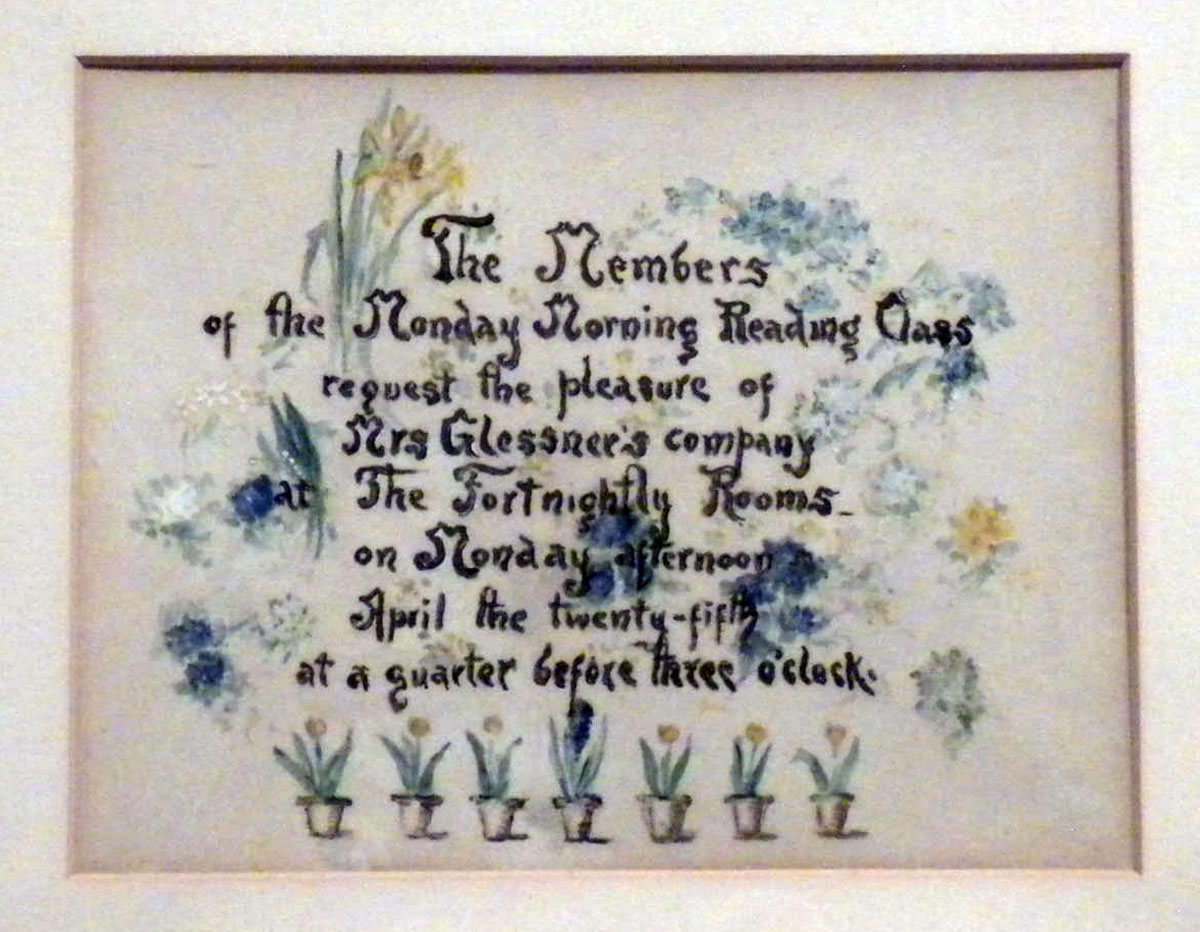
Invitation to reception held April 25, 1904

In the next article, we will examine an even more extraordinary expression of affection given to Frances Glessner by the Reading Class – her 1906 calendar.


Thursday, November 21, 2019

The Monday Morning Reading Class, Part I


Monday Morning Reading Class, May 5, 1902
(Photo by George Glessner)

Today marks the 125th anniversary of the first meeting of Frances Glessner’s Monday Morning Reading Class on November 21, 1894.  As her husband John noted in a tribute written shortly after her death in 1932, “Perhaps the Monday Morning Reading Class was her choicest activity and the one in which she took most pride and pleasure.”  In this first of several articles about the class, we will explore the origins of the class and how it was structured.

In his tribute, John Glessner noted that the idea for the class originated in an activity begun several years earlier, while the family was residing in their home at the northeast corner of Washington and Morgan:

Library of Washington Street house

“While living on Washington Street, Mrs. Glessner arranged a series of meetings of ladies in our library and parlors to listen to talks and readings about the latest books by scholars and experts, which were well attended and interesting and became the nucleus and forerunner of the Monday Morning Reading Class, so that that afterwards vigorous society had its origination and beginning then and there.”

Addie Hibbard Gregory, a member of the class for its entire 36 years of existence, recalled in her book, A Great-Grandmother Remembers, that Frances Glessner renewed the idea of her earlier meetings at the request of William Rainey Harper, first president of the newly formed University of Chicago:

“Early in the nineties, President Harper of the University of Chicago had asked Mrs. Glessner how the newly arrived wives and families of the university faculty could become acquainted with Chicago women, and we with them.  This class was Mrs. Glessner’s answer.  We were all grateful for the opportunity of meeting as soon as we did those delightful and clever women.”

John Glessner painted the picture of the University families arriving and his wife’s response in more colorful terms:

“When the University of Chicago was started and the staff drawn from all over the world with their families, all cultivated people but strangers to each other, found living conditions almost unbearable in crudely finished houses, with seas of mud in street and sidewalks, she made life more bearable by social attentions.”

In her journal entry for November 18, 1894, Frances Glessner wrote, “I have invited some of the young matrons on the south side to come here once a week for a reading class this winter.  The first reading is on Wednesday next – when they will lunch with me.”  The following week’s journal entry noted, “Wednesday my twenty-five ladies came for the reading aloud.  Miss Gaylord read to us.  We had Meneval’s Memoirs of Napoleon the first hour and The Memories of Dean Hole for the second hour.  Then we had our luncheon.”

Memoirs of the Baron de Meneval

Membership in the class was by invitation only - with two rules set in place.  One was that only married ladies would be invited, although a few exceptions were made through the years.  Secondly, and equally important, was the requirement that the ladies reside on the south side of the city.  In an informal history of the class written by John Glessner in 1925, he humorously noted:

“Membership was confined to the South Side – the mudsills of the North were frowned upon and taboo – only the South Side aristocracy of letters and beauty and gracious manners were drawn upon.  (Alas how the mighty haven fallen!  Our best people have been driven over the divide and we, the saving remnant, are merely permitted in tolerance to enter the sacred regions of north latitude beyond the river.)”

Members would have been residents of the south side at the time they were invited to join the class but were permitted to remain in the class if they later moved elsewhere, as many had by the 1920s.

Library at 1800 Prairie Avenue

The structure of the first class was set – the first hour would consist of more serious reading, usually of a historical nature, the second hour would feature lighter reading.  A paid professional reader would read selections from the books.  John Glessner, in his history of the class, noted “the labor the reader must give to find what to omit, what to explain, what to emphasize.  Every book has some dull pages and pages of indifferent interest that must be cut out to make for speed and to avoid tediosity.”   The selection of The Memories of Dean Hole also shows how current the book selections often were.  The book had just been published in 1894 by the Rev. Dr. Samuel Reynolds Hole, an English Anglican priest, horticulturalist, and leading expert on roses.  As Louise Goldsmith, another life-long member of the class noted, “he had visited Chicago the previous winter and we were all anxious to hear what he said about it.”

A few adjustments were made as well.  The first class was held on a Wednesday, but the class shifted to Monday the following week, and soon after the name “Monday Morning Reading Class” was adopted.  Invitations were extended to additional women, and the class quickly grew to fifty.  Additionally, it was soon determined that Miss Gaylord was not the ideal reader to lead the class.  Louise Goldsmith recounted:

“Miss Gaylord’s reading was very good; but she was young and could not have the broad knowledge and experience necessary for a full understanding of the erudite books she was proposed to read, so Mrs. Glessner looked about for someone who had the lighted torch of knowledge with which to illuminate the printed page revealing the thought of the writer in all of its clearness and strength.”

Miss Ann Trimingham

The new reader for the class, starting on December 17, was Miss Ann Trimingham, a former teacher at the West Side High School, and a sister of Louise Goldsmith.  She remained the reader until May 1902, “missing only one of the two hundred or more meetings.” 

Regarding the selection of the books, it was a democratic process from the start.  Louise Goldsmith recalled:

“Mrs. Glessner has always consulted the class with regard to the books, the one thing insisted upon by her and our reader was that they should be good literature worth spending time on.  Usually at the beginning of each year, a list of books has been presented to the class from which to select.  These books have been recommended by some outsider of known literary ability, by our own members, or by our reader.  A vote has then been taken and the choice of the majority has decided the question.”

The Glessner library (Photo by Chris Tyre)

Regarding the selection of the books, Addie Hibbard Gregory noted, “I, for one, am most grateful for glimpses into books which I should not have dared even to begin, in my busy life.”  She also recorded a delightful barb from New York, “We surely did not deserve the comment (or inuendo) of the eastern society journal which stated that it was ‘glad that Chicago women were learning to read, for Mrs. J. J. Glessner has organized a class for that purpose.’”

On the first Monday of each month, the class was followed by a luncheon, which frequently included musical entertainment.  A typical menu, recorded in 1895, featured sandwiches, baking powder biscuits buttered, sweetbread patties, coffee, hot chocolate, ice cream, and cake.”  The ladies would sit at tables of six, set up in the parlor and dining room.  Frances Glessner purchased a special set of luncheon china in a delicate blue and white pattern, which was reserved for the use of the monthly class luncheons.  (The maker of the hard paste porcelain with transferware decoration is unknown, as the pieces are unmarked).

Reading Class china

The first season of the class concluded on May 13, 1895, shortly before Frances Glessner left Chicago for her summer estate, The Rocks, in New Hampshire.  She recorded in her journal:

“Monday, the Reading Class came to luncheon.  Each lady came walking in carrying a bunch of large long-stemmed American Beauty roses for me.  There were thirty ladies – and it was a lovely sight to see them coming in processions of six or eight carrying these roses.  Frederick and John (butler and footman) arranged them in large vases in the dining room – all on the table, sideboard and side table.  It was very beautiful to look at and certainly a lovely attention to me.  We read our Fyffe for an hour and then Miss Trimingham read her last Fortnightly paper to us – on Sydney Smith and his friends.  After that we had luncheon, then a little music, then goodbye for the summer.”

(Fyffe is a reference to Volume I of The History of Modern Europe by Charles Alan Fyffe, which by the third class had replaced Meneval’s Memoirs of Napoleon, as class members had found it to be “rather dry.”  Sydney Smith (1771-1845) was an English humorist, writer, and Anglican cleric).

Monday, August 5, 2019

John La Farge's Sleep returns to Glessner House


John La Farge
Sleep, 1884-1885
Watercolor on paper
8 in. x 6 1/2 in. (2032. cm x 16.51 cm)
The Lunder Collection
Accession Number: 011.2011
Colby College Museum of Art

The Glessners were avid collectors of steel engravings but did acquire a small number of paintings and drawings to decorate their home.  John Glessner, in his The Story of a House written in 1923, noted that they possessed a painting by John La Farge, but little was known about it, as it is not currently in the Glessner House collection.

John La Farge (1835-1910) was an American painter and stained-glass designer who enjoyed a considerable reputation throughout the last decades of the 19th century.  Although largely remembered for his stained-glass work and rivalry with Louis Comfort Tiffany, he produced a significant number of easel paintings and murals during his career.  His extensive decoration of Trinity Church in Boston, designed by H. H. Richardson, gave him a national reputation, and the Glessners saw his murals and stained-glass windows while visiting the church with Richardson in 1885.  La Farge was also among the first American artists to be directly influenced by Japanese prints.  The Glessners had two books by La Farge in their library, Considerations on Painting: Lectures Given in the Year 1893 at the Metropolitan Museum of Art (1896), and An Artist’s Letters from Japan (1897).

Frances Glessner provided clues about the painting and its acquisition in her journal.  On June 26, 1887, she noted:
“Today we have enjoyed looking at twelve of La Farge’s water colors sent to us by Wunderlich.”
H. Wunderlich & Co. was a New York gallery founded by Hermann Wunderlich in 1874.  It dealt mostly in prints as well as the works of selected contemporary artists including James McNeil Whistler.  Frances Glessner first noted visiting Wunderlich in October 1883 when she went to see a collection of fifty etchings by Whistler.  In March 1885, Wunderlich sent several engravings to the Glessners for review.  They purchased three, including two “Dutch Admirals” they had been anxious to acquire for quite some time.  During a trip to New York in February 1886, they visited the gallery again, so clearly had developed a relationship with the owner.

The most significant clue to the identity of the painting is revealed in a journal entry from May 4, 1892, which recounts a visit by John La Farge to the Glessner home:
“Mr. Norman Williams brought the great John La Farge to call on me and see the house.  He was much astonished to find his painting of the sleeping woman here – he didn’t know it was even in Chicago.  He was delightful and I greatly enjoyed the call.  Mr. Williams told me in confidence that Mr. La Farge is to make a stained-glass window to the memory of John Crerar to put in the Second (Presbyterian) Church.”  (The large rose window was installed in 1893 but was lost in a March 1900 fire that destroyed the sanctuary).

La Farge's watercolor study for the Ascension window at Second Presbyterian Church

Taking Frances Glessner’s description of the work as depicting a sleeping woman, an internet search uncovered a La Farge painting entitled Sleep, now in the collection of the Colby College Museum of Art.  With an image in hand, it was possible to locate the historic location of the painting in the house.  It was revealed that the painting hung over the south music cabinet in the parlor, and appears in the earliest photos taken in 1888, and later photos taken in 1923 for The Story of a House. 

Glessner parlor, 1888 (Sleep at left, centered over music cabinet)

Detail of Glessner parlor, 1923, Sleep at upper center

Another photo provided a valuable clue.  A descendant of the Glessners’ son George donated a photograph of George and Alice Glessner’s home, The Ledge, at The Rocks in Bethlehem, New Hampshire.  Taken about 1940, by which time Alice was a widow, the La Farge painting can clearly be seen on the wall behind her over a table lamp, confirming that the painting went to her when the Prairie Avenue house was broken up following John Glessner’s death in January 1936. 

The Ledge, home of George and Alice Glessner, The Rocks, Bethlehem, New Hampshire
Sleep shown at left above table lamp

In March 2011, the painting was placed for auction with Christie’s in New York.  It was acquired by collectors Peter and Paula Crane Lunder, who gifted it to Colby College, along with seven other La Farge watercolors and two oils, part of a huge donation of more than 500 works of art given to the Art Museum.  In July 2019, the Museum graciously provided Glessner House with a high-resolution scan of the artwork, so that it could be framed and hung in the same location in the parlor where the original hung for nearly fifty years.

The watercolor on paper, executed in 1884 or 1885, measures just 6.5” x 8” and is based on an oil painting (now destroyed) John La Farge completed in 1869 depicting his wife.  Exhibition records indicate the watercolor was exhibited at least three times in 1886 and 1887, prior to the Glessners’ acquisition of the piece.  As noted on the Colby College Museum of Art website:
“Intimate in scale and private in mood, the watercolor Sleep combines realistic representation with decorative arrangement.  The artist’s wife, Margaret Mason Perry, is shown reclining in a shallow, interior space, her limp arms and gracefully turned head suggesting complete repose.  Repeated patterns and soft washes of color connect the figure with the surrounding space.”

John La Farge
Sleep, 1884-1885
Watercolor on paper
8 in. x 6 1/2 in. (2032. cm x 16.51 cm)
The Lunder Collection
Accession Number: 011.2011
Colby College Museum of Art
This full image shows the artist's brush wipe marks and signature
that are concealed by the mat when framed.

We are delighted to have Sleep return to the Glessner House parlor, so that visitors can enjoy La Farge’s work of art, just as guests of the Glessners did for half a century.  Special thanks to the staff at the Colby College Museum of Art for their assistance in making this project possible.

The reproduction of John LaFarge's Sleep as reinstalled in the
Glessner House parlor on August 2, 2019.

Tuesday, May 7, 2019

Happy 150th birthday Howard Van Doren Shaw!


May 7, 2019 marks the 150th anniversary of the birth of architect Howard Van Doren Shaw.  One of the best-known architects in his day, Shaw’s distinctive blending of traditional elements with his own personal style, led to his reputation in the architectural community as the most radical of the conservatives, and the most conservative of the radicals. 

Glessner House, in partnership with Friends of Historic Second Church, will honor Shaw by hosting a half-day symposium on May 11, 2019, with five scholars exploring various aspects of Shaw’s career.  The symposium will take place in the sanctuary of Second Presbyterian Church, Shaw’s masterpiece of the Arts and Crafts movement, and the only one of his designs to be designated a National Historic Landmark.  For more information on the symposium, or to purchase tickets, click here.  In this article, we look back at Shaw’s life and several commissions he received in the South Loop which exhibit the breadth of his abilities.

Howard Van Doren Shaw was born on May 7, 1869 to Theodore and Sarah (Van Doren) Shaw.  Theodore was a successful dry goods merchant and a descendant of an early Quaker settler who came to America with William Penn.  Sarah was a talented painter and a descendant of a prominent Dutch family that included the first mayor of Brooklyn, New York.  Shortly after Shaw’s death, fellow architect Alfred Granger noted that Shaw had inherited his father’s “strength of character and quiet firmness” while receiving “his artistic taste, his love for color and fantasy” from his mother.  

Shaw’s parents married in 1865 and established their home at 66 Calumet Avenue (later 2124 S. Calumet).  By the time Howard was a young boy, the house sat in the midst of the most exclusive residential district in the city.  He received a privileged upbringing, attended the exclusive Harvard School for Boys at 2101 S. Indiana Ave., and became a member of Second Presbyterian Church, which his parents had attended since the time of their marriage.  Shaw earned a Bachelor of Arts degree from Yale in 1890 and that fall, entered the Massachusetts Institute of Technology, where he completed the rigorous two-year architecture program in just one year. 

He returned to Chicago in 1891 and quickly obtained an apprenticeship in the prominent firm of Jenney & Mundie, an outstanding training ground that had produced architects including Daniel Burnham and Louis Sullivan.  The office was located in the Home Insurance Building, Jenney’s most prominent building, widely regarded as the first true skyscraper.  In the summer of 1892, Shaw headed off to Europe for an extended journey studying and sketching architecture.  While in Spain, he met and traveled with James Renwick Jr., the architect of St. Patrick’s Cathedral in New York, and Second Presbyterian Church in Chicago.

Shaw house, 2124 S. Calumet Avenue

Returning to Chicago in early 1893, he rejoined the firm of Jenney & Mundie, and in April, married Frances Wells, the daughter of a pioneer Chicago boot merchant.  By early 1894, Shaw established his own practice, setting up his office on the top floor of his family home on Calumet Avenue.  He hired a draftsman, Robert G. Work, and quickly established a reputation for designing distinctive residences in a variety of architectural styles.


In 1897, Shaw received his first large commission through his Yale classmate Thomas E. Donnelley.  The building at 731 S. Plymouth Court housed the Lakeside Press, later R. R. Donnelley & Sons.  The vaulted fireproof structure with reinforced concrete floors showed Shaw’s ability to design a building that was both beautiful and highly functional. 


That same year, he received his first commission from Second Presbyterian Church, to design the Crerar Sunday School Chapel at 5831 S. Indiana Ave.  The building, designed and built at the same time as Shaw’s summer house, Ragdale, in Lake Forest, features a similar façade with twin gables sheathed in a smooth stucco finish.  The Chapel and Ragdale both exhibit Shaw’s early mastery of interpreting the English Arts & Crafts style. 


The first of three houses Shaw designed in the neighborhood stood at 1900 S. Calumet Ave. and was commissioned by Charles Starkweather in 1899.  Although based on classic Georgian design, interesting features such as the Palladian window cut into the pediment over the main entrance show Shaw’s interest in, and mastery of, introducing his personal touch into each commission he received. 


In March 1900, Second Presbyterian Church suffered a devastating fire which destroyed the sanctuary but left the outer walls intact.  Shaw was commissioned to rebuild the sanctuary, the design of which was inspired by his love of the English Arts & Crafts.  He and his wife traveled to England that summer for inspiration, and the completed designs were presented to, and approved by, the church board of Trustees that fall.  He engaged several talented Chicago craftsmen, including muralist Frederic Clay Bartlett, lighting designer Willy H. Lau, and the leaded glass firm of Giannini & Hilgart, to execute his vision for the space.  Shaw carefully incorporated several motifs including grapevines, pomegranates, and angels to create a unified appearance throughout the sanctuary, from the lighting fixtures and windows, to the carved wood ornament and cast plaster panels.  The result, completed in late 1901, is a gesamtkunstwerk, or total work of art, that was an essential tenet of the Arts & Crafts movement.


As work on the church was nearing completion, Shaw received a commission from his father-in-law, Moses D. Wells, for a commercial office and warehouse building at 1249 S. Wabash Avenue, known as the Eiger Building.  The façade of the five-story structure was almost entirely glass, with huge groupings of windows set back between thin vertical brick piers that clearly express the structural frame of the building.  The windows on the top floor, smaller in scale, are set within a long horizontal frame, giving the façade a carefully balanced composition which, combined with the simple but distinctive ornament, made the building stand apart from similar nearby structures. 


In 1902, he designed the Henneberry Press building one block to the north at 1139-1143 S. Wabash Avenue for a printing company.  The eight-story structure, again exhibiting huge amounts of glass on the façade, displays a clearly articulated base, middle, and top.  Shallow pediments at the base and cornice give a sense of verticality and lightness to the composition.


Shaw designed two additional houses in 1903.  The first was built for John B. Drake, Jr. and stood at 2106 S. Calumet Ave., just a couple of doors north of his family home.  For the Drake house, Shaw turned to the Tudor style creating a pleasing asymmetrical brick façade, anchored by a central recessed entryway and wrap-around porch. 


The second house designed that year was more controversial.  Built for his Yale classmate Ralph Martin Shaw (no relation) at 2632 S. Prairie Ave., the narrow brick rowhouse was stylistically different from its neighbors, but more importantly, addressed the need for housing an automobile.  The ground floor was centered by the entrance to the “motor room” or garage that featured a large turntable set into the floor so that the auto could be turned around when it was time to exit.  The ground level was visually cut off from the rest of the house by a projecting limestone lintel above which was set a large grouping of three windows, denoting the main living spaces on the second level.  Although praised by architects, Shaw’s handwritten note next to a photo of the house in his scrapbook read “very avant-garde and criticized.”


Shaw’s later commissions in the neighborhood reflect its rapid transformation from residential to commercial in the first decades of the 20th century.  In 1907, he designed a printing plant for the publishers, Ginn & Co., on the 2300 block of South Prairie Avenue.  Built of reinforced concrete in the Classical Revival style, the most notable feature was a series of three-story brick columns which lent a grand effect to the façade.  The building was the center of two preservation battles at the turn of the 21st century; the reconstructed façade survives at 2203 S. Martin Luther King Dr.


In 1911, Shaw received another commission from the Donnelley company, which had outgrown its Lakeside Press building on Plymouth Court.  That year, the company acquired all of the lots on the east side of the 2100 block of Calumet Ave., directly across the street from the house in which Shaw’s widowed mother was still living.  Considered one of the finest examples of “Industrial Gothic,” the building’s design reflects Shaw’s directive to design the structure “so that it will not be beautiful only today, but one hundred years from now.  We want to build it so people will say that it is art, intelligence and beauty rather than a flashy display of money.”  


Brick and limestone piers are clearly articulated as buttresses with recessed spandrels and large expanses of glass in between.  Ornament includes rich stone carving and terra cotta plaques depicting historic printers’ marks.  It was built in four phases, the last completed after Shaw’s death, but true to his original design. 


Shaw’s final commission in the neighborhood was for the Nyberg Automobile Works at 2435-37 S. Michigan Avenue, reflecting the growth of “Motor Row” along that street.  Completed in 1912, the building featured huge plate glass windows at ground level to showcase the automobiles, with a variety of Shaw ornament enlivening the façade above. 

Although Shaw never designed another building in the neighborhood, he remained active throughout the Chicago area and beyond, designing everything from houses to industrial buildings, and from the planned company town of Marktown in East Chicago, Indiana to the first modern shopping mall, Market Square, in Lake Forest.  Shaw died on May 6, 1926, one day before his 57th birthday while being treated for pernicious anemia in Baltimore.  He was awarded the prestigious gold medal from the American Institute of Architects the day before his death.  Shaw was only the fifth American to receive the medal, which is awarded by the national AIA Board of Directors “in recognition of a significant body of work of lasting influence on the theory and practice of architecture.”  


His wife later wrote, “It was said about William Morris, ‘You can not lose a man like that by his own death, only by your own.’  I know his family feels this to be true of Howard Shaw.”  The architectural community felt the same – he was highly regarded by his peers for his distinctive style and was still actively engaged in his architectural practice at the time of his final illness.  He was buried at Graceland Cemetery, the family plot centered by a marker of his own design, surmounted by a copper orb displaying the words of the 23rd Psalm. 

Related Posts Plugin for WordPress, Blogger...