Showing posts with label John Glessner. Show all posts

Tuesday, December 14, 2021

The Glessner House Christmas Tree

John and Frances (Macbeth) Glessner, both born in the 1840s, would have seen the tradition of a Christmas tree evolve during their childhood. Virtually unknown outside of Germany until Queen Victoria and Prince Albert introduced the custom to Great Britain that decade, Christmas trees quickly started to appear in American homes. Frances Glessner’s journal provides interesting information about the Christmas trees that would have been displayed at 1800 S. Prairie Avenue, although the references are usually brief, as the tree was typically in place for less than 48 hours.

The Glessners moved into their new home on December 1, 1887. The first Christmas tree was decorated on Christmas Day, Frances Glessner noting simply “the children are today trimming a Xmas tree in the school room.” (Most of the journal entry describes the gifts given and received).

George Glessner, a talented amateur photographer, documented the tree in 1888. Frances Glessner wrote, “We all hung up our stockings and trimmed our pretty little tree just three feet high. It stands on the table in the school room.” As was typical for the period, trees were small and were placed on a table. The photograph shows the variety of decorations used including candles, a foil-paper covered cardboard bird at the top, tinsel, three types of garlands (tinsel, glass beads, and popcorn), blown-glass ornaments, and miniature drums.


The year 1898 was special as both of the Glessners’ children had married that year, so were celebrating their first Christmas in their own homes – apartments located in a large building on the 2000 block of South Indiana Avenue. George and Frances each received some of the ornaments that they had used to decorate the school room tree:

“John and I went over towards noon to call on the young people. We found them all very happy – the baby sleeping soundly. A tiny tree was decorated with balls and ornaments from the first tree George ever had and which have been used every Christmas since.”

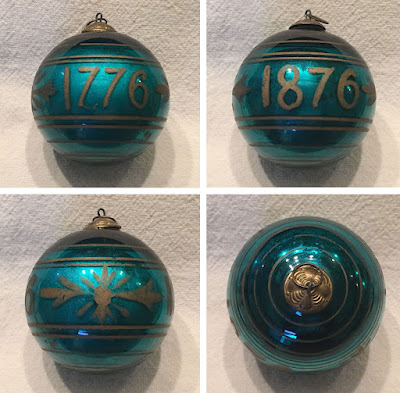
Among the ornaments given to George and his wife Alice, was a special glass piece known as a kugel. Unlike the thin-walled glass ornaments that became popular later on, kugels were heavy glass ornaments usually lined with silver, which gave the glass a deep rich color. The ornament was purchased by the Glessners during their visit to the Centennial Exposition in Philadelphia during the summer of 1876. It is painted with simple gold decoration, and features the dates of 1776 and 1876, denoting the centennial of the United States. The kugel was passed down through several generations of George’s family, before being returned to Glessner house in 2018. It is the only original family ornament in the collection today.

With the Glessner children married and away from home, Frances Glessner usually selected friends – often the age of her children – to decorate the Christmas tree. Favorites included the architect Hermann von Holst, whom the Glessners unofficially “adopted” as a young adult after his parents returned to Germany; he always spent the holiday with the Glessners. In 1900, Hermann “trimmed our Christmas tree and staid all night to see the fun in the morning.” After he married, his wife Lucy joined in the annual tradition. Other favorites to assist with the tree trimming included the principal harpist of the Chicago Symphony, Enrico Tramonti, and his wife Juliette. The Glessners’ grandchildren start participating in the decorating activities by 1905.

The Glessners had switched to a larger tree by 1902, when Frances Glessner wrote in her journal, “the children all came home Christmas morning at ten o’clock when we lighted the tree which stood in the hall. All of the family and household were in the hall.” The tree was still lit with candles at this point, so the lighting was a major part of the celebration with everyone gathered to observe the tree briefly illuminated with its lit candles (perhaps 15-20 minutes) before the candles were extinguished.

Electric lights were first incorporated on the Glessner Christmas tree in 1911, and the display was quite elaborate. Few people had electric lights at this time, the first strings being introduced by General Electric in 1903, although Frances Glessner noted seeing individual electric lights on the tree of a friend in 1900. Strings of lights were initially quite expensive, and, as few people had electric outlets, were designed to screw into a light bulb socket of a nearby wall sconce or chandelier.

The festivities around the Christmas tree for 1911 began with the arrival of the fresh tree from The Rocks, the Glessners’ summer estate in the White Mountains of New Hampshire. John Glessner noted that five trees were delivered for use in their home, and the homes of their son George, daughter Frances, sisters-in-law Helen and Anna (who shared an apartment), and neighbors James and Narcissa Thorne (later known for her meticulous Thorne Rooms, on permanent display at the Art Institute).


Three of the trees from The Rocks were delivered to these Prairie Avenue homes: (L-R) James and Narcissa Thorne (1708), George and Alice Glessner (1706), and Blewett and Frances Lee (1700).


John Glessner wrote that an electrician with International Harvester was recruited for the special electric light display:
 

“Cheney the electrician spent all of Saturday and Sunday over our Christmas tree and it was wonderfully pretty. The tree came from The Rocks and was placed in an alcove made of curtains in the main hall, had many and various colored lights that “flashed” and twinkled; there were spotlights of various colors thrown on it and snow fell from the canopy over it.

“It was lighted first at 9 pm for our company at Sunday (Christmas Eve) supper – 19 in all at the table, and again at 10 o’clock on Christmas morning for the benefit of the children and our guests and servants – 36 or 37 in all, so that the tree blazed for about two hours on Sunday night and about two hours on Monday morning and then was taken down. It had its day and was no more. And before evening we were back to the original condition with only the memory.”

Despite the elaborate preparations for the tree, it was not photographed, but we know what the bulbs on the tree would have looked like. The earliest bulbs were pear-shaped, like early Edison bulbs, but in 1910 General Electric switched to a round bulb with a small “exhaust tip” at the end. This shape was used until 1919, when the cone shape resembling a flame was adopted; this remained the standard version until the 1970s and is now popular again as a “vintage style” bulb. The photos below show a light kit produced by General Electric in 1910. (To learn more about the history of electric Christmas tree lights, visit Old Christmas Tree Lights, from which the images below were retrieved.)


In 1978, Frances Glessner Lee’s two surviving children, John Glessner Lee and Martha Lee Batchelder, donated The Rocks Estate to the Society for the Protection of New Hampshire Forests, with the stipulation that a crop always be grown in the fields. Christmas trees were the chosen crop, and for more than three decades, a tree was shipped from The Rocks each year to decorate the main hall at Glessner House. That tradition ended in 2019, when the building housing the shipping operation burned to the ground; since that time a tree has been sourced locally.


In order to tell the full story of Christmas at the house, two trees are decorated each year. A small three-foot tree sits on the table in the schoolroom – this is where the original kugel is hung. A larger tree is displayed in the main hall. There are no electric lights on either tree, interpreting the period prior to the grand electric light display of 1911.


Tuesday, December 1, 2020

A Toast to the Glessners - Christmas 1924


Framed Deed of Gift, December 1, 1924

Today, December 1, 2020, marks the 96th anniversary of the Glessners deeding their beloved Prairie Avenue home to the Chicago Chapter of the American Institute of Architects (CCAIA), to ensure its preservation. A beautiful toast noting that act of generosity, written and delivered by architect Hermann V. von Holst at the Glessners’ Christmas dinner later that month, was recently acquired for the house collection. Clearly, it was a celebratory month for the Glessners as their friends and the architectural community thanked them for their magnificent gift. In this article, we will reconstruct the month of December 1924, ending with von Holst’s touching tribute to his long-time friends.

THE HOUSE IS GIFTED TO THE CCAIA
During the 1910s and early 1920s, the Glessners witnessed the enormous change that was happening all around them, as families left Prairie Avenue and their homes were demolished or converted into boarding houses or business offices. In 1922, Richardson’s only other house in Chicago, built for Franklin and Emily MacVeagh at 1400 North Lake Shore Drive, was razed and replaced with a high-rise apartment house.

The Deed of Gift between the Glessners and the CCAIA, signed on December 1, 1924, represented the best way to ensure the preservation of their house, and its continued use by the architectural community that understood its significance. The Deed was specific – Richardson’s portrait must always remain on the wall, and his monogram on the façade must never be altered – but the use of the house would change dramatically. This was no house museum – the building was to be repurposed for the uses of the CCAIA to include offices, meeting rooms, gallery space, and an atelier.


Chicago Tribune, December 3, 1924

The announcement of the gift was published in the Chicago newspapers, and within weeks newspapers from across the country covered the story, a clear indication of how important the house was considered even at that time. Among the many notes of appreciation the Glessners received was one from Julia “Lula” Shepley, daughter of Henry Hobson Richardson and the wife of George Shepley, one of the three men, who, following Richardson’s death in 1886, reorganized his office as Shepley, Rutan and Coolidge.


Page 1 of Lula Richardson Shepley's letter to Frances Glessner

HERMANN V. VON HOLST
An important member of Chicago’s architectural community in 1924 was Hermann V. von Holst, and he was among the Glessners’ closest friends. (Read this 2012 blog article for more information on his life and career). Hermann, just 18 years old when he arrived in the U.S. in 1892, accompanied his father, Dr. Hermann E. von Holst, who had accepted an appointment at the new University of Chicago. The Glessners quickly formed a friendship with the von Holst family, which also included Hermann’s mother and sister. Dr. von Holst was forced to retire in 1900 due to ill health. He returned to Germany with his wife and daughter and died in 1904.


Hermann V. von Holst (from 1924 passport application)

Son Hermann, who by this point was chief draftsman in the Chicago office of Shepley, Rutan and Coolidge, stayed behind and was quickly “adopted” by the Glessners. He starts showing up regularly in Frances Glessner’s journal, attending Sunday suppers or joining them at the symphony. For the first Christmas apart from his family, Hermann was invited to trim the Glessners’ tree on Christmas Eve, and he stayed the night, so that he could “see the fun in the morning.” In a letter from Hermann’s mother to Frances Glessner, dated February 1, 1901, she noted:

“Yes, he is lonely and we, too, miss him greatly. In almost every letter, indeed in every one now, he speaks of your kindness to him and of the enjoyment he receives from his visits with you. It was so very kind of you to have him with you just at Christmas time, for a Christmas spent alone is about the most doleful thing imaginable.”

The Glessners greatly enjoyed surrounding themselves with architects, artists, authors, and musicians, so the friendship is no surprise. But in the case of Hermann, it may well have had added significance. Hermann was born in 1874, the same year as the Glessners’ son, John Francis, who had died at the age of just eight months. In a meaningful way, the young and talented architect may have been a surrogate for the lost son, especially in those first years after George and Frances had both married and were preparing for the holiday in their own homes. (In 1902, on the anniversary of the birth of the infant son, Frances Glessner noted in her journal that he would have been 28 years old had he lived, so his memory always remained with her).

Hermann traveled to Germany to help care for his ailing father in April 1901, remaining for three years, but upon returning to Chicago, he was welcomed again to share in the Glessners’ Christmas festivities, as noted in his reply to Frances Glessner’s invitation for Christmas Day 1904:

“To begin and to close Christmas Day at Mr. and Mrs. Glessners’ – nothing finer could Mr. von Holst wish, and, as the best wishes are so seldom realized, he looks forward with pleasure to the fulfillment of this one: to Breakfast at 8, to Supper at 7.”

His Christmas card from 1909 contains a short but heartfelt greeting:

“To Mrs. Glessner – a Merry Christmas. I know of no truer heart or better friend. Hermann”

It appears Hermann was present every Christmas for decades, even after his marriage to Lucy Hammond in 1911. Soon after, Hermann published Modern American Homes, and one of the first copies was presented to Frances Glessner for Christmas in 1912, with the following, thoughtful inscription:

“To Mrs. Glessner – Your ideals and ideas for the American Home have ever been an inspiration, to seek and strive for beauty along simple straightforward lines.”


Dining room, 1923

CHRISTMAS 1924

Frances Glessner’s journal stops in 1917, but various other documents left behind help us to reconstruct what Christmas would have been like in 1924. The guest list shows that seventeen people joined the Glessners for dinner. 

Frederick and Elizabeth Stock – Music director of the symphony since 1905. On his photo above, which he presented to the Glessners for Christmas in 1907, he notes that they are his “best friends.”


(From left) Frederick Wessels, Henry Voegeli, Eric DeLamarter

Frederick and Minnie Wessels – The orchestra’s business manager, and treasurer of the Orchestral Association, of which John Glessner was a trustee. 

Henry and Frances Voegeli – The orchestra’s assistant business manager, and assistant treasurer of the Orchestral Association. He took over as business manager upon Wessel’s retirement in 1927.

Eric DeLamarter – Assistant conductor of the symphony since October 1918.

Enrico and Juliette Tramonti – They came to Chicago in 1902 when he accepted the position of principal harpist with the symphony; he continued in that position until 1927.


William Bernhard with "Jerry" (Ephraim Historical Foundation)

William and Svea Bernhard – A Chicago architect who later designed the summer home for the Stocks in Ephraim, Wisconsin.


Lucy von Holst (from 1924 passport application)

Hermann and Lucy von Holst – Records indicate that Lucy von Holst, Juliette Tramonti, and Svea Bernhard were regularly asked to decorate the Glessners’ Christmas tree. All would have been about the age of the Glessners’ children.

Nathalie Sieboth Kennedy – Reader for Frances Glessner’s Monday Morning Reading Class from 1902 until it was disbanded in 1930. During the 1890s and early 1900s, she was co-principal of the Sieboth-Kennedy School for Girls with her sister Marie (Sieboth) Gookin. It was considered one of Chicago’s finest finishing schools, the graduates “marrying well and early.”

Nathalie Gookin – Mrs. Kennedy’s niece, and the daughter of Frederick and Marie Gookin. Frederick was a close friend of John Glessner, and the long-time curator of Japanese prints and drawings at the Art Institute of Chicago.

Alfred and Vera Wolfe – Vera was the only child of Frederick and Elizabeth Stock. This was the couple’s first Christmas as husband and wife, having been married at Fourth Presbyterian Church in April 1924.

In addition to the guest list, we also have Frances Glessners’ seating chart. Frederick Stock occupied the place of honor to her right; Eric DeLamarter sat to her left. The two youngest female guests, Nathalie Gookin and Vera Wolfe, sat to either side of John Glessner.

The menu was not as elaborate as it would have been in the late 1800s, this time including just four courses (as opposed to eight).

First course
Soup, served with crackers, olives, and celery. Crackers would have been baked by the cook (no saltines here), and celery was still quite popular, with special dishes designed to hold the crudité. 

Second course
Turkey, sausage, cranberries, jelly, sweet potatoes, corn, beans, and radishes. The sausage was most likely from Deerfoot Farms, the finest and most expensive sausages at the time; it is frequently identified by name on other dinner menus. Jelly referred to a gelatin dish, i.e. a “Jello mold,” all the rage at the time. 

Third course
Tomato and lettuce salad, with cheese balls and crackers. Menus consistently show that salad was always served after the entrée. 

Fourth course
Plum pudding, ice cream, cake, candy, fruit, nuts, and raisins. Plum pudding was a standard on the Glessners’ Christmas table, and ice cream was served at almost all dinner parties. 

Beverages
This being Prohibition, no alcohol was served. During dinner, guests consumed cider and White Rock, the most popular mineral water of its day. Coffee was served with dessert.

HERMANN’S TOAST
The toast read by Hermann at dinner is significant in that it combines a bit of history of his relationship with the Glessners, how meaningful the years of friendship were to him, and a first-hand account of how the Glessners’ “spirit” impacted all those around them. 

He begins the toast by noting that in 1896, he received his first independent commission as an architect from the Glessners – a bronze tablet commemorating their horse Jim, who had died earlier that year at The Rocks, where he was buried beneath a huge boulder.


Jim's memorial plaque, 2013

The remainder of the toast makes note of the Glessners’ gift of their Prairie Avenue home and how that act embodied and reflected their generous spirit. The toast reads:

“A few weeks ago, the Chicago papers announced that this home was presented in perpetuity to the (Chicago) Chapter of the American Institute of Architects. The same spirit that remembered the faithful horse with a bronze table dedicated this beautiful structure to posterity, a gift which will have untold influence for good on generations of followers of the art of building. 

“The young draughtsman of 1896 has been under the influence of this spirit for 28 years and knows what it has done for him.

“You assembled here know too what a wonderful enlightening factor it has been in your lives. It is a spirit for good and it will outlast this glorious, lovable building. It is the spirit of Christmas that lasts 365 days in the year. Mrs. Glessner and Mr. Glessner are the embodiment of this spirit. They have given the inert materials composing this structure a mighty soul.

“Let us rise and wish them in unison A MERRY CHRISTMAS.”


And with those carefully chosen words, Hermann V. von Holst preserved the special spirit of this house and its occupants for all of us to appreciate nearly a century later, when the true spirit of Christmas is needed more than ever.


POSTSCRIPT
After dinner, the party traveled down to Orchestra Hall, where Stock led one of his “popular concerts” consisting of lighter works, with tickets priced from 15 to 50 cents, making the concerts available to a wide audience. 

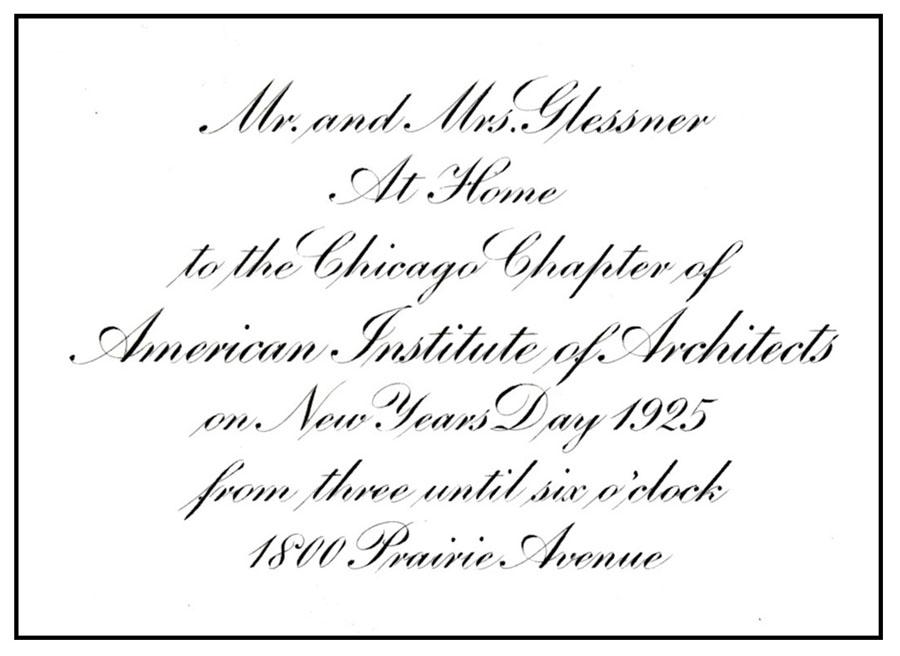
On January 1, 1925, to conclude the celebratory month, the Glessners hosted a reception for the members of the Chicago Chapter of the American Institute of Architects, assisted by the Chapter president, Alfred H. Granger. That day was also Frances Glessner’s 77th birthday.


Friday, January 31, 2020

55 Years Ago - Glessner House Fights For Its Life

Fifty-five years ago today, the Chicago Tribune ran a story sounding the alarm that the nationally and internationally significant Glessner House was up for sale and facing an uncertain future. Given the fact that most of the houses along Prairie Avenue had been torn down during the previous decades when the area transformed from a high-class residential neighborhood into a manufacturing district, the alarm was warranted. Businesses operating nearby, mostly connected with the printing and publishing industries, were still buying houses and tearing them down to provide more parking for their employees. (The two houses immediately south of Glessner House would be torn down in 1968 specifically for that purpose). Many people would have seen the 75 by 176 foot lot upon which the Glessner House stood, to have more value than the house itself.

The sale of the house by the Graphic Arts Technical Foundation (GATF), which had occupied the building since 1945, did not come as a surprise to those in the architectural and emerging preservation communities. In November 1963, a meeting took place between two senior staff members of GATF and Wilbert R. Hasbrouck (Chairman of the Preservation Committee of the Chicago Chapter of the American Institute of Architects), Joseph Benson (Secretary of the Commission on Chicago Architectural Landmarks), and Marian Despres (early Chicago preservationist and wife of Alderman Leon Despres, who drafted the city's first landmarks ordinance). It was at that meeting that GATF announced its plans to relocate operations to Pennsylvania and put Glessner House up for sale. Hasbrouck reported back to Jack Train, president of the Chicago Chapter AIA:

"Regardless of what final use is made of this building, I feel the AIA must take a major advisory role in its disposition. The Glessner House is too important a structure to go the way of the Garrick." (This was a reference to Adler & Sullivan's Garrick Theater, razed in 1961 after a significant battle that helped galvanize Chicago's early preservationists. A number of the individuals who fought to save the Garrick played a leading role in successfully saving Glessner House).

Turning back the clock 55 years to January 31, 1965, if you were to have picked up the morning edition of the Chicago Tribune and turned to page S3, you would have read the following article about the house. It may well have also been your first introduction to John and Frances Glessner, whose names had slipped into obscurity after their deaths three decades earlier.

Old Show Place on Prairie Avenue Haunted by Shaky Future; Now for Sale
Architects Hope to Make It a Museum
by Sylvia Shepherd


Granite block old home of late J. J. Glessner at 1800 Prairie av.,
was built in 1886 and has survived decline of once-fashionable
south side gold coast. Fate of house worries history-
conscious Chicagoans.

The uncertain destiny of the old J. J. Glessner house, built almost 80 years ago at 1800 Prairie av., has aroused the fears of several history-conscious Chicagoans.

The house, one of the show places of the original south side gold coast, now holds the Graphic Arts Technical Foundation. This research organization has moved most of its operations to a new headquarters in Pittsburgh and wants to sell the Glessner building.

Richardson's Last Work
William Hasbrook (sic), one of those interested in preserving the building, said the Glessner house "would make a small museum of architecture." Hasbrook is chairman of the committee for preservation of historical buildings for the local chapter of the American Institute of Architects.

Hasbrook believes the house is the only remaining residential work of the late Henry Hobson Richardson, famous Boston architect, in this city.

"Chicago is known thruout the world for architecture - not only of the past but of the present," said Hasbrook. "Material on architectural history is scattered around the city - in bits and pieces. This house could become a central spot for this material."

Mrs. Leon DePres (sic) wife of the 5th ward alderman, said, "Anything could happen to the building. There's no protection for it."

"We must see what we can do to preserve it," she added. "It could be a future attraction for tourists."

A City Landmark
Also interested in preserving the building is the Commission on Chicago Architectural Landmarks. Joseph Benson, commission secretary, said his group is "very concerned" about the fate of the house, which is one of 39 official landmarks in the city.

Richardson built the house in 1886 in what came to be known as "Richardsonian Romanesque." Because the architect believed beauty to be found in strength, granite blocks were used in the construction. He died three weeks after completing the house.

John J. Glessner was born in Zanesville, O., and came to this city as a young man. When International Harvester company was founded in 1902, he was a founder and became a vice president.

Glessner and his wife, Frances, were social leaders for 60 years. The house was famous for architectural significance and hospitality.

Glessner was a board president of Rush Medical college, a director of the Chicago Relief and Aid society, and a trustee of the Chicago Orphan asylum, the Chicago Orchestral association, and the Art Institute.

Society Rendezvous
His wife's Monday Morning Reading class was a feature of south side society for 50 years. Most of the fashionable women of the city began gathering at 10:30 a.m. until a class of more than 40 was assembled in the long library.

It was to their home that the Chicago Symphony orchestra members came once a year for a party.

Mrs. Glessner once was quoted as saying, "For all its granite, this home is wonderfully elastic. You can squeeze as many as you want into it."

In 1924, Glessner announced that the house would be given to the American Institute of Architects after the deaths of himself and his wife. His will asked for its maintenance as "a museum, library, gallery, and educational institution, including a school of design for legitimate architectural assemblages."

Rich Social Background
By 1925, a reporter wrote, "The antennae of business have encroached all round and about the dignified granite residence." Already changing was the neighborhood which once housed the George M. Pullmans, the Marshall Fields, T. B. Blackstone, the elder Philip Armours, and Dr. Frank Billings.

Mrs. Glessner died in 1932 at the age of 84. Her husband died just before his 93d birthday in 1936.

Conforming to the request in Glessner's will was deemed too costly in 1937 by the A. I. A., which estimated remodeling expenses at $25,000. It returned the home to the Glessner estate, whose heirs decided in 1938 to give the building to the Armour Institute of Technology.

"It is still in excellent shape" said Hasbrook, "and a choice piece of property."

Corrections to 1965 article:

  • Henry Hobson Richardson died in April 1886, three weeks after completing the design for the house. The house itself was completed in time for the Glessners to move in on December 1, 1887.
  • The Glessners invited the entire Chicago Symphony Orchestra for dinner on three occasions. Smaller dinners for the music director, selected orchestra members, and visiting soloists were held frequently.


Thursday, November 21, 2019

The Monday Morning Reading Class, Part I


Monday Morning Reading Class, May 5, 1902
(Photo by George Glessner)

Today marks the 125th anniversary of the first meeting of Frances Glessner’s Monday Morning Reading Class on November 21, 1894.  As her husband John noted in a tribute written shortly after her death in 1932, “Perhaps the Monday Morning Reading Class was her choicest activity and the one in which she took most pride and pleasure.”  In this first of several articles about the class, we will explore the origins of the class and how it was structured.

In his tribute, John Glessner noted that the idea for the class originated in an activity begun several years earlier, while the family was residing in their home at the northeast corner of Washington and Morgan:

Library of Washington Street house

“While living on Washington Street, Mrs. Glessner arranged a series of meetings of ladies in our library and parlors to listen to talks and readings about the latest books by scholars and experts, which were well attended and interesting and became the nucleus and forerunner of the Monday Morning Reading Class, so that that afterwards vigorous society had its origination and beginning then and there.”

Addie Hibbard Gregory, a member of the class for its entire 36 years of existence, recalled in her book, A Great-Grandmother Remembers, that Frances Glessner renewed the idea of her earlier meetings at the request of William Rainey Harper, first president of the newly formed University of Chicago:

“Early in the nineties, President Harper of the University of Chicago had asked Mrs. Glessner how the newly arrived wives and families of the university faculty could become acquainted with Chicago women, and we with them.  This class was Mrs. Glessner’s answer.  We were all grateful for the opportunity of meeting as soon as we did those delightful and clever women.”

John Glessner painted the picture of the University families arriving and his wife’s response in more colorful terms:

“When the University of Chicago was started and the staff drawn from all over the world with their families, all cultivated people but strangers to each other, found living conditions almost unbearable in crudely finished houses, with seas of mud in street and sidewalks, she made life more bearable by social attentions.”

In her journal entry for November 18, 1894, Frances Glessner wrote, “I have invited some of the young matrons on the south side to come here once a week for a reading class this winter.  The first reading is on Wednesday next – when they will lunch with me.”  The following week’s journal entry noted, “Wednesday my twenty-five ladies came for the reading aloud.  Miss Gaylord read to us.  We had Meneval’s Memoirs of Napoleon the first hour and The Memories of Dean Hole for the second hour.  Then we had our luncheon.”

Memoirs of the Baron de Meneval

Membership in the class was by invitation only - with two rules set in place.  One was that only married ladies would be invited, although a few exceptions were made through the years.  Secondly, and equally important, was the requirement that the ladies reside on the south side of the city.  In an informal history of the class written by John Glessner in 1925, he humorously noted:

“Membership was confined to the South Side – the mudsills of the North were frowned upon and taboo – only the South Side aristocracy of letters and beauty and gracious manners were drawn upon.  (Alas how the mighty haven fallen!  Our best people have been driven over the divide and we, the saving remnant, are merely permitted in tolerance to enter the sacred regions of north latitude beyond the river.)”

Members would have been residents of the south side at the time they were invited to join the class but were permitted to remain in the class if they later moved elsewhere, as many had by the 1920s.

Library at 1800 Prairie Avenue

The structure of the first class was set – the first hour would consist of more serious reading, usually of a historical nature, the second hour would feature lighter reading.  A paid professional reader would read selections from the books.  John Glessner, in his history of the class, noted “the labor the reader must give to find what to omit, what to explain, what to emphasize.  Every book has some dull pages and pages of indifferent interest that must be cut out to make for speed and to avoid tediosity.”   The selection of The Memories of Dean Hole also shows how current the book selections often were.  The book had just been published in 1894 by the Rev. Dr. Samuel Reynolds Hole, an English Anglican priest, horticulturalist, and leading expert on roses.  As Louise Goldsmith, another life-long member of the class noted, “he had visited Chicago the previous winter and we were all anxious to hear what he said about it.”

A few adjustments were made as well.  The first class was held on a Wednesday, but the class shifted to Monday the following week, and soon after the name “Monday Morning Reading Class” was adopted.  Invitations were extended to additional women, and the class quickly grew to fifty.  Additionally, it was soon determined that Miss Gaylord was not the ideal reader to lead the class.  Louise Goldsmith recounted:

“Miss Gaylord’s reading was very good; but she was young and could not have the broad knowledge and experience necessary for a full understanding of the erudite books she was proposed to read, so Mrs. Glessner looked about for someone who had the lighted torch of knowledge with which to illuminate the printed page revealing the thought of the writer in all of its clearness and strength.”

Miss Ann Trimingham

The new reader for the class, starting on December 17, was Miss Ann Trimingham, a former teacher at the West Side High School, and a sister of Louise Goldsmith.  She remained the reader until May 1902, “missing only one of the two hundred or more meetings.” 

Regarding the selection of the books, it was a democratic process from the start.  Louise Goldsmith recalled:

“Mrs. Glessner has always consulted the class with regard to the books, the one thing insisted upon by her and our reader was that they should be good literature worth spending time on.  Usually at the beginning of each year, a list of books has been presented to the class from which to select.  These books have been recommended by some outsider of known literary ability, by our own members, or by our reader.  A vote has then been taken and the choice of the majority has decided the question.”

The Glessner library (Photo by Chris Tyre)

Regarding the selection of the books, Addie Hibbard Gregory noted, “I, for one, am most grateful for glimpses into books which I should not have dared even to begin, in my busy life.”  She also recorded a delightful barb from New York, “We surely did not deserve the comment (or inuendo) of the eastern society journal which stated that it was ‘glad that Chicago women were learning to read, for Mrs. J. J. Glessner has organized a class for that purpose.’”

On the first Monday of each month, the class was followed by a luncheon, which frequently included musical entertainment.  A typical menu, recorded in 1895, featured sandwiches, baking powder biscuits buttered, sweetbread patties, coffee, hot chocolate, ice cream, and cake.”  The ladies would sit at tables of six, set up in the parlor and dining room.  Frances Glessner purchased a special set of luncheon china in a delicate blue and white pattern, which was reserved for the use of the monthly class luncheons.  (The maker of the hard paste porcelain with transferware decoration is unknown, as the pieces are unmarked).

Reading Class china

The first season of the class concluded on May 13, 1895, shortly before Frances Glessner left Chicago for her summer estate, The Rocks, in New Hampshire.  She recorded in her journal:

“Monday, the Reading Class came to luncheon.  Each lady came walking in carrying a bunch of large long-stemmed American Beauty roses for me.  There were thirty ladies – and it was a lovely sight to see them coming in processions of six or eight carrying these roses.  Frederick and John (butler and footman) arranged them in large vases in the dining room – all on the table, sideboard and side table.  It was very beautiful to look at and certainly a lovely attention to me.  We read our Fyffe for an hour and then Miss Trimingham read her last Fortnightly paper to us – on Sydney Smith and his friends.  After that we had luncheon, then a little music, then goodbye for the summer.”

(Fyffe is a reference to Volume I of The History of Modern Europe by Charles Alan Fyffe, which by the third class had replaced Meneval’s Memoirs of Napoleon, as class members had found it to be “rather dry.”  Sydney Smith (1771-1845) was an English humorist, writer, and Anglican cleric).

Monday, April 15, 2019

The Glessners in Paris - 1890


Panorama of the seven bridges

As this article is being written, the iconic Cathedral of Notre Dame in Paris, continues to burn, the images of the building devastation heartbreaking for Parisians, Christians, and all those who love and appreciate historic architecture.  As stewards of a Chicago landmark (designed by H. H. Richardson, who received his architectural training at L’Ecole des Beaux Arts in Paris), we sympathize with all those who are impacted by the irreplaceable loss of this internationally significant architectural treasure. 

John and Frances Glessner and their daughter Fanny (accompanied by her paid companion Miss Scharff) had the opportunity to visit Notre Dame during a trip to Europe in the early part of 1890.  Below are selected excerpts from the Glessner journal (written by John Glessner) detailing their time in Paris.  (All images, other than that of Notre Dame Cathedral, taken from an album of photographs assembled by the Glessners during their trip).

Place de la Concorde

Monday February 24, 1890 (in Havre):
“At 7:30am left by train for Paris . . .Had telegraphed Hotel Baida to send man to meet us at RR station in Paris and soon after arrival were comfortably placed in our hotel with two good sunny communicating rooms, fire lighted etc. . . We went for a long drive through Paris. . . We drove for four hours through places of great interest – only stopping once or twice.  We were most impressed by the Madeleine, Notre Dame, Arc de Triomphe.  We drove on the Champs Elysses to the Bois de Boulogne to Café Cascade where we got out and had a cup of delicious hot chocolate. 

Venus de Milo

“Tuesday Feby. 25 was spent – morning at the Louvre with antique statuary and some old paintings.  The enormous galleries are full of wonderful and beautiful historical works.  Were most impressed by the Venus de Milo and Melpomene.  The Venus is larger than we had expected, and most beautiful from every view.  The coloring of Van Dyck and Titian and Tintoretto and the great works of Rubens impressed us . . . Murillo’s Immaculate Conception kept our attention for as long as we could spare. . . Dined table d’hote at the Continental and from there to Port St. Martin Theatre to see Sarah Bernhardt in Joan of Arc.  Small theatre, so that everybody was close to stage.  Four balconies or galleries and the 1st floor gave seat space.  The play was fine and well given. 

A gallery at the Louvre

Wednesday February 26:
“The ladies, Fanny included, started out shopping immediately after breakfast and I wandered about until 11, when I went to meet Fanny and relieve her from further shopping, but they had been delayed so we all lunched together at Café Voisin.  From there drove to Notre Dame Cathedral and went through that beautiful building and saw the wonderful 
treasures it contains.  After that all four took top of street car and rode across Paris. 

Thursday February 27:
“After breakfast went to Ste. Chapelle, the oldest church in Paris.  Then to the Cluny Museum where we were more than delighted with the collections of furniture, embroideries, laces, porcelain, etc.  Then to the Pantheon and walked hastily through looking at the frescoes but did not go down to the underground tombs nor up to the tower.

Eiffel Tower

Friday February 28:
“Went to the Luxembourg at once after breakfast.  Saw the large bronze St. John by Paul Dubois and some fine pictures.  Liked best Jules Dupre’s Eleaner, Rosa Bonheur’s Cattle Plowing, Bonnet’s portrait of Lion Cogniet, and Bastien-Lepage’s Haymaking.  Saw also the Oyster Gatherers by Feyen-Perrin of which we once had an etching.  From there the ladies went to Au Bon Marche after walking through the gardens, and I to the bankers for letters.  Lunched at the Binda, left Fanny here and we went shopping and to call on (Mihaly) Munkacsy at his studio.  The reception room was furnished with screens and sofas and hangings, had a bright fire burning and was filled with French callers. . . He took us into his studio, through a door draped with three or four thicknesses of hangings, and we sat there on a corner sofa a while talking with him through Miss Scharff. . . The studio had a stuffed horse in it and some stuffs and was very light.  Visited many old shops and Theodore Deck’s place, but found nothing to buy.  Bought at Barbedienne’s a bronze Sitting Mercury.  We are getting quite in conceit with our own bric-a-brac, as it compares well with what we see, or is reproduction of what we see. 

Saturday March 1:
“Went to Louvre after breakfast to have another look at the art treasures. . . After that to a private exhibition of paintings at The Cercle de L’Union Artistique 5 Rue Boissay D’Anglas. . . Neglected to say above that we went Friday night to the Grand Opera, L’Africaine and found the performance magnificent.  Had never seen such stage setting.  Over 100 players in orchestra and at one time at least 175 people on the stage, perhaps more.  A Chicago audience on a similar occasion will compare favorably with this one, though perhaps not so many jewels worn by the ladies.  Generally the dresses here were not so low at the neck as at home, but a few were lower.  The men wore hats between the acts. 

Foyer of the Grand Opera House

“Sunday morning went to the Greek church and staid through the service.  The church is in shape of Greek cross about 35 feet square and contained many paintings some at least of which were very good and perhaps more, for we couldn’t see them very well.”

(On Monday March 3, the Glessners traveled to Cannes and then to Italy, returning to Paris on April 2, during Holy Week, spending ten days there before boarding their ship at Havre for the passage home).

Friday April 4:
“Good Friday.  We all four went shopping together this morning.  Bought a bureau and writing table for bedroom at home. . .

Notre Dame Cathedral in the 1890s

Sunday April 6:
“On Sunday morning – Easter Sunday – Frances and Miss Scharff went to service at Notre Dame, which they found interesting. . . Fanny and I staid at home and wrote letters.  After luncheon we drove to St. Cloud and on the Bois de Boulogne until dinner time.  Fanny wore her Bersagliero hat and cloak, supposing that anything might be worn here without remark, but found it unpleasant because of the attention it seemed to attract.”

“On Wednesday morning April 9th, I visited Central Halles the great market, the Tower of St. Jacques, Sainte Chappelle, and Notre Dame while the two ladies and Fanny went to dressmakers, bought embroideries, etc.  After luncheon, Miss Scharff and Fanny drove to the Jardin d’Acclimatation to see the animals and birds. . . At 7 we took carriages four ourselves and our guests the Hutchinsons and went to our dinner.  When we came home Miss Scharff and I from our cab saw the blaze from a large fire, so got Mr. H. to join us and drove to it.  Some large sheds of second hand building material were burning, with great heat and blaze, and quite a crowd had gathered.  A number of men and boys had climbed into the trees for a better sight.”

Newspaper clipping:
“Big Blaze in the Rue Daru”
“Last evening, between nine and ten o’clock, by the lurid appearance of the sky in the direction of the Arc de Triomphe, it was plain that a large fire was raging somewhere in that part of the city, and excited crowds hastened along the boulevards to the scene of disaster.
“On the rue Daru, near the Russian church, stood a row of sheds and ware-houses used by a firm of dealers in second-hand building materials.  These were found to be in flames, and owing to the inflammable nature of the contents, straw, piles of boards, etc., the fire blazed fiercely, lighting up the whole neighborhood.
“The flames threw out such volumes of heat that it was almost impossible for the firemen to hold their ground.  For an hour or so water and fire fought for the mastery, while thousands watched the struggle with admiration.  Finally the water won, streaming down in a deluge from many lines of hose.  The light died away, the heat diminished, the multitude dispersed, and the fire was out.”

NOTE:  A large engraving, depicting Notre Dame Cathedral, always hung over the bed in George Glessner's bedroom, as seen in this historic image below.


Related Posts Plugin for WordPress, Blogger...