Monday, February 14, 2022

Black History Month Spotlight: Charles H. Smiley, Chicago's society caterer


During the last two decades of the 19
th century, Charles H. Smiley secured a position as one of Chicago’s most prosperous and successful African-American businessmen. Born into humble beginnings, he built a business which served Chicago’s wealthiest families, earning him their patronage and deep respect. In this article, we will explore his origins, how he built his business, and his commitment to providing business and educational opportunities for members of Chicago’s growing African-American community.

Origins

Charles H. Smiley was born on October 5, 1850, in St. Catharines, Ontario, Canada to freedom seekers who had escaped the bonds of slavery in Virginia. St. Catharines, located immediately west of Niagara Falls on the south shore of Lake Ontario, was the final terminus on the Niagara Freedom Trail of the Underground Railroad for hundreds of former slaves from the 1820s through the American Civil War.

In 1850, the year of Smiley’s birth, the United States passed the Fugitive Slave Act, which permitted escaped slaves living in the northern states to be apprehended and returned to their owners. This led to a huge exodus of freedom seekers into various parts of Canada. By the mid-1850s, the population of St. Catharines had grown to 6,000 of which more than 800 were of African descendent.

Harriet Tubman, one of the most important Underground Railroad conductors and abolitionists, made St. Catharines her home throughout the 1850s, making numerous trips back into the United States at significant personal risk, to help additional freedom seekers make the final leg of their journey into Canada. The center of abolitionist activity for Tubman and others was the Bethel Chapel, associated with the African Methodist Episcopal Church. In 1855, a larger chapel was built which stands today as Salem Chapel. Two plaques on its exterior denote its designation as a national historic site, and for its connection with Harriet Tubman, designated a national historic person.
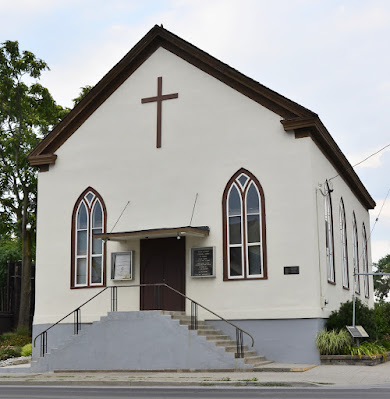

Young Charles would have been keenly aware of the arrival of the freedom seekers, following in the steps his parents had taken years earlier. It is quite likely that his family attended services at the chapel, as Smiley’s funeral decades later in Chicago took place at an African Methodist Episcopal Church. 

Philadelphia

Few educational opportunities were available to Charles and at an early age he engaged in hard manual labor for minimal pay. He turned 15 just months after the end of the Civil War, and his family, hoping to find better opportunities back in the United States, settled in Philadelphia. Smiley took whatever jobs he could find, ranging from driver to janitor, and in his extra time served as a waiter at dinners and parties. Many years later, his friend Booker T. Washington said of him, “he had a resolute character, good powers of observation, ambition, and brains.” With those traits in hand, Smiley quickly saw the potential in the catering business.

In 1899, the civil rights activist W. E. B. Du Bois wrote:

“To the more pushing and energetic Negroes only two courses were open: to enter into commercial life in some small way, or to develop certain lines of home service into a more independent and lucrative employment. In this latter way was the most striking advance made; the whole catering business, arising from an evolution shrewdly, persistently and tastefully directed, transformed the Negro cook and waiter into the public caterer and restaurateur, and raised a crowd of underpaid menials to become a set of self-reliant, original business men, who amassed fortunes for themselves and won general respect for their people.” 

John S. Trower, Philadelphia’s most successful African-American caterer and a life-long friend of Smiley, echoed this sentiment during an address at the National Negro Business League, held at Chicago in 1901:

“Catering was all ours. We were America’s acknowledged cooks, butlers, waiters, and caterers. But a few years ago, white men were unknown in many of these kinds of work. Colored men once controlled this work in Baltimore, Washington, Philadelphia, Boston, New York, Chicago and the great Northern cities. As a result of this control, the wealthiest colored citizens were caterers.” 

The 1880 census, taken just as Smiley turned 30 years of age, shows him engaged in the catering business, with a wife and two sons – John Hockley age 6 and William S. age 4. The next year, he left Philadelphia and moved to Chicago, where he felt the rapidly growing city and burgeoning wealthy class provided even more opportunities for an energetic and ambitious businessman to make his fortune.

Chicago

By 1881, Prairie Avenue had established itself as Chicago’s most exclusive residential street with dozens of mansions standing in the six blocks between 16th and 22nd streets. Smiley set up his new catering business nearby, first on Indiana Avenue and then on 22nd Street (now Cermak Road) near Michigan Avenue, less than two blocks west of Prairie Avenue. Within a few years he moved to larger facilities literally at the back door of a Prairie Avenue mansion.

Like most businessmen, he had his ups and downs in his early years. At the time of his death, his longtime friend, Judge Jesse A. Baldwin, wrote:

“I knew him for many years and he was one of the squarest men I ever knew. A good many years ago, while I was practicing law, he came to me and told me that he was tied up financially and that he would have to come to some understanding with his creditors. He gave me a list of his creditors, with the amount he owed each one, and he gave me an account of his assets. He asked me to make the transfer. He came in a few days later, after I had seen his creditors, feeling downcast.

“Charlie, your creditors feel sorry for you and I can settle with them for 50 cents on the dollar. With tears rolling down his face he said: ‘I couldn’t do that, Mr. Jesse. My mother borns me poor, but she borns me honest. Pay them every cent. I don’t care if there ain’t any left.’ I never had a client yet who was more insistent on being honest.”


In 1907, Booker T. Washington published
The Negro in Business, discussing the advances many African-Americans had made in the business world since the end of the Civil War. His good friend Charles Smiley is the only Chicagoan included in the book, represented by a portrait, a picture of his handsome business block, and a brief summary of his business life. From this we learn why Smiley found such success in his new city:

“Mr. Smiley’s success seems to have been due, in great part, to the enterprise he displayed in meeting every new want that manifested itself in connection with his business. As caterer for a wedding, he did not merely provide the wedding cake but was ready, if required, to furnish appropriate floral decorations, canopies, calcium lights, pillows, ribbons and kneeling altars, - even ushers. He advertised that he was willing to deliver invitations, to guard wedding presents with male and female detectives, in fact to take entire charge of the social function at which his services were required.” 

By expanding his business, Smiley was also providing more opportunities to help others in his community as noted by Washington who went on to say:

“Mr. Smiley is said to give employment to more colored men than any other man of his race in the West. He uses sixteen horses for his delivery wagons.”

He became a citizen of the United States in 1886, the newspapers noting that he was the first African-American to be naturalized in Chicago.

His impeccable reputation and reliability earned him the business of many of Chicago’s leading families. Journalists, reporting on the elaborate parties he catered, soon realized that adding “Smiley served” to their newspaper column was as important as listing the guests in attendance.


The Glessners

John and Frances Glessner utilized Smiley’s services for many years, as noted in his 1911 obituary:

“Smiley served the family of J. J. Glessner, 1800 Prairie avenue, more than three decades. He used to tell the story of one of his first affairs, when he was located at Indiana avenue and Twenty-fourth street. The entertainment took place on a stormy winter night. The caterer was forced to hire a hansom to take his small outfit to the Glessner residence. The outfit was so meager that it contained only one coffee boiler. Years after, at one of his correspondingly big entertainments, he chartered a special train to carry his help and his supplies to the scene of a great wedding.”

The first time Smiley is mentioned in Frances Glessner’s journal is in January 1888, less than two months after the family had moved into their new Prairie Avenue home. They hosted an evening musicale to which 35 guests had been invited.

“After the music we had supper served in the hall and dining room – hot oysters, salad, coffee, sandwiches, cake and ice cream. Charles Smiley served the supper. We have had the very pleasantest things said about the evening.” 

In November 1891, a period in which Frances Glessner went through several cooks in quick succession, she noted “I had Annie Smiley come in to cook our dinner,” a reference to Smiley’s wife and partner in the business.

Most significantly, the journal entry for the wedding of the Glessners’ daughter Frances to Blewett Lee at the house in February 1898, notes that the cook Mattie Williamson baked the wedding cakes, but they “were taken away to be iced by Smiley.”

Prominence grows


In 1893, Smiley constructed an elegant three-story stone front building to house his growing business, along with a large dining room and ballroom that could be rented out. The building stood at 76 22
nd St. (later 220 E. 22nd Street), immediately west of the mansion of Northern Trust founder and president Byron Laflin Smith at 2140 S. Prairie Avenue. The new building also served as his residence, and his unique position within Chicago’s society is noted by the fact that the census shows he and his family to be the only African-Americans living in the area.


The Smith house at 2140 S. Prairie Avenue. The silhouette of Smiley's building can be seen at far left.


That same year, Smiley would have been celebrated as an outstanding example of local “Negro progress” during “Colored American Day” at the World’s Columbian Exposition which featured addresses by Ida B. Wells and Frederick Douglass. African-Americans traveled from across the country for the event and they marveled at the “few Negroes that had managed to attain some prominence and wealth, and the handful that possessed well established businesses catering to a white clientele.”

Provident Hospital

In 1891, Provident Hospital was organized as the first African-American owned and operated hospital in the United States. The hospital was open to everyone, regardless of race, and patients were only asked to pay what they could afford. Smiley was among the group of successful Chicago businessmen, both black and white, that supported the effort from its inception. The hospital achieved prominence in 1893, when its surgeon, Dr. Daniel Hale Williams, performed the first successful heart surgery. He operated on a stabbing victim, using a new type of suture to sew up the heart, which resulted in a complete recovery for the patient. It was the first private hospital in Illinois to provide internship opportunities for black physicians, the first to establish a school of nursing to train black women, and the first black hospital to be approved by the American College of Surgeons for full graduate training in surgery.

In 1895, the Chicago newspapers announced that Charles and Anna Smiley were to host a charity ball at their facility to benefit the hospital, which had quickly outgrown its original building at 29th and Dearborn streets.  Over 300 guests attended, many from Chicago but a good number from other parts of the country as well. Plans had already been drawn up for a larger three-story stone and brick building at 36th and Dearborn streets, and the ball was to aid in the fundraising efforts for that project.


The new Provident Hospital

The newspaper accounts of the ball, held on July 3, read like any other society event, except for the headline which noted “Ball in Behalf of Charity – Colored People Dance for Benefit of Provident Hospital.” Smiley’s new building was “lavishly decorated with ferns, palms and smilax” and music was provided by Johnny Hand’s Orchestra for dancing and by Tomaso’s mandolin orchestra during supper. Anna Smiley “wore a handsome gown of black grenadine with white point lace trimmings” and carried lavender sweet peas, and her married daughter wore “a delicate pink silk gown, with Dresden ribbon and wide lace bertha.” Supper, served at elaborately decorated tables in the first floor dining room, was followed by dancing on all three floors “until the small, wee hours of the glorious Fourth had set in.”


Later years

Smiley became active in the National Negro Business League, founded by Booker T. Washington in 1900, and financed by philanthropist Andrew Carnegie. The goal of the organization was “to promote the commercial and financial development of the Negro” and was “composed of Negro men and women who have achieved success along business lines.” Smiley was a leader in the Chicago chapter and attended the annual conventions, held in various cities across the country.

He retired from active business in 1906, at which time Francis Angela established the catering firm of Angela & Co. in Smiley’s building, although Smiley still held considerable stock in the new corporation. He moved into a rented house across the street at 229 E. 22nd Street, directly behind the stately home at 2200 S. Prairie Avenue built for Dr. Edwin M. Hale, a leading homeopathic physician in Chicago.


Dr. Hale's house at 2200 S. Prairie Avenue. Smiley's house at 229 E. 22nd Street is shown at far right, with the steeply pitched front-facing gable.

Family

In spite of considerable business success, Smiley’s personal life encountered difficulties in the first decade of the 1900s. He and his wife Anna divorced in 1903, and a few years later he found himself estranged from his two sons, although his son’s ex-wife is listed as living with Smiley in the 1910 census, along with her new husband, a most unusual living arrangement!

Anna later married A. T. Ponder and opened her own catering operation at 2111 S. Indiana Avenue. Son John Hockley Smiley was a well-known reporter and, in 1910, became the first paid staffer hired by John S. Abbott for the Chicago Defender, serving as managing editor until his death in 1915.

Death


Charles Smiley died on March 25, 1911, at the age of 60 in his 22
nd Street home. Headlines included “Caterer to Society is Dead,” “C. H. Smiley, Who Served Chicago’s Best Families, Succumbs,” and “Society Grieves for Smiley.”

A lengthy article in the Chicago Tribune, published on March 28, noted in part:

“The home of a negro . . . was the vortex into which all day yesterday Chicagoans of prominence poured a flood of condolences. The occupant of that residence was Charles H. Smiley. He is dead now, and society, in telegrams, letters, and personal calls, is paying tribute to his memory. Smiley was society’s favorite caterer.

“Tomorrow Smiley will be given a funeral such as will delight the old negro’s spirit if he can see it. There will be flowers there from the city’s ‘oldest families” and its ‘best people.’ Many a social climber would give his ears to attain the social recognition that Caterer Smiley will achieve at his obsequies. The service will take place at the African Methodist church and the interment will be at Oakwoods cemetery.

“He had courtesy, dignity, and efficiency. And with all this he had that indefinable ‘air’ which gives to the good negro servant a distinction that is the joy of the man who knows and appreciates superlative living.

“He had the reputation of being one of the best caterers in the United States. He served at most of the big functions in Chicago society for many years. He directed the entertainment of presidents and princes. He was personally acquainted with almost all the large Chicago entertainers. For nearly thirty years he stood at the top of the list of Chicago caterers.

“A few of the people who hired Smiley for years are John J. Herrick, Byron L. Smith, J. J. Glessner, Judge Jesse A. Baldwin, Dr. Robert H. Babcock, Harry M. Higinbotham, Mrs. Charles W. Brega, Carter H. Harrison, Mrs. A. B. Dick, Mrs. Nelson Morris, Mrs. Edson Keith, Edward Morris, Mrs. P. D. Armour, F. W. Peck, Paul Morton, and many others.”


Smiley's neighborhood as it appeared in 1911. The red star marks the location of his business at 220 E. 22nd St. The blue star marks the house at 229 E. 22nd St. where he died. 

University of Chicago

Smiley’s will was published in the Chicago Defender the next month, the newspaper noting it was the first time the entire will of any Chicago citizen was ever published in a “race paper.” His estate was estimated at $11,000 (the equivalent of $325,000 today). 

Notable is the fact that the two sons are not mentioned, and that a sizable portion of the estate was given to Smiley’s ex-daughter-in-law. The most significant bequest was to the University of Chicago with the following stipulation:

“I direct that my said Executor and Trustee shall pay to the University of Chicago, the sum of Three Thousand Dollars ($3,000), as and for Endowment, creating a scholarship, to be known as the “Charles H. Smiley Scholarship,” which shall be administered by the Board of Trustees of said University, as they may from time to time decide wise, hereby expressing the preference that the proceeds of such scholarship shall be used for the benefit of poor but promising students, preferably of the colored race, though not at all intending this as any limitation upon their right to use the same as they see fit. I am making this bequest because of my limited opportunity to acquire an education, and my desire to aid others in acquiring an education.”

The bequest was received in June 1912. To close this article, we quote from an article published by the University in 1919:

“About $150 a year has been awarded to poor but promising students of the colored race as often as such students have made application. And thus, this humble black man has made his life a fountain of perennial blessing to his race and to the world.”

Tuesday, January 18, 2022

Burley & Tyrrell, Chicago's Forgotten Retailer


Among the decorative objects in the Glessner House collection is a large majolica vase with a label on the base reading BURLEY & CO., CHICAGO, identifying the store from which the Glessners acquired their item. This discovery started a journey to learn more about the business and resulted in uncovering a story of one of the most prominent retailers in 19th century Chicago, and one of its most prominent families. In this article, we will share the story of Arthur G. Burley, his business, his family, and their interactions with the Glessners.

Arthur G. Burley


The founder of the company was Arthur G. Burley, born in Exeter, New Hampshire in 1812. When he was 22 years old, he headed west in search of his fortune, arriving in the town of Chicago in May 1835, where he initially clerked in the boot, shoe, and clothing store of John Holbrook. Two years later, he accepted a position with the book and stationery store of his stepbrother, Stephen Gale. (Gale would go on to make a fortune in Chicago real estate, and his grandson, William Hale “Big Bill” Thompson, would serve three terms as mayor between 1915 and 1931).

Burley received his big break in 1838 when he purchased a large quantity of crockery from the State Bank of Illinois in a bankruptcy sale. In April of that year, he established A. G. Burley & Co. and opened his retail and wholesale business on Lake Street, then the primary business thoroughfare. Noted at the time of his death as “a man of invincible energy, rugged honesty, and sharp foresight,” Burley grew his business as quickly as his rapidly growing adopted city.

In 1849, he married Welthyan Loomis Harmon, the youngest daughter of Dr. Elijah Harmon, and the union brought together two pioneer Chicago families. Elijah Harmon is credited with performing the first surgical operation in Chicago (at Ft. Dearborn), and in 1833 purchased 138 acres of land from the U.S. government for $1.25 per acre. That parcel of land included the future site of Glessner House and the entire neighborhood around it, stretching from 16th Street on the north to 22nd Street (Cermak Road) on the south, and running west from the lake to State Street.

John Tyrrell


In 1850, Burley’s half-sister, Caroline, married John Tyrrell in New Hampshire. Two years later, the couple moved to Chicago and Tyrrell became a partner in the growing business, which was renamed Burley & Tyrrell. Both men became prominent in civic affairs, Tyrrell being one of the founders of the Chicago Historical Society, and Burley serving as president of the Union Defense Committee during the Civil War.


In 1868, Tyrrell purchased a large lot on South Prairie Avenue and engaged architect Otis L. Wheelock to design a substantial two-story frame house in the Italianate style. (He sold the house at 1720 S. Prairie in 1878 and relocated to Evanston). Burley settled into a comfortable rowhouse nearby at 1620 S. Indiana Avenue where he would live for the remainder of his life.


Site of Glessner House shown at bottom center.
Red arrow: Burley house at 1620 S. Indiana Avenue
Blue arrow: Tyrrell house at 1720 S. Prairie Avenue


The meteoric growth of the city fueled the business which continued to expand its business into larger quarters on Lake Street. In 1870, C. W. Baldwin invented and installed the first hydraulic elevator in a Chicago building for the firm. Just one year later, in October 1871, the building was completely destroyed in the Great Chicago Fire.

Post-Fire growth

Within a few weeks of the fire, Burley & Tyrrell had set up offices in a three-story stone front building at the northeast corner of State and Sixteenth streets. Demand for their goods was greater than ever, and they coordinated huge shipments of crockery and other items from New York to help supply the 100,000 people who had been burned out in the fire.


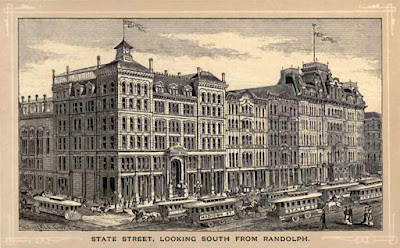
In April 1872, just six months after the fire, the business moved into the recently finished Averill building (shown above), located at 274-278 Wabash Avenue, on the northeast corner of Van Buren Street. State Street quickly emerged as Chicago’s preeminent business street after the fire, and by 1875 Burley & Tyrrell had moved yet again, this time occupying a five story building on the east side of State Street between Washington and Randolph streets, immediately north of Field, Leiter & Co. (later Marshall Field & Co.).


Majolica is listed in this advertisement from 1875


White House china

In the spring of 1879, President Hayes and his wife placed an order for a new state dinner service. The china was designed by Theodore R. Davis, an artist for Harper’s Weekly, who had suggested to the First Lady that the new service should depict American fish, game, fruits, and plants. Davis spent six months generating the watercolor studies which were then turned over to Haviland & Co. in Limoges, Frances for production.

The total service, made to serve a nine-course dinner, comprised 592 pieces in 130 assorted designs including game, fish, and fowl for the pieces on which they would be served and consumed. Butter dishes were designed as miniature lily pads, oyster plates featured seaweed, and coffee and teacups featured free flowing foliage as handles. Many of the pieces were in unconventional shapes – platters with upturned corners, dessert plates shaped liked apples, and others with asymmetrical borders. Perhaps the most unusual pieces were the ice cream plates decorated with snowshoes.


The service, delivered to the White House on July 2, 1880, was extensively covered in art journals, and attracted great attention. Manufactured at a considerable loss for Haviland, the decision was made to produce a limited number of modified sets of plates which would be offered in only the finest department and jewelry stores in the United States.


Burley & Tyrrell was selected as the exclusive dealer for the White House china in Chicago, beating out Fields and others for the honor. An advertisement appeared in the Chicago newspapers on December 15 noting that the china had arrived and was available for inspection. The next day, Frances Glessner noted in her journal, “To Burley & Tyrrell to see White House china.”

Continued growth

By 1882, with business continuing to grow, the wholesale division was moved to a large building on Lake Street, so that the State Street location could be used in its entirety for the retail store.

An article in the Chicago Tribune from that year regarding the annual Interstate Industrial Exposition (held in an enormous building on the current site of the Art Institute), noted:

“Burley & Tyrrell have the only exhibit of all that is artistic and elegant in French, English, and American china, glassware, bronzes, etc. – particularly noticeable is the exquisite Sevres china set of fifteen pieces, in a fine case, valued at $350.”


Left to right: Central Music Hall, Chicago Business College, Burley & Tyrrell (dark facade), and Marshall Field & Co. (From "Picturesque Chicago," 1882).

The article continues with a summary of a visit to the State Street retail store:

“To give even a brief description of the goods seen would take too much space, so attention is called to a few only. The ground floor is stocked with a miscellaneous class of goods, including dinner, breakfast, and tea sets, and glassware, also everything suitable for household furnishing. The second floor has been arranged in suitable style, to show to advantage the many pieces of art displayed, chief among which were noticed many antique designs in bronzes, and a large line of brass goods, including mirrors, umbrella-stands, candelabras, hall-trees, etc. . . Hammered copper lamps in various styles; clocks set in Delft plaques with small musical box attached; Persian lamps in various styles and colors . . .”

The year 1882 also saw the huge company split into two. The retail and hotel portions of the business were purchased by Burley’s nephew, Frank, and incorporated as Burley & Co., while the lucrative wholesale business continued under the old name. In 1888, Burley & Co. moved into larger quarters immediately to the north (shown below), adjacent to Central Music Hall.


(The two buildings immediately north of Marshall Field & Co. were razed in 1901 after Field acquired the entire block. In the top image below, Fields is the large building occupying the right half of the block; the two buildings occupied by Burley can be seen to its left; Central Music Hall is barely visible at far left. In the lower image, the north half of the present Macy’s building has replaced these three structures, the prominent columned entrance situated exactly where the Burley store had stood.)


By the early 1890s, Burley & Co. had moved again, this time to the east side of State Street south of Madison Street (the building was later razed for construction of the Schlesinger & Mayer/Carson Pirie Scott store). Burley carried extensive offerings of silver, glassware, and crystal, as well as china from the leading makers in Europe including Minton, Haviland, Copeland-Spode, Villeroy & Boch, and Doulton. It even stocked Mettlach steins and established its own porcelain factory in Germany. In 1897, it became the exclusive Chicago dealer for Royal Copenhagen, and a number of platters and serving bowls acquired by Frances Glessner in the 1890s may well have come from the store.

Burley also purchased huge quantities of blank china and specialized in china decorating and custom orders for both private households and hotels.


Glessner connections

Frances Glessner’s visit to see the White House china in 1880 is the earliest mention of Burley in her journal, but there are a number of entries which follow in later years. An interesting entry from October 1883 helped to explain the condition of a china fruit dish in the collection which had clearly been repaired at some point:


“While we were at lunch, the china fruit dish presented me by Miss Grail was jarred off the upper shelf of the sideboard and fell to the floor breaking off both handles. It has since been sent to Burley & Tyrrell’s for repairs.”

Another journal entry, from July 1885, notes that Frances Glessner had her purse stolen outside the store.

It is not known when the Glessners purchased their majolica vase from Burley & Co., but as it does not appear in historic photographs taken soon after they moved to Prairie Avenue in December 1887, it was most likely purchased in the 1890s.


The wheel-thrown, exaggerated baluster form majolica vase measures fourteen inches in height and is nearly ten inches across at its widest point. The polychrome decoration in green, puce, and blue on a yellow ground is dominated by three large, stylized flowers, each of unique design. The evidence of the hand of the maker with its irregular surface and crudely painted decoration, exemplified the tenets of the Arts and Crafts movement, and no doubt appealed to Frances Glessner’s sensibilities. In later photos of the house, taken in 1923, it is displayed atop the Isaac Scott bookcase in the second floor hall, which is where it can be found today.


There are numerous journal entries throughout the 1890s that mention Clarence Burley calling on the Glessners or being invited for Sunday supper. Clarence was a nephew of Arthur Burley and as a prominent attorney, would have come to know John Glessner in business circles. (Clarence’s father, Augustus, younger brother of Arthur, served as the first superintendent of Lincoln Park, and as comptroller for the City of Chicago).

The Glessner family continued to patronize Burley for many years to come. In 1913, Burley issued a small volume entitled The Story of a Hundred Operas which was given out gratis to its best customers; the Glessners’ copy still resides on a shelf in the library.


Later History

In April 1897, Arthur Burley’s wife Welthyan died after 48 years of marriage; the loss was devastating, and his health quickly declined. Burley’s prominence in Chicago, both as one of its longest residents, and as the founder of “the oldest business house in Chicago” at the time, is noted by the number of articles about his final days which appeared in the Chicago papers. On August 26, the Chicago Tribune noted that Burley was ill; the next day two articles in different editions noting he was “very low” and “failing.” His death on August 27 in his Indiana Avenue home at the age of eighty-four received considerable coverage, including an editorial praising his sterling character. Details of the funeral were reported on August 31, noting his internment in Graceland Cemetery.

John Tyrrell assumed the presidency of the firm following Burley’s passing, and served for six years, before his own death in 1903 at the age of eighty-three at his home in Kenilworth. Frank Burley died unexpectedly in 1906 at the age of fifty-six.


Courtesy of the University Guild, Northwestern University


Shortly before Frank Burley’s passing, he designed a unique piece for the store, which has become a much sought after collectible. Known as the “Chicago pitcher,” it depicts a series of scenes chronicling the history of Chicago from the arrival of Father Marquette in 1673 through the World’s Columbian Exposition of 1893. Other events depicted include the Chicago Fire and the Battle of Fort Dearborn, the latter represented with a depiction of the monument George Pullman had erected adjacent to his home, immediately east of Glessner house. The pitcher was modeled by Copeland, Stoke-upon-Trent, England and retailed for $5.00 (the equivalent of $150.00 today).


With Arthur Burley, John Tyrrell, and Frank Burley all deceased, the decision was made to merge the two companies back into one under the name Burley & Tyrrell Co. The retail store remained at 118-120 Wabash Avenue (later renumbered as 7 N. Wabash), into which Burley & Co. had moved in 1900. For the first time in its history, the company was led by a non-family member, William O. Coleman, who served as president until his own death in November 1918, after which Clarence Burley assumed the role.

In the spring of 1919, Clarence Burley negotiated an agreement with Albert Pick & Company to purchase the company, which was estimated to add about $1,000,000 worth of merchandise and goodwill to Pick. By this time Pick, founded in the 1850s, was the world’s largest outfitter of hotels, restaurants, and other institutions. (Its enormous warehouse at Racine Avenue and 35th Street in recent years has been successfully adapted into a new use as the Bridgeport Art Center.).

Conclusion


The sale was finalized in 1923, and for the first time in the history of the city of Chicago, the Burley company was no more. For the 85 years of its existence, it was, without a doubt, one of the most prominent retailers in Chicago, also having a significant impact far beyond through its wholesale and hotel divisions. Today, the name is frequently found on pieces in the secondary market and even in urban archaeology sites, such as pieces unearthed in recent years at the Charnley-Persky House on Astor Street.

The majolica vase is a tangible reminder of the long patronage of Burley & Tyrrell and Burley & Co. by the Glessners. No doubt other pieces in the house today were purchased there that have either lost their labels or which bear marks awaiting discovery.


Tuesday, December 14, 2021

The Glessner House Christmas Tree

John and Frances (Macbeth) Glessner, both born in the 1840s, would have seen the tradition of a Christmas tree evolve during their childhood. Virtually unknown outside of Germany until Queen Victoria and Prince Albert introduced the custom to Great Britain that decade, Christmas trees quickly started to appear in American homes. Frances Glessner’s journal provides interesting information about the Christmas trees that would have been displayed at 1800 S. Prairie Avenue, although the references are usually brief, as the tree was typically in place for less than 48 hours.

The Glessners moved into their new home on December 1, 1887. The first Christmas tree was decorated on Christmas Day, Frances Glessner noting simply “the children are today trimming a Xmas tree in the school room.” (Most of the journal entry describes the gifts given and received).

George Glessner, a talented amateur photographer, documented the tree in 1888. Frances Glessner wrote, “We all hung up our stockings and trimmed our pretty little tree just three feet high. It stands on the table in the school room.” As was typical for the period, trees were small and were placed on a table. The photograph shows the variety of decorations used including candles, a foil-paper covered cardboard bird at the top, tinsel, three types of garlands (tinsel, glass beads, and popcorn), blown-glass ornaments, and miniature drums.


The year 1898 was special as both of the Glessners’ children had married that year, so were celebrating their first Christmas in their own homes – apartments located in a large building on the 2000 block of South Indiana Avenue. George and Frances each received some of the ornaments that they had used to decorate the school room tree:

“John and I went over towards noon to call on the young people. We found them all very happy – the baby sleeping soundly. A tiny tree was decorated with balls and ornaments from the first tree George ever had and which have been used every Christmas since.”

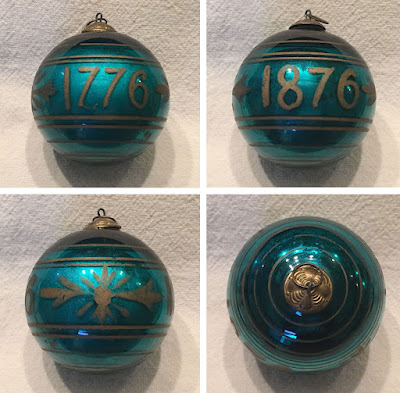
Among the ornaments given to George and his wife Alice, was a special glass piece known as a kugel. Unlike the thin-walled glass ornaments that became popular later on, kugels were heavy glass ornaments usually lined with silver, which gave the glass a deep rich color. The ornament was purchased by the Glessners during their visit to the Centennial Exposition in Philadelphia during the summer of 1876. It is painted with simple gold decoration, and features the dates of 1776 and 1876, denoting the centennial of the United States. The kugel was passed down through several generations of George’s family, before being returned to Glessner house in 2018. It is the only original family ornament in the collection today.


With the Glessner children married and away from home, Frances Glessner usually selected friends – often the age of her children – to decorate the Christmas tree. Favorites included the architect Hermann von Holst, whom the Glessners unofficially “adopted” as a young adult after his parents returned to Germany; he always spent the holiday with the Glessners. In 1900, Hermann “trimmed our Christmas tree and staid all night to see the fun in the morning.” After he married, his wife Lucy joined in the annual tradition. Other favorites to assist with the tree trimming included the principal harpist of the Chicago Symphony, Enrico Tramonti, and his wife Juliette. The Glessners’ grandchildren start participating in the decorating activities by 1905.

The Glessners had switched to a larger tree by 1902, when Frances Glessner wrote in her journal, “the children all came home Christmas morning at ten o’clock when we lighted the tree which stood in the hall. All of the family and household were in the hall.” The tree was still lit with candles at this point, so the lighting was a major part of the celebration with everyone gathered to observe the tree briefly illuminated with its lit candles (perhaps 15-20 minutes) before the candles were extinguished.

Electric lights were first incorporated on the Glessner Christmas tree in 1911, and the display was quite elaborate. Few people had electric lights at this time, the first strings being introduced by General Electric in 1903, although Frances Glessner noted seeing individual electric lights on the tree of a friend in 1900. Strings of lights were initially quite expensive, and, as few people had electric outlets, were designed to screw into a light bulb socket of a nearby wall sconce or chandelier.

The festivities around the Christmas tree for 1911 began with the arrival of the fresh tree from The Rocks, the Glessners’ summer estate in the White Mountains of New Hampshire. John Glessner noted that five trees were delivered for use in their home, and the homes of their son George, daughter Frances, sisters-in-law Helen and Anna (who shared an apartment), and neighbors James and Narcissa Thorne (later known for her meticulous Thorne Rooms, on permanent display at the Art Institute).


Three of the trees from The Rocks were delivered to these Prairie Avenue homes: (L-R) James and Narcissa Thorne (1708), George and Alice Glessner (1706), and Blewett and Frances Lee (1700).


John Glessner wrote that an electrician with International Harvester was recruited for the special electric light display:
 

“Cheney the electrician spent all of Saturday and Sunday over our Christmas tree and it was wonderfully pretty. The tree came from The Rocks and was placed in an alcove made of curtains in the main hall, had many and various colored lights that “flashed” and twinkled; there were spotlights of various colors thrown on it and snow fell from the canopy over it.

“It was lighted first at 9 pm for our company at Sunday (Christmas Eve) supper – 19 in all at the table, and again at 10 o’clock on Christmas morning for the benefit of the children and our guests and servants – 36 or 37 in all, so that the tree blazed for about two hours on Sunday night and about two hours on Monday morning and then was taken down. It had its day and was no more. And before evening we were back to the original condition with only the memory.”

Despite the elaborate preparations for the tree, it was not photographed, but we know what the bulbs on the tree would have looked like. The earliest bulbs were pear-shaped, like early Edison bulbs, but in 1910 General Electric switched to a round bulb with a small “exhaust tip” at the end. This shape was used until 1919, when the cone shape resembling a flame was adopted; this remained the standard version until the 1970s and is now popular again as a “vintage style” bulb. The photos below show a light kit produced by General Electric in 1910. (To learn more about the history of electric Christmas tree lights, visit Old Christmas Tree Lights, from which the images below were retrieved.)


In 1978, Frances Glessner Lee’s two surviving children, John Glessner Lee and Martha Lee Batchelder, donated The Rocks Estate to the Society for the Protection of New Hampshire Forests, with the stipulation that a crop always be grown in the fields. Christmas trees were the chosen crop, and for more than three decades, a tree was shipped from The Rocks each year to decorate the main hall at Glessner House. That tradition ended in 2019, when the building housing the shipping operation burned to the ground; since that time a tree has been sourced locally.


In order to tell the full story of Christmas at the house, two trees are decorated each year. A small three-foot tree sits on the table in the schoolroom – this is where the original kugel is hung. A larger tree is displayed in the main hall. There are no electric lights on either tree, interpreting the period prior to the grand electric light display of 1911.


Tuesday, November 16, 2021

Controversy Upon the Stage: The Ballet Russes Comes to Chicago, 1916


The idea for this month’s article began with a postcard. Among recently acquired Glessner family items was a framed real photo postcard from 1916 featuring a portrait of the Swiss conductor Ernest Ansermet, with a short message in French on the reverse addressed to Frances Glessner Lee. A quick review of Frances Glessner’s journal confirmed how Frances Glessner Lee and Ansermet met. A deeper dive into Ansermet’s reason for coming to Chicago that year uncovered a long-forgotten story of one of the most controversial performances to ever take place upon the Chicago stage.

The Ballet Russes


Sergei Diaghilev (Leon Bakst, 1906)

The Ballet Russes was the brainchild of the great Russian impresario Sergei Diaghilev. Formed in Paris in 1909, the ballet company created a huge sensation with its boundary-pushing performances that combined modern music, innovative choreography, and stunning visual arts. Among those engaged by Diaghilev were Igor Stravinsky, Claude Debussy, Sergei Prokofiev, Maurice Ravel, Vasily Kandinsky, Pablo Picasso, Henri Matisse, Leon Bakst, and Coco Chanel. The company, which gained broad exposure during tours through Europe and North and South America from 1909 through 1929, has long been regarded as the most influential ballet company of the 20th century.


In 1916, New York’s Metropolitan Opera Company arranged for the Ballet Russes to undertake a multi-city U.S. tour. That tour included a two-week residency at the Auditorium Theater in Chicago, to be managed by Frederick J. Wessels and Henry E. Voegeli, the business manager and assistant manager, respectively, of the Chicago Symphony Orchestra. The company, which comprised about 200 “artistes direct from Russia” arrived in Chicago on February 13 aboard a special train on the Michigan Central. Opening night, scheduled for the next day, was reserved as a special benefit performance for the Eli Bates Settlement House. The controversy, however, started before the curtain went up on that Valentine’s Day performance.

The Afternoon of a Faun

An article, which ran in the Chicago Tribune the day of the opening, recounted the controversy over the troupe’s New York and Boston performances, noting that Chicagoan’s would have a chance to see the performances as originally intended and make up their own minds:

“In New York the police authorities were shocked by ‘L’Apres-Midi d’un Faune’ (The Afternoon of a Faun) and ordered changes in one scene. As it was originally played the faun seizes a part of the girl’s lingerie and then goes to sleep, using the garment as the covering for a rock on which he reposes. The New York authorities considered this bad form and the faun thereafter had to sleep on a bare rock. Boston went New York one better and officially frowned on the harem scene in ‘Scheherazade.’ Mayor Curley said bare feet were right, but bare legs could not be tolerated. Accordingly, the legs were covered.

“Chicago is going to be given the original uncensored, unexpurgated versions of Serge de Diaghileff’s Ballet Russe – that is, provided Maj. Funkhouser doesn’t order excisions. Mr. Diaghileff upon his arrival yesterday with his company of dancers from the imperial Russian theater let it be known that Chicago will be permitted to judge for itself whether or not the scenes are ‘improper.’ ‘Art has nothing to do with morality,’ it was explained on behalf of the producer. ‘The esthetic test is the only one that can be applied, but what do the police know about art?’”

(Note: Major Metellus Lucullus Cicero Funkhouser was an interesting character. In 1912, he was appointed head of the newly formed Chicago censorship board, which primarily targeted the burgeoning film industry in the city. A veteran of the Spanish-American War and a Second Deputy Superintendent in the Chicago Police Department, he was known for his corruption, taking bribes from the studios, and breaking his own censorship rules. For example, he would take the “naughty” portions of movies he had censored and then host private screenings of those scenes for friends in his home. His actions seriously hurt the local film industry, and he was fired in 1918.)


Bakst design for The Afternoon of a Faun

The eagerly anticipated The Afternoon of a Faun was scheduled for February 16, when “the sophistication of this primitive frontier will be tested by an unexpurgated performance.” A review noted that “the details of an appetent satyr’s voluptuous stupor were again observed with appropriate lenity and there was some applause following the revolting end.” As was the case in previous cities, the company was asked to make changes to the choreography. A review following the February 24 performed noted:

“The news of the Ballet Russe is that yesterday ‘The Faun’ was presented without its final phallic sting and that it seemed to give more pleasure thus than when it had the audacious emphasis of continental bravado. That is to say that the faun indicated himself as a primordial voluptuary instead of visualizing the thing that everybody knew about. It was much more exquisite yesterday, dim, dreamy, primitive, and suggestive in its fascinating profiles and attitudes, with vague, mythical inferences and postures. It was very beguiling.”

Controversy, which can often increase attendance, had just the opposite effect in this case, and audiences remained small throughout the engagement. Critic Percy Hammond questioned why the situation seemed to be worse in Chicago than in other cities:

“Other American communities have not been indifferent to the beauty of these performances and to the munificence of those who make them possible; so why, it is asked, does this center regard their ministrations with a stubborn apathy like that of Caliban to the practices of Ariel?”

(Note: Caliban and Ariel were two servants in Shakespeare’s The Tempest, Ariel being submissive, while Caliban is portrayed as rebellious and showing a lack of gratitude.)

Is it controversial or does it just require a new way of thinking?

Although The Faun received the most pointed attacks, several of the ballets were seen as controversial, or at the very least, difficult for the audience to understand. But some critics realized the significance of what was taking place and opened their minds to what had been laid before them. One example was the first performance of Stravinsky’s ‘Petrouchka’ which elicited the following:

“Strange though it may seem, the Russian ballet at the Auditorium really includes music. Some of last night’s audience may have doubted the assertion, after hearing Stravinsky’s score for ‘Petrouchka,’ but they had in mind archaic sounds like Beethoven symphonies or Wagner music dramas, or Debussyisms of the moment. If the organized cacophony arising from the orchestra pit didn’t reassure them, the sight of an orchestra should have. It was there and it was busy, under the masterly conducting of M. Ansermet.

“Based upon the gospel that dissonance is just as much a part of music as consonance, the score translates the story’s grotesqueries into a tale funnier than Bernard Shaw and Mark Twain together. But this score is not extravagance. It is eminently sober as to logic, and the creation of a skilled and imaginative mind. Some day, when the ‘dead line’ is less like a ravening wolf, we may be moved to consider these sequences of strange intervals and chord combinations, the tone-colors dizzying to the ear, and the esthetic prophecy of their scientific scheme.”


Scheherezade


Another writer, encouraged the audience to free themselves of previously held inhibitions and try to enjoy the ballet for what it was:

“It is a good deal to ask an American audience, at least an audience handicapped by Anglo-American culture, not to be bewildered by the Russian ballet. Our culture, which is rather thin and excessively self-conscious, prevents us usually from any frank and expansive surrender to sheer sensuous beauty. We are bullied alike by our conscience and by our fear of what has been labeled good in art. We deprecate the free gesture. Our motto is Safety First, and Mrs. Grundy never leaves our elbow.

“This is a poor background for enjoying the Russian ballet, which is a gorgeous flower of the east, growing from a life of the imagination never touched by puritanism, freer in impulse, richer in instinct than our own. Yet, after all, we are human, and the appeal of wondrous color and strangely compelling rhythm is so strong in this case that we must yield to it, even be carried away by it.”

(Note: “Mrs. Grundy” is a colloquial term referring to a person with very conventional standards of propriety).


Caroline Kirkland, a friend of Frances Glessner who wrote a society column for the
Chicago Tribune under the pseudonym “Madame X,” went the farthest by praising those who embraced everything the Ballet Russes had to offer:

“The question of the moment among the elect is ‘How did you like the Russian ballet?’ If you respond with hyperbolic praise then you are set apart from the common herd; you belong to the Brahmins; you show yourself a true cosmopolite, one who can at will adopt the mood of the Russ, the French, and all others who represent the latest word in supreme culture.

“It is an enviable status. The modern admirers and supporters of the Russian ballet show themselves the true descendants of that small, select group who in the seventies boldly went to see the world’s greatest actress of her day, Sarah Bernhardt, and still more boldly acclaimed her genius to a community that preached against her from every pulpit and fireside as the prototype of the scarlet woman.

“It is to be deplored that of the splendid heritage left us by our Puritan forefathers – a heritage that included frugality industry, self-denial, piety, stern sense of duty, and moral courage – little remains to us today except self-righteousness, false modesty, and a strange reluctance to recognize and enjoy the beautiful.”

Leon Bakst

The sets and costumes were as important to the productions as the music and choreography. Several were designed by Leon Bakst, a Russian painter and designer who first came into contact with Diaghilev when the latter organized a show of Russian painters in 1898. Four years later, Bakst’s star had risen, and he was commissioned to undertake a work for Tsar Nicholas II. He went to work for the Ballet Russes in 1908, the collaboration lasting until 1922 when he came to Baltimore to work under his American patron, Alice Warder Garrett (the daughter of John Glessner’s business partner, Benjamin H. Warder).


Bakst's design for The Afternoon of a Faun


Bakst’s work received praise during his years with the ballet, a Chicago journalist writing:

“In Chicago for the last ten days there has been disclosed in the scenes and costumes of the Russian ballet the work of the Russian painter, Leon Bakst. There has never been anything like his achievements in the splendor and harmonies of color available to the Chicago public, and it is a great pity conditions have been such that few have taken advantage of the opportunity to see them. Bakst is a great genius in color, and he offers us his wonderful eyes to see visions gorgeous beyond our imagining. Bakst comes from a world where color is brilliant, and contrast sharp. In America our color in nature, and, therefore, in art, is more reticent, and for that reasons Bakst discovers for us a new world, inundating our senses, matching the myriad tones and thunderous power of the modern orchestra with tones as overwhelming in power and combination.

“The Russian master already has enriched the color sense of Europe, and even America sees a little with his eyes, as the increased strength and daring of color in costume shows. And this, as we began by saying, is the supreme service of the creative artist, that he creates not only, or even chiefly, the objective beauty of his master works, but a new beauty of the world.”


Bakst costume for The Firebird


Bakst’s work was considered so significant that Marshall Field & Company held a special show of costumes from selected productions, as noted in the advertisement below.


The Glessners and Ernest Ansermet

Frances Glessner Lee appears to have been enchanted by the Ballet Russes, attending several performances. On Saturday, February 19, she invited conductor Ernest Ansermet to supper at her home, along with Henry Voegeli and his wife, CSO harpist Enrico Tramonti and his wife, and a Dr. Richardson. The Glessner journal notes that “the Tramontis and Frances Lee have been much pleased with Mr. Ansermet.”

The press shared their admiration for Ansermet’s conducting. In spite of what was being said about the choreography or the music itself, reviews consistently praised Ansermet’s mastery of the works.


His postcard to Frances Glessner Lee, written on May 5, 1916, from New York, was in thanks for the supper at her home, his brief message being “with respectful and grateful memories of E. Ansermet.”

(Note: Kudos to the U.S. Post Office of 1916. Ansermet addressed the postcard: Mrs. Frances Lee, Prairie Avenue, Chicago, Michigan. A postal worker corrected the state to Illinois and added “1700” in front of Prairie Avenue.)


Ernest Ansermet was born in Switzerland in 1883, so was just 32 years old at the time he first came to Chicago. After several years teaching mathematics at the University of Lausanne, he turned to conducting, accepting the position to lead the Ballet Russes orchestra in 1915. During the period, he had the opportunity to meet Debussy, Ravel, and Stravinsky, and he became a champion of modern music. He founded his own orchestra, the Orchestre de la Suisse Romande in 1918 which toured the U.S. and Europe, making many recordings for Decca Records. Ansermet returned to Chicago in 1936 to open the inaugural season of the Chicago Symphony Orchestra at the Ravinia Festival and was still actively conducting at the time of his death in 1969. The Orchestre is regarded as the premier orchestra in Switzerland.

John Glessner notes in the journal that Ansermet called on his wife during the CSO matinee concert on Friday February 19. They subsequently attended the Ballet Russes matinee performance on its last day, February 26:

“Frances and I went to Russian ballet on Saturday afternoon at Auditorium. The house was filled – many were children. This was only the second good house of the two weeks engagement – the other being the opening night which was taken by the Eli Bates Settlement House. Wessels and Voegeli, the managers, may lose a considerable sum on the engagement.”

No further comment is made as to what they thought of the performances, although they would have been fully aware of the controversy surrounding them. They saw four ballets performed that afternoon:


Cleopatra: Music by Anton Arensky and others, choreographed by Michael Fokine, sets and costumes by Leon Bakst


Petrouchka: Music by Igor Stravinsky, choreographed by Michael Fokine, sets and costumes by Alexandre Benois


Spectre de la Rose (The Spirit of the Rose): Music by Carol Maria von Weber as orchestrated by Hector Berlioz, choreographed by Michael Fokine, sets and costumes by Leon Bakst


Soleil de Nuit (Midnight Sun): Music by Rimsky-Korsakov, choreographed by Leonide Massine (his first ballet), sets and costumes by Mikhail Larionov

The Ballet Russes leaves Chicago

The final performance took place the evening of February 26. It had been rumored that The Faun would be presented in its original pre-censored iteration, “but nothing of the sort happened. The faun was as chaste as a cold mutton chop.” Attendance had improved slightly during the second week, but not nearly enough to avoid large financial losses. Many praised “the New York banker, who backed the enterprise financially, knowing that he would probably lose in the venture, but anxious to give Americans a chance to see these Russian chef d’oeuvres.”


Bakst's design for Cleopatra

The Ballet Russes left Chicago and continued its U.S. tour. The conversation no doubt continued long after they had left, and, as had been the case three years earlier when the Armory Show at the Art Institute raised the question of “what is art?” their appearance in Chicago forever made people consider what ballet should be in the 20th century.

Related Posts Plugin for WordPress, Blogger...