Tuesday, July 19, 2022

"Portrait of a Man with a Pink" by Quentin Massys


Portrait of a Man with a Pink is a charming early 16th century painting by the Netherlandish artist Quentin Massys, which has recently gone on display at the Art Institute of Chicago for the first time in many years. The painting was a gift from John J. Glessner, a long-time trustee of the Institute and a close friend of its president, Charles L. Hutchinson. In this article, we will explore the somewhat complicated history of the artwork and how it found its way to Chicago.

Charles Hutchinson and the growth of the Art Institute


The Art Institute of Chicago emerged out of the Chicago Academy of Fine Arts, formed in 1879. The Academy had acquired the assets of the defunct Chicago Academy of Design, including its leased rooms, artwork, and furniture, and some of its teaching staff. Hutchinson, who was just 25 years old when the Academy of Fine Arts was founded, was deeply involved in both the educational and exhibition aspects of the organization from the beginning, and in 1881 was named vice president. He quickly advocated for a larger permanent location and a name change to the Art Institute of Chicago. The latter was adopted in 1882, the year Hutchinson was elected president.

At that time, there were only three major art museums in the United States, located in Boston, New York, and Philadelphia. By the time Hutchinson died in 1924, having served continuously as president of the Art Institute for 42 years, it was an internationally recognized museum, thanks to Hutchinson’s boundless vision and determination. As Celia Hilliard noted of Hutchinson and his contemporaries in her excellent biography, The Prime Mover: Charles L. Hutchinson and the Making of the Art Institute of Chicago (Museum Studies 36 No. 1, Art Institute of Chicago, 2010):

“Thanks to their wealth, these men traveled widely in the United States, and, above all, Europe, where they were exposed to grand cultural institutions that their fathers could not have imagined; they returned to their hometowns eager to ‘civilize’ them. Coming of age at a critical juncture in the lives of their cities, they were able to help shape these places according to their ideals, founding libraries, museums, and symphonies – organizations intended to make the elevating forces of culture available to all. Thanks to their enthusiasm, generosity, and social connections, their success was unprecedented. Hutchinson, the son of a meat packer and speculator, stood at the helm of the Midwest’s preeminent museum for over forty years, and epitomizes these changes. Like his peers, he was a product of his time and place and, simultaneously, exactly what it needed.”

Growth of the collection


In November 1887, the Art Institute moved into its first permanent building at the southwest corner of Michigan Avenue and Van Buren Street, a Richardsonian Romanesque structure designed by Burnham & Root. Although attendance and membership were strong, the Institute was still relying largely on the exhibition of loaned artworks to draw people through its doors. As Hillard wrote:

“Many great museums are noted for the buildings they inhabit, but ultimately their quality rests on the excellence of their collections and the skill with which they are presented. Thus, during this same period when the grand new home of the Art Institute was in gestation, Hutchinson also turned his attention to issues of interior design and presentation, and considered what purchases and gifts might best augment the museum’s growing reputation.”

This led Hutchinson to make two significant trips to Europe in 1889 and 1890. During the 1889 trip, Hutchinson and his wife visited the Villa di Pratolino outside of Florence, to view an important collection of Dutch and Flemish Old Master paintings that had been assembled by the Russian industrialist Count Nikolay Nikitich Demidov and expanded by his son Anatoly, who had died in 1870. Many of the artworks had been sold off at that time, but a significant collection was bequeathed to Anatoly’s nephew Paul, who sold additional pieces in 1881, retaining thirty of the best works for himself. Paul died in 1885 and his widow sold a few more paintings (now at the Museum of Fine Arts in Boston). By the time Hutchinson arrived in Europe, she had decided to sell the remaining works and engaged the house of Durand-Ruel to negotiate the sale.


Durand-Ruel was the most important French art dealer in the 19
th century. The business had started as an art shop in 1839 by Jean Marie Fortune Durand and Marie Ferdinande Ruel. Their son, Paul, took over the business in 1865 at the age of 24, expanding the operation with a larger gallery and advocating for painters of the Barbizon school. By the late 1880s, Paul’s three sons were actively engaged in the business, buying Old Masters and continuing their father’s significant interest in, and support of, the Impressionists. They also expanded to the United States, opening a gallery in New York, and coordinating exhibitions in Chicago as early as 1888.

Hutchinson returned to Europe in 1890 with the goal of coordinating a loan of the Demidov paintings for the Art Institute. He quickly discovered, however, that a few paintings had already been sold, and that the works were available for purchase, not loan. He cabled trustees and friends back in Chicago, including Marshall Field, Philip Armour, and Sidney Kent, asking if they would purchase the paintings and hold them until the Art Institute could purchase them, or donors could be found to donate them. They agreed, and Hutchinson went to Florence to finalize the purchase of thirteen paintings for $200,000, including works by van Dyck, Hals, Hobbema, Rembrandt, Rubens, and Steen. Back in Paris, Hutchinson ran into Art Institute trustee Edson Keith (a Prairie Avenue neighbor of the Glessners), who made the first gift, acquiring Willem Van Mieris’s canvas, The Happy Mother.

Portrait of a Man with a Pink comes to Chicago

While at the Durand-Ruel gallery, Hutchinson noted another painting, Portrait of a Man with a Pink, attributed to Hans Holbein the Younger. The German artist of the first half of the 16th century was regarded as one of the greatest portraitists of his time, and Hutchinson was anxious to have his work represented in the museum. He acquired the painting, bringing it back to Chicago with the goal of finding a donor to finance its $4,000 purchase (about $130,000 today).

The portrait, painted between 1500 and 1510, is believed to have been part of the Colonna di Sciarra collection for many years. The House of Colonna, also known as Sciarrillo or Sciarra, was an Italian noble family powerful in medieval and Renaissance Rome. One family member, Oddone Colonna, became Pope Martin V in 1417. By the early 1880s, the painting was owned by Ernest May, a prominent French financier and art collector. This was the period in which May was shifting his interest to the Impressionists, including the work of Edgar Degas, who captured May (at center) in the painting shown below. On June 4, 1890, May sold the Holbein portrait through Durand-Ruel to Charles Hutchinson for the Art Institute.


Less than a month later, Hutchinson was back in the United States, anxious to share the news of his successful journey with the newspapers. On July 2, 1890, the Chicago Tribune reported:

“Charley Hutchinson is just in from Europe, fresh as a daisy, and enthusiastic over the art purchases that Mr. Ryerson and he have made to enrich the growing treasures of the Chicago Art Institute . . . He feels that what has been bought by Chicago’s committee so truly represents the Dutch masters that Chicago need not give place even to New York in the possession of examples of this school of art.”

Members of the press were invited to view the paintings on November 7, 1890, the day before the exhibition opened to members. Beautifully displayed in a gallery accented with palms, ferns, and live music, the paintings impressed the journalist for the Chicago Tribune, who reported, no doubt to Hutchinson’s satisfaction:

“They are unquestionably the most representative collection of pictures by the old Dutch masters ever brought to this country, embracing many works of the first importance, which the great European museums would be proud to possess and have indeed tried to secure. They give to Chicago the supremacy among American cities in this department, and open for our students of art a vast field of profitable study. Thus the thanks of the community are due to the gentlemen who so promptly and with such admirable public spirit availed themselves of a unique opportunity.”
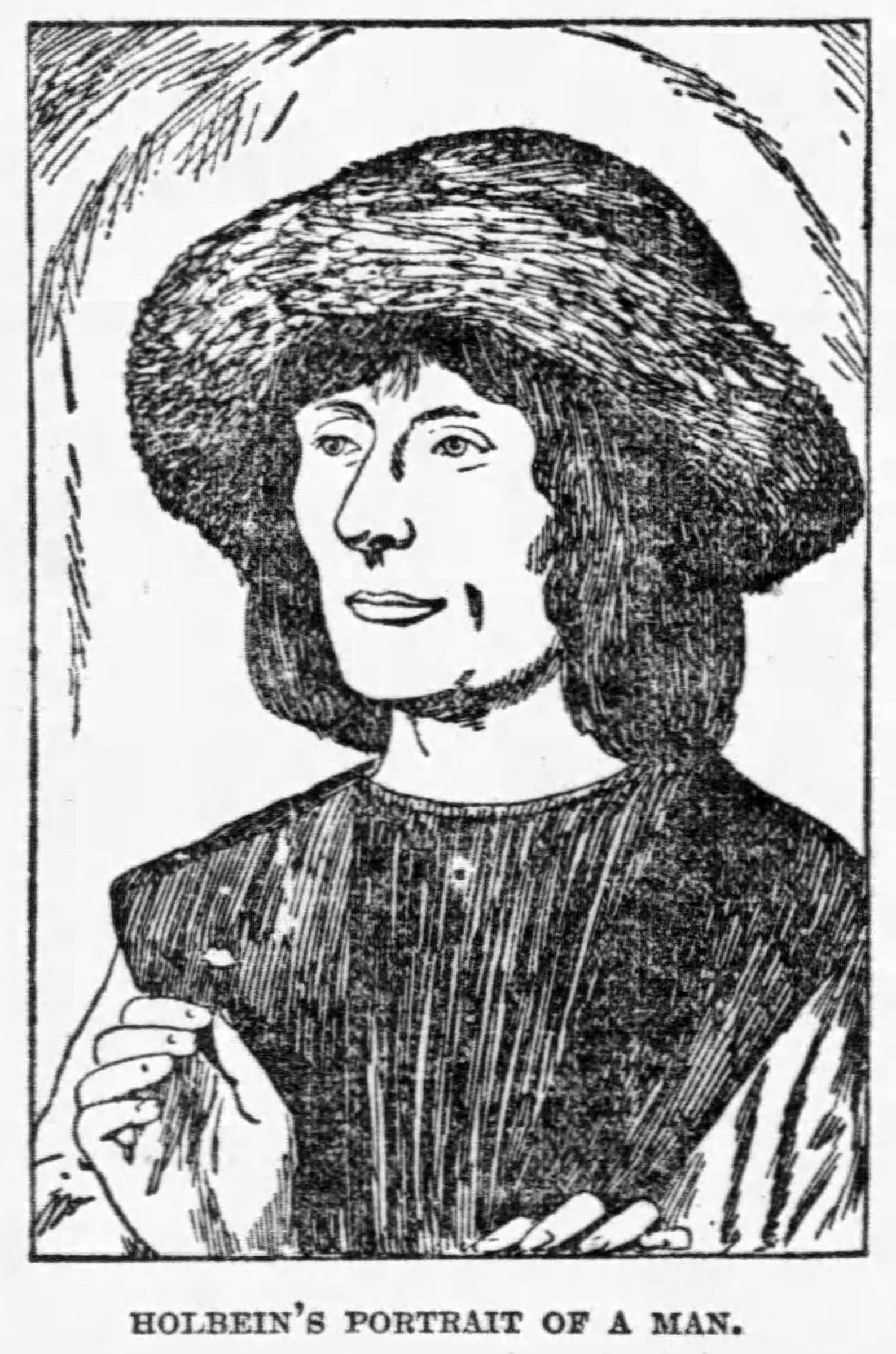

The illustration of the Portrait of a Man with a Pink shown above, was included in the article with the following description:

“The last of the portraits to be noticed is also the smallest, the others being life-size half-length figures; and the oldest, belonging to the sixteenth century, while the others date from the seventeenth. This is the panel by the German master Holbein, which is a good example of the rigid, literal, sculpturesque style of Henry the Eighth’s court painter . . . the face is unmistakably, humanly true; one does not doubt this man’s existence for an instant or miss one note of his rather strenuous character.”

A question of attribution

The exhibition proved an enormous success with Chicagoans rightly proud of their “masterly coup.” However, almost immediately, the authenticity of a few of the works, including the Holbein, was called into question by an attendee of the opening night reception. He notified the Chicago Tribune of his opinion, which was summarily dismissed by the journalist who maintained that the collection consisted of “first-class examples of the respective painters.”

The Holbein attribution did receive closer scrutiny, and by the time John Glessner made his anonymous, retroactive gift of $4,000 in 1894, the painting was attributed simply to the “Flemish School.” The listing below, taken from the annual report of the Art Institute issued in 1895, shows the painting as item #1.


In December 1913, the painting received renewed attention when the well-respected art expert, Dr. Abraham Bredius, director of theMauritshuis art museum at The Hague in the Netherlands, toured the Old Masters galleries at the Art Institute. He identified the portrait as the work of Hans Memling (c. 1430-1494), regarded as one of the most important Netherlandish painters of the 15th century. Memling’s art had been rediscovered in the 19th century, so this attribution made the painting far more valuable than the work of an unidentified Flemish artist.


The attribution was short-lived but brought additional attention to the painting. Within a few years, it was conclusively identified as the work of Quentin Massys (also spelled Matsys), a founder of the Antwerp school of painting. Massys was born in Leuven in 1466 and is believed to have attained his master’s status there, before moving to Antwerp, which, by the early 16th century, had become the artistic center of The Netherlands. Massys became one of the first notable artists in Antwerp and was elected a member of the Guild of Saint Luke.


His work is noted for its effects of light and shade, firmness of outline, clear modelling, and thorough finish of detail. His effective use of transparent pigments provided a glowing richness to his paintings that was reminiscent of the work of Memling. He was also known for his “strenuous effort” to express individual character, something clearly seen in the portrait. Massys died in Antwerp in 1530, after enjoying a reputation as a cult figure, and paving the path for a school of painting that culminated with the career of Peter Paul Rubens.

Conclusion

The painting remained popular, traveling to New York for a loan exhibition in 1929 and to Antwerp in 1930 for the Exposition d’art flamand ancien, showcasing the work of early Flemish painters. It was exhibited by the Art Institute during the Century of Progress in both 1933 and 1934 and returned to New York in the years following, as well as being exhibited in Columbus, Ohio (which, by coincidence, is just an hour from Zanesville, where John Glessner was born and raised).


Now back on the display in Gallery 207 (The Charles H. and Mary F. S. Worcester Gallery) for the first time in many years, the oil on panel painting, which measures just 11-1/2 by 17-1/4 inches, still captivates with its brilliant use of color, and stark realism. The tag adjacent to the painting reads:

“In this portrait from relatively early in his career, Quentin Massys followed stylistic conventions that appealed to Antwerp’s growing market of patrons while also exhibiting the bold innovations that ultimately made him one of the city’s most influential painters. The sitter appears frozen in a somewhat unnatural pose, as was the fashion for half-length portraits at the time, and the positioning of his left hand on the painting’s lower edge recalls the spatial illusionism found in portraits by Netherlandish artists of the previous generation. However, the subtle modeling of the face conveys a strong sense of the sitter’s individual character at a time when such works tended to idealize their subjects. The pink, or carnation, held by the sitter could symbolize marriage or Jesus Christ’s incarnation.”

Thursday, June 30, 2022

Elihu Vedder and the Rubaiyat of Omar Khayyam


The Glessners assembled more than 8,000 books for the libraries in their Prairie Avenue and New Hampshire homes. Among the most distinctive volumes is a folio-size edition of the Rubaiyat of Omar Khayyam, designed and illustrated by the American artist Elihu Vedder in 1883-1884. The book received rave reviews upon its release, secured Vedder’s reputation as an artist, and provided him with financial security for the rest of his life. In this article, we will explore Vedder’s career, the creation of the Rubaiyat, how it came into the Glessner library, and their ongoing interest in the artist.

Elihu Vedder
Vedder was born in New York City on February 26, 1836, to first cousins Elihu (Sr.) and Elizabeth Vedder. By Elihu’s mid-teens he showed promise as an artist, his mother actively supporting his intentions; his father was less convinced. He studied with the American artist Tompkins Harrison Matteson in New York City before heading to Paris to study with Francois-Edouard Picot, who had been a recipient of the Prix de Rome scholarship and a student of Jacques-Louis David.

In 1858, Vedder traveled to Italy where he remained for two years, and it transformed his life, being deeply inspired by Italian Renaissance painting as well as the landscape, which he frequently depicted in his paintings. He befriended fellow painter Giovanni Costa, with whom he traveled extensively through the Italian countryside, until Vedder’s father cut off his allowance.


Returning to the United States at the start of the Civil War, he earned money as a commercial illustrator and quickly became involved in Greenwich Village’s first “Bohemian hangout” at Pfaff’s beer cellar. It was here he befriended Walt Whitman, Herman Melville, and many others known as the Pfaffians, the start of long-standing friendships with some of the most creative and intellectual minds of the period. 

At the conclusion of the Civil War, he returned to his beloved Italy. He frequently traveled to England, being influenced by the Pre-Raphaelites, and befriended Simeon Solomon, a prominent painter of the movement known for his depiction of Jewish life. Vedder occasionally returned to the United States, and for a period of time designed objects for Louis Comfort Tiffany, as well as a bronze statue, The Boy, which Tiffany placed in a fountain at his Long Island estate, Laurelton Hall. In the late 1890s, Vedder designed a mosaic of Minerva and a series of murals depicting various aspects of government, to adorn the Reading Room of the Library of Congress in Washington, D.C.


Best remembered today for his monochromatic accompaniments for the Rubaiyat (he disliked the term illustrations), he produced a significant amount of artwork that is difficult to classify, although he is often referenced as a Symbolist painter. As Joshua C. Taylor noted in Perceptions and Evocations: The Art of Elihu Vedder (Smithsonian Institution Press, 1979):

“Vedder has been remembered for several different accomplishments but rarely as a unified artistic personality. His extraordinary illustrations to accompany Omar Khayyam’s Rubaiyat, published in 1884, are an early and persuasive lesson in the compelling evocative powers of a decorative style. His disarmingly simple, richly colored glimpses of the Italian landscape, however, celebrate the pleasures of direct perception. His work seems to be rooted firmly in two opposing traditions, each revolutionary in its way in the nineteenth century. Yet probably the most revolutionary aspect of Vedder was his refusal to take sides, to admit that the perceptual and visionary were at odds with each other.”

Of his personality, Taylor, as co-author with Jane Dillenberger of The Hand and the Spirit: Religious Art in America 1700-1900 (University Art Museum, Berkeley, CA, 1972), wrote:

“His personality emerges as a compound of extroverted vigor, volatility, jocularity, and flirtatiousness, with an introverted fascination with dreams, a preoccupation with death, a tendency toward melancholia, and an appetite for the macabre.”

Elihu Vedder died in 1923 at the age of 86 and was buried in the Protestant Cemetery in Rome. 

Omar Khayyam, Edward FitzGerald, and the origins of the Rubaiyat
Omar Khayyam, known as the “Astronomer-Poet of Persia” lived from 1048 to 1131 A.D. He achieved modern recognition when the English writer and poet Edward FitzGerald (1809-1883) completed his translation of a selection of quatrains (rubaiyat) in the late 1850s. The authenticity of the poetry attributed to Khayyam is uncertain, as during his lifetime he was known as an astronomer and mathematician. It was not until a biography was written decades after his death that we find the first references to his having written poetry. Of the 2,000 or so quatrains attributed to him, scholars vary widely as to how many of them truly came from Khayyam, most agreeing that less than 200 can be authenticated. 

FitzGerald is best remembered today for his English translation of the Rubaiyat. He began studying Persian literature with Professor Edward Byles Cowell at the University of Oxford in 1853. Four years later, Cowell discovered a set of Persian quatrains by Khayyam in the Asiatic Society library in Calcutta, which he sent to FitzGerald, who completed his initial translation later that year. In January 1859, he privately printed 250 copies, but the work remained largely unknown until being discovered by Dante Gabriel Rossetti in 1861 and soon after by the author and critic Algernon Charles Swinburne (of whom Rossetti later painted a portrait). 

A second, greatly revised edition was published by FitzGerald in 1868, with further editions in 1872 and 1879 and a posthumous edition in 1889. The third edition was the first to contain the now standard 101 quatrains, and the first American edition of 1878 was a reprint of this version. William Morris became enamored with the work, producing his own version in the 1870s, with the text in his hand, supplemented by illustrations by Edward Burne-Jones (shown below). In time, “the slim volume was handed from artist to artist, and it served as a touchstone for the spiritual and poetic in a time of strident materialism.” By the 1890s, more than two hundred editions had been produced, resulting in total sales exceeding two million copies, the formation of Omar Khayyam clubs throughout the English-speaking world, and the rise of a fin de siècle cult of the Rubaiyat.


FitzGerald openly admitted that he took considerable liberties with the source material. In correspondence to Cowell in 1858 and 1859, he wrote:

“My translation will interest you from its form, and also in many respects in its detail: very un-literal as it is. Many quatrains are mashed together: and something lost, I doubt, of Omar’s simplicity, which is so much a virtue in him.

“I suppose very few people have ever taken such Pains in Translation as I have: though certainly not to be literal. But at all Costs, a Thing must live: with a transfusion of one’s own worse[FP2]  Life if one can’t retain the Originals better. Better a live Sparrow than a stuffed Eagle.”

Vedder’s Rubaiyat


The 55 drawings in pencil, ink, chalk, and watercolor on tinted paper, comprising Vedder’s edition of the Rubaiyat, were completed over a ten month period from May 1883 to March 1884 while in Rome, as noted on the signature page below.


His signature, always depicted as an asymmetrical V, is explained in the end notes to the volume:

“If an explanation of the artist’s signature is demanded, why may it not be taken as representing the high and low notes, the light and shade in which this work is done? Hastily plucked and rudely fashioned, this double pipe is (the artist believes) yet capable of producing some music worthy of the listening ear.”

Vedder also designed the cover, the lining papers on the inside of the front and back covers, and the distinctive lettering. The two sides of his artistic expression are evident, one description of an exhibition of the original drawings noting how “he reconciled the critics who called for accurate depiction of observed reality with those who argued for feeling and emotion over objective form.”


He dedicated the book to his wife, the former Caroline Rosekrans, (the daughter of a New York Supreme Court judge), to whom he was united in marriage in 1869 in her hometown of Glens Falls, New York. 

Just as FitzGerald had taken liberties in translating the quatrains, Vedder took additional liberties in rearranging them in order to express what he felt were the three stages of existence explored in the text – happiness and youth, death and darkness, and rebirth. Examining the details in the drawings, one finds everything from traditional Christian symbols and classical figures to mystical imagery of Vedder’s invention. A prominent device is the “cosmic swirl,” first seen on the front cover, and repeated throughout the volume. Vedder, in his end notes, explains:

“The swirl which appears here, and is an ever-recurring feature in the work, represents the gradual concentration of the elements which combine in life: the sudden pause, through the reversal of the movement, which marks the instant of life; then the gradual, ever-widening dispersion again into the primitive elements.”


The first edition of the book was released on November 8, 1884, and sold out in just six days. A deluxe limited edition with a stamped leather cover cost $100; a regular edition with cloth cover was $25. The book was published by Houghton, Mifflin and Company, a prominent Boston-based publisher that held the rights to the literary works of Ralph Waldo Emerson, Nathaniel Hawthorne, and Henry David Thoreau. It was printed at its Riverside Press, “one of the model printing-offices in America,” noted for its unusual practice of employing male and female compositors, who worked side by side.

The book was praised as a masterwork of American art, and Vedder secured his place as the master American artist. Critics noted that he set the standard for the artist-designed book by creating all of its elements.


The quality of the reproduced drawings was also praised, a review in the January 1885 issue of The Atlantic noting:

“The mechanical execution of the book is worthy of a word. The plates seem to reproduce the drawings with little or no loss, and in one or two cases with some trifling gain, which now and then follows reduction and translation into one color. This adaptation of an improved gelatine-printing method, made directly from original drawings, is a new feature in American illustrated bookmaking, and has been tried here for the first time in large and difficult plates. If the promise made by this addition to our illustrative methods is kept, we may hope to see other magnificent pictures contribute intimately to literary enjoyment.”

The Rubaiyat comes to Chicago
The book was offered for sale in Chicago within a few weeks of its sell-out release in Boston. The “Literature” column in the December 6, 1884 edition of the Chicago Tribune led with a lengthy review of the book, which opened:

“Originality is earnestly striven after by the artists of today; but no one of them has more of that distinguishing quality, or attains it more easily, than Mr. Elihu Vedder. It is so much his nature to be original that the after-expression of any artistic idea passed through the alembic of his brain is certain not only to bear the impress of a most vigorous imagination, but to be notably different from the form that it would assume if presented by any other human being. In the “Rubaiyat” of Omar Khayyam he has found a congenial theme for the exercise of his genius; and the result is a series of designs which, for refinement of conception, dignity and breadth of treatment, combined with wonderful grace and beauty of expression, is worthy to rank with the highest achievements of modern art.”


The 1884 advertisement above is for S. A. Maxwell & Co., located at 134-136 Wabash Avenue. This was the Jewelers' Building, completed in 1882 from designs by Adler & Sullivan. The current address is 15-17 S. Wabash Avenue.

By February 1885, Vedder's original drawings for the Rubaiyat had come to Chicago for exhibition at the Art Institute, at the time located in its first building at the southwest corner of Michigan Avenue and Van Buren Street. The drawings, which measured approximately 13 by 17 inches, were hugely popular, leading the Art Institute to open the exhibit for free on Saturday, February 28, between the hours of 9:00am and 10:00pm. Frances Glessner would have almost certainly seen the exhibit, as she was taking her son George to the Institute each Saturday morning for a drawing class.


The Glessners received their copy of the Rubaiyat as a Christmas gift from George in 1892 – perhaps a remembrance of his viewing the 1885 exhibit with his mother? Her journal entry for Christmas Day notes “George gave us Vedder’s illustrated Rubaiyat.” The folio-size regular edition with cloth cover cost $25, the equivalent of $735 in today’s dollars. (When John Glessner died in 1936, the book was valued at $5 in the estate appraisal; today, copies sell in the $1,000 to $1,500 range).


Each leaf measures 12 inches wide by 15-1/2 inches tall and is printed on a heavy paper which is mounted on linen guards gathered at the spine. The leaves are arranged in pairs which face each other. The 101 quatrains are contained within 47 plates, with additional drawings used for the end papers, title page, and notes pages. The book does not contain a copyright date, but the title page lists both Houghton, Mifflin and Company of Boston and Bernard Quaritch of London as publishers. Vedder’s colophon for the Riverside Press (shown below) faces the dedication page to his wife.


The Digressions of V


 In 1910, Vedder published his autobiography entitled The Digressions of V, with the notation “Written for his own fun and that of his friends,” and the added stanza:

“Somewhat o’ershadowed by great names,
A feeble plant he tries to rear;
It is not nourished by great aims
Nor yet retarded by much fear;
His aims if any are but these,
To be remembered and to please.”


It, too, was published by Houghton, Mifflin and Company at its Riverside Press. The Glessners purchased their copy for $6.00, confirmed by the penciled notation inside the back cover inserted by the bookseller, A. C. McClurg and Company. They placed the book in their library at The Rocks, their summer estate in New Hampshire, as noted by the bookplate inside the front cover.

A review in the Chicago Tribune noted:

“Very often when a book is introduced with the remark that the author was induced to write it because friends asked him to, we may prepare for something that the world would willingly let die. It is not so in the case of Mr. Vedder. His friends knew what they were about when they urged him to write this book. It is quite unconventional, as Vedder’s art work is certainly unconventional.

“Mr. Vedder has made a beautiful book and certainly original. He apparently attended to the typographical arrangement himself, for it is artistic and characteristic – just the sort of a book one would expect Mr. Vedder to write and publish.”

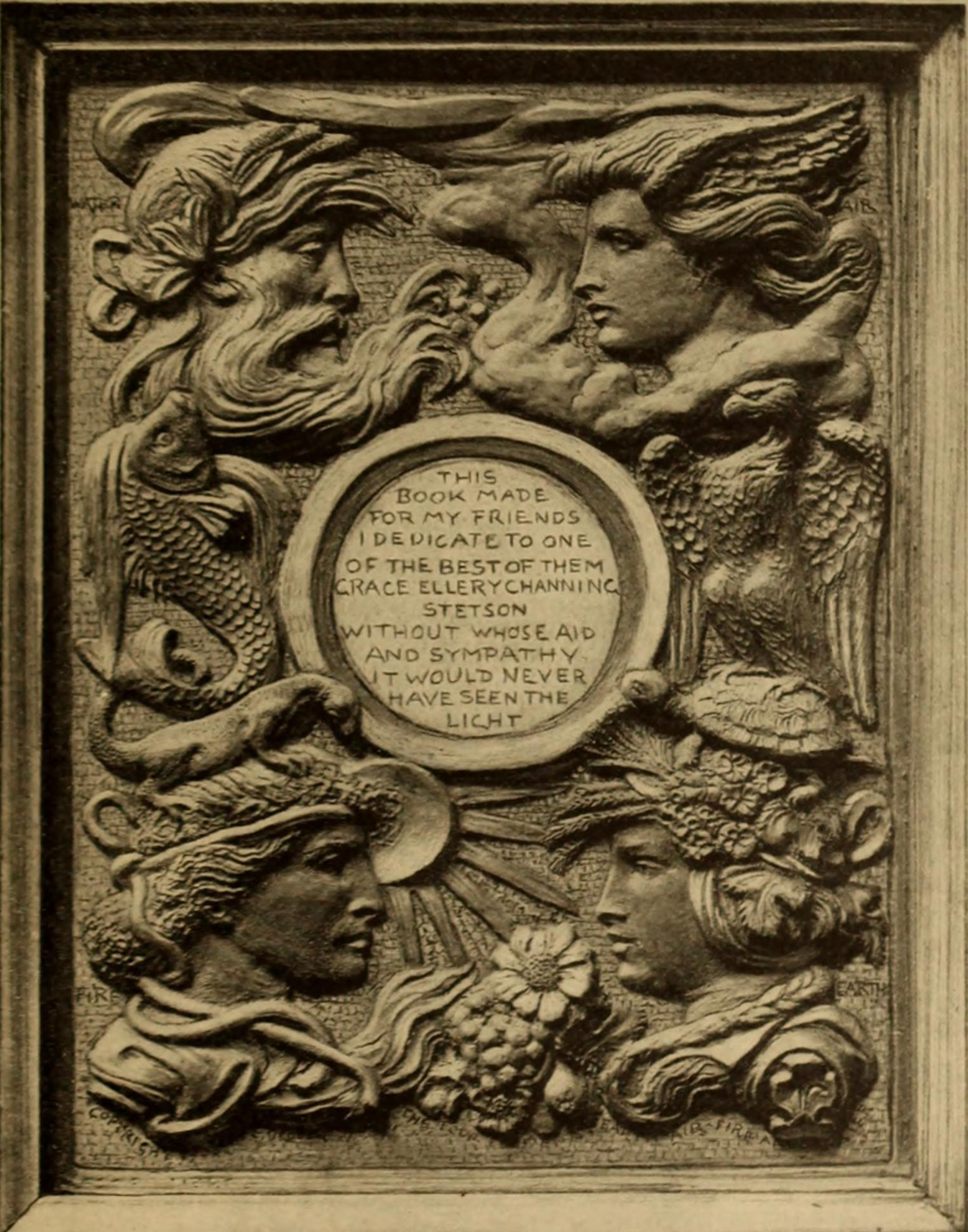
Vedder dedicated his book to Grace Ellery Channing Stetson, an American writer and poet who lived in Rome, and helped him edit and compile the autobiography. The dedication page, shown below, depicts the four elements (from upper left) – water, air, fire, and earth.


The book includes a chapter covering the period in which the drawings for the Rubaiyat were created. Vedder noted how the book came about:

“On one of my trips home, seeing that other people were making books, I thought – Why not make one myself? And of course Omar came into my mind, and the more I thought of it, the more the idea pleased me. . . In Boston, Mr. Houghton listened to my scheme, and asked, “But who and where is this Omar?” I said that was natural; he was too near; he only published the poem. To make a long story short, he agreed to bring out the book, and on the way back to Rome I thought it all out. In three weeks I had divided the verses into groups and settled on the subjects of the drawings, and commenced making them. I was somewhat wise also: I did not begin at the beginning and go through, but dipped in here and there through the book, so that they should not begin well and peter out, or begin ill and improve, but were kept as even as moods and circumstances would permit; but they boiled out, and I kept the fire hot, and they were all done. . . The drawings were all made in a studio in the Villa Strohl Fern outside the Porta del Popolo, Rome.

“To those who object to the work, - and there are those who do, - I will only say that it is selling yet – a poor argument, but it must suffice.”


(Note: The Villa Strohl Fern was erected a few years before Vedder created his drawings there. It is located on the grounds of the Villa Borghese in Rome. Alfred Wilhelm Strohl, an exile from Alsace, purchased the large plot of land, creating elaborate gardens and constructing the main villa and multiple smaller villas and studio facilities, which were leased to numerous artists through the years. The word “fern” translates as “far away,” emphasizing Strohls’ exile.)

Vedder’s artwork today


The complete set of original drawings for the Rubaiyat was acquired by purchase and gift by the Smithsonian American Art Museum in 1978 from Elizabeth W. Henderson, in memory of her husband, Francis Tracy Henderson. In 2008, the museum organized an exhibition of the drawings that toured several museums around the country.

The Art Institute of Chicago owns several works by Vedder, including a figure study for the Rubaiyat, retouched in 1911 (not currently on exhibit) and one of four copies of The Boy, a bronze fountain statue made in collaboration with sculptor Charles Keck. It is the same as the statue that stood on Louis Comfort Tiffany’s Long Island estate and can be viewed in the Art of the Americas Gallery 161. Paintings include The Fates Gathering in the Stars (Gallery 161) and Storm in Umbria (Gallery 174), the latter a gift of Mr. and Mrs. Samuel M. Nickerson in 1900. It would have originally hung in their Erie Street home, now the Driehaus Museum.

The Glessners’ copy of the Rubaiyat of Omar Khayyam is a visually stunning reminder of the collection of books they gathered during the decades they resided in their Prairie Avenue home. It reflects their discriminating taste, sophisticated abilities as book collectors, and their interest in the newest trends in art and publishing.


Monday, May 9, 2022

The Story of "Meditation" by Paul Dubois


In 1968, the Glessners’ grandchildren, John Glessner Lee and Martha (Lee) Batchelder, returned 143 items of furniture and decorative arts to the house, the first of many donations which have allowed us to restore the interior to its appearance during the Glessner family occupancy (1887-1936). Among the items in the first donation was a bronze sculpture of a seated man deep in thought which until recently was misidentified in the museum database. The record has been corrected. This is the story of that sculpture.

When the artwork was first accepted for the house in 1968, the donor record listed it simply as a bronze sculpture entitled “The Thinker.” The next year, an appraisal referred to it as the “Scholar.” In 1971, a curator with the Art Institute identified it as “The Thinker,” misattributing it to the Belgian sculptor, Paul Du Bois (1859-1938). Two additional appraisals in 1984 and 1991 identified the sculpture as the “Seated Philosopher,” artist unknown (somewhat surprising given that the name of the artist, P. DUBOIS, is written in large letters on the back side of the sculpture). It is no wonder that there has been some confusion over the years!


Paul Dubois

The actual artist is Paul Dubois, born in Nogent-sur-Seine, France in 1829. Known primarily as a sculptor, he also achieved later success as a portrait painter. He initially studied law at the request of his father and did not begin his training as a sculptor until the age of 26. Dubois first exhibited at the Paris Salon in 1857, the salon being the official art exhibition of the Academy des Beaux-Arts in Paris, and widely regarded as the greatest annual art event in the Western world at the time. The year after the salon, Dubois entered the atelier of Armand Toussaint at the Ecole des Beaux-Arts.


In 1859, he moved to Italy, which would become his home base for four years, studying and copying great sculptures in Rome, Naples and Florence, leading to his work often being described as neo-Florentine. It was during this time that he created plaster models for two of his best-known works, Saint John the Baptist as a Child and Narcissus, both of which were exhibited at the Paris Salon in 1863. Narcissus was awarded a second prize medal, and the model was purchased by the State. A version executed in marble was later added to the façade of the Louvre Palace.

Bronze copies of both works were made and sold in Europe and the United States. The Glessners acquired a 30-inch copy of Saint John, which they displayed atop a cabinet on the landing of the main staircase, as seen in this image from 1923.


Of St. John, an 1888 article in Harper’s Magazine noted:

“M. Dubois’s St. John, if the allusion may be permitted, was a forerunner in sculpture. By his inspired movement, by the prophetic ardor of his gesture, by his delicate boyish head, with fixed eyes and speaking lips, he carried with him all the young French sculptors, and led them to Florence, where they proclaimed Donatello to be the honored ancestor of modern plastic naturalism.”

Other works by Dubois include Le Chant, installed on the main façade of the Opera Garnier in Paris, and the equestrian statue, Joan of Arc, commissioned by Reims Cathedral and first presented at the Paris Salon in 1889. In addition to the bronze version placed in front of the cathedral, additional copies were made for placement in front of Saint-Augustin Church in Paris and St. Maurice’s Church in Strasbourg. The final copy, a slightly reduced version, was installed in Meridian Hill Park in Washington, D.C. in 1923.

Dubois received many honors in his lifetime and was named a Knight of the Legion of Honor in 1867; in 1889 he was decorated with the Grand Cross of the Legion. In 1873, he was appointed curator of the Luxembourg Museum, and five years later became director of the Ecole des Beaux-Arts, a position he held until his death in 1905.

Tomb of General Christophe Léon Louis Juchault de Lamoricière

Lamoricière was born in Nantes in 1806 and rose in the military ranks during the Algerian campaigns in the 1830s, being appointed a major-general in 1840 and a general of division three years later. He served as minister of war in 1848, but, as a vocal opponent of Louis Napoleon, was arrested and exiled in 1851 after refusing to give his allegiance to Emperor Napoleon III. He was allowed to return to France in 1857 and died at Prouzel in 1865.

The year after his death, a subscription was raised to erect his tomb at Nantes Cathedral. (Officially the Cathedral of St. Peter and St. Paul, work on the building continued for 457 years, commencing in 1434 and finishing in 1891.) The architect of the tomb was Louis Boitte, and Dubois was engaged to design four allegorical statues positioned at each corner of the monument.

Meditation at far left, facing the back wall
(Andrew Dickson White Architectural Photographs Collection, Cornell University)

The 1888 Harper’s Magazine article, quoted earlier, provides a glowing review of Dubois’s work on the tomb:

“(At) the Salon of 1878, M. Dubois exhibited the tomb of General Lamoricière, the result of twelve years’ labor. The work won its author by acclamation the first place amongst living sculptors and classed him on a level with some of the greatest of the past. In this magnificent monument bronze and marble are married with perfect art. The martial figure of the general, draped in his shroud like a soldier in his cloak, rests under a pillared canopy of marble, guarded, as it were, by four seated figures at the angles of the tomb – Faith, Charity, Meditation, and Military Courage.

“Faith, a virginal and pure figure of a maiden, raising with fervor her clasped hands heavenward; Charity, holding in her lap two nurslings, seems like a vision of Andrea del Sarto or of Bernardino Luini realized in sculpture; Meditation, in the guise of an old man with finely intelligent features furrowed by reflection; Military Courage, clad in the armor of a warrior, resting on his sword, pensive and resolute, calm, superb, and strong.

“The Cathedral of Nantes possesses in this monument a work as fine as the finest work of the Renaissance, as fine as the tomb of Louis XII at St. Denis, as fine as the tomb of the Dreux-Brézé at Rouen. Nay, it is even finer, for the life in M. Dubois’s statues is more intense, the moral expression more profound. . . I have compared these statues, to Renaissance statues, but the comparison is only just so far as style and purity of conception are concerned, for M. Dubois’s work is animated by modern sentiment, and impressed with the character of contemporary life and thought.”

The Glessners’ copy of “Meditation”


The tomb was completed in 1879, so reduced versions of Dubois’s four statues were presumably made and offered for sale soon after. The Glessners acquired their copy by 1888, when it shows up on the west bookcase in the library, as circled in red in the photo above. Although the exact circumstances of their acquisition are unknown, several markings on the piece, which measures 13.75” in height, provide clues to its production.


As noted earlier, the artist’s name, P. DUBOIS, is prominently featured on the back side of the stone on which the man is seated. The piece was retailed through Tiffany & Co., the great New York retailer, as noted by its name being stamped in two places on the left side of the base.


The name of the Barbedienne Foundry in Paris can also be found on the left side of the base. 


The foundry was started by Ferdinand Barbedienne (1810-1892) in partnership with Achille Collas (see below). The business focused on selling miniature versions of statues from museums across Europe, seeking to democratize art by making it more widely accessibly. Later on, the firm started reproducing works by living artists, most notably Auguste Rodin. Following Barbedienne’s death in 1892, the firm was carried on for another six decades by his nephew, Gustave Leblanc.


Achille Collas


Achille Collas (1795-1859) was an important French engineer and inventor who developed a way of mechanically copying sculptures on a reduced scale, a process he called “réduction méchanique” or mechanical reproduction. The resultant popularization of small sculptures and statues literally transformed the bronze industry.

He perfected his mechanical reproduction machine in 1836, and two years later formed his partnership with Barbedienne. Copies could be produced in plaster, wood, ivory, and bronze, the latter being the most common. They soon produced a version of the Venus de Milo, but business remained slow until the firm displayed their work at the Great Exhibition of 1851 in London (also known as the Crystal Palace Exhibition), where it received a special medal. Collas was also awarded a medal in 1855 at the Exposition Universelle in Paris. Business thrived, and the firm had 600 employees by the early 1890s.

The official mark of Collas is set into the back side of the base as shown below. Collas is shown in side profile with REDUCTION MECANIQUE around the perimeter, and his name A. COLLAS below with the added word BREVETE meaning “patented.”


Alternate names

Although Meditation is clearly the official name of the sculpture, it was referred to by various names through the years, both in writings and in the plaques that were sometimes affixed to the copies. (The Glessner version has no such plaque). Names applied to the artwork through the years include:
-Etude et meditation (Study and meditation)
-Le Courage civil ou la Meditation (Civil Courage or Meditation)
-Le Penseur (The Thinker)
-Wisdom
-Seated Philosopher 

Later History 


Dubois’s four statues for Lamoricière’s tomb remained popular, and the full-size plaster models continued to be shown. It appears that more than one version in plaster was created, as subtle variations can be detected in surviving historic images. The illustration above is taken from the official illustrated catalogue of 19th century French sculpture exhibited at the Paris Exhibition of 1900. The undated postcard below, showing both Meditation and Faith, was produced when the models were displayed at the Art Institute of Chicago. 


Following Dubois’s death in 1905, his widow donated the 1878 plaster model of Meditation to the municipal museum in Nogent-sur-Seine, France, started by Dubois and fellow sculptor Alfred Boucher in 1902. The museum was decimated by pillagers by the mid-20th century and the artworks were placed in storage for protection. The Musée Dubois-Boucher reopened in 1975 and in 2008 purchased more than 40 artworks by the French sculptor Camille Claudel. Claudel’s childhood home was renovated and expanded, and the current Musée Camille Claudel opened in 2017, housing approximately half of her surviving works, alongside those of Dubois, Boucher, her mentors, and their contemporaries. 


Plaster model as currently displayed at the Musée Camille Claudel

Conclusion 


The Glessners’ copy of Meditation, which sits atop the south music cabinet in the parlor, tells a rich and complex story including the developments in 19th century French sculpture, the Barbedienne foundry (maker of several pieces in the Glessner collection), and the widespread availability of reproduced works of art due to Collas’ invention. The Glessners, who enjoyed studying history and art, would have been well aware of the story, adding to their enjoyment of the piece which occupied a place of honor in their home for nearly fifty years.

Related Posts Plugin for WordPress, Blogger...