Showing posts with label Charles Hutchinson. Show all posts

Tuesday, July 19, 2022

"Portrait of a Man with a Pink" by Quentin Massys


Portrait of a Man with a Pink is a charming early 16th century painting by the Netherlandish artist Quentin Massys, which has recently gone on display at the Art Institute of Chicago for the first time in many years. The painting was a gift from John J. Glessner, a long-time trustee of the Institute and a close friend of its president, Charles L. Hutchinson. In this article, we will explore the somewhat complicated history of the artwork and how it found its way to Chicago.

Charles Hutchinson and the growth of the Art Institute


The Art Institute of Chicago emerged out of the Chicago Academy of Fine Arts, formed in 1879. The Academy had acquired the assets of the defunct Chicago Academy of Design, including its leased rooms, artwork, and furniture, and some of its teaching staff. Hutchinson, who was just 25 years old when the Academy of Fine Arts was founded, was deeply involved in both the educational and exhibition aspects of the organization from the beginning, and in 1881 was named vice president. He quickly advocated for a larger permanent location and a name change to the Art Institute of Chicago. The latter was adopted in 1882, the year Hutchinson was elected president.

At that time, there were only three major art museums in the United States, located in Boston, New York, and Philadelphia. By the time Hutchinson died in 1924, having served continuously as president of the Art Institute for 42 years, it was an internationally recognized museum, thanks to Hutchinson’s boundless vision and determination. As Celia Hilliard noted of Hutchinson and his contemporaries in her excellent biography, The Prime Mover: Charles L. Hutchinson and the Making of the Art Institute of Chicago (Museum Studies 36 No. 1, Art Institute of Chicago, 2010):

“Thanks to their wealth, these men traveled widely in the United States, and, above all, Europe, where they were exposed to grand cultural institutions that their fathers could not have imagined; they returned to their hometowns eager to ‘civilize’ them. Coming of age at a critical juncture in the lives of their cities, they were able to help shape these places according to their ideals, founding libraries, museums, and symphonies – organizations intended to make the elevating forces of culture available to all. Thanks to their enthusiasm, generosity, and social connections, their success was unprecedented. Hutchinson, the son of a meat packer and speculator, stood at the helm of the Midwest’s preeminent museum for over forty years, and epitomizes these changes. Like his peers, he was a product of his time and place and, simultaneously, exactly what it needed.”

Growth of the collection


In November 1887, the Art Institute moved into its first permanent building at the southwest corner of Michigan Avenue and Van Buren Street, a Richardsonian Romanesque structure designed by Burnham & Root. Although attendance and membership were strong, the Institute was still relying largely on the exhibition of loaned artworks to draw people through its doors. As Hillard wrote:

“Many great museums are noted for the buildings they inhabit, but ultimately their quality rests on the excellence of their collections and the skill with which they are presented. Thus, during this same period when the grand new home of the Art Institute was in gestation, Hutchinson also turned his attention to issues of interior design and presentation, and considered what purchases and gifts might best augment the museum’s growing reputation.”

This led Hutchinson to make two significant trips to Europe in 1889 and 1890. During the 1889 trip, Hutchinson and his wife visited the Villa di Pratolino outside of Florence, to view an important collection of Dutch and Flemish Old Master paintings that had been assembled by the Russian industrialist Count Nikolay Nikitich Demidov and expanded by his son Anatoly, who had died in 1870. Many of the artworks had been sold off at that time, but a significant collection was bequeathed to Anatoly’s nephew Paul, who sold additional pieces in 1881, retaining thirty of the best works for himself. Paul died in 1885 and his widow sold a few more paintings (now at the Museum of Fine Arts in Boston). By the time Hutchinson arrived in Europe, she had decided to sell the remaining works and engaged the house of Durand-Ruel to negotiate the sale.


Durand-Ruel was the most important French art dealer in the 19
th century. The business had started as an art shop in 1839 by Jean Marie Fortune Durand and Marie Ferdinande Ruel. Their son, Paul, took over the business in 1865 at the age of 24, expanding the operation with a larger gallery and advocating for painters of the Barbizon school. By the late 1880s, Paul’s three sons were actively engaged in the business, buying Old Masters and continuing their father’s significant interest in, and support of, the Impressionists. They also expanded to the United States, opening a gallery in New York, and coordinating exhibitions in Chicago as early as 1888.

Hutchinson returned to Europe in 1890 with the goal of coordinating a loan of the Demidov paintings for the Art Institute. He quickly discovered, however, that a few paintings had already been sold, and that the works were available for purchase, not loan. He cabled trustees and friends back in Chicago, including Marshall Field, Philip Armour, and Sidney Kent, asking if they would purchase the paintings and hold them until the Art Institute could purchase them, or donors could be found to donate them. They agreed, and Hutchinson went to Florence to finalize the purchase of thirteen paintings for $200,000, including works by van Dyck, Hals, Hobbema, Rembrandt, Rubens, and Steen. Back in Paris, Hutchinson ran into Art Institute trustee Edson Keith (a Prairie Avenue neighbor of the Glessners), who made the first gift, acquiring Willem Van Mieris’s canvas, The Happy Mother.

Portrait of a Man with a Pink comes to Chicago

While at the Durand-Ruel gallery, Hutchinson noted another painting, Portrait of a Man with a Pink, attributed to Hans Holbein the Younger. The German artist of the first half of the 16th century was regarded as one of the greatest portraitists of his time, and Hutchinson was anxious to have his work represented in the museum. He acquired the painting, bringing it back to Chicago with the goal of finding a donor to finance its $4,000 purchase (about $130,000 today).

The portrait, painted between 1500 and 1510, is believed to have been part of the Colonna di Sciarra collection for many years. The House of Colonna, also known as Sciarrillo or Sciarra, was an Italian noble family powerful in medieval and Renaissance Rome. One family member, Oddone Colonna, became Pope Martin V in 1417. By the early 1880s, the painting was owned by Ernest May, a prominent French financier and art collector. This was the period in which May was shifting his interest to the Impressionists, including the work of Edgar Degas, who captured May (at center) in the painting shown below. On June 4, 1890, May sold the Holbein portrait through Durand-Ruel to Charles Hutchinson for the Art Institute.


Less than a month later, Hutchinson was back in the United States, anxious to share the news of his successful journey with the newspapers. On July 2, 1890, the Chicago Tribune reported:

“Charley Hutchinson is just in from Europe, fresh as a daisy, and enthusiastic over the art purchases that Mr. Ryerson and he have made to enrich the growing treasures of the Chicago Art Institute . . . He feels that what has been bought by Chicago’s committee so truly represents the Dutch masters that Chicago need not give place even to New York in the possession of examples of this school of art.”

Members of the press were invited to view the paintings on November 7, 1890, the day before the exhibition opened to members. Beautifully displayed in a gallery accented with palms, ferns, and live music, the paintings impressed the journalist for the Chicago Tribune, who reported, no doubt to Hutchinson’s satisfaction:

“They are unquestionably the most representative collection of pictures by the old Dutch masters ever brought to this country, embracing many works of the first importance, which the great European museums would be proud to possess and have indeed tried to secure. They give to Chicago the supremacy among American cities in this department, and open for our students of art a vast field of profitable study. Thus the thanks of the community are due to the gentlemen who so promptly and with such admirable public spirit availed themselves of a unique opportunity.”
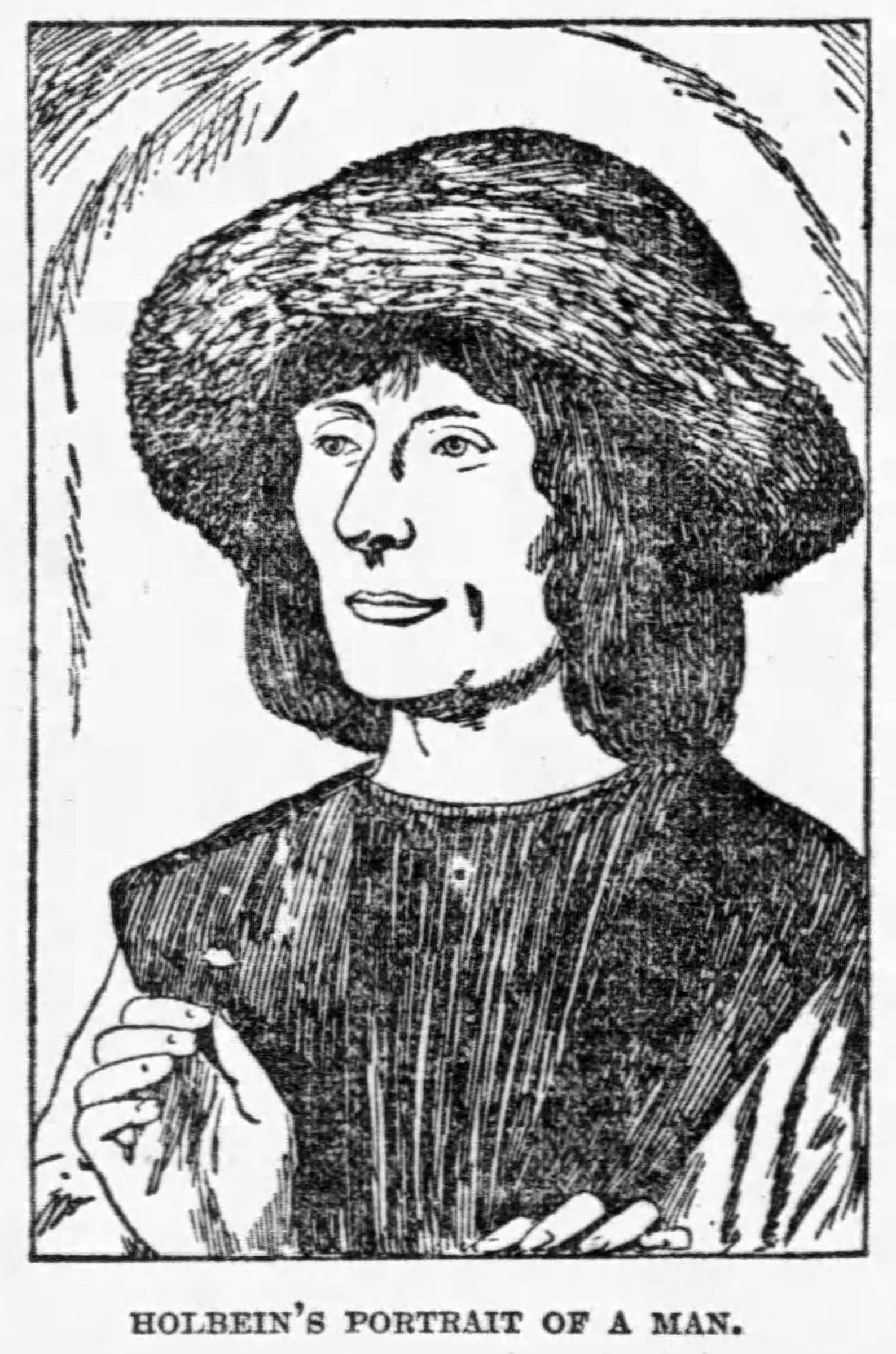

The illustration of the Portrait of a Man with a Pink shown above, was included in the article with the following description:

“The last of the portraits to be noticed is also the smallest, the others being life-size half-length figures; and the oldest, belonging to the sixteenth century, while the others date from the seventeenth. This is the panel by the German master Holbein, which is a good example of the rigid, literal, sculpturesque style of Henry the Eighth’s court painter . . . the face is unmistakably, humanly true; one does not doubt this man’s existence for an instant or miss one note of his rather strenuous character.”

A question of attribution

The exhibition proved an enormous success with Chicagoans rightly proud of their “masterly coup.” However, almost immediately, the authenticity of a few of the works, including the Holbein, was called into question by an attendee of the opening night reception. He notified the Chicago Tribune of his opinion, which was summarily dismissed by the journalist who maintained that the collection consisted of “first-class examples of the respective painters.”

The Holbein attribution did receive closer scrutiny, and by the time John Glessner made his anonymous, retroactive gift of $4,000 in 1894, the painting was attributed simply to the “Flemish School.” The listing below, taken from the annual report of the Art Institute issued in 1895, shows the painting as item #1.


In December 1913, the painting received renewed attention when the well-respected art expert, Dr. Abraham Bredius, director of theMauritshuis art museum at The Hague in the Netherlands, toured the Old Masters galleries at the Art Institute. He identified the portrait as the work of Hans Memling (c. 1430-1494), regarded as one of the most important Netherlandish painters of the 15th century. Memling’s art had been rediscovered in the 19th century, so this attribution made the painting far more valuable than the work of an unidentified Flemish artist.


The attribution was short-lived but brought additional attention to the painting. Within a few years, it was conclusively identified as the work of Quentin Massys (also spelled Matsys), a founder of the Antwerp school of painting. Massys was born in Leuven in 1466 and is believed to have attained his master’s status there, before moving to Antwerp, which, by the early 16th century, had become the artistic center of The Netherlands. Massys became one of the first notable artists in Antwerp and was elected a member of the Guild of Saint Luke.


His work is noted for its effects of light and shade, firmness of outline, clear modelling, and thorough finish of detail. His effective use of transparent pigments provided a glowing richness to his paintings that was reminiscent of the work of Memling. He was also known for his “strenuous effort” to express individual character, something clearly seen in the portrait. Massys died in Antwerp in 1530, after enjoying a reputation as a cult figure, and paving the path for a school of painting that culminated with the career of Peter Paul Rubens.

Conclusion

The painting remained popular, traveling to New York for a loan exhibition in 1929 and to Antwerp in 1930 for the Exposition d’art flamand ancien, showcasing the work of early Flemish painters. It was exhibited by the Art Institute during the Century of Progress in both 1933 and 1934 and returned to New York in the years following, as well as being exhibited in Columbus, Ohio (which, by coincidence, is just an hour from Zanesville, where John Glessner was born and raised).


Now back on the display in Gallery 207 (The Charles H. and Mary F. S. Worcester Gallery) for the first time in many years, the oil on panel painting, which measures just 11-1/2 by 17-1/4 inches, still captivates with its brilliant use of color, and stark realism. The tag adjacent to the painting reads:

“In this portrait from relatively early in his career, Quentin Massys followed stylistic conventions that appealed to Antwerp’s growing market of patrons while also exhibiting the bold innovations that ultimately made him one of the city’s most influential painters. The sitter appears frozen in a somewhat unnatural pose, as was the fashion for half-length portraits at the time, and the positioning of his left hand on the painting’s lower edge recalls the spatial illusionism found in portraits by Netherlandish artists of the previous generation. However, the subtle modeling of the face conveys a strong sense of the sitter’s individual character at a time when such works tended to idealize their subjects. The pink, or carnation, held by the sitter could symbolize marriage or Jesus Christ’s incarnation.”

Tuesday, December 10, 2019

The Monday Morning Reading Class, Part III


During the year 1905, the Monday Morning Reading Class, which had been meeting for more than a decade, planned a very special gift to be presented to Frances Glessner on her 58th birthday, January 1, 1906.  A large leather-bound calendar, contained pages prepared by class members, friends, and family members, to be read daily throughout the year.  The book itself measured 12-1/2” x 17” and was four inches thick.  With its case, it was designed to fit exactly, when opened, on the library table in the second-floor hall.  The individual pages, one for each day of the year, were mounted two to a page, and measured 5” by 8”.  The calendar remains one of the most extraordinary items in the house collection.


Frances Glessner recalled the receipt of the calendar in her journal:

“January 1st I had several pretty gifts from embers of the family, flowers from friends, when a box came in beautifully done up, everything in the choicest and most attractive manner – box of green leather with gold letters monogram etc. a standard of the same, in all a very remarkable calendar prepared for me by members of the Reading class.  It is in four sections – each one has an original title page, one done by Mr. Gookin, one by Fred Bartlett, one by Herman von Holst, one by Mr. Scott – all exceedingly beautiful.”


Frances Glessner was deeply involved in the civic and social life of the city, so it is not surprising that many of the pages were contributed by names still recognized today – Daniel Burnham, Hermann V. von Holst, Frederic Clay Bartlett, Frederick Stock, Charles Hutchinson, Bryan and Helen Lathrop, Harold and Edith McCormick, Frank Lowden, and William Rainey Harper.  Friends from outside Chicago contributed as well, including Frederick Law Olmsted Jr., Isabella Stewart Gardner, and Julia Shepley (the daughter of H. H. Richardson).  The result is an assemblage of beautifully designed and executed pages that convey the profound respect in which Frances Glessner was held by all who knew her.


When the Reading Class met the following week, Frances Glessner asked her daughter-in-law, Alice, to read a thank you letter to the class which read in part:

“How could you think of it?  How could you accomplish it?  How did you know there were so many choice people in the world with big hearts, willing wits and loving thoughts?  How could anything so exquisite in every detail, so perfect in workmanship, so dainty so refined be put together?

“Fairies and elves could conceive nothing which would give me greater pleasure, more lasting delight than that tribute of your affection . . . The first thought each morning is what does the calendar bring today?  What old friend speaks, what dear face looks out, what poem, what song, what picture, what sacred association?

“Not all of the lovely women in the world are in this class, but there is not one here who is not lovely . . . my heart swells with pride to see a splendid room filled with charming matrons in becoming garb, no introductions needed, all friends, all clever, all intellectual, with high ideals.  This circle is something to be proud of, and I am proud of it and of every individual in it.

“I have one small confession to make.  I have peeped ahead a little in the calendar – only a little – members of my family interfered in the most officious manner and told me I was dishonorable.  Now I have come to a conclusion of my own.  What if I should die before I see it all?  So after today I fling honor to the breeze and establish a code of my own, I am going to peep.”

Reproductions of 104 pages were put on exhibit at Glessner House in early 2007.  Rick Kogan featured the calendar in an article entitled “Ghostly Writers: City Giants of Long Ago Send Messages Through Time at Glessner House” in his weekly Sidewalks column in the Chicago Tribune Magazine on February 18, 2007.  Below we present a few select pages from the calendar, it was most hard to choose, indeed!

January 12, 1906: William Rainey Harper
The first president of the University of Chicago, whose suggestion led to the formation of the Reading Class in 1894, was fluent in several ancient languages, and wrote his message in both English and cuneiform.


January 18: Helen Macbeth
The sister of Frances Glessner, Helen was a talented painter and created an artwork showing the Macbeth family home in Springfield, Ohio, where John and Frances Glessner were married on December 7, 1870.


February 23: Frederick Stock
Second conductor of the Chicago Symphony Orchestra.  Among the Glessners closest friends, a few years later he would dedicate his first symphony to them, much of it having been composed at their New Hampshire summer estate, The Rocks.


March 7: Charles L. Hutchinson
Hutchinson was the long-time president of the Art Institute of Chicago, and he and his wife Frances were frequent guests to the Glessner House.  For his page, he selected a print by the well-known English etcher and printmaker, Sir Francis Seymour Haden.


March 31: William G. Hibbard
Part of the large Hibbard clan which occupied several house on Prairie and Calumet Avenues, he provided a detailed landscape plan for his summer home in Winnetka, then under development.


April 25: Susan Follansbee Hibbard
Hibbard’s wife, a member of the Reading Class, had the architect of their summer home, A. Lincoln Fechheimer, based in Cincinnati, draw out the floor plan for Frances Glessner to study and enjoy.


July-September title page: Frederic Clay Bartlett
Bartlett designed the title page for the third section of the calendar.  Using his typical pre-Raphaelite style at the time, he depicted the Reading Class, its monthly lunches, and Frances Glessner’s interest in music and beekeeping.


October 11: Theodore Thomas memorial
The first conductor of the Chicago Symphony was among the Glessners closest friends and had died in January 1905.  The beautifully illustrated page was one of two commissioned by the orchestra for inclusion in the calendar.


November 4: Daniel H. Burnham
Architect Daniel Burnham and his wife Margaret both contributed pages.  Daniel Burnham’s page features a quote about the satisfaction of doing good work, a reflection of his interest in the Swedenborgian faith.


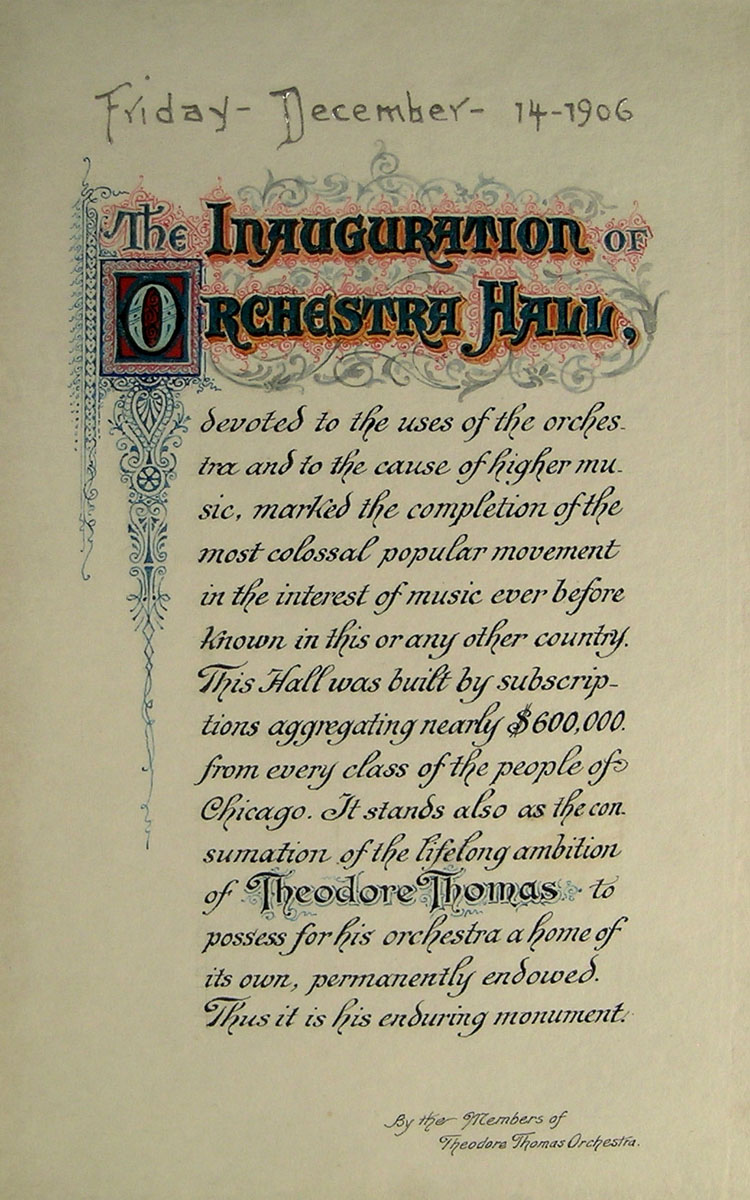
December 14: Inauguration of Orchestra Hall
The second of two pages contributed by the orchestra, this page commemorated the second anniversary of the opening of Orchestra Hall in December 1904.  The Glessners personally raised much of the funding to construct the hall.


Monday, September 24, 2012

The White City - Chicago's 1893 World's Columbian Exposition

On Friday September 28, 2012 at 7:00pm, the museum is proud to host a production of “The White City.”  This original musical, produced by Lost and Found Productions and playwright June Finfer, focuses on one of the most legendary events in Chicago history – the World’s Columbian Exposition.

When Chicago wins the right to host the 1893 fair, the first great fair in the United States, the architect chosen to design and build it in record time – Daniel Burnham – finds that ambition is not enough.  He needs a lot of help from even those who oppose him.  In the three-year period of construction of the mile square fairgrounds and dozens of buildings, a vast canvas of characters vie with fate, death, and love to achieve the impossible.  Original music by Elizabeth Doyle that could have been written in the Gay 90s brings color and humor to a story of “making no little plans.”  This musical explores the politics and passions behind a unique national event, in many ways the first and last of its kind.

June Finfer is an award-winning writer, and a producer of documentaries.  Her film about the architecture of Mies van der Rohe has been broadcast on A&E and PBS and won a first prize at the American Film Festival.

Pre-paid tickets are $25.00 per person and may be purchased by calling 312.326.1480.  The production will take place in the coach house of Glessner House Museum, located at 1800 S. Prairie Avenue in Chicago’s South Loop neighborhood.

John and Frances Glessner made numerous trips to the fairgrounds, which are recorded in Frances’ journal.  Daniel Burnham, the fair’s Director of Construction, was a close friend of the family, so they were given special privileges, like access to the grounds in advance of its official openings and the opportunity to visit private viewing areas. 

In a manuscript entitled “Ghosts of Yesterday,” John Glessner recalled some of the individuals who visited 1800 S. Prairie Avenue during the Fair.  We herewith present a few excerpts from that manuscript.

“Other dear and delightful friends were Mr. and Mrs. Frederick Law Olmsted.  Our families were on very intimate terms.  George and young Frederick were classmates in College (Harvard).  During the World’s Fair Mr. and Mrs. Olmsted visited us.  He was America’s first and leading landscape architect, really settled the location of the Fair and laid it out.  In many warm discussions with the architects Mr. Olmsted always kept still until everyone else had talked, and then quietly would say – ‘Why don’t you do so and so?’ and that invariably settled it.  Mrs. Olmsted was a quaint little body, wore a white lace cap built over a rather high frame and tied under her chin in a large bow knot of wide muslin strings, and was a lovely picture.”

“It was (Charles) Hutchinson, too, who first brought Sir Caspar Purden Clarke, Director of the Metropolitan Museum of Art, New York, possessing a great and thorough knowledge of art but never forcing his knowledge or position on one – another cultured Englishman, with all that that implies.  As he left our dining room he said to Hutchinson – ‘You ought to keep you eyes on that punch bowl.  That’s a museum piece.  You ought to have it in your Art Museum.”  (Hutchinson was the long-time president of the Art Institute of Chicago.  The Glessners purchased their silver niello punch bowl from the Siam exhibit at the close of the fair.)

“The World’s Fair brought us many pleasing experiences with men and things, both in the early days of preparation and later in the installing of exhibits and the display itself.  It brought, also, some official representatives from abroad that our authorities treated very well, better than some of them deserved.  Special attention was paid to the Spanish representative.  I think the Duke of Veragua was never in my house, but I had some small connection with his entertainment – once at a horse show on the Dunham farm at Wayne, where Arthur Caton was in charge and asked my help; and again at South Bend, where the first Clement Studebakers were entertaining the “royal” party at luncheon, where I witnessed the most marvelous exhibition of hospitality.  We went from Chicago, a train load of men.  Unfortunately the house had taken fire that morning and the roof and part of the upper storeys burned, but the Studebakers spread tarpaulins under the ceiling of the dining room and gave us a magnificent luncheon on a beautifully decorated table just as if nothing had happened or as if that was the way they always did it, while water trickled down the walls of the room and leaked through spots in the tarpaulin.  Again it was my lot to help entertain the Duke in a theater box at a play.  Perhaps my total ignorance of Spanish and his imperfect knowledge of English combined with the inanities of the play at least account partially for the lack of spontaneous hilarity that marked the evening for both of us.”

“Perhaps it was not only the Chatelain that brought these World’s Fair men to us.  There was the daughter of the house – only a child then, it is true, but good company even then.  (Fanny Glessner was 15 years old at the time of the Fair).  There was the freedom of the house, a man might come or go as he pleased, he might talk or merely listen, he might read or merely sit and contemplate; there was a willing ear to hear and a heart to sympathize in their troubles, and there were creature comforts as well – always a good Sunday supper, and as with the proverbial stage or street car, there was at table always room for one more.  This house was a haven of refuge for many, the shadow of a great rock in a weary land, and these friends brought many amusing tales.  One gay young visitor came home one day from the Fair to say that going into one building she met an elderly man coming out who apparently had no one to talk with and who was oppressed by the size of the thing and the short time at his disposal, and perhaps encouraged by her winning smile broke out with, “I can’t see the damned thing in a month.” 

“And we had the World’s Fair architects – Burnham, and John Root, before his untimely death, and Charles Follen McKim, and Robert Swain Peabody, and William R. Meade, and (John Goddard) Stearns and George B. Post, and Charles Coolidge, who built the present Art Institute for religious and other conferences during the Fair, and who restrained his impatience one night until everybody else had gone that he might tell us of his love romance that had culminated in acceptance the day before in St. Louis.”
Related Posts Plugin for WordPress, Blogger...