Showing posts with label Edith Rockefeller McCormick. Show all posts

Monday, January 4, 2016

A Bit of Chicago History in Rockford, Illinois

In 1993, Jim Vitale opened the Cliffbreakers Restaurant in Rockford, Illinois.  Four years later, he opened the adjacent hotel.  One of the distinguishing features of the establishment was Vitale’s extensive collection of antiques and architectural fragments from around the world, including several from Chicago.  Although Vitale sold the business in 2006, and some of the pieces have been sold off, many remain, making it worth a visit for those interested in seeing pieces of Chicago’s history.  Below is a summary of the pieces with a Chicago connection.  The descriptions are taken directly from a brochure acquired at the hotel in 2009 (no longer available).

Crane Company Building
836 S. Michigan Avenue
Holabird & Roche, architects
1913


“These massive 10-foot bronze doors weight 750 pounds each and were the original entry doors to the famous Crane building in Chicago.”


Corn Exchange Bank Building (demolished)
122-136 S. LaSalle Street
Shepley, Rutan & Coolidge, architects
1908


“This magnificent window was discovered above a plaster ceiling during the demolition of the Chicago Corn Exchange at LaSalle and Adams Streets.  It contains over 7,000 pieces of leaded glass.  An amazing stroke of luck for Cliffbreakers!”


Germania Club
108 W. Germania Place (at Clark St.)
Addison & Fiedler, architects
1888-1889


“These massive oak beams on the ceiling of the lobby, the hanging bronze light fixtures, along with the balcony railing and registration desk came from the old Germania Club in Chicago.  This was a private men’s club until its closing in the late 50s.  The 50-foot carved oak grand wall with leaded windows was the original entry to the Club.”


Continental Bank (demolished)
208 S. LaSalle Street
Burnham & Root, architects
1885


 “These two canvasses flanking either side of the lobby are 8 feet high and 27 feet long.  They were painted by American artist George Marshall for the famous Continental Bank of Chicago, at the turn of the century.  One features pilgrims landing at Plymouth Rock; the second, a hillside view of Florence in the springtime.”


Standard Club
320 S. Plymouth Court
Albert Kahn, architect
1926


“These magnificent bronze chandeliers once hung in the Standard Club in Chicago.”


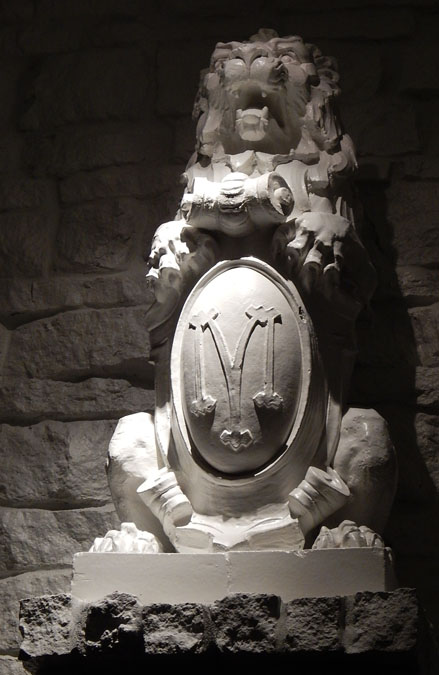
Edith Rockefeller McCormick Mansion (demolished)
1000 N. Lake Shore Drive
Solon S. Beman, architect
1888
Note:  The house was built for Nathaniel S. Jones and purchased by John D. Rockefeller in 1895 and presented to his daughter as a gift


“A pair of glazed terra cotta lions in superior condition.  From the original McCormick Mansion torn down in 1953.”  (The lions have recently been painted white, the earlier photo dates from 2009).


Monday, August 15, 2011

Lightner Museum Preserves Prairie Avenue's Past

In 1934, Otto C. Lightner, publisher of Hobbies magazine, opened a unique museum in a former mansion at 2816 S. Michigan Avenue.  The museum was a treasure trove of objects collected over the course of years, many from the leading homes in Chicago, on Prairie Avenue, Lake Shore Drive, and elsewhere.  Lightner acquired the decorative objects, light fixtures, stained glass, and architectural fragments, from the grand old houses as they were being demolished.

The house had originally been built for Charles W. Brega in the late 1880s.  The architect was Solon S. Beman, architect of the Town of Pullman and the Kimball mansion at 1801 S. Prairie Avenue to name but a few.  Brega was a prominent member of the Chicago Board of Trade and his elegant home on this fashionable section of Michigan Avenue reflected his business and social successes.  He lived there with his wife Fanny and their only child Louise, who later married a British army officer, Colonel Ralph H. James, and moved to England.  (Their son Charles James, became a well-known clothing designer in the U.S.).  After Brega died in 1906, his wife also moved to England, and the house was acquired by Franklin P. Smith, a prominent wire and iron manufacturer and one of the early settlers of Lake Forest. 

Lightner acquired the house from the Smith family in 1933 and immediately began converting the building into his museum.  The rooms were filled with fine objects from leading families – Potter Palmer, Edith Rockefeller McCormick, Victor Lawson, John Farwell, and many more.  Stained glass (including panels from the Chicago Board of Trade) filled the windows, furniture was crammed into every space, and countless curio cabinets were filled to overflowing with art glass and more.  The rooms were given themes and names – the Music Room, the Gold Room, the Textile Room, the Curio Room, the Egyptian Room, the Crystal Room, and the Oriental Room.  The museum also featured an especially fine collection of objects from the World’s Columbian Exposition.

Several objects from Prairie Avenue homes made their way into the museum including paneled doors from the Pullman house, a gold-plated chandelier from the Buckingham house, brass andirons from the Armour house, and a dining room – complete with glassware, china, paneling, furniture, and all – from the residence of Isabella Blackstone. 

As the collection grew, Lightner acquired the adjacent properties.  To the north he constructed a building to house his publishing business.  To the south, he planned a huge modern addition to the museum that would connect to the nearby Kohl mansion.  At the close of World War II however, due to ill health, Lightner made the decision to move to St. Augustine Florida and take his collections with him.  The publishing business was moved to 1006 S. Michigan Avenue, which still features a faded sign publicizing Hobbies Magazine on its side.

Next week: The Lightner Museum opens in St. Augustine
Related Posts Plugin for WordPress, Blogger...