Showing posts with label Felsengarten. Show all posts

Monday, March 21, 2016

Rose Fay Thomas


On March 29, 2016, music historian Joan Bentley Hoffman will present a lecture on the life and accomplishments of Rose Fay Thomas, the first is a series of three spring lectures exploring women prominent in the advancement of classical music at the turn of the 20th century.  (Additional lectures will examine Frances Glessner on April 28 and Fannie Bloomfield Zeisler on May 24.  For more information, or to reserve tickets, visit www.glessnerhouse.org/events/).   In this article, we will look briefly at the life of Rose Fay Thomas.

Rose Fay arrived in Chicago in 1878, taking up residence with her brother Charles.  She became acquainted with Frances Glessner through her sister Amy, an accomplished pianist, and one of the first women to study in Europe.  In May of 1890, Rose married Theodore Thomas, the nationally-recognized music director who had brought his celebrated orchestra to Chicago annually since 1869.  Soon after, Thomas accepted the position to establish a permanent orchestra in Chicago, the present day Chicago Symphony Orchestra, now celebrating its 125th anniversary season.
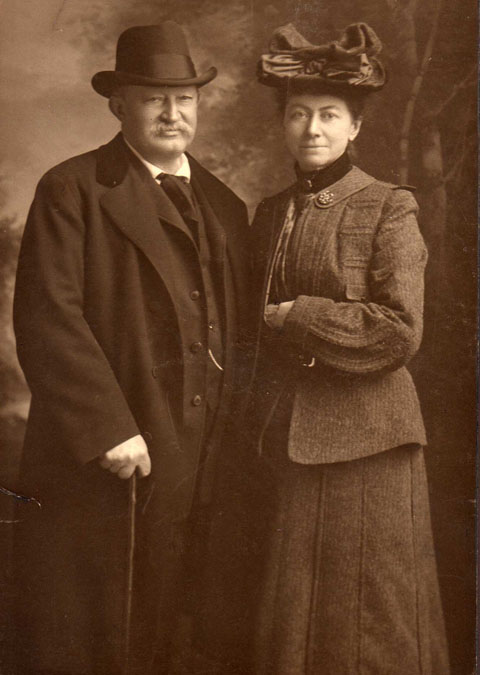

Rose Thomas became her husband’s able help mate and most ardent supporter.  In a letter to Frances Glessner dated May 3, 1892, she noted in part:

“I want to tell Mr. Glessner how much pleasure his letter gave to Mr. Thomas.  He has worked himself almost to death this winter to bring the orchestra up to the highest standard, and make the concerts as perfect as possible. . . “

Regarding the criticisms he was receiving, she went on to acknowledge the Glessners:

‘for the generous sympathy, and support of those far seeing, and noble minded men and women, like yourself and Mr. Glessner, who can grasp the situation, and understand that Mr. Thomas is here to establish a great Art Work, and to make Chicago one of the first musical centers of the world.”

During the World’s Columbian Exposition, for which Theodore Thomas was placed in charge of the extensive musical program, Rose Thomas organized the music clubs of the country into the National Federation of Music Clubs.  She served as the first president and was later appointed honorary president, a position she held until her death.

In August 1894, the Thomases visited the Glessners at their summer estate, The Rocks, in the White Mountains of New Hampshire.  While driving through the surrounding countryside:

“Mrs. Thomas was in raptures over one of the views and locations and came back thoroughly in love with it . . . The Thomases went to Bethlehem and bought about fourteen acres out of Whitcomb’s farm – for which they paid $800.  They have been wild with enthusiasm and interest ever since.”


Two years later, the Thomases completed their home, Felsengarten, on the property, with Rose Thomas personally supervising much of the work.  From this point forward, they spent their summers at their beloved summer estate, as neighbors of the Glessners.  Rose Thomas became an accomplished gardener, frequently sharing plants with Frances Glessner, and in 1904 Rose Thomas published an account of her estate, entitled Our Mountain Garden, a copy of which she presented to Frances Glessner for Christmas.


Rose Thomas was passionate about the abolition of cruelty toward animals.  In January 1899, she convened a small group of ladies to organize what evolved into the Anti-Cruelty Society.  Two months later, by-laws were adopted, and Rose Thomas was appointed president, one of the first women to head a Humane Society in the country.
(Today, the Rose Fay Thomas Society recognizes those individuals who have made planned gifts for the ongoing support of the Anti-Cruelty Society). 

Theodore Thomas died of pneumonia on January 4, 1905, just two weeks after the official opening of Orchestra Hall.  His widow soon gave up their home at 43 Bellevue Place, moving to an apartment at 2000 S. Indiana Avenue, just a few blocks from the Glessners.  Before the move, she came to stay with the Glessners for much needed rest, Frances Glessner noting:

“Mrs. Thomas came in the afternoon to stay with us.  She brought her little dog.  She was perfectly worn out with all the hard work and anxiety she has gone through.  I gave her the big corner room with a bright fire in it – and have left her alone as much as possible.  She says it is the first rest she has had since October and has visibly improved since coming.”

She remained a champion of her husband’s work and in 1911 published Memoirs of Theodore Thomas, dedicating the volume to her brother Charles Norman Fay, “the best and truest friend of Theodore Thomas and the chief promoter of his art.” 

When she died in 1929, she was given a military funeral in recognition of her significant service assisting enlisted men as a director of the Soldiers and Sailors Club.  She was the first woman in New England and only the fourth in the United States to be accorded a military funeral up to that time.  She was interred beside her husband at Mt. Auburn Cemetery in Cambridge, Massachusetts.

Today, the Anti-Cruelty Society and the National Federation of Music Clubs serve as the enduring legacy of this fascinating and inspiring individual.


Monday, April 11, 2011

The Glessners and the Chicago Symphony Orchestra

The history and success of the Chicago Symphony Orchestra is closely intertwined with the lives of John and Frances Glessner.  The founding conductor, Theodore Thomas (shown above) was an intimate friend of the couple for many years, and he consulted with them frequently on all matters relating to the orchestra.

Thomas first came to Chicago as a conductor in 1869 with his orchestra, having initially visited the city fifteen years earlier as a violinist in a small orchestra.  The November 1869 appearance marked the beginning of a long relationship that culminated in Chicago’s reputation as having one of the very finest orchestras in the country.  Thomas and his orchestra returned in 1870 for a series of seven concerts.  In 1871, his orchestra was scheduled to perform on October 9.  They arrived in Chicago that morning to find the city in ruins from the Great Fire, but in subsequent years they visited on an annual basis, earning a respect from increasingly large audiences.

It is not known exactly how and when the Glessners and Thomas became acquainted, but by the time of formation of the orchestra in 1891, John Glessner was one of 50 guarantors who each provided $1,000 annually against losses (which were considerable in the early years). 

Thomas was appointed Music Director in the Bureau of Music at the World’s Columbian Exposition, and Music Hall (shown above) was constructed for his use.  The Fair proved a trying time for Thomas, who was inadvertently drawn into the politics of the fair, in regards to policies implemented to forbid the use of any instruments made by manufacturers who did not exhibit at the fair (including Steinway).  Thomas felt strongly that his guest artists, including Ignace Paderewski and Camille Saint-Saens, should be allowed to play the instruments of their choosing.  The Glessners were staunch supporters of Thomas throughout the ordeal, which resulted in his resignation in August 1893.  In time the whole episode was forgotten, and by May 1895, Frances Glessner headed up a group of thirty-six ladies in Chicago who presented Theodore Thomas with a beautiful silver punch bowl in thanks for his services in enriching the cultural lives of the residents of the city.

By 1898, when John Glessner was elected a trustee of the Orchestral Association, he had contributed over $7,200 to the orchestra, making him one of the four largest donors to date.  He remained a trustee until his death in 1936 and for the last twenty years of his life served on the Executive Committee.  Frances Glessner was one of the founders of the Chicago Chamber Music Society, an arm of the orchestra, and served on its executive committee for many years. 

Away from Chicago, the connection between the Glessners and the Thomases continued.  After John and Frances Glessner completed their summer home, The Rocks, in New Hampshire, the Thomases purchased land nearby and constructed their own summer home, which they named Felsengarten.   It was here that Theodore Thomas could truly relax, far removed from the heavy demands of the orchestra.

Members of the orchestra frequently entertained at the Glessner home, providing music for dinner parties and meetings of the Monday Morning Reading Class.  On more than one occasion, Thomas brought musicians by surprise to the Glessner house for a birthday or anniversary.  The Glessners reciprocated by providing wonderful receptions and dinners for the musicians, and on more than one occasion hosted the entire orchestra for a sit down dinner.  One of these times was in January 1913, when the members of the orchestra were able to view the meticulously executed miniature orchestra that Frances Glessner Lee had made herself, a birthday gift to her mother.

In 1902, when the time came to realize the long-held dream of Theodore Thomas to construct a permanent hall for the orchestra, John Glessner, along with Daniel Burnham and Bryan Lathrop, held the title for the newly purchased property on Michigan Avenue.  These three men, along with seven other trustees, carried the entire purchase price, by cash and their personal notes, until 1905, when the Association secured a loan for the completion of orchestra hall.  The Glessners were instrumental in raising a significant portion of the funds needed to construct the hall, which opened in December 1904.  They were assigned Box M in the new hall (shown above), directly behind the conductor’s podium, and it was reserved for their exclusive use until their deaths in the 1930s.

Less than one month after the opening of the new hall, Theodore Thomas died.  His wife and the Glessners were the only ones at the bedside.  After his passing, George Glessner was summoned and took post-mortem photographs, presumably given to the widow.  Soon after the funeral, Thomas’ widow Rose presented the Glessners with his baton and a preserved palm frond from his casket, mementoes of their long friendship.  (The pieces remain on view today in the museum, in the hallway outside the master bedroom).

The relationship with the orchestra remained close under Thomas’ successor, Frederick Stock.  On December 31, 1909, Stock premiered his Symphony in c minor, which was dedicated to the Glessners.  Much of the piece in fact had been written while Stock was a guest of the Glessners at The Rocks.  Their support for Stock was equally as strong as it was for Thomas, especially during the period of the first World War when Stock’s allegiance to America was (falsely) questioned. 

John Glessner died on January 20, 1936.  In the program for the concert three days later, a full page tribute to Glessner included the following statement, “To no one man has The Orchestral Association been more beholden.  He was one of the small group of men who in the Association’s first years of struggle were loyal in their support and generous in their gifts.  Since 1898 he has served as a Trustee and by his constant attendance on meetings and his sound judgment has brought much needed help to his associates.  He and his devoted wife while she lived were always in their box to delight in the music their generosity made possible, and in their hospitable home men of the Orchestra and their musical friends found frequent entertainment.”  On February 11, the CSO concert included Richard Strauss’ tone poem “Death and Transfiguration” as a fitting tribute to this ardent supporter of the orchestra.


Related Posts Plugin for WordPress, Blogger...