Showing posts with label Frederic Clay Bartlett. Show all posts

Tuesday, December 10, 2019

The Monday Morning Reading Class, Part III


During the year 1905, the Monday Morning Reading Class, which had been meeting for more than a decade, planned a very special gift to be presented to Frances Glessner on her 58th birthday, January 1, 1906.  A large leather-bound calendar, contained pages prepared by class members, friends, and family members, to be read daily throughout the year.  The book itself measured 12-1/2” x 17” and was four inches thick.  With its case, it was designed to fit exactly, when opened, on the library table in the second-floor hall.  The individual pages, one for each day of the year, were mounted two to a page, and measured 5” by 8”.  The calendar remains one of the most extraordinary items in the house collection.


Frances Glessner recalled the receipt of the calendar in her journal:

“January 1st I had several pretty gifts from embers of the family, flowers from friends, when a box came in beautifully done up, everything in the choicest and most attractive manner – box of green leather with gold letters monogram etc. a standard of the same, in all a very remarkable calendar prepared for me by members of the Reading class.  It is in four sections – each one has an original title page, one done by Mr. Gookin, one by Fred Bartlett, one by Herman von Holst, one by Mr. Scott – all exceedingly beautiful.”


Frances Glessner was deeply involved in the civic and social life of the city, so it is not surprising that many of the pages were contributed by names still recognized today – Daniel Burnham, Hermann V. von Holst, Frederic Clay Bartlett, Frederick Stock, Charles Hutchinson, Bryan and Helen Lathrop, Harold and Edith McCormick, Frank Lowden, and William Rainey Harper.  Friends from outside Chicago contributed as well, including Frederick Law Olmsted Jr., Isabella Stewart Gardner, and Julia Shepley (the daughter of H. H. Richardson).  The result is an assemblage of beautifully designed and executed pages that convey the profound respect in which Frances Glessner was held by all who knew her.


When the Reading Class met the following week, Frances Glessner asked her daughter-in-law, Alice, to read a thank you letter to the class which read in part:

“How could you think of it?  How could you accomplish it?  How did you know there were so many choice people in the world with big hearts, willing wits and loving thoughts?  How could anything so exquisite in every detail, so perfect in workmanship, so dainty so refined be put together?

“Fairies and elves could conceive nothing which would give me greater pleasure, more lasting delight than that tribute of your affection . . . The first thought each morning is what does the calendar bring today?  What old friend speaks, what dear face looks out, what poem, what song, what picture, what sacred association?

“Not all of the lovely women in the world are in this class, but there is not one here who is not lovely . . . my heart swells with pride to see a splendid room filled with charming matrons in becoming garb, no introductions needed, all friends, all clever, all intellectual, with high ideals.  This circle is something to be proud of, and I am proud of it and of every individual in it.

“I have one small confession to make.  I have peeped ahead a little in the calendar – only a little – members of my family interfered in the most officious manner and told me I was dishonorable.  Now I have come to a conclusion of my own.  What if I should die before I see it all?  So after today I fling honor to the breeze and establish a code of my own, I am going to peep.”

Reproductions of 104 pages were put on exhibit at Glessner House in early 2007.  Rick Kogan featured the calendar in an article entitled “Ghostly Writers: City Giants of Long Ago Send Messages Through Time at Glessner House” in his weekly Sidewalks column in the Chicago Tribune Magazine on February 18, 2007.  Below we present a few select pages from the calendar, it was most hard to choose, indeed!

January 12, 1906: William Rainey Harper
The first president of the University of Chicago, whose suggestion led to the formation of the Reading Class in 1894, was fluent in several ancient languages, and wrote his message in both English and cuneiform.


January 18: Helen Macbeth
The sister of Frances Glessner, Helen was a talented painter and created an artwork showing the Macbeth family home in Springfield, Ohio, where John and Frances Glessner were married on December 7, 1870.


February 23: Frederick Stock
Second conductor of the Chicago Symphony Orchestra.  Among the Glessners closest friends, a few years later he would dedicate his first symphony to them, much of it having been composed at their New Hampshire summer estate, The Rocks.


March 7: Charles L. Hutchinson
Hutchinson was the long-time president of the Art Institute of Chicago, and he and his wife Frances were frequent guests to the Glessner House.  For his page, he selected a print by the well-known English etcher and printmaker, Sir Francis Seymour Haden.


March 31: William G. Hibbard
Part of the large Hibbard clan which occupied several house on Prairie and Calumet Avenues, he provided a detailed landscape plan for his summer home in Winnetka, then under development.


April 25: Susan Follansbee Hibbard
Hibbard’s wife, a member of the Reading Class, had the architect of their summer home, A. Lincoln Fechheimer, based in Cincinnati, draw out the floor plan for Frances Glessner to study and enjoy.


July-September title page: Frederic Clay Bartlett
Bartlett designed the title page for the third section of the calendar.  Using his typical pre-Raphaelite style at the time, he depicted the Reading Class, its monthly lunches, and Frances Glessner’s interest in music and beekeeping.


October 11: Theodore Thomas memorial
The first conductor of the Chicago Symphony was among the Glessners closest friends and had died in January 1905.  The beautifully illustrated page was one of two commissioned by the orchestra for inclusion in the calendar.


November 4: Daniel H. Burnham
Architect Daniel Burnham and his wife Margaret both contributed pages.  Daniel Burnham’s page features a quote about the satisfaction of doing good work, a reflection of his interest in the Swedenborgian faith.


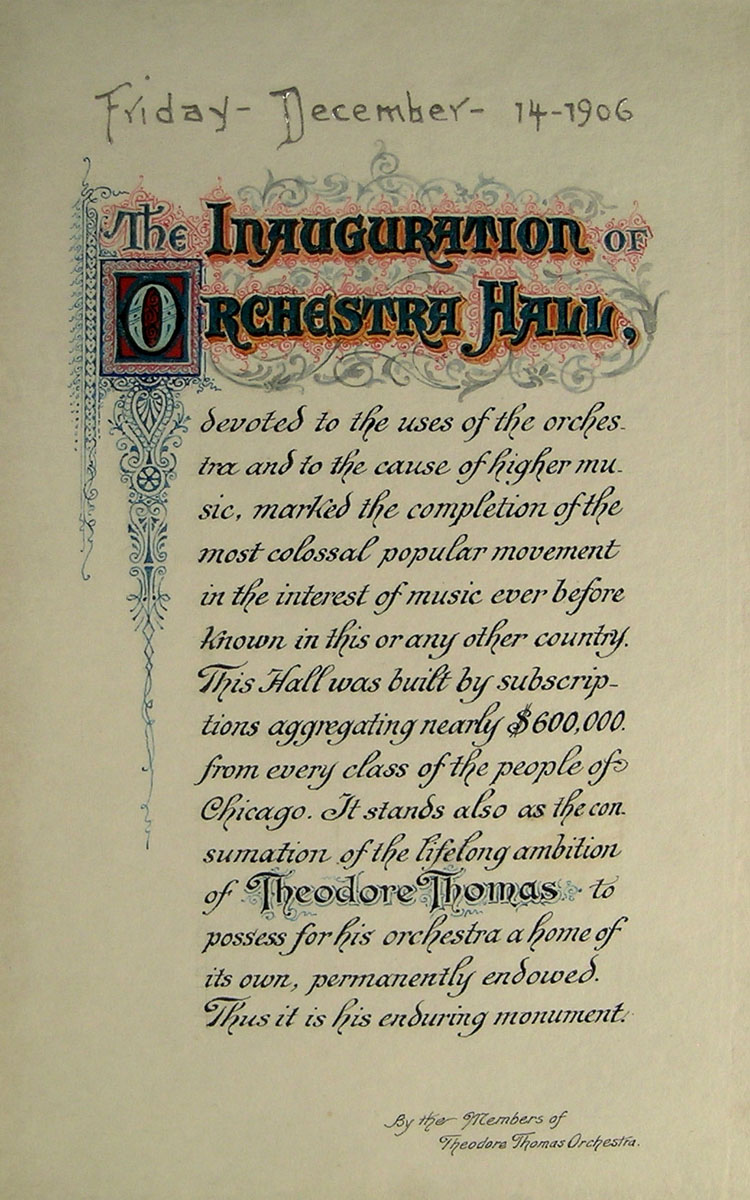
December 14: Inauguration of Orchestra Hall
The second of two pages contributed by the orchestra, this page commemorated the second anniversary of the opening of Orchestra Hall in December 1904.  The Glessners personally raised much of the funding to construct the hall.


Monday, November 23, 2015

Chicago's First Christmas Tree - 1913


On Tuesday, November 24, 2015, the City of Chicago will conduct its 102nd annual Christmas Tree Lighting Ceremony.  The tree will be located in Millennium Park at Michigan Avenue and Washington Street, just two blocks north of the location of Chicago’s first Christmas tree in 1913.  Since 1966, the official Christmas tree has stood in Daley Plaza (except for 1982 when it was placed at State Street and Wacker Drive).  In this article, we will look at the beginning of the decades long tradition of the placement of the tree in Grant Park.

Charles L. Hutchinson

The idea for the 1913 municipal Christmas tree started many weeks in advance with the creation of the Municipal Christmas Festival Association headed by Charles L. Hutchinson, long time president of the Art Institute.  Hutchinson assembled an impressive list of artisans to assist the effort including architect Howard Van Doren Shaw, and artists Frederic Clay Bartlett, Abram Poole, and Lorado Taft, all of whom “(put) aside their own personal affairs in a public spirited way.”

A large site in Grant Park north of the Art Institute at Monroe Street was selected and christened the “Court of Honor” – a name last used during the World’s Columbian Exposition of 1893.  In addition to the main tree itself, a large arcade consisting of a series of arches served as a backdrop, with dozens of smaller trees forming a grove.  


On December 19, the top section of the tree was set in place atop a grouping of three huge telephone poles secured in a concrete base.  The top was a single 35-foot tree donated by F. J. Jordan, a former partner of Captain Herman Scheunemann, the famous captain of Chicago’s “Christmas Tree Ship” which had gone down in Lake Michigan the previous year.   In an article which appeared in the Chicago Tribune on December 20, Jordan noted:

“This is the best gift I could give to the city.  I have watched this old tree grow for many years.  Many times I was tempted to bring it to some rich family.  But it didn’t seem quite right to the poor girl and poor boy, who had no tree at all.  Now it belongs to the city, and rich and poor alike may enjoy it.”


The telephone company funded the erection of the tree and Commonwealth Edison furnished the elaborate lighting.  As such, the actual cost of the whole project was only $3,000 – funded by businessmen appointed to the Municipal Christmas Festival Association, and their friends.  Henry Blair donated 25,000 tickets on the street railways which were distributed through various social service agencies to children who would otherwise be unable to attend the festivities.

Crowds began to gather by 4:00pm on Christmas Eve, lining both sides of Michigan Avenue between Monroe and Washington Streets.  The Chicago Band provided entertainment.  Michigan Avenue was closed to traffic at 5:30pm and soon after, Mayor Carter H. Harrison Jr. arrived in the company of Charles L. Hutchinson, with a squadron of twelve mounted buglers from the Illinois National Guard acting as escort.  The ceremony began at 5:45pm.  Charles Hutchinson opened the festivities, concluding with the introduction of the mayor, who ended his remarks with the following statement:

“Let us hope the lights on this tree will so shine out as to be an inspiration to Christian charity and to inject new courage and new hope into the hearts of those not so fortunate as we are.”

Mayor Carter H. Harrison, Jr.

At precisely 6:00pm, the mayor pushed a button to illuminate the 600 varicolored bulbs on the tree and the huge star of Bethlehem at its apex.  The crowd, estimated at 100,000, most of whom had been unable to hear the mayor’s speech, “cheered lustily.” 

One of the more creative aspects of the ceremony setting was designed by artist Abram Poole in collaboration with the Illinois Central Railroad.  The railroad agreed to stop all of its trains during the ceremony and installed a half dozen engines behind the Court of Honor.  According to a Tribune article on December 21:

“Abram Poole has designed a scheme of color and lights such as Chicago has never seen since the nights of splendor at the world’s fair.  The colonnade, which is to form a background for the tree, is to be all trimmed with green, festooned with lights of all kinds, steady and flickering, and behind this will be a crimson splendor of Bengal lights on a still larger, more distant background of white, rolling, billowing, changing steam.”


A “motion picture machine” was installed in one of the office buildings on the west side of Michigan Avenue in order to project onto a huge screen installed between the Christmas tree and the Art Institute.  This was probably the least successful element of the ceremony, as the films did not relate to the holiday festivities, but instead were provided by the Public Safety Commission “to show how carelessness may result in accident.”

Following the illumination of the tree, the band, housed at the north end of the grounds, played a “Salute to the Nations” – a medley of national anthems.  

Crowd facing the Chicago Athletic Association

The crowd then turned to hear a trumpet fanfare coming from the Venetian balcony of the Chicago Athletic Association.  An improvised sounding board had been added to the balcony to improve sound quality and the balustrade was draped in rich red velvet draperies borrowed from the Art Institute.  Bass Henri Scott and tenor George Hamlin sang selections from opera, followed by the opera company chorus and Paulist choir singing selections from the north terrace of the Art Institute.   The ceremony concluded with everyone present joining in the singing of “The Star Spangled Banner.”  The crowd lingered for hours.

The tree was illuminated nightly throughout Christmas week until New Year’s Day.  The Association pronounced the entire event a huge success, with the hopes that it would become an annual event.  More than a century later, we can thank these civic minded individuals for starting what has become one of Chicago’s most anticipated and best loved holiday traditions.

Next week: A century ago – the Christmas tree of 1915 as recalled by John Glessner; perhaps the most spectacular municipal Christmas tree of all.

Monday, April 29, 2013

The Armory Show of 1913

The current exhibition at the Art Institute of Chicago, Picasso and Chicago, celebrates in part the 100th anniversary of the famous “Armory Show” where Picasso’s works were first shown in the United States.  The Armory Show, officially known as the International Exhibition of Modern Art, was one of the most controversial art exhibitions ever held and its impact continues to be felt today, most recently with the opening of the Modern Wing at the Art Institute designed by Renzo Piano.

The Armory Show featured the work of avant-garde European and American artists and received its common name from its initial venue, the 69th Regiment Armory in New York, where the show ran from February 17 through March 15, 1913.  The show came to Chicago and ran from March 24 through April 16 and had its final venue in Boston through the Copley Society, April 23 through May 14. 

An important note is that the Art Institute of Chicago was the only art museum to host the show during its tour of the United States.  Prior to the show, Chicagoans had almost no opportunity to see this type of art, save for a few progressive galleries and two Art Institute exhibitions on contemporary German and Scandinavian art in early 1913, which showcased artists including Vassily Kandinsky and Edvard Munch.

The Armory Show filled nine galleries at the Art Institute, but featured only a portion of the 1,090 works shown in New York.   Per the request of Art Institute Director William M. R. French, the focus on the Chicago exhibition was European artists that Chicagoans had not seen previously.  Artists represented included Matisse, Picasso, Cezanne, Gauguin, Van Gogh, Rousseau, and several of the “Cubists.” 

Within a few years of the show, the Renaissance Society at the University of Chicago and the Arts Club of Chicago were formed, both focusing on the understanding of contemporary art.  A few private collectors also began purchasing works of art, such as Arthur Jerome Eddy, who purchased several of the most controversial works from the Armory Show, and amassed a sizeable collection by the time of his death in 1920. 

Glessner family friends Frederic Clay Bartlett and his wife Helen Birch Bartlett became major collectors of Post-Impressionistic and modern French art.  Their collection included works by Matisse and Picasso and other artists exhibited at the Armory Show, and several of these were displayed at the Art Institute in the 1920s. 

In 1926, following the death of Helen Bartlett, the collection, including Georges Seurat’s iconic A Sunday on La Grande Jatte, was donated to the Art Institute, making it the first museum in America to own a significant collection of modern art on permanent display. 

The Glessners’ neighbor Robert Allerton was also an important collector, donating nearly 900 works of art to the museum over his lifetime.  Chief among these were Sketches of a Young Woman and a Man and Seated Male Nude by Picasso, which became the first works by the artist in the Art Institute collection when they were donated in 1923 and 1924, respectively.

Although John Glessner was a long-time trustee of the Art Institute, there is no indication in the family journal that he or his wife attended the Armory Show.  However, an amusing entry in their journal, dated April 13, 1913 confirms that Mrs. Glessner’s two sisters, Helen Macbeth and Anna Macbeth Robertson, did attend the show.  John Glessner wrote:

“In the afternoon Frances and I went to the Flonzaley Quartet concert in the Fine Arts Theatre, and as we came out met Helen and Anna, who not only had been to the concert but before that went to the Art Institute to see the ‘Cubist’ pictures – which I thought too much for invalids to do.”

What exactly John Glessner meant by invalids is unknown; he may have felt that the controversial art was inappropriate for two ladies in their 70s to view.  However, Helen Macbeth was a gifted painter, so it is not surprising that she would have been most interested in seeing the modern pictures that were generating so much publicity and controversy.

Picasso and Chicago runs through Sunday May 12, 2013.  For detailed information on the Armory Show and its impact, visit www.artic.edu/armoryshow.  

Monday, March 25, 2013

Second Presbyterian Church Designated a National Historic Landmark

On March 11, 2013, Secretary of the Interior Ken Salazar and Director of the National Park Service Director Jonathan B. Jarvis announced the designation of 13 new National Historic Landmarks, including Second Presbyterian Church located at 1936 S. Michigan Avenue in Chicago’s South Loop neighborhood.  National Historic Landmarks are nationally significant historic places that possess exceptional value or quality in illustrating or interpreting the heritage of the United States.  The program, established in 1935, is administered by the National Park Service on behalf of the Secretary of the Interior.  Currently there are 2,540 designated National Historical Landmarks, of which 85 are in the State of Illinois.

Second Presbyterian Church, already listed on the National Register of Historic Places and a designated Chicago landmark, is one of only three churches in the state to be elevated to this highest landmark status.  The others are Unity Temple in Oak Park designed by Frank Lloyd Wright, and the Church of the Holy Family in Cahokia, a 1799 log structure and the oldest church building west of the Alleghany Mountains.  Other significant National Historic Landmarks in Chicago include the Auditorium Building, the Carson, Pirie, Scott and Company Store, the Charnley-Persky House, Glessner House Museum, Hull House, Orchestra Hall, the Pullman Historic District, the Reliance Building, the Robie House, the Rookery Building, S. R. Crown Hall, and the Site of the First Self-Sustaining Nuclear Reaction.

The official press release issued by the Secretary of the Interior noted that “Second Presbyterian Church represents the visual and philosophical precepts of the turn of the century Arts and Crafts design movement.  Its interior, the masterwork of noted architect Howard Van Doren Shaw, presents some of the finest examples of Arts and Crafts mural painting, sculpture, stained glass and crafting in metals, fabrics, wood and plaster.”

The sanctuary of the church is widely regarded as one of the largest and best preserved Arts and Crafts interiors in the nation, created in 1900-1901 following a devastating fire which destroyed the original sanctuary but left the exterior limestone walls intact.  Shaw, a highly-regarded Chicago architect studied the emerging English Arts and Crafts movement extensively and used its ideals to create an American version of the style in buildings ranging from private residences to factories.  He enlisted other leading Chicago craftsmen to help design the interior of the church including muralist Frederic Clay Bartlett, stained glass artisans Giannini & Hilgart, and lighting designer Willy H. Lau.  The sanctuary also contains a wealth of important stained glass windows including nine by the firm of Louis Comfort Tiffany, and two rare English windows designed by Sir Edward Burne-Jones and manufactured by Morris & Company.

Second Presbyterian Church, founded in 1842, has been an important cultural institution and community center since it opened at its present location in 1874, serving a multi-cultural congregation, and providing programming including After School Matters, a concert series and much more.  Friends of Historic Second Church, a separate not-for-profit organization formed in 2006, has as their mission to “preserve and restore the internationally recognized art and architecture of Chicago's landmark Second Presbyterian Church, educate a worldwide audience about its historical and cultural significance, and share those resources with the community.”

The church has become a valuable partner with Glessner House Museum, offering visitors the rare opportunity to see some of the finest examples of Arts and Crafts design in both ecclesiastical and residential settings.  Tours of the church are offered by Friends on Wednesdays and Saturdays from 1:00 to 3:00pm and on Sundays at 12:15pm.  For further information on tours and the art and architectural treasures of the church, visit www.2ndpresbyterianfriends.org or call 800-657-0687.

Below are images showcasing just a few of the many extraordinary features of the church.

Pre-Raphaelite mural by Frederic Clay Bartlett

Original ingrain carpeting purchased through Marshall Field & Company

Organ loft drapery detail

Pulpit chair designed by Shaw

Pulpit candelabra (above) and detail (below)


Globe light fixture, recently restored

Plaster detail on ceiling

Decorative plaster panels on face of balcony

Baptismal font, carved from a solid block of limestone

St. Cecilia window, designed by Sir Edward Burne-Jones,
made by Morris & Company

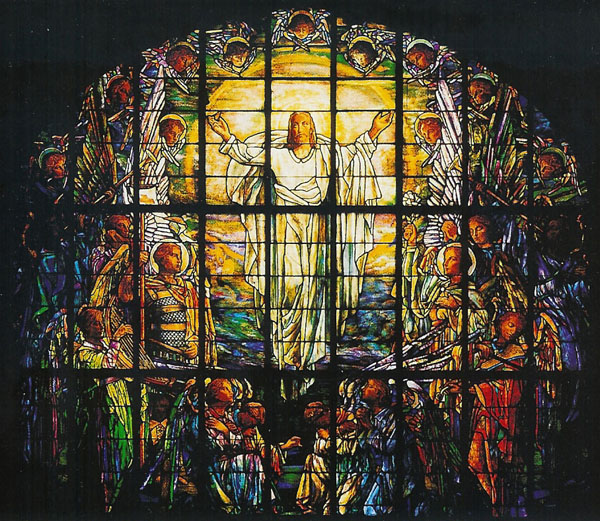
Pastoral Window by Tiffany Studios

Ascension Window, designed by William Fair Kline,
made by Calvert and Kimberly for the
Church Glass and Decorating Company

Monday, January 9, 2012

Docent Diaries: Bonnet House and the Prairie Avenue Connection

The entrance to Bonnet House
For many years, before I became a volunteer docent at the Clarke House and Glessner House museums, I vacationed in Fort Lauderdale, Florida. I would pass by Hugh Taylor Birch State Park, wondering who Mr. Birch was and why he had a park named for him. It wasn’t until I started my docent training that I learned about Birch. Birch was not only significant to Chicago history, but Florida history as well. On my most recent trip to Fort Lauderdale, I took a tour of Bonnet House and learned a little bit more about Birch and his extended family.

South Florida Paradise
Birch was a prominent corporate attorney who lived at 1912 S. Michigan Avenue and was part of Prairie Avenue society. A bit of an eccentric, Birch shunned crowds and preferred a more casual lifestyle. In the late 1890s, Birch traveled by train to Titusville, Florida, the end of the line for the railroad in those days. He then sailed further south by boat, encountering a storm that forced his ship ashore. When Birch saw the tropical beauty of the South Florida coast, he decided he needed to live there. He bought three miles of oceanfront property, that is now part of present-day Fort Lauderdale, for less than $1.00 per acre. According to the Genealogical Society of Broward County (GSBC), silent film director D.W. Griffith offered Birch $250,000 in 1920 for 2/3 of the land, but Birch refused the offer.

A Generous Wedding Present
View of the bird house in courtyard
In 1919, Birch’s daughter, Helen married artist and Prairie Avenue resident, Frederic Clay Bartlett (2901 S. Prairie Avenue). As a wedding gift, Birch gave the newlyweds 30 acres—a piece of his Florida estate. In 1920, construction, of what would eventually be known as Bonnet House (named for the bonnet lilies found on the estate), began and would continue for more than 20 years.

“Eclectic” Design
Bartlett was an artist and designer.  Among his works are the thirteen pre-Raphaelite murals that adorn Second Presbyterian Church at 1936 S. Michigan Avenue.  He had a practical interest in architecture and designed every aspect of Bonnet House. The home was modeled after a Caribbean-style plantation as interpreted by Bartlett. It includes a large courtyard with fountains and gardens. Almost every wall of the courtyard is decorated with paintings, pieces or art, and cultural artifacts from Europe and Asia. The docent that led my tour said there is no discernible decorating style. He described it as “eclectic,” which fits just fine. Bartlett painted almost every inch of the house, including intricate designs on the courtyard ceilings, walls, and floors. While the estate is large, it is not luxurious. Both Birch and Bartlett had luxurious homes in Chicago and elsewhere, but craved a more casual lifestyle. Fort Lauderdale, in the early 20th century was a sparsely populated tropical paradise that suited both men perfectly.

Carousel giraffes are typical of the whimsical artwork throughout the house

Art and Music Lovers
Frederic and Helen loved to travel around the world. During their travels, they purchased many Impressionist and post-Impressionist paintings, including A Sunday Afternoon on the Island of La Grande Jatte by Georges-Pierre Seurat. Helen was a talented pianist and composer, having several of her compositions copyrighted and published. Bartlett had his artist studio on one end of Bonnet House and Helen had her music studio on the other.

A swan swims in a pond on the estate
Helen died of cancer in 1925 and Frederic lost interest in their tropical retreat. He donated their important collection of paintings, including works by Picasso, Degas, and Matisse to the Art Institute of Chicago.  It was the first major collection of post-Impressionist paintings to be acquired and exhibited by an American museum. 

Six years after Helen’s death, Frederic married Evelyn Fortune Lilly, who was divorced from Eli Lilly. After their marriage, Evelyn convinced Frederic to return to the estate and the two turned Bonnet House into a one-of-a-kind retreat. The house looks pretty much the way it did during the 1930s and 1940s.

Frederic died in 1953. Evelyn continued to live and entertain at Bonnet House after Frederic’s death. She eventually gifted the estate to the Florida Trust for Historic Preservation in 1983, but continued to winter there until 1997 as part of the trust agreement. Evelyn died on July 1, 1997 at the age of 109.

Wrought iron railings were crafted in New Orleans

Bonnet House Survives
Bonnet House is listed on the National Register of Historic Places and is a City of Fort Lauderdale Historic Landmark. If you have the opportunity to visit Fort Lauderdale, a tour of Bonnet House is a must.  For further information, visit their website, http://www.bonnethouse.org/


Submitted by Stephen Reginald, Clarke House and Glessner House volunteer docent. Reginald is also a writer, editor, neighborhood blogger, and amateur classic film historian.

Monday, March 14, 2011

Museum offers tour of the Union League of Chicago art collection

On Saturday April 2, 2011, the museum will offer an exclusive opportunity to view the wonderful art collection at the Union League Club of Chicago.   The Union League has the largest club art collection in the country, if not the world.  It currently consists of nearly 800 works of art including paintings, sculpture, works of art on paper, photographs, and some decorative arts.  The focus of the collection is American with a particular emphasis on artists connected to Chicago.  In spite of that focus however, the signature painting is Pommiers en fleur, an 1872 work by Claude Monet, pictured above.

The collection represents more than 120 years of collecting, reflecting the changing tastes and trends of a segment of Chicagoans, artists and patrons.  The collection, often referred to as “Chicago’s hidden collection” continues to grow.

John J. Glessner was a member of the Union League Club from 1887 (the year he moved to Prairie Avenue) until his death in 1936.  Not surprisingly, numerous residents of Prairie Avenue were members, and three served as president: Elbridge Keith (1900 S. Prairie Avenue), George Bissell (2003 S. Prairie Avenue), and John Hamline (1621 S. Prairie Avenue).  A fine portrait of Elbridge Keith, painted by Ralph Elmer Clarkson, is part of the club collection, although not currently on display.  At least one Prairie Avenue resident, Frederic Clay Bartlett, created a work now in the collection (Martigues, France). 

The April 2 tour will be led by Joan Wagner, author of A History of the Art Collection of the Union League Club of Chicago. 

Following the tour, participants will lunch in the Heritage Room (where Bartlett’s painting is on display). 

Group size is strictly limited.  For further information on the tour or to make a reservation, please call 312-326-1480.  For further information on the art collection, visit the Club website at http://bit.ly/eTL8M7.
Related Posts Plugin for WordPress, Blogger...