Showing posts with label Society for the Protection of New Hampshire Forests. Show all posts

Thursday, February 14, 2019

Fire destroys two buildings at The Rocks


Tool Building (courtesy Littleton Fire Rescue)

The same view in June 2010

A devastating fire at The Rocks on the evening of Wednesday February 13, 2019, destroyed two century-old historic structures on the property, which was listed on the National Register of Historic Places in 1984.  No one was injured in the fire, and the nearby home of long-time property manager Nigel Manley, escaped damage.  The Rocks, located in Bethlehem, New Hampshire, was the summer estate and working farm of the Glessner family for several generations and since 1978 has been owned and operated by The Society for the Protection of New Hampshire Forests (SPNHF).

Electric Plant in foreground, Tool Building behind to the left
(courtesy Littleton Fire Rescue)

The same view in June 2010

The two structures destroyed were historically known as the Tool Building and the Electric Plant.  The Tool Building served as the North Country Conservation and Education Center for SPNHF, and housed staff offices and a large multi-purpose room used for programs and events.  The Electric Plant functioned as a gift shop.

TOOL BUILDING
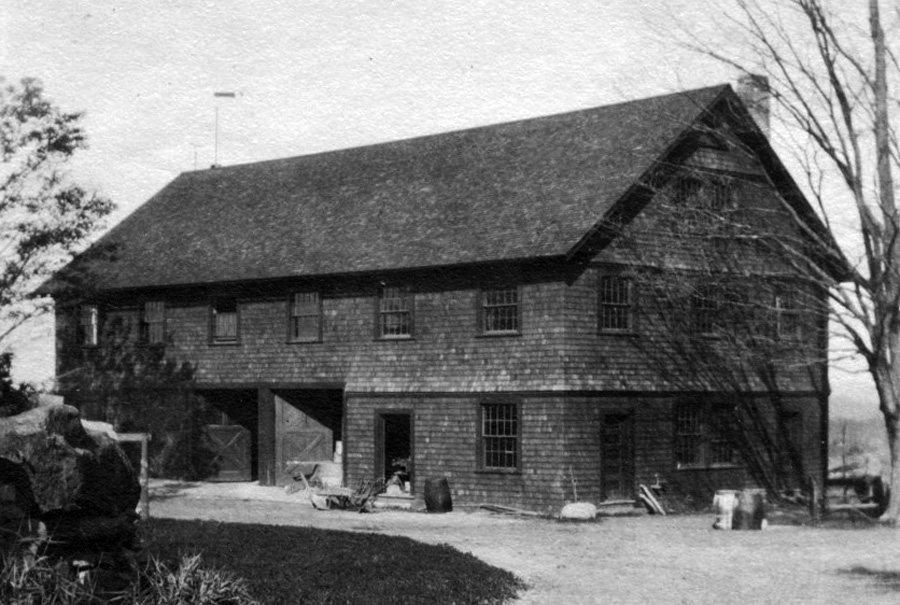
Tool Building, front, circa 1904

Tool Building, rear, circa 1910

The Tool Building was built to house a variety of power-driven machines used in the production and repair of equipment for the estate.  The large, gable-roofed structure was two stories high on the west front, and three stories on the rear.  It was clad in wood shingles which were stained a dark red, like other buildings on the estate.   An L-shaped wing on the north side of the building functioned primarily as an ice house.  

Ice house, June 2010

On September 12, 1903, Frances Glessner noted in her journal, “we commenced work on the new tool building.”  Work proceeded rapidly, as she noted on October 3rd, “we gave the annual dinner to the men on the place.  The table was set in the new tool building.”  Later that week the exterior was shingled. 

Tool Building, 1905 (Togo the mule in foreground)

The building was the site of numerous social events, one of which was recorded in some detail in a journal entry dated September 18, 1906:
“Friday evening, we gave a party to the working people in the Tool building.  We took everything out and made a little stage.  We hung branches of evergreen in among the iron strips and put two large vases of sun flowers and asparagus fern on each side of the stage.  We took lamps down and put one on each side of the stage and put hanging chimes around from the ceiling.  We asked our people and their wives – and many who have been connected with the place, and many of the neighbors.
“We hired omnibuses to bring them out from town.  There were one hundred and sixty-five here.  Mr. Tramonti (harpist with the Chicago Orchestra) was very nervous but pleased the audience very much.  John introduced him very nicely and the audience was very appreciative and attentive.  After the concert ice cream and cake was served.”

Tool Building in 1978, showing the bay added in 1907 at right

In June 1907, Frances Glessner noted “we commenced to build the addition to the tool building.”   That addition, consisting of one additional bay located at the south end of the building, was constructed to provide a blacksmith shop (used in recent years by a Glessner descendant).  


The upper floor contained a fully equipped woodworking shop with a variety of early equipment, originally belt-driven from a central power source.  A gas pump was installed outside to provide fuel for farm vehicles.


ELECTRIC PLANT

The Electric Building, circa 1910

The Electric Plant stood immediately to the east of the Tool Building and was constructed to house the original power plant for the estate.    Laid out on a T-plan, the plant was a low hip-roofed frame structure with a clerestory at the central roof ridge.  It was clad in the same dark red-stained wood shingles.  

The foundation for the building was set in place in July 1910 as work was underway to electrify the various buildings as noted in this journal entry dated July 16, 1910:
“Some progress has been made on the Cottage improvements, and the electric light work has been started.  The foundations are in for the power building.  Wynne the Chicago electrician began on Wednesday or Thursday and has a good deal of the tool building piped for wiring.”
By August 21st, “the electric and power building is completed except the chimney and the “help” in our different houses have asked for a dance there next Thursday” (which did take place).  Electric was apparently fully functional by September 18th when the first electric lamp was lighted at the Big House (the Glessners’ residence) as an experiment. 

Electric Plant, June 2010

LATER HISTORY
After John Glessner’s death in January 1936, the estate, which had grown to 1,500 acres, was divided equally between his daughter, Frances Glessner Lee, and his daughter-in-law, Alice Hamlin Glessner.  Following Alice’s death, Lee reassembled the estate and continued to operate it as a farm until her death in January 1962.  (Her tax returns each year listed her occupation as “farmer.”).  Lee’s children, John Glessner Lee and Martha Lee Batchelder continued operations of the farm until 1978 when the property was donated to the Society for the Protection of New Hampshire Forests, of which their grandfather, John J. Glessner, was an early member.  

A stipulation of the gift was that there always be a crop in the field.  The Forest Society noted, “for more than three decades, that crop has been Christmas trees, and people come to The Rocks from near and far each year to find their perfect tree.”  (Continuing a tradition begun by the Glessners in the 1880s, Glessner House acquires its Christmas tree each year from The Rocks).

The famous Budweiser Clydesdales in front of the Tool Building,
January 2010 (Courtesy of The Rocks Estate)

Glessner House docents in front of the Tool Building, August 2017


Wednesday, September 24, 2014

Preserving the beauty of the White Mountains

The Glessners' summer home, The Rocks, in New Hampshire

Exactly 125 years ago, during the summer of 1889, John J. Glessner penned a letter to the editor of a local newspaper near his summer home in New Hampshire.  Entitled “Good Advice to Mountain Folk – A Few Words of Truth and Importance by a Prominent Summer Resident,” the article shared Glessner’s thoughts on the importance of preserving the natural beauty of the White Mountains, which he felt was being compromised with signage and other manmade intrusions.  In addition to preserving the landscape in and of itself, Glessner was also careful to point out that it was the natural beauty that drew many visitors to the area every summer, bolstering the local economy.  Glessner would go on to write many more articles on this topic, and was among the earliest members of the Society for the Protection of New Hampshire Forests when it was organized in 1901.  In the late 1970s, nearly 1,300 acres of his summer estate “The Rocks” was donated to the Society by his grandchildren, a fitting tribute to this early conservationist.  The text of the 1889 article, in its entirety, follows.

A view from the Glessners' home at The Rocks

On an eminence a little to the south of the carriage-road between Bethlehem and Littleton, and about midway between those villages stands the “Rocks,” the summer abode of Mr. J. J. Glessner of Chicago.  During a few years residence amid its beautiful surroundings, that gentleman’s keen eye has detected many shortcomings of the resident population, and, in a letter published in a recent number of the LITTLETON JOURNAL, has, in a few kindly words, made some valuable suggestions to follow.  Here is what he says.

I wonder if the people of the White Mountain region appreciate the grand scenery in the midst of which they dwell.  Frequently the things which we come in contact with every day are not highly prized.  I imagine that here in Chicago, with its dead level surroundings, even though it has a considerable elevation above the sea level, we think more of the hills and rocks and forests and magnificent scenery of Grafton and Coos counties than do the people who see these beauties constantly.

Looking from the porch at The Rocks

Not only have you the bracing air and pure water and all things so grateful to the denizens of the cities, but the beautiful surroundings are greater attractions than you realize, and draw the summer visitors to your neighborhood.  With the advent of the summer visitor comes not only gaiety, but a handy and profitable market for your commodities and labor.  Under other circumstances the produce and labor must go to market, but here the market comes to the produce and labor, and it is because this influx of summer visitors is pleasant and profitable to you, that I ask whether you fully appreciate the beauty of the surroundings and their market value.

Personally I am not anxious to have many city people visit the mountains in summer, for it increases somewhat the cost of my living there, and I see enough city people in general at other seasons; but it has a money value to you, in that it enhances the selling price of butter and eggs and poultry and vegetables, and gives employment to hundreds of people and horses, etc. etc.

But the pure air and the pure water are not enough to fill your hotels.  City people, with their eyes full of city dust, and their ears deafened with city din, want something pleasant to look upon, and your people are not careful enough in preserving the natural scenery.  It is all right and desirable to have neat fences, well-cleared and cultivated fields, substantial barns, comfortable houses, etc., but do not mar the boulders or fences or barns with advertising signs, do not destroy the beautiful wild shrubbery that lines the roadsides; do not cut down the fine trees on the farm, or by any act reduce the natural attractions of your surroundings.  As it is now, many persons feel repaid for a journey half the world over to visit the White Mountains.  I have personally known Englishmen who came to the United States merely to see the White Mountain country while the forests were in their gorgeous autumn coloring.  But you may be sure a sign on a boulder advertising some one’s liver pills, or a board nailed to a barn advertising the tourists to take the Fall River Steamers, or a bridge lettered to show the virtues of somebody’s bitters, nor yet a dirty barnyard visible from the road, or a roadside devoid of shrubbery, or a field showing the deformities made by the woodman’s axe, help in any way to draw the visitor or induce him to lighten his pocketbook.  These things are not congruous with the landscape.

A view through a window at The Rocks

The wild flowers of Northern New England, the asters, goldenrod, ferns and maple bush, even the hazel-bush, are beautiful beyond your thoughts.  Make a good drive-way by all means, smooth it and drain it properly, but do not destroy the shrubbery at its sides.  Have good fences, walls or board fences, but do not deface them with signs, and never permit such an indignity as painting anything on the noble rocks.  Keep your barnyards and dooryards clean, it is both profitable and pleasant to you.  Keep your dwelling and other buildings in good repair; that is pleasant and profitable, too.  But as far as possible let Nature alone.  Do not try to improve upon her work.  In both extremes she surpasses all that you can do; hers are more delicate and graceful, and again greater and grander than any workman ever can do.

The summer traveler may be selfish and supercilious; he may be a cad and disagreeable; he may not be a model for imitation by your sons, but he spends money, he helps to make your farm and labor profitable.  Cultivate him, cherish him, even pamper him, do all in your power to induce him to come again and bring his family and friends, but do not kill the goose that lays the golden eggs; do not damage or deface or destroy the natural scenery about you.

My great admiration for your many attractions has induced the writing of this letter, and I shall be more than pleased if through your courtesy, Mr. Editor, my words have even a slight influence.


Monday, March 11, 2013

The Rocks Estate

The Rocks Estate, located in the White Mountains in northern New Hampshire, has been an important part of the lives of generations of the Glessner family since 1883.  Approximately 1,300 acres of the estate was donated to the Society for the Protection of New Hampshire Forest in 1978, and today, thousands of visitors each year come to the site to hike, explore nature, select the perfect Christmas tree, and much more.  The Rocks Estate recently earned its seal of approval from Certified Grand Adventures as detailed in the article below, which appeared in the New Hampshire Union Leader on February 12, 2013.

ROCKS ESTATE:  GRAND CERTIFIED ADVENTURE
Touted: The designation means the estate has a unique flavor for tourists
By Sara Young-Knox

Bethlehem – The Rocks Estate, a North Country destination for outdoor family activities and environmental education, has received the seal of approval from Certified Grand Adventures.
The 1,400-acre Rocks Estate, known for its Christmas tree farm and spring maple syrup tours, is home to the North Country Conservation and Education Center for the Society for the Protection of New Hampshire Forests.
In the winter, The Rocks Estate partners with another certified experience – Muddy Paw Sled Dog Kennel of Jefferson offers dog sled rides at The Rocks.
The Rocks joins 14 other Certified Grand Adventures of northern New Hampshire.  To become certified, an experience needs to be:  different, better, first or bigger than other adventures within easy driving distance for people from Boston and Montreal.  They also must have a 3-to-1 ratio of positive comments on web feedback sites, be interactive, endorsed by two regional and one national media outlet, open a minimum of 60 days a year, and clearly communicate safety guidelines.
Pam Sullivan, marketing coordinator for New Hampshire Grand, said the Bethlehem landmark was a natural fit. 
“The Rocks has been described as a modern-day Norman Rockwell Christmas scene, complete with the jingling bells of their horse-drawn wagon rides and roasted marshmallows at the fire pit.”
The Rocks Estate was the seasonal home of the Glessner family, who escaped the heat and stench of summer in Chicago to enjoy the mountain air.  John Jacob and Frances Glessner purchased a 100-acre farm in 1882, constructing the 19-room mansion known then as the Big House in 1883.  That house is gone, but many of the buildings they added remain, and those buildings, and the expanded land holdings, were donated to the Forest Society in 1978 by the Glessners’ grandchildren.
What was a wonderful summer place for the Glessner family remains a wonderful year-round destination for all families.  The trail system is open every day and includes the Heritage Trail.  Springtime guests at The Rocks come to the estate to learn about maple sugaring past and present as part of the New Hampshire Maple Experience.
“The most interesting part of this experience for me is when families come for the tours the parents often think that it’s going to be great for the kids – and short enough so that they don’t get too bored,” said Nigel Manley, director of The Rocks.  “However, by the time they’re midway through, the parents are asking more questions than their children, and are fascinated by the time-honored tradition of maple sugaring.”

For more information on The Rocks, visit http://www.therocks.org/.

(Note:  The New Hampshire Maple Experience is housed in a structure [shown at the top of the article] originally built as a combination sawmill and pigpen for the Glessner family in 1906.  It was designed by architect and family friend Hermann V. von Holst.)

Monday, July 30, 2012

A Visit to The Rocks

In late July 2012, museum director/curator Bill Tyre and museum docent John Waters traveled to The Rocks, the Glessners’ former summer estate in the White Mountains of New Hampshire.  The estate was an important part of the lives of the Glessners who would spend four to five months there each summer.  Their two children, George and Frances, in later years made The Rocks their permanent year-round home.

The Glessners selected the location due to its positive effects on George, who found immediate relief from his severe hay fever when first traveling there in 1877.  After spending several summers in a large resort hotel, they purchased the first 100 acres of land in September 1882.  Within a year their home, known simply as the “Big House” was completed based on a design by Isaac Scott.  Scott designed numerous other structures on the estate including a carriage-horse barn, a playhouse for Fanny, an observatory, gardener’s cottage, and a series of summer houses.

John Glessner continued to buy surround acreage and eventually the estate grew to incorporate about 1,500 acres of land, much of it purchased to prevent it from being deforested.  Glessner was an early conservationist and in 1903 joined the Society for the Protection of New Hampshire Forests.  The area closest to the Big House was elaborately landscaped by family friend Frederick Law Olmsted, and was later reworked by his sons, one of whom attended Harvard with George Glessner.

Architect Hermann H. von Holst, another family friend, designed several structures on the estate in the early 1900s including The Ledge (a home for George and Alice Glessner), the entrance gates, an enlarged horse barn, a combination sawmill-pigpen, and a cow barn. 

The Rocks functioned as a thriving farm.  John Glessner was especially interested in raising prize winning poultry.  His crops won numerous awards at the annual state fair.  The farm supplied the family and staff with food not only in New Hampshire, but in their Chicago home as well.  Glessner also used the estate as a testing ground for new equipment being developed by Warder Bushnell & Glessner (later International Harvester). 

In 1977, most of the estate was donated to the Society for the Protection of New Hampshire Forest by two of the Glessner grandchildren, John Glessner Lee and Martha Batchelder.  Much of the land has been allowed to return to its natural forested state.  The site is open to the public year-round, and various trails cut through the property, including one trail that goes past the various remaining structures from the Glessner period. 

Nigel Manley has served as director of the estate for 26 years.  The operations are supported in large part by the growing of Christmas trees, and the museum acquires its live Fraser fir each year from The Rocks, continuing a tradition begun by the Glessners in the 1880s.  For more information, visit http://www.therocks.org/.

This view shows the Bee House designed by Isaac Scott for Frances Glessner in 1896.  It was elaborated carved by Scott who also added a series of quotes relating to Mrs. Glessner’s interest in beekeeping.  In the 1930s, it was remodeled into a pool house, when the Glessners’ daughter-in-law added an in-ground swimming pool.  In recent years, it has been faithfully restored to its original design.  The Big House would have originally stood just to the left of the Bee House, just up the hill.

Elaborate carved brackets and fascia in the Bee House by Isaac Scott. 

Log cabin playhouse, designed by Issac Scott for Fanny Glessner in 1886.  Today the house functions as the visitor’s center for The Rocks Estate.

Big Rock Summer House, one of several designed by Isaac Scott in the 1880s.  It is the only one still standing.

This house began as the gardener’s cottage.  After the marriage of George Glessner and Alice Hamlin in 1898, it was remodeled and enlarged for their use.  After a new house, The Ledge, was built for them, the cottage became the home of Frances and Blewett Lee.  By 1938, it became her year-round residence until her death in 1962.  It is now owned by the North Country Council.

View of the White Mountains from the area behind the cottage.  This large flat area was graded and used as a tennis court when Frances Glessner Lee’s children were young.  Note the chaise lounge to the right carved from a solid block of granite found on the grounds.

A portion of the original terraced gardens designed and installed by Olmsted and his sons. 

This beautiful combination structure housed a sawmill on the left and a pigpen on the right.  It was designed by Hermann V. von Holst in 1906.

Today, the building houses an interesting exhibit about the New Hampshire maple industry, showing equipment used to harvest maple syrup. 

Each year, the museum acquires its Fraser fir from The Rocks.  This is the Christmas tree selected to stand in the main hall of the museum for 2012.

Monday, November 14, 2011

The Rocks Estate

In August 1883, John and Frances Glessner and their children George and Fanny moved into their new summer home, which they called the “Big House” at their estate “The Rocks” in the White Mountains of New Hampshire, mid-way between Littleton and Bethlehem.  The Glessners had first considered the White Mountains for their summer home at the suggestion of George’s doctor, who indicated that George might experience significant relief from his severe hayfever by leaving Chicago and traveling to this part of the country.  When George first visited the White Mountains in 1878, the relief was dramatic and immediate, so the Glessners opted to make the locale their annual destination.  The Glessners continued to make The Rocks their home every summer until their deaths in the 1930s, and both George and Fanny later made the estate their permanent home.  A portion of the estate at the western end of the property is still in the possession of two descendants of George Glessner, making six generations of the family to call The Rocks home. 

In 1977, two of the Glessners grandchildren, John Glessner Lee and Martha Lee Batchelder, made the decision to donate the majority of the property (1333 of the approximate 2000 acres assembled by their grandparents) to the Society for the Protection of New Hampshire Forests.  The Society had been formed in 1901 to acquire and protect forested lands throughout the state in response to widespread clear-cutting being undertaken by farmers.  John Glessner was a strong supporter of the Society and joined in 1903, just two years after it was founded, so it was a very appropriate choice for the grandchildren to present the organization with The Rocks property.  The estate includes numerous original buildings constructed by the Glessners from the 1880s through the 1910s designed by Isaac Scott, Hermann V. von Holst and others, as well as more than 500 species of trees and other plants. 

The Rocks Estate is supported in large part today by its use as a Christmas tree farm, which satisfies one of the stipulations of the gift requiring the Society to keep an active crop growing on the estate at all times.   Open to the public year round, the estate also offers a number of hiking trails and other activities which help visitors to explore the vast beauty of the property.  Visit http://www.therocks.org/ for more information.

At the museum, we carry on a Glessner family tradition begun more than a century ago by shipping a Christmas tree from The Rocks every year.  The Glessners originally used small table-top trees (their 1888 tree is pictured above), but by the early 1900s adopted the custom of a larger tree which they displayed in the main hall, where the museum places the tree each year.   Click on the link below to see the tree selected for this year’s celebration:

Glessner and Clarke House Museums will be decorated for Christmas from Wednesday November 23rd through Saturday December 31st.  A special part of the holiday tradition at the museums is our annual Candlelight Tours, scheduled this year for Saturday December 10 and Sunday December 11.  During these special tours, attendees will learn about Christmas traditions of the mid- to late-19th century and see both houses decorated in historically appropriate fashion.  Afterwards, participants are invited to the nearby Wheeler Mansion for refreshments.  For more information, visit http://www.glessnerhouse.org/Events.htm , or call 312-326-1480 to make reservations.
Related Posts Plugin for WordPress, Blogger...