Showing posts with label Chicago Architecture Foundation. Show all posts

Monday, April 11, 2016

Glessner House Museum celebrates 50 years


On April 16, 1966, twenty individuals signed a resolution creating the Chicago School of Architecture Foundation.  Out of that organization evolved both Glessner House Museum and the Chicago Architecture Foundation, entities that champion and celebrate the rich architectural tradition in Chicago, past and present.  As we commemorate the 50th anniversary of that milestone event this week, we pause to honor those individuals whose foresight and vision saved H. H. Richardson’s iconic Glessner house, launched the successful preservation movement in our city, and made Chicago a destination for architectural enthusiasts from around the world.


Glessner House is Threatened
For twenty years, Glessner house was occupied by the Lithographic Technical Foundation, but by early 1965 that organization had relocated to Pittsburgh and the building was put up for sale.  The early 1960s had been a period of extraordinary challenge and frustration for those attempting to preserve Chicago’s rich architectural heritage.   Among the chief losses was Adler & Sullivan’s Garrick Theater on Randolph Street, demolished in 1961. 

The fate of the Glessner house was known as early as November 1963, when several individuals met with representatives from the Foundation to discuss the future of the building.  Among those at the meeting were Wilbert Hasbrouck, chairman of the Preservation Committee of the Chicago Chapter of the American Institute of Architects (CCAIA); Joseph Benson, Secretary of the Commission on Chicago Architectural Landmarks; and Marian Despres, wife of Alderman Leon Despres, and the daughter of architect Alfred Alschuler.  Hasbrouck reported back to Jack Train, president of CCAIA:

“Regardless of what final use is made of this building, I feel the AIA must take a major advisory role in its disposition.  The Glessner House is too important a structure to go the way of the Garrick.”


On January 31, 1965, the Chicago Tribune published an article noting that the future of the house was in jeopardy, but quoted several individuals who recognized that the house was simply too important to lose.  Wilbert Hasbrouck noted that the building would make a perfect museum of Chicago architecture.  Joseph Benson also expressed concern and noted that it was one of 38 buildings in the city to be designated a landmark.  But Marian Despres noted that the landmark designation was purely honorary, and did nothing to protect the building from demolition. 


Individuals Come Together
Many of those involved in saving Glessner house were well acquainted with each other by the time the house went up for sale.  Leon and Marian Despres and others had rallied together to save Frank Lloyd Wright’s Robie House when it came under threat of demolition in 1957.  That successful effort led to the formation of Chicago’s first preservation group, the Chicago Heritage Committee, co-founded by architect Ben Weese.  Soon after, Alderman Despres proposed an ordinance creating an historical and architectural landmark commission which awarded landmark status to 38 buildings in 1960, including Glessner house.

In 1960, Weese, Despres, and Hasbrouck joined others, including photographer Richard Nickel and architect John Vinci, to march together in a picket line to save the Garrick Theater.  Although their efforts proved unsuccessful, it brought these like-minded individuals together and the preservation movement gained momentum. 


Worthy of Architects’ Praise
Ben Weese recalled that in the early 1960s, he spent the day escorting the world famous architect Alvar Aalto around Chicago, showing him the buildings of Louis Sullivan and Frank Lloyd Wright.  Aalto appeared only mildly interested.  But when the two pulled up in front of Glessner house, Aalto stepped out onto the sidewalk and stood transfixed, studying the building for over an hour.

In March 1965, Weese and his brother Harry took architect Philip Johnson to see Glessner house.  Johnson praised the building, and was especially taken by the floor plan which oriented the major rooms toward the private south-facing courtyard.  He offered to pay half of the purchase price of $70,000 if those in Chicago could raise the other half, but later rescinded the offer when “the horrid question of maintenance came up.”  In spite of that, however, Johnson was quoted in June 1966 as saying “Glessner House is the most important house in the country to me.”

The Weeses Search for Funds
Ben and Harry Weese continued to search for funds to purchase and maintain the house throughout 1965 and into early 1966.  In a letter to selected Chicago architects, Harry Weese laid out the purposes of the proposed organization that would acquire Glessner house:

“To establish the first architectural organization in the country, at the birthplace of modern architecture, in a historic and architecturally significant building.

“To create a unique institution to become the center of architectural history, a staging point for tours, a place to sell books and literature, a gallery, a museum for artifacts in the courtyard.”

Others Express Interest
At the same time that these architects and preservationists were attempting to raise the funds to purchase the house, four young men, working independently, had also learned of the house and decided to find a way to purchase it.  Richard Wintergreen and Jim Schultz were draftsmen in the office of Mies van der Rohe.  Wayne Benjamin, a businessman in finance, had met Wintergreen at the University of Illinois, and Paul Lurie, an attorney, became acquainted with Wintergreen through his fiancĂ©e.  The four men formulated their idea to save the house over dinner at Pizzeria Due, ironically housed in a late 19th century mansion.

CSAF meeting, August 18, 1966

The Chicago School of Architecture Foundation is Organized
On April 6, 1966, the Weese brothers announced publicly that they would pledge $10,000 toward the purchase of Glessner house.  The same day, Richard Wintergreen wrote to Philip Johnson alerting him to the fact that he and his three friends had formed a group to purchase the house.  Johnson suggested that Wintergreen’s group coordinate their plans with the Weeses, and from that point on, all those working to save Glessner house worked together.

On Saturday April 16, 1966, a resolution was signed by twenty individuals creating the Chicago School of Architecture Foundation.  Those signing were:  Carl Condit, Richard Nickel, Herman Pundt, Earl Reed, Wilbert Hasbrouck, James Speyer, Joseph Benson, Clement Sylvestro, George Danforth, Maurice English, Phyllis Lambert, Dirk Lohan, Paul Lurie, Wayne Benjamin, Richard Wintergreen, James Schultz, Dan Murphy, Ben Weese, Harry Weese, and Irving Berman. 

The first order of business was to raise the funds needed to purchase the Glessner house. 

Additional articles will be posted throughout our anniversary year highlighting the efforts of our founders in purchasing and preserving what survives today as Glessner House Museum.

Photos by Richard Nickel


Monday, November 10, 2014

In Memoriam - Jeanette Fields

Courtesy www.oakpark.com

Jeanette Fields, who served as the first Executive Director of Glessner House from 1970 to 1976, passed away at her Oak Park home on Sunday November 2, 2014 at the age of 94.  Fields came to Glessner House, at that time owned and operated by the Chicago School of Architecture Foundation (CAF), during a period of organizational growth and left a lasting mark on both the house and CAF. 

Marian Depres, one of the founders of CAF and a long-time advocate for the house wrote the history of the organization in 1986.  In Chicago Architecture Foundation: The First Twenty Years 1966-1986, Depres recalls Fields arrival at the landmark home and what was expected of her:


“(In 1970), Jeanette Fields was hired as executive secretary to work for 24 hours per week.  Although not an architect, she was deeply interested in the subject.  She lived in a Frank Lloyd Wright house and had done public relations for various organizations, including an architectural firm, for which she had conducted bus tours.  She had also done social work and had secretarial abilities.  In her new job, all these skills were called upon.

“In the 24 hours per week for which she had been hired, Fields was supposed to keep records, type letters, manage the house, supervise the two students who lived on the second floor (until the day she found one of them keeping his pet ocelot in the kitchen), answer the telephone, and cope with starlings in the chimney and pigeons in the coach house.  She kept the utilities functioning and decided which bills could most safely be delayed.  In addition, three afternoons a week, she was to show visitors around the house.  Every week during the summer, she managed to bring in flowers from her garden for the front hall. 

“Despite all these demands, she began a vigorous and imaginative public relations program which was significant in promoting the early growth of CAF.  Board members, and later docents, began to be seen and heard on radio and television.  Fields enlisted Stuart Talbot, an energetic volunteer who organized a group to work every Monday evening. . . Things began to happen as a result of the new publicity . . . More money began to come in.  More people came to view the house.  Fields soon was promoted to full-time, and then hired Lynn Anderson, who had successfully taken the docent training class, as a half-time assistant.”

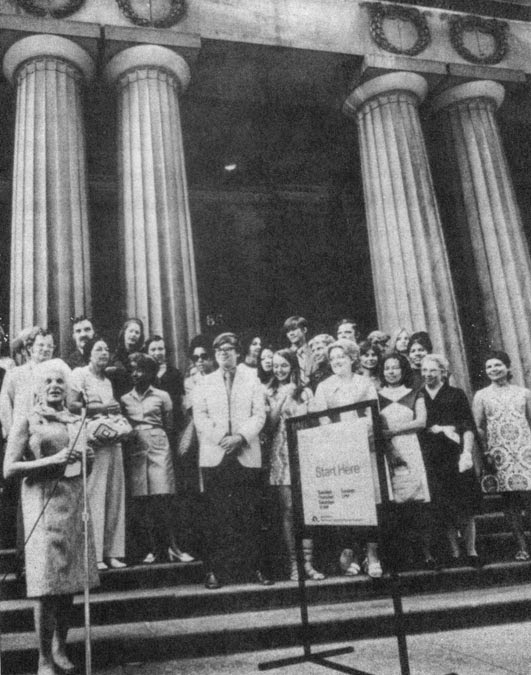
Perhaps her greatest legacy is her work in establishing the docent program, in partnership with Marian Depres.  In response to the increasing number of visitors coming to the house, the two, in conjunction with Barbara Wriston (director of museum education at the Art Institute of Chicago) and Kenneth Englund (a former teacher on the staff of the Illinois Arts Council), gathered experts in the field to lead the training and secured $5,000 in funding from the Illinois Arts Council to launch the first docent training program.  A total of 36 people started the class in April 1971 and 33 graduated on June 12, 1971.  It was Jeanette Fields who had the idea of holding the graduation ceremony on the north steps of the Chicago Public Library (now the Chicago Cultural Center).  It was a brilliant move – reporters, photographers, and TV cameras were there, and a representative from the Mayor’s office gave the graduation speech.  By year end, almost 3,000 people had taken tours of the house and the Loop.


Another achievement of Fields’ tenure was the significant work leading to the establishment of the Prairie Avenue Historic District.  When she arrived in 1970, the idea was still in its infancy, and many felt the street had already lost too much for a district to have meaning.  Fields and others vigorously pursued the idea, forming the Prairie Avenue District Committee in 1971.  Their work resulted in a co-partnership with the City of Chicago, bringing needed resources and financial assistance to the project, along with $350,000 in funding from the State of Illinois to purchase parcels of land.  By the time the district was landmarked in 1978, the streetscape of the 1800 block of Prairie Avenue had been restored to its 1890s appearance, and the city had acquired and relocated the Clarke House to its present location.

During the Festival on Prairie Avenue held in 2008, Fields was honored for her work on the creation of the district.  Her award read in part:

“In recognition of her leadership as Executive Director of the Chicago Architecture Foundation from 1970 to 1976 during which period the groundwork was laid for a unique public-private partnership with the City of Chicago that led to the establishment of the Prairie Avenue Historic District.  Presented at the Festival on Prairie Avenue, celebrating the 30th anniversary of the Prairie Avenue Historic District September 6, 2008.”

Festival on Prairie Avenue, 2008.  L to R:
Bill Tyre, Alderman Robert Fioretti, Jeanette Fields,
Mayor Richard M. Daley, Marian Premer,
Jack Simmerling, Tina Feldstein

Fields remained actively interested in both Glessner House and the Prairie Avenue Historic District long after she concluded her tenure as executive director in 1976.  She enjoyed visiting to witness progress on the house, and marveled at the dramatic redevelopment of the neighborhood beginning in the mid-1990s.  Each year she was an honored guest as docents from the early classes gathered to reminisce over the early years of the tour program.


Memorial wreath on the front door of Glessner House

Jeanette Fields was among the early group of individuals to recognize the importance of Glessner House.  The thousands of guests who visit each year from across the country and around the world are a testament to her work in shepherding the museum through this important era in its growth and development.  

Monday, October 21, 2013

Chicago Time Machine films at Glessner House

On Tuesday December 3, 2013, WTTW will broadcast their newest documentary hosted by Chicago’s favorite tour guide, Geoffrey Baer.  In this new special entitled Chicago Time Machine, Baer will use his recently discovered “time machine” to transport viewers back in time to different places and eras in Chicago history, aided by archival film and photographs.  Baer provides a unique view of special moments of Chicago’s past that happened in places that many of us frequent today.  As the WTTW promo states, “it is Chicago as you’ve never seen it before.”

On Monday October 14, Baer and his producer Dan Protess were at Glessner House Museum filming in the beautiful restored parlor, as seen in the accompanying photographs.  The site was most appropriate as one of the segments in the program will discuss the “dark days” of Prairie Avenue after the original residents moved away and long before the neighborhood once again became a thriving residential community.

Geoffrey Baer was trained as a docent for the Chicago Architecture Foundation in 1987.  At that time, the Foundation still owned and operated Glessner (the museum became its own separate entity in 1994), and Baer was trained to give tours of both Glessner and Clarke House Museums.  During his visit, he enjoyed touring the house and seeing the many changes that have occurred over the past several years.


It was a privilege to welcome Geoffrey Baer “home” again and we all look forward to seeing him travel back in time to a very different Prairie Avenue than we know today.

Monday, June 13, 2011

Honoring Four Decades of Service

On Sunday June 12, 2011 during the reception following our popular annual “A Walk Through Time” tour of the mansions of Prairie Avenue, the museum took the opportunity to mark an important milestone in our history.  The formal tour program at the museum, with trained docents at its core, turned forty years old and it was an opportunity to celebrate.

On June 12, 1971, the first docent class graduation was held, on the steps of what is now the Chicago Cultural Center.  At that time, Glessner House Museum was owned and operated by the Chicago Architecture Foundation (CAF), so the curriculum for the class was much different from today.  In addition to Glessner, docents received an in-depth training about Chicago architecture, with a focus on downtown, as CAF also offered a walking tour of the central Loop.  The docent class was the brain-child of Marion Despres (shown above in the foreground), one of the small group of individuals who saved Glessner from demolition in 1966, and Jeanette Fields, the first executive director of the museum.  It was a revolutionary idea that ushered in the concept of architectural tourism in Chicago and elsewhere.

One member of the original 1971 class continues as a docent today.  Robert F. Irving has provided thousands of hours of service to countless numbers of visitors to Chicago who have come to see not only Glessner House Museum, but Clarke House Museum, Second Presbyterian Church, Charnley-Persky House, and the city as a whole.  Irving, who spent the first part of the afternoon regaling visitors with stories as he led them through the Wheeler Mansion at 2020 S. Calumet was on hand for a special tribute.

After opening remarks by museum director William Tyre, the floor was given over to Jason Neises, who spoke about Irving’s enormous contributions to the CAF tour program, helping to make Chicago a destination for visitors from around the globe, who come to learn more about the amazing architecture of this city.  As Neises noted, Irving’s greatest single contribution to CAF was his development of the now immensely popular river cruise, which had its genesis in a private tour given by Irving nearly 30 years ago during the annual NEOCON conference.  Today, the river cruise is one of the most popular tourist attractions in the city.

Jackie Walker-Dunscomb, chair of the Glessner House Museum Docent Council, spoke next.  In her brief and inspiring remarks she summed up the high level of esteem in which Bob Irving is held by the docents, citing him as an inspiration to all who have followed, and declaring him a true legend. 

Ann Belletire, speaking as chair of the tour program for Friends of Historic Second Church, regaled the audience with amusing emails sent to her by Bob Irving, reporting on his experiences during weekly tours of the church.  As Ann noted, Irving’s mastery of the English language and use of words and phrases usually found only in the great English classics, often sent her to the dictionary to fully understand what Bob was trying to say.

Bill Tyre returned to the floor to share a story from Kevin Harrington, long-time professor of architectural history at the Illinois Institute of Technology.  Harrington recalled being interviewed by Irving in 1978 and soon after being treated to his first tour of Glessner house by Bob, an event which left a deep and lasting impression.

Finally Tyre read an excerpt from “My Life,” the autobiography of Bill Clinton, who was privileged to have Irving as a professor during his years at Georgetown University.  Of Dr. Irving, Clinton writes:

“My other two teachers were real characters.  Robert Irving taught English to freshmen who were unprepared for his rapid-fire, acid commentary on the propensity of freshmen to be verbose and imprecise.  He wrote withering comments in the margins of essays, calling one of his students “a capricious little bilge pump,” responding to another’s expression of chagrin with “turned into a cabbage, did you?”  My papers received more pedestrian rebukes: in the margins or at the end, Dr. Irving wrote “awk” for awkward, “ugh,” “rather dull, pathetic.”  On one paper I saved, he finally wrote “clever and thoughtful,” only to follow it by asking me to “next time be a sport” and write my essay on “better paper”!  One day Dr. Irving read aloud an essay one of his former students had written on Marvell to illustrate the importance of using language with care.  The student noted that Marvell loved his wife even after she died, then added the unfortunate sentence, “Of course physical love, for the most part, ends after death.”  Irving roared, “For the most part! For the most part! I suppose to some people, there’s nothing better on a warm day than a nice cold corpse!”  That was a little rich for a bunch of eighteen-year-old Catholic school kids and one Southern Baptist.  Wherever he is today, I dread the thought of Dr. Irving reading this book, and can only imagine the scorching comments he’s scribbling in the margins.”

After a few remarks by Bob Irving where he commented on the joys of service and the many life-long friendships that have been formed, guests were treated to cake, and Irving was presented with gifts in grateful appreciation for his 40 years of service.  A fitting tribute to an extraordinary individual who is an inspiration to us all.
Related Posts Plugin for WordPress, Blogger...